
An excerpt from the original text.(complete · 3816 words)
aria Clara Weds
Capitan Tiago was very happy, for in all this terrible storm no one
had taken any notice of him. He had not been arrested, nor had he been
subjected to solitary confinement, investigations, electric machines,
continuous foot-baths in underground cells, or other pleasantries that
are well-known to certain folk who call themselves civilized. His
friends, that is, those who had been his friends--for the good man
had denied all his Filipino friends from the instant when they were
suspected by the government--had also returned to their homes after a
few days' vacation in the state edifices. The Captain-General himself
had ordered that they be cast out from his precincts, not considering
them worthy of remaining therein, to the great disgust of the one-armed
individual, who had hoped to celebrate the approaching Christmas in
their abundant and opulent company.
Capitan Tinong had returned to his home sick, pale, and swollen; the
excursion had not done him good. He was so changed that he said not
a word, nor even greeted his family, who wept, laughed, chattered,
and almost went mad with joy. The poor man no longer ventured out
of his house for fear of running the risk of saying good-day to a
filibuster. Not even Don Primitivo himself, with all the wisdom of
the ancients, could draw him out of his silence.
"Crede, prime," the Latinist told him, "if I hadn't got here to
burn all your papers, they would have squeezed your neck; and if I
had burned the whole house they wouldn't have touched a hair of your
head. But quod eventum, eventum; gratias agamus Domino Deo quia
non in Marianis Insulis es, camotes seminando." [167]
Stories similar to Capitan Tinong's were not unknown to Capitan Tiago,
so he bubbled over with gratitude, without knowing exactly to whom he
owed such signal favors. Aunt Isabel attributed the miracle to the
Virgin of Antipolo, to the Virgin of the Rosary, or at least to the
Virgin of Carmen, and at the very, very least that she was willing
to concede, to Our Lady of the Girdle; according to her the miracle
could not get beyond that.
Capitan Tiago did not deny the miracle, but added: "I think so, Isabel,
but the Virgin of Antipolo couldn't have done it alone. My friends
have helped, my future son-in-law, Señor Linares, who, as you know,
joked with Señor Antonio Canovas himself, the premier whose portrait
appears in the Ilustración, he who doesn't condescend to show more
than half his face to the people."
So the good man could not repress a smile of satisfaction every
time that he heard any important news. And there was plenty of news:
it was whispered about in secret that Ibarra would be hanged; that,
while many proofs of his guilt had been lacking, at last some one
had appeared to sustain the accusation; that experts had declared
that in fact the work on the schoolhouse could pass for a bulwark of
fortification, although somewhat defective, as was only to be expected
of ignorant Indians. These rumors calmed him and made him smile.
In the same way that Capitan Tiago and his cousin diverged in
their opinions, the friends of the family were also divided into
two parties,--one miraculous, the other governmental, although this
latter was insignificant. The miraculous party was again subdivided:
the senior sacristan of Binondo, the candle-woman, and the leader
of the Brotherhood saw the hand of God directed by the Virgin of the
Rosary; while the Chinese wax-chandler, his caterer on his visits to
Antipolo, said, as he fanned himself and shook his leg:
"Don't fool yourself--it's the Virgin of Antipolo! She can do more
than all the rest--don't fool yourself!" [168]
Capitan Tiago had great respect for this Chinese, who passed himself
off as a prophet and a physician. Examining the palm of the deceased
lady just before her daughter was born, he had prognosticated:
"If it's not a boy and doesn't die, it'll be a fine girl!" [169] and
Maria Clara had come into the world to fulfill the infidel's prophecy.
Capitan Tiago, then, as a prudent and cautious man, could not decide
so easily as Trojan Paris--he could not so lightly give the preference
to one Virgin for fear of offending another, a situation that might be
fraught with grave consequences. "Prudence!" he said to himself. "Let's
not go and spoil it all now."
He was still in the midst of these doubts when the governmental party
arrived,--Doña Victorina, Don Tiburcio, and Linares. Doña Victorina did
the talking for the three men as well as for herself. She mentioned
Linares' visits to the Captain-General and repeatedly insinuated
the advantages of a relative of "quality." "Now," she concluded,
"as we was zaying: he who zhelterz himzelf well, builds a good roof."
"T-the other w-way, w-woman!" corrected the doctor.
For some days now she had been endeavoring to Andalusize her speech,
and no one had been able to get this idea out of her head--she would
sooner have first let them tear off her false frizzes.
"Yez," she went on, speaking of Ibarra, "he deserves it all. I told
you zo when I first zaw him, he's a filibuzter. What did the General
zay to you, cousin? What did he zay? What news did he tell you about
thiz Ibarra?"
Seeing that her cousin was slow in answering, she continued, directing
her remarks to Capitan Tiago, "Believe me, if they zentenz him to
death, as is to be hoped, it'll be on account of my cousin."
"Señora, señora!" protested Linares.
But she gave him no time for objections. "How diplomatic you have
become! We know that you're the adviser of the General, that he
couldn't live without you. Ah, Clarita, what a pleasure to zee you!"
Maria Clara was still pale, although now quite recovered from her
illness. Her long hair was tied up with a light blue silk ribbon. With
a timid bow and a sad smile she went up to Doña Victorina for the
ceremonial kiss.
After the usual conventional remarks, the pseudo-Andalusian continued:
"We've come to visit you. You've been zaved, thankz to your
relations." This was said with a significant glance toward Linares.
"God has protected my father," replied the girl in a low voice.
"Yez, Clarita, but the time of the miracles is pazt. We Zpaniards zay:
'Truzt in the Virgin and take to your heels.'"
"T-the other w-way!"
Capitan Tiago, who had up to this point had no chance to speak, now
made bold enough to ask, while he threw himself into an attitude of
strict attention, "So you, Doña Victorina, think that the Virgin--"
"We've come ezpezially to talk with you about the virgin," she answered
mysteriously, making a sign toward Maria Clara. "We've come to talk
business."
The maiden understood that she was expected to retire, so with an
excuse she went away, supporting herself on the furniture.
What was said and what was agreed upon in this conference was so
sordid and mean that we prefer not to recount it. It is enough to
record that as they took their leave they were all merry, and that
afterwards Capitan Tiago said to Aunt Isabel:
"Notify the restaurant that we'll have a fiesta tomorrow. Get Maria
ready, for we're going to marry her off before long."
Aunt Isabel stared at him in consternation.
"You'll see! When Señor Linares is our son-in-law we'll get into all
the palaces. Every one will envy us, every one will die of envy!"
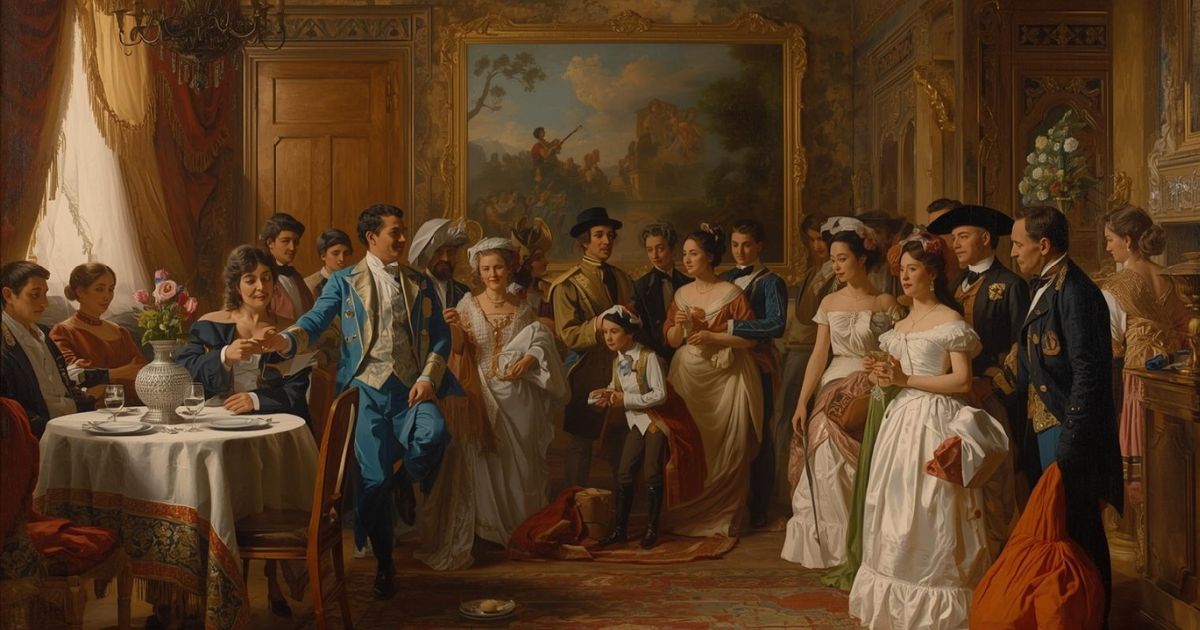
Thus it happened that at eight o'clock on the following evening
the house of Capitan Tiago was once again filled, but this time his
guests were only Spaniards and Chinese. The fair sex was represented
by Peninsular and Philippine-Spanish ladies.
There were present the greater part of our acquaintances: Padre Sibyla
and Padre Salvi among various Franciscans and Dominicans; the old
lieutenant of the Civil Guard, Señor Guevara, gloomier than ever;
the alferez, who was for the thousandth time describing his battle
and gazing over his shoulders at every one, believing himself to
be a Don John of Austria, for he was now a major; De Espadaña, who
looked at the alferez with respect and fear, and avoided his gaze;
and Doña Victorina, swelling with indignation. Linares had not yet
come; as a personage of importance, he had to arrive later than the
others. There are creatures so simple that by being an hour behind
time they transform themselves into great men.
In the group of women Maria Clara was the subject of a murmured
conversation. The maiden had welcomed them all ceremoniously, without
losing her air of sadness.
"Pish!" remarked one young woman. "The proud little thing!"
"Pretty little thing!" responded another. "But he might have picked
out some other girl with a less foolish face."
"The gold, child! The good youth is selling himself."
In another part the comments ran thus:
"To get married when her first fiancé is about to be hanged!"
"That's what's called prudence, having a substitute ready."
"Well, when she gets to be a widow--"
Maria Clara was seated in a chair arranging a salver of flowers and
doubtless heard all these remarks, for her hand trembled, she turned
pale, and several times bit her lips.
In the circle of men the conversation was carried on in loud tones
and, naturally, turned upon recent events. All were talking, even
Don Tiburcio, with the exception of Padre Sibyla, who maintained his
usual disdainful silence.
"I've heard it said that your Reverence is leaving the town, Padre
Salvi?" inquired the new major, whose fresh star had made him more
amiable.
"I have nothing more to do there. I'm going to stay permanently in
Manila. And you?"
"I'm also leaving the town," answered the ex-alferez, swelling up. "The
government needs me to command a flying column to clean the provinces
of filibusters."
Fray Sibyla looked him over rapidly from head to foot and then turned
his back completely.
"Is it known for certain what will become of the ringleader, the
filibuster?" inquired a government employee.
"Do you mean Crisostomo Ibarra?" asked another. "The most likely and
most just thing is that he will be hanged, like those of '72."
"He's going to be deported," remarked the old lieutenant, dryly.
"Deported! Nothing more than deported? But it will be a perpetual
deportation!" exclaimed several voices at the same time.
"If that young man," continued the lieutenant, Guevara, in a loud
and severe tone, "had been more cautious, if he had confided less
in certain persons with whom he corresponded, if our prosecutors did
not know how to interpret so subtly what is written, that young man
would surely have been acquitted."
This declaration on the part of the old lieutenant and the tone
of his voice produced great surprise among his hearers, who were
apparently at a loss to know what to say. Padre Salvi stared in
another direction, perhaps to avoid the gloomy look that the old
soldier turned on him. Maria Clara let her flowers fall and remained
motionless. Padre Sibyla, who knew so well how to be silent, seemed
also to be the only one who knew how to ask a question.
"You're speaking of letters, Señor Guevara?"
"I'm speaking of what was told me by his lawyer, who looked after the
case with interest and zeal. Outside of some ambiguous lines which this
youth wrote to a woman before he left for Europe, lines in which the
government's attorney saw a plot and a threat against the government,
and which he acknowledged to be his, there wasn't anything found to
accuse him of."
"But the declaration of the outlaw before he died?"
"His lawyer had that thrown out because, according to the outlaw
himself, they had never communicated with the young man, but with
a certain Lucas, who was an enemy of his, as could be proved, and
who committed suicide, perhaps from remorse. It was proved that the
papers found on the corpse were forged, since the handwriting was
like that of Señor Ibarra's seven years ago, but not like his now,
which leads to the belief that the model for them may have been that
incriminating letter. Besides, the lawyer says that if Señor Ibarra
had refused to acknowledge the letter, he might have been able to
do a great deal for him--but at sight of the letter he turned pale,
lost his courage, and confirmed everything written in it."
"Did you say that the letter was directed to a woman?" asked a
Franciscan. "How did it get into the hands of the prosecutor?"
The lieutenant did not answer. He stared for a moment at Padre Salvi
and then moved away, nervously twisting the sharp point of his gray
beard. The others made their comments.
"There is seen the hand of God!" remarked one. "Even the women
hate him."
"He had his house burned down, thinking in that way to save himself,
but he didn't count on the guest, on his querida, his babaye,"
added another, laughing. "It's the work of God! Santiago y cierra
España!" [170]
Meanwhile the old soldier paused in his pacing about and approached
Maria Clara, who was listening to the conversation, motionless in
her chair, with the flowers scattered at her feet.
"You are a very prudent girl," the old officer whispered to her. "You
did well to give up the letter. You have thus assured yourself an
untroubled future."
With startled eyes she watched him move away from her, and bit her
lip. Fortunately, Aunt Isabel came along, and she had sufficient
strength left to catch hold of the old lady's skirt.
"Aunt!" she murmured.
"What's the matter?" asked the old lady, frightened by the look on
the girl's face.
"Take me to my room!" she pleaded, grasping her aunt's arm in order
to rise.
"Are you sick, daughter? You look as if you'd lost your bones! What's
the matter?"
"A fainting spell--the people in the room--so many lights--I need to
rest. Tell father that I'm going to sleep."
"You're cold. Do you want some tea?"
Maria Clara shook her head, entered and locked the door of her
chamber, and then, her strength failing her, she fell sobbing to the
floor at the feet of an image.
"Mother, mother, mother mine!" she sobbed.
Through the window and a door that opened on the azotea the moonlight
entered. The musicians continued to play merry waltzes, laughter
and the hum of voices penetrated into the chamber, several times her
father, Aunt Isabel, Doña Victorina, and even Linares knocked at the
door, but Maria did not move. Heavy sobs shook her breast.
Hours passed--the pleasures of the dinner-table ended, the sound of
singing and dancing was heard, the candle burned itself out, but the
maiden still remained motionless on the moonlit floor at the feet of
an image of the Mother of Jesus.
Gradually the house became quiet again, the lights were extinguished,
and Aunt Isabel once more knocked at the door.
"Well, she's gone to sleep," said the old woman, aloud. "As she's
young and has no cares, she sleeps like a corpse."
When all was silence she raised herself slowly and threw a look about
her. She saw the azotea with its little arbors bathed in the ghostly
light of the moon.
"An untroubled future! She sleeps like a corpse!" she repeated in a
low voice as she made her way out to the azotea.
The city slept. Only from time to time there was heard the noise of a
carriage crossing the wooden bridge over the river, whose undisturbed
waters reflected smoothly the light of the moon. The young woman
raised her eyes toward a sky as clear as sapphire. Slowly she took
the rings from her fingers and from her ears and removed the combs
from her hair. Placing them on the balustrade of the azotea, she
gazed toward the river.
A small banka loaded with zacate stopped at the foot of the landing
such as every house on the bank of the river has. One of two men who
were in it ran up the stone stairway and jumped over the wall, and a
few seconds later his footsteps were heard on the stairs leading to
the azotea.
Maria Clara saw him pause on discovering her, but only for a
moment. Then he advanced slowly and stopped within a few paces of
her. Maria Clara recoiled.
"Crisostomo!" she murmured, overcome with fright.
"Yes, I am Crisostomo," replied the young man gravely. "An enemy,
a man who has every reason for hating me, Elias, has rescued me from
the prison into which my friends threw me."
A sad silence followed these words. Maria Clara bowed her head and
let her arms fall.
Ibarra went on: "Beside my mother's corpse I swore that I would make
you happy, whatever might be my destiny! You can have been faithless
to your oath, for she was not your mother; but I, I who am her son,
hold her memory so sacred that in spite of a thousand difficulties I
have come here to carry mine out, and fate has willed that I should
speak to you yourself. Maria, we shall never see each other again--you
are young and perhaps some day your conscience may reproach you--I have
come to tell you, before I go away forever, that I forgive you. Now,
may you be happy and--farewell!"
Ibarra started to move away, but the girl stopped him.
"Crisostomo," she said, "God has sent you to save me from
desperation. Hear me and then judge me!"
Ibarra tried gently to draw away from her. "I didn't come to call
you to account! I came to give you peace!"
"I don't want that peace which you bring me. Peace I will give
myself. You despise me and your contempt will embitter all the rest
of my life."
Ibarra read the despair and sorrow depicted in the suffering girl's
face and asked her what she wished.
"That you believe that I have always loved you!"
At this he smiled bitterly.
"Ah, you doubt me! You doubt the friend of your childhood, who
has never hidden a single thought from you!" the maiden exclaimed
sorrowfully. "I understand now! But when you hear my story, the sad
story that was revealed to me during my illness, you will have mercy
on me, you will not have that smile for my sorrow. Why did you not
let me die in the hands of my ignorant physician? You and I both
would have been happier!"
Resting a moment, she then went on: "You have desired it, you have
doubted me! But may my mother forgive me! On one of the sorrowfulest
of my nights of suffering, a man revealed to me the name of my real
father and forbade me to love you--except that my father himself
should pardon the injury you had done him."
Ibarra recoiled a pace and gazed fearfully at her.
"Yes," she continued, "that man told me that he could not permit our
union, since his conscience would forbid it, and that he would be
obliged to reveal the name of my real father at the risk of causing a
great scandal, for my father is--" And she murmured into the youth's
ear a name in so low a tone that only he could have heard it.
"What was I to do? Must I sacrifice to my love the memory of my
mother, the honor of my supposed father, and the good name of the
real one? Could I have done that without having even you despise me?"
"But the proof! Had you any proof? You needed proofs!" exclaimed
Ibarra, trembling with emotion.
The maiden snatched two papers from her bosom.
"Two letters of my mother's, two letters written in the midst of her
remorse, while I was yet unborn! Take them, read them, and you will
see how she cursed me and wished for my death, which my father vainly
tried to bring about with drugs. These letters he had forgotten in a
building where he had lived; the other man found and preserved them
and only gave them up to me in exchange for your letter, in order
to assure himself, so he said, that I would not marry you without
the consent of my father. Since I have been carrying them about with
me, in place of your letter, I have, felt the chill in my heart. I
sacrificed you, I sacrificed my love! What else could one do for a
dead mother and two living fathers? Could I have suspected the use
that was to be made of your letter?"
Ibarra stood appalled, while she continued: "What more was left for me
to do? Could I perhaps tell you who my father was, could I tell you
that you should beg forgiveness of him who made your father suffer
so much? Could I ask my father that he forgive you, could I tell him
that I knew that I was his daughter--him, who desired my death so
eagerly? It was only left to me to suffer, to guard the secret, and
to die suffering! Now, my friend, now that you know the sad history
of your poor Maria, will you still have for her that disdainful smile?"
"Maria, you are an angel!"
"Then I am happy, since you believe me--"
"But yet," added the youth with a change of tone, "I've heard that
you are going to be married."
"Yes," sobbed the girl, "my father demands this sacrifice. He has
loved me and cared for me when it was not his duty to do so, and I
will pay this debt of gratitude to assure his peace, by means of this
new relationship, but--"
"But what?"
"I will never forget the vows of faithfulness that I have made to you."
"What are you thinking of doing?" asked Ibarra, trying to read the
look in her eyes.
"The future is dark and my destiny is wrapped in gloom! I don't know
what I should do. But know, that I have loved but once and that without
love I will never belong to any man. And you, what is going to become
of you?"
"I am only a fugitive, I am fleeing. In a little while my flight will
have been discovered. Maria--"
Maria Clara caught the youth's head in her hands and kissed him
repeatedly on the lips, embraced him, and drew abruptly away. "Go,
go!" she cried. "Go, and farewell!"
Ibarra gazed at her with shining eyes, but at a gesture from her
moved away--intoxicated, wavering.
Once again he leaped over the wall and stepped into the banka. Maria
Clara, leaning over the balustrade, watched him depart. Elias took
off his hat and bowed to her profoundly.
Master this chapter. Complete your experience
Purchase the complete book to access all chapters and support classic literature
As an Amazon Associate, we earn a small commission from qualifying purchases at no additional cost to you.
Available in paperback, hardcover, and e-book formats
Let's Analyse the Pattern
When those in power use your private vulnerabilities to force impossible choices between protecting what you love and doing what you know is right.
Why This Matters
Connect literature to life
This chapter teaches how to recognize when powerful people weaponize personal secrets to control behavior and choices.
Practice This Today
This week, notice when someone in authority suddenly knows private information about you—ask yourself who benefits from your compliance and what they're really asking you to sacrifice.
Now let's explore the literary elements.
Key Quotes & Analysis
"The poor man no longer ventured out of his house for fear of running the risk of saying good-day to a filibuster."
Context: Describing Capitan Tinong's paranoia after his arrest and release
This shows how colonial terror works - even innocent social contact becomes dangerous when the government labels people as enemies. The fear extends beyond actual revolutionaries to anyone who might accidentally associate with them.
In Today's Words:
He was so scared of guilt by association that he wouldn't even leave his house.
"I sacrificed my love to my family's honor and to the memory of my mother."
Context: Explaining to Crisostomo why she betrayed him
This reveals the impossible position women face in patriarchal systems - forced to choose between personal happiness and family reputation. Her sacrifice shows how honor culture weaponizes love itself.
In Today's Words:
I had to choose between what I wanted and protecting my family's reputation.
"They had discovered letters that proved Padre Damaso was my real father."
Context: Revealing the blackmail that forced her betrayal
This exposes how religious hypocrisy creates vulnerabilities that authorities exploit. The priest's secret becomes a weapon against his own daughter, showing how corruption at the top destroys innocents below.
In Today's Words:
They found proof that the priest was actually my dad and used it against me.
"In all this terrible storm no one had taken any notice of him."
Context: Describing Capitan Tiago's relief at escaping the crackdown
His relief reveals the constant fear under colonial rule and his strategy of becoming invisible by abandoning principles. Survival requires betraying everything you once claimed to believe in.
In Today's Words:
He was just grateful to fly under the radar while everyone else got in trouble.
Thematic Threads
Power
In This Chapter
Padre Salvi uses Maria Clara's family secret to force her betrayal of Crisostomo
Development
Evolved from subtle influence to explicit blackmail and control
In Your Life:
You might see this when someone uses your personal information to manipulate your decisions at work or in relationships.
Sacrifice
In This Chapter
Maria Clara sacrifices her love to protect her family's reputation and her fathers' standing
Development
Escalated from small compromises to devastating personal loss
In Your Life:
You might face this when choosing between your own happiness and protecting family members from consequences.
Identity
In This Chapter
Maria Clara's true parentage becomes a weapon against her, forcing her to choose between authentic love and social acceptance
Development
Revealed as the hidden force behind earlier conflicts and social tensions
In Your Life:
You might experience this when parts of your background or history become obstacles to opportunities or relationships.
Betrayal
In This Chapter
Maria Clara's forced betrayal of Crisostomo transforms from seeming treachery into tragic necessity
Development
Revealed as coercion rather than choice, showing how power structures create betrayal
In Your Life:
You might find yourself forced to act against your values when someone threatens something you can't bear to lose.
Love
In This Chapter
True love proves insufficient against institutional power and social pressure
Development
Transformed from romantic ideal into tragic casualty of larger forces
In Your Life:
You might discover that loving someone deeply doesn't always mean you can protect them from systemic pressures.
You now have the context. Time to form your own thoughts.
Discussion Questions
- 1
What specific information did the mysterious man use to blackmail Maria Clara, and why was this knowledge so powerful?
analysis • surface - 2
Why did Maria Clara choose to sacrifice her love for Crisostomo rather than let her family secrets be exposed?
analysis • medium - 3
Where do you see people today using others' secrets or vulnerabilities to control their decisions?
application • medium - 4
If you discovered someone was collecting damaging information about you, what steps would you take to protect yourself?
application • deep - 5
What does Maria Clara's impossible choice reveal about how shame and social reputation can become tools of control?
reflection • deep
Critical Thinking Exercise
Map Your Vulnerability Points
Think about your own life and identify three pieces of information that, if revealed, could be used to pressure or control you. For each vulnerability, write down who might have access to this information and what they could potentially demand from you. Then brainstorm one concrete step you could take to reduce each vulnerability's power over you.
Consider:
- •Consider both personal secrets and systemic vulnerabilities like job status or legal situation
- •Think about who in your life has gathered information about your struggles or mistakes
- •Remember that reducing vulnerability doesn't mean living in shame—it means taking back control
Journaling Prompt
Write about a time when someone used information against you to get what they wanted. How did you handle it, and what would you do differently knowing what you know now?
Coming Up Next...
Chapter 61: The Lake Chase
Crisostomo's escape triggers a manhunt across the lake, but his flight toward freedom may lead to an even deadlier confrontation. The chase begins at dawn.



