
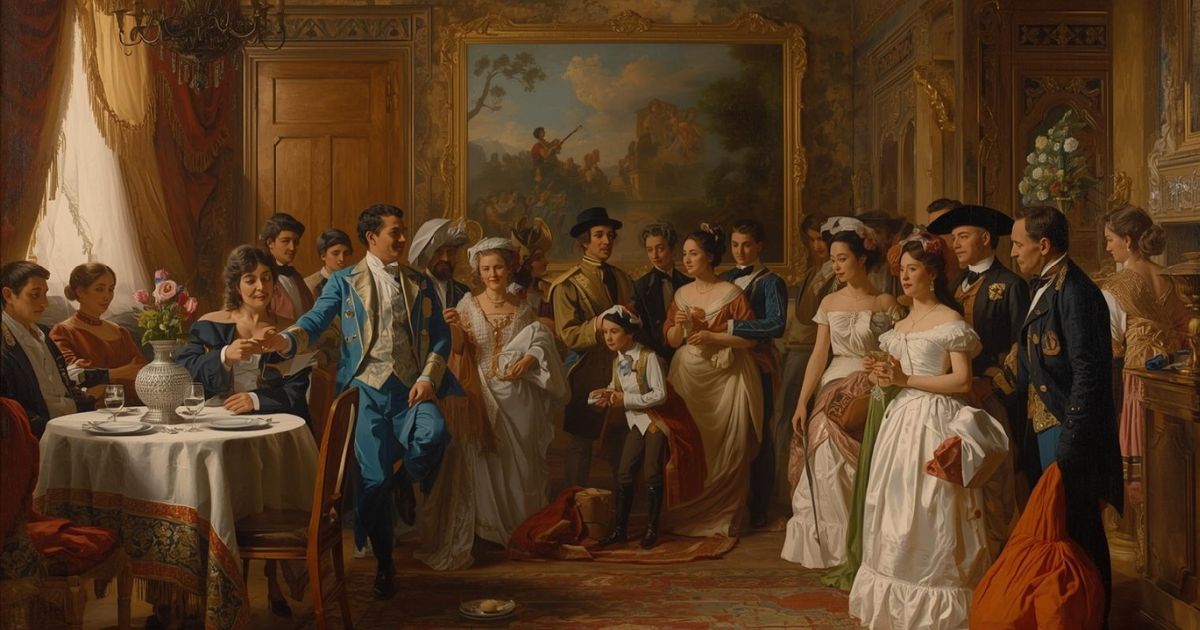
An excerpt from the original text.(complete · 3588 words)
he Voice of the Hunted
As the sun was sinking below the horizon Ibarra stepped into Elias's
banka at the shore of the lake. The youth looked out of humor.
"Pardon me, sir," said Elias sadly, on seeing him, "that I have been
so bold as to make this appointment. I wanted to talk to you freely
and so I chose this means, for here we won't have any listeners. We
can return within an hour."
"You're wrong, friend," answered Ibarra with a forced smile. "You'll
have to take me to that town whose belfry we see from here. A mischance
forces me to this."
"A mischance?"
"Yes. On my way here I met the alferez and he forced his company on
me. I thought of you and remembered that he knows you, so to get away
from him I told him that I was going to that town. I'll have to stay
there all day, since he will look for me tomorrow afternoon."
"I appreciate your thoughtfulness, but you might simply have invited
him to accompany you," answered Elias naturally.
"What about you?"
"He wouldn't have recognized me, since the only time he ever saw me
he wasn't in a position to take careful note of my appearance."
"I'm in bad luck," sighed Ibarra, thinking of Maria Clara. "What did
you have to tell me?"
Elias looked about him. They were already at a distance from the
shore, the sun had set, and as in these latitudes there is scarcely
any twilight, the shades were lengthening, bringing into view the
bright disk of the full moon.
"Sir," replied Elias gravely, "I am the bearer of the wishes of many
unfortunates."
"Unfortunates? What do you mean?"
In a few words Elias recounted his conversation with the leader of the
tulisanes, omitting the latter's doubts and threats. Ibarra listened
attentively and was the first to break the long silence that reigned
after he had finished his story.
"So they want--"
"Radical reforms in the armed forces, in the priesthood, and in the
administration of justice; that is to say, they ask for paternal
treatment from the government."
"Reforms? In what sense?"
"For example, more respect for a man's dignity, more security for the
individual, less force in the armed forces, fewer privileges for that
corps which so easily abuses what it has."
"Elias," answered the youth, "I don't know who you are, but I
suspect that you are not a man of the people; you think and act so
differently from others. You will understand me if I tell you that,
however imperfect the condition of affairs may be now, it would be
more so if it were changed. I might be able to get the friends that
I have in Madrid to talk, by paying them; I might even be able to
see the Captain-General; but neither would the former accomplish
anything nor has the latter sufficient power to introduce so many
novelties. Nor would I ever take a single step in that direction,
for the reason that, while I fully understand that it is true that
these corporations have their faults, they are necessary at this
time. They are what is known as a necessary evil."
Greatly surprised, Elias raised his head and looked at him in
astonishment. "Do you, then, also believe in a necessary evil,
sir?" he asked in a voice that trembled slightly. "Do you believe
that in order to do good it is necessary to do evil?"
"No, I believe in it as in a violent remedy that we make use of when we
wish to cure a disease. Now then, the country is an organism suffering
from a chronic malady, and in order to cure it, the government sees
the necessity of employing such means, harsh and violent if you wish,
but useful and necessary."
"He is a bad doctor, sir, who seeks only to destroy or stifle the
symptoms without an effort to examine into the origin of the malady,
or, when knowing it, fears to attack it. The Civil Guard has only
this purpose: the repression of crime by means of terror and force, a
purpose that it does not fulfil or accomplishes only incidentally. You
must take into account the truth that society can be severe with
individuals only when it has provided them with the means necessary
for their moral perfection. In our country, where there is no society,
since there is no unity between the people and the government, the
latter should be indulgent, not only because indulgence is necessary
but also because the individual, abandoned and uncared for by it,
has less responsibility, for the very reason that he has received less
guidance. Besides, following out your comparison, the treatment that
is applied to the ills of the country is so destructive that it is
felt only in the sound parts of the organism, whose vitality is thus
weakened and made receptive of evil. Would it not be more rational to
strengthen the diseased parts of the organism and lessen the violence
of the remedy a little?"
"To weaken the Civil Guard would be to endanger the security of
the towns."
"The security of the towns!" exclaimed Elias bitterly. "It will
soon be fifteen years since the towns have had their Civil Guard,
and look: still we have tulisanes, still we hear that they sack
towns, that they infest the highways. Robberies continue and the
perpetrators are not hunted down; crime flourishes, and the real
criminal goes scot-free, but not so the peaceful inhabitant of the
town. Ask any honorable citizen if he looks upon this institution as
a benefit, a protection on the part of the government, and not as an
imposition, a despotism whose outrageous acts do more damage than
the violent deeds of criminals. These latter are indeed serious,
but they are rare, and against them one has the right to defend
himself, but against the molestations of legal force he is not even
allowed a protest, and if they are not serious they are nevertheless
continued and sanctioned. What effect does this institution produce
among our people? It paralyzes communication because all are afraid
of being abused on trifling pretexts. It pays more attention to
formalities than to the real nature of things, which is the first
symptom of incapacity. Because one has forgotten his cedula he must
be manacled and knocked about, regardless of the fact that he may be
a decent and respectable citizen. The superiors hold it their first
duty to make people salute them, either willingly or forcibly, even
in the darkness of the night, and their inferiors imitate them by
mistreating and robbing the country folk, nor are pretexts lacking
to this end. Sanctity of the home does not exist; not long ago in
Kalamba they entered, by forcing their way through the windows, the
house of a peaceful inhabitant to whom their chief owed money and
favors. There is no personal security; when they need to have their
barracks or houses cleaned they go out and arrest any one who does not
resist them, in order to make him work the whole day. Do you care to
hear more? During these holidays gambling, which is prohibited by law,
has gone on while they forcibly broke up the celebrations permitted by
the authorities. You saw what the people thought about these things;
what have they got by repressing their anger and hoping for human
justice? Ah, sir, if that is what you call keeping the peace--"
"I agree with you that there are evils," replied Ibarra, "but let
us bear with those evils on account of the benefits that accompany
them. This institution may be imperfect, but, believe me, by the fear
that it inspires it keeps the number of criminals from increasing."
"Say rather that by this fear the number is increased," corrected
Elias. "Before the creation of this corps almost all the evil-doers,
with the exception of a very few, were criminals from hunger. They
plundered and robbed in order to live, but when their time of want
was passed, they again left the highways clear. Sufficient to put
them to flight were the poor, but brave cuadrilleros, they who have
been so calumniated by the writers about our country, who have for a
right, death, for duty, fighting, and for reward, jests. Now there are
tulisanes who are such for life. A single fault, a crime inhumanly
punished, resistance against the outrages of this power, fear of
atrocious tortures, east them out forever from society and condemn
them to slay or be slain. The terrorism of the Civil Guard closes
against them the doors of repentance, and as outlaws they fight to
defend themselves in the mountains better than the soldiers at whom
they laugh. The result is that we are unable to put an end to the evil
that we have created. Remember what the prudence of the Captain-General
de la Torre [131] accomplished. The amnesty granted by him to those
unhappy people has proved that in those mountains there still beat the
hearts of men and that they only wait for pardon. Terrorism is useful
when the people are slaves, when the mountains afford no hiding-places,
when power places a sentinel behind every tree, and when the body of
the slave contains nothing more than a stomach and intestines. But
when in desperation he fights for his life, feeling his arm strong,
his heart throb, his whole being fill with hate, how can terrorism
hope to extinguish the flame to which it is only adding fuel?"
"I am perplexed, Elias, to hear you talk thus, and I should almost
believe that you were right had I not my own convictions. But note this
fact--and don't be offended, for I consider you an exception--look
who the men are that ask for these reforms" nearly all criminals or
on the way to be such!"
"Criminals now, or future criminals; but why are they such? Because
their peace has been disturbed, their happiness destroyed, their
dearest affections wounded, and when they have asked justice for
protection, they have become convinced that they can expect it only
from themselves. But you are mistaken, sir, if you think that only the
criminals ask for justice. Go from town to town, from house to house,
listen to the secret sighings in the bosoms of the families, and you
will be convinced that the evils which the Civil Guard corrects are
the same as, if not less than, those it causes all the time. Should
we decide from this that all the people are criminals? If so, then
why defend some from the others, why not destroy them all?"
"Some error exists here which I do not see just now some fallacy in the
theory to invalidate the practise, for in Spain, the mother country,
this corps is displaying, and has ever displayed, great usefulness."
"I don't doubt it. Perhaps there, it is better organized, the men
of better grade, perhaps also Spain needs it while the Philippines
does not. Our customs, our mode of life, which are always invoked
when there is a desire to deny us some right, are entirely overlooked
when the desire is to impose something upon us. And tell me, sir, why
have not the other nations, which from their nearness to Spain must be
more like her than the Philippines is, adopted this institution? Is it
because of this that they still have fewer robberies on their railway
trains, fewer riots, fewer murders, and fewer assassinations in their
great capitals?"
Ibarra bowed his head in deep thought, raising it after a few
moments to reply: "This question, my friend, calls for serious
study. If my inquiries convince me that these complaints are well
founded I will write to my friends in Madrid, since we have no
representatives. Meanwhile, believe me that the government needs a
corps with strength enough to make itself respected and to enforce
its authority."
"Yes, sir, when the government is at war with the country. But for
the welfare of the government itself we must not have the people think
that they are in opposition to authority. Rather, if such were true,
if we prefer force to prestige, we ought to take care to whom we grant
this unlimited power, this authority. So much power in the hands
of men, ignorant men filled with passions, without moral training,
of untried principles, is a weapon in the hands of a madman in a
defenseless multitude. I concede and wish to believe with you that
the government needs this weapon, but then let it choose this weapon
carefully, let it select the most worthy instruments, and since it
prefers to take upon itself authority, rather than have the people
grant it, at least let it be seen that it knows how to exercise it."
Elias spoke passionately, enthusiastically, in vibrating tones; his
eyes flashed. A solemn pause followed. The banka, unimpelled by the
paddle, seemed to stand still on the water. The moon shone majestically
in a sapphire sky and a few lights glimmered on the distant shore.
"What more do they ask for?" inquired Ibarra.
"Reform in the priesthood," answered Elias in a sad and discouraged
tone. "These unfortunates ask for more protection against--"
"Against the religious orders?"
"Against their oppressors, sir."
"Has the Philippines forgotten what she owes to those orders? Has she
forgotten the immense debt of gratitude that is due from her to those
who snatched her from error to give her the true faith, to those who
have protected her against the tyrannical acts of the civil power? This
is the evil result of not knowing the history of our native land!"
The surprised Elias could hardly credit what he heard. "Sir," he
replied in a grave tone, "you accuse these people of ingratitude;
let me, one of the people who suffer, defend them. Favors rendered,
in order to have any claims to recognition, must be disinterested. Let
us pass over its missionary work, the much-invoked Christian charity;
let us brush history aside and not ask what Spain has done with the
Jewish people, who gave all Europe a Book, a Religion, and a God;
what she has done with the Arabic people, who gave her culture,
who were tolerant with her religious beliefs, and who awoke her
lethargic national spirit, so nearly destroyed during the Roman and
Gothic dominations. You say that she snatched us from error and gave
us the true faith: do you call faith these outward forms, do you
call religion this traffic in girdles and scapularies, truth these
miracles and wonderful tales that we hear daily? Is this the law of
Jesus Christ? For this it was hardly necessary that a God should allow
Himself to be crucified or that we should be obliged to show eternal
gratitude. Superstition existed long before--it was only necessary
to systematize it and raise the price of its merchandise!
"You will tell me that however imperfect our religion may be at
present, it is preferable to what we had before. I believe that, too,
and would agree with you in saying so, but the cost is too great,
since for it we have given up our nationality, our independence. For
it we have given over to its priests our best towns, our fields, and
still give up our savings by the purchase of religious objects. An
article of foreign manufacture has been introduced among us, we have
paid well for it, and we are even.
"If you mean the protection that they afforded us against the
encomenderos, [132] I might answer that through them we fell under
the power of the encomenderos. But no, I realize that a true faith
and a sincere love for humanity guided the first missionaries to our
shores; I realize the debt of gratitude we owe to those noble hearts;
I know that at that time Spain abounded in heroes of all kinds, in
religious as well as in political affairs, in civil and in military
life. But because the forefathers were virtuous, should we consent
to the abuses of their degenerate descendants? Because they have
rendered us great service, should we be to blame for preventing them
from doing us wrong? The country does not ask for their expulsion but
only for reforms required by the changed circumstances and new needs."
"I love our native land as well as you can, Elias; I understand
something of what it desires, and I have listened with attention to
all you have said. But, after all, my friend, I believe that we are
looking at things through rather impassioned eyes. Here, less than
in other parts, do I see the necessity for reforms."
"Is it possible, sir," asked Elias, extending his arms in a gesture
of despair, "that you do not see the necessity for reforms, you,
after the misfortunes of your family?"
"Ah, I forget myself and my own troubles in the presence of the
security of the Philippines, in the presence of the interests of
Spain!" interrupted Ibarra warmly. "To preserve the Philippines it
is meet that the friars continue as they are. On the union with Spain
depends the welfare of our country."
When Ibarra had ceased Elias still sat in an attitude of attention
with a sad countenance and eyes that had lost their luster. "The
missionaries conquered the country, it is true," he replied, "but do
you believe that by the friars the Philippines will be preserved?"
"Yes, by them alone. Such is the belief of all who have written about
the country."
"Oh!" exclaimed Elias dejectedly, throwing the paddle clown in the
banka, "I did not believe that you would have so poor an idea of
the government and of the country. Why don't you condemn both? What
would you say of the members of a family that dwells in peace only
through the intervention of an outsider: a country that is obedient
because it is deceived; a government that commands be, cause it avails
itself of fraud, a government that does not know how to make itself
loved or respected for its own sake? Pardon me, sir, but I believe
that our government is stupid and is working its own ruin when it
rejoices that such is the belief. I thank you for your kindness,
where do you wish me to take you now?"
"No," replied Ibarra, "let us talk; it is necessary to see who is
right on such an important subject."
"Pardon me, sir," replied Elias, shaking his head, "but I haven't the
eloquence to convince you. Even though I have had some education I am
still an Indian, my way of life seems to you a precarious one, and my
words will always seem to you suspicious. Those who have given voice
to the opposite opinion are Spaniards, and as such, even though they
may speak idly and foolishly, their tones, their titles, and their
origin make their words sacred and give them such authority that I
have desisted forever from arguing against them. Moreover, when I
see that you, who love your country, you, whose father sleeps beneath
these quiet waters, you, who have seen yourself attacked, insulted,
and persecuted, hold such opinions in spite of all these things, and
in spite of your knowledge, I begin to doubt my own convictions and
to admit the possibility that the people may be mistaken. I'll have
to tell those unfortunates who have put their trust in men that they
must place it in God and their own strength. Again I thank you--tell
me where I shall take you."
"Elias, your bitter words touch my heart and make me also doubt. What
do you want? I was not brought up among the people, so I am perhaps
ignorant of their needs. I spent my childhood in the Jesuit college,
I grew up in Europe, I have been molded by books, learning only what
men have been able to bring to light. What remains among the shadows,
what the writers do not tell, that I am ignorant of. Yet I love our
country as you do, not only because it is the duty of every man to
love the country to which he owes his existence and to which he will
no doubt owe his final rest, not only because my father so taught
me, but also because my mother was an Indian, because my fondest
recollections cluster around my country, and I love it also because
to it I owe and shall ever owe my happiness!"
"And I, because to it I owe my misfortunes," muttered Elias.
"Yes, my friend, I know that you suffer, that you are unfortunate,
and that those facts make you look into the future darkly and
influence your way of thinking, so I am somewhat forearmed against
your complaints. If I could understand your motives, something of
your past--"
"My misfortunes had another source. If I thought that the story of
them would be of any use, I would relate it to you, since, apart from
the fact that I make no secret of it, it is quite well known to many."
"Perhaps on hearing it I might correct my opinions. You know that I do
not trust much to theories, preferring rather to be guided by facts."
Elias remained thoughtful for a few moments. "If that is the case,
sir, I will tell you my story briefly."
Master this chapter. Complete your experience
Purchase the complete book to access all chapters and support classic literature
As an Amazon Associate, we earn a small commission from qualifying purchases at no additional cost to you.
Available in paperback, hardcover, and e-book formats
Let's Analyse the Pattern
When formal education teaches people to defend the systems that exploit them, making victims into advocates for their own oppression.
Why This Matters
Connect literature to life
This chapter teaches how to recognize when formal education has been designed to make you complicit in your own oppression.
Practice This Today
This week, notice when you defend policies or systems that hurt you or people like you - ask yourself who benefits from your 'reasonable' position.
Now let's explore the literary elements.
Key Quotes & Analysis
"The Civil Guard, instead of pursuing criminals, makes them."
Context: While arguing that the colonial police force creates more problems than it solves
This gets to the heart of how oppressive systems work - they create the very problems they claim to fix. Elias is pointing out that when you treat innocent people like criminals, you push them toward actual resistance.
In Today's Words:
The cops are making more criminals than they're catching.
"I believe that the friars and the Civil Guard are necessary evils."
Context: Defending the colonial system despite his family's persecution
Shows how colonial education worked - even someone who suffered under the system defends it. Ibarra has been taught that questioning authority leads to chaos, so he accepts oppression as necessary.
In Today's Words:
The system sucks but we need it to keep things from falling apart.
"You have been to Europe and have breathed other air, but the evil has been stronger than the good."
Context: Expressing frustration that even Ibarra's European education hasn't opened his eyes
Elias realizes that education alone isn't enough to break mental colonization. Even exposure to different ideas can't overcome deep programming about authority and order.
In Today's Words:
You've seen how things could be different, but you're still brainwashed by the system.
Thematic Threads
Class
In This Chapter
Ibarra's privilege blinds him to the reality that poorer people like Elias experience daily under colonial rule
Development
Deepened from earlier tensions—now showing how class shapes not just opportunity but perception of reality
In Your Life:
Notice how your economic position might make you defend systems that harm people with less security than you have.
Identity
In This Chapter
Ibarra's European education has shaped his identity as 'enlightened,' making him unable to see his own colonized thinking
Development
Evolved from his return to Philippines—his identity crisis now shows its dangerous side
In Your Life:
Question whether your professional identity or education makes you defend practices you know are wrong.
Social Expectations
In This Chapter
Both men are trapped by what their backgrounds expect them to believe—Ibarra must be 'reasonable,' Elias must be 'radical'
Development
Intensified from earlier chapters—now showing how expectations prevent understanding across class lines
In Your Life:
Recognize when social expectations keep you from hearing truths that challenge your worldview.
Power
In This Chapter
The real power isn't in Ibarra's wealth but in how the system has convinced him to police his own thoughts
Development
Revealed more clearly—power works through mind control, not just force
In Your Life:
Ask yourself what beliefs you hold that might serve someone else's power more than your own interests.
Truth
In This Chapter
Elias offers concrete examples while Ibarra clings to abstract principles, showing how power obscures reality
Development
Introduced here as central conflict—truth versus comfortable lies
In Your Life:
Trust concrete evidence over abstract theories, especially when those theories justify your comfort.
You now have the context. Time to form your own thoughts.
Discussion Questions
- 1
What specific examples does Elias give to show how the Civil Guard and colonial system harm innocent people?
analysis • surface - 2
Why does Ibarra defend the same system that persecuted his own family?
analysis • medium - 3
Where do you see people today defending systems that actually harm them or their communities?
application • medium - 4
How can you tell the difference between necessary authority and oppressive control in your own life?
application • deep - 5
What does this chapter reveal about how education can be used to control people's thinking?
reflection • deep
Critical Thinking Exercise
Spot the Education Trap
Think of something you were taught to believe that you now question. It could be about work, relationships, money, health, or success. Write down what you were taught, who taught it, and who benefited from you believing it. Then write what you actually observe from your own experience.
Consider:
- •Consider whether your formal education prepared you for real-world challenges or just compliance
- •Notice if you defend systems even when they don't serve your interests
- •Pay attention to whose voices are missing from what you were taught
Journaling Prompt
Write about a time when you realized that something you'd been taught to accept was actually working against you. How did you recognize this? What did you do about it?
Coming Up Next...
Chapter 50: The Weight of Family Legacy
Elias prepares to reveal the personal tragedy that transformed him from a man of privilege into a voice for the oppressed. His story will challenge everything Ibarra believes about justice, family, and the true cost of colonial rule.



