
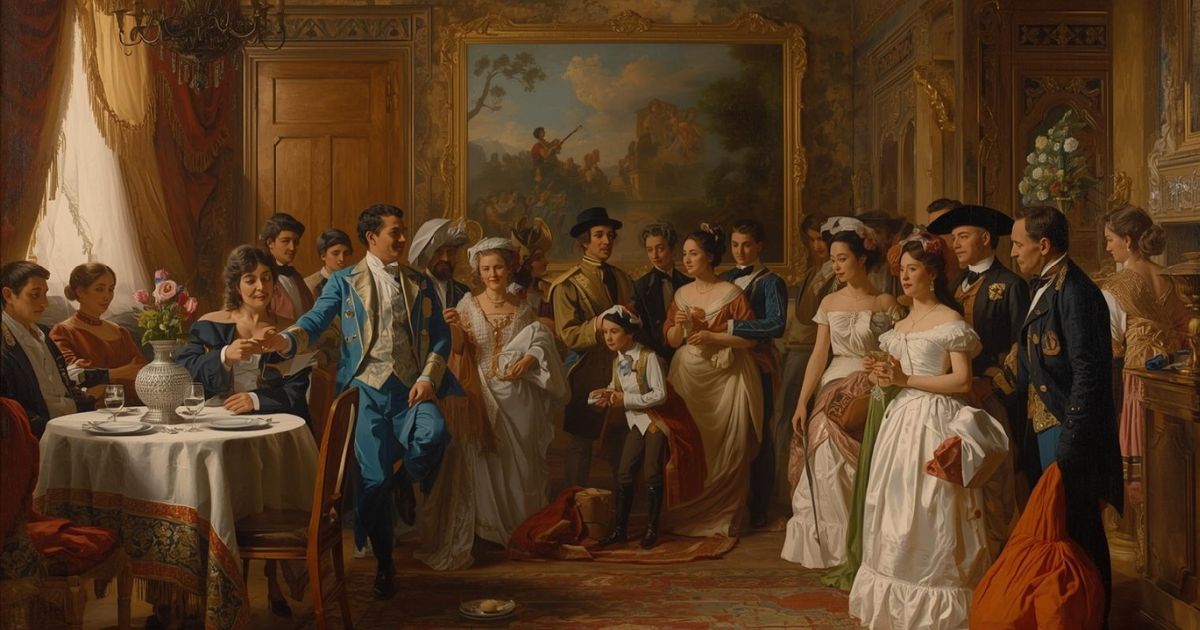
An excerpt from the original text.(complete · 1977 words)
n Examination of Conscience
Long days and weary nights passed at the sick girl's bed. After having
confessed herself, Maria Clara had suffered a relapse, and in her
delirium she uttered only the name of the mother whom she had never
known. But her girl friends, her father, and her aunt kept watch at
her side. Offerings and alms were sent to all the miraculous images,
Capitan Tiago vowed a gold cane to the Virgin of Antipolo, and at
length the fever began to subside slowly and regularly.
Doctor De Espadaña was astonished at the virtues of the syrup of
marshmallow and the infusion of lichen, prescriptions that he had not
varied. Doña Victorina was so pleased with her husband that one day
when he stepped on the train of her gown she did not apply her penal
code to the extent of taking his set of false teeth away from him,
but contented herself with merely exclaiming, "If you weren't lame
you'd even step on my corset!"--an article of apparel she did not wear.
One afternoon while Sinang and Victoria were visiting their friend,
the curate, Capitan Tiago, and Doña Victorina's family were conversing
over their lunch in the dining-room.
"Well, I feel very sorry about it," said the doctor; "Padre Damaso
also will regret it very much."
"Where do you say they're transferring him to?" Linares asked the
curate.
"To the province of Tayabas," replied the curate negligently.
"One who will be greatly affected by it is Maria Clara, when she
learns of it," said Capitan Tiago. "She loves him like a father."
Fray Salvi looked at him askance.
"I believe, Padre," continued Capitan Tiago, "that all her illness
is the result of the trouble on the last day of the fiesta."
"I'm of the same opinion, and think that you've done well not to let
Señor Ibarra see her. She would have got worse.
"If it wasn't for us," put in Doña Victorina, "Clarita would already
be in heaven singing praises to God."
"Amen!" Capitan Tiago thought it his duty to exclaim. "It's lucky
for you that my husband didn't have any patient of greater quality,
for then you'd have had to call in another, and all those here are
ignoramuses. My husband--"
"Just as I was saying," the curate in turn interrupted, "I think that
the confession that Maria Clara made brought on the favorable crisis
which has saved her life. A clean conscience is worth more than a lot
of medicine. Don't think that I deny the power of science, above all,
that of surgery, but a clean conscience! Read the pious books and
you'll see how many cures are effected merely by a clean confession."
"Pardon me," objected the piqued Doña Victorina, "this power of the
confessional--cure the alferez's woman with a confession!"
"A wound, madam, is not a form of illness which the conscience
can affect," replied Padre Salvi severely. "Nevertheless, a clean
confession will preserve her from receiving in the future such blows
as she got this morning."
"She deserves them!" went on Doña Victorina as if she had not heard
what Padre Salvi said. "That woman is so insolent! In the church she
did nothing but stare at me. You can see that she's a nobody. Sunday
I was going to ask her if she saw anything funny about my face,
but who would lower oneself to speak to people that are not of rank?"
The curate, on his part, continued just as though he had not heard
this tirade. "Believe me, Don Santiago, to complete your daughter's
recovery it's necessary that she take communion tomorrow. I'll bring
the viaticum over here. I don't think she has anything to confess,
but yet, if she wants to confess herself tonight--"
"I don't know," Doña Victorina instantly took advantage of a slight
hesitation on Padre Salvi's part to add, "I don't understand how
there can be men capable of marrying such a fright as that woman
is. It's easily seen where she comes from. She's just dying of envy,
you can see it! How much does an alferez get?"
"Accordingly, Don Santiago, tell your cousin to prepare the sick girl
for the communion tomorrow. I'll come over tonight to absolve her of
her peccadillos."
Seeing Aunt Isabel come from the sick-room, he said to her in Tagalog,
"Prepare your niece for confession tonight. Tomorrow I'll bring over
the viaticum. With that she'll improve faster."
"But, Padre," Linares gathered up enough courage to ask faintly,
"you don't think that she's in any danger of dying?"
"Don't you worry," answered the padre without looking at him. "I
know what I'm doing; I've helped take care of plenty of sick people
before. Besides, she'll decide herself whether or not she wishes to
receive the holy communion and you'll see that she says yes."
Capitan Tiago immediately agreed to everything, while Aunt Isabel
returned to the sick girl's chamber. Maria Clara was still in bed,
pale, very pale, and at her side were her two friends.
"Take one more grain," Sinang whispered, as she offered her a white
tablet that she took from a small glass tube. "He says that when you
feel a rumbling or buzzing in your ears you are to stop the medicine."
"Hasn't he written to you again?" asked the sick girl in a low voice.
"No, he must be very busy."
"Hasn't he sent any message?"
"He says nothing more than that he's going to try to get the Archbishop
to absolve him from the excommunication, so that--"
This conversation was suspended at the aunt's approach. "The
padre says for you to get ready for confession, daughter," said the
latter. "You girls must leave her so that she can make her examination
of conscience."
"But it hasn't been a week since she confessed!" protested Sinang. "I'm
not sick and I don't sin as often as that."
"Abá! Don't you know what the curate says: the righteous sin seven
times a day? Come, what book shall I bring you, the Ancora, the
Ramillete, or the Camino Recto para ir al Cielo?"
Maria Clara did not answer.
"Well, you mustn't tire yourself," added the good aunt to console
her. "I'll read the examination myself and you'll have only to recall
your sins."
"Write to him not to think of me any more," murmured Maria Clara in
Sinang's ear as the latter said good-by to her.
"What?"
But the aunt again approached, and Sinang had to go away without
understanding what her friend had meant. The good old aunt drew a
chair up to the light, put her spectacles on the end of her nose, and
opened a booklet. "Pay close attention, daughter. I'm going to begin
with the Ten Commandments. I'll go slow so that you can meditate. If
you don't hear well tell me so that I can repeat. You know that in
looking after your welfare I'm never weary."
She began to read in a monotonous and snuffling voice the
considerations of cases of sinfulness. At the end of each paragraph
she made a long pause in order to give the girl time to recall her
sins and to repent of them.
Maria Clara stared vaguely into space. After finishing the first
commandment, to love God above all things, Aunt Isabel looked at
her over her spectacles and was satisfied with her sad and thoughtful
mien. She coughed piously and after a long pause began to read the
second commandment. The good old woman read with unction and when she
had finished the commentaries looked again at her niece, who turned
her head slowly to the other side.
"Bah!" said Aunt Isabel to herself. "With taking His holy name in vain
the poor child has nothing to do. Let's pass on to the third." [122]
The third commandment was analyzed and commented upon. After citing
all the cases in which one can break it she again looked toward the
bed. But now she lifted up her glasses and rubbed her eyes, for she
had seen her niece raise a handkerchief to her face as if to wipe
away tears.
"Hum, ahem! The poor child once went to sleep during the sermon." Then
replacing her glasses on the end of her nose, she said, "Now let's
see if, just as you've failed to keep holy the Sabbath, you've failed
to honor your father and mother."
So she read the fourth commandment in an even slower and more snuffling
voice, thinking thus to give solemnity to the act, just as she had
seen many friars do. Aunt Isabel had never heard a Quaker preach or
she would also have trembled.
The sick girl, in the meantime, raised the handkerchief to her eyes
several times and her breathing became more noticeable.
"What a good soul!" thought the old woman. "She who is so obedient
and submissive to every one! I've committed more sins and yet I've
never been able really to cry."
She then began the fifth commandment with greater pauses and even
more pronounced snuffling, if that were possible, and with such great
enthusiasm that she did not hear the stifled sobs of her niece. Only
in a pause which she made after the comments on homicide, by violence
did she notice the groans of the sinner. Then her tone passed into the
sublime as she read the rest of the commandment in accents that she
tried to reader threatening, seeing that her niece was still weeping.
"Weep, daughter, weep!" she said, approaching the bed. "The more you
weep the sooner God will pardon you. Hold the sorrow of repentance as
better than that of mere penitence. Weep, daughter, weep! You don't
know how much I enjoy seeing you weep. Beat yourself on the breast
also, but not hard, for you're still sick."
But, as if her sorrow needed mystery and solitude to make it increase,
Maria Clara, on seeing herself observed, little by little stopped
sighing and dried her eyes without saying anything or answering her
aunt, who continued the reading. Since the wails of her audience had
ceased, however, she lost her enthusiasm, and the last commandments
made her so sleepy that she began to yawn, with great detriment to
her snuffling, which was thus interrupted.
"If I hadn't seen it with my own eyes, I wouldn't have believed it,"
thought the good old lady afterwards. "This girl sins like a soldier
against the first five and from the sixth to the tenth not a venial
sin, just the opposite to us! How the world does move now!"
So she lighted a large candle to the Virgin of Antipolo and two other
smaller ones to Our Lady of the Rosary and Our Lady of the Pillar,
[123] taking care to put away in a corner a marble crucifix to make
it understand that the candles were not lighted for it. Nor did the
Virgin of Delaroche have any share; she was an unknown foreigner,
and Aunt Isabel had never heard of any miracle of hers.
We do not know what occurred during the confession that night and we
respect such secrets. But the confession was a long one and the aunt,
who stood watch over her niece at a distance, could note that the
curate, instead of turning his ear to hear the words of the sick girl,
rather had his face turned toward hers, and seemed only to be trying
to read, or divine, her thoughts by gazing into her beautiful eyes.
Pale and with contracted lips Padre Salvi left the chamber. Looking
at his forehead, which was gloomy and covered with perspiration,
one would have said that it was he who had confessed and had not
obtained absolution.
"Jesús, María, y José!" exclaimed Aunt Isabel, crossing herself to
dispel an evil thought, "who understands the girls nowadays?"
Master this chapter. Complete your experience
Purchase the complete book to access all chapters and support classic literature
As an Amazon Associate, we earn a small commission from qualifying purchases at no additional cost to you.
Available in paperback, hardcover, and e-book formats
Let's Analyse the Pattern
Predators exploit moments when people are weakened by trauma, illness, or crisis to gain psychological, physical, or emotional control.
Why This Matters
Connect literature to life
This chapter teaches how to recognize when someone exploits your moments of weakness or confusion for their gain.
Practice This Today
This week, notice when authority figures insist on private meetings during your vulnerable moments, and trust your gut even when you can't explain why someone feels wrong.
Now let's explore the literary elements.
Key Quotes & Analysis
"in her delirium she uttered only the name of the mother whom she had never known"
Context: During Maria Clara's fever, when her defenses are down
Shows how illness strips away our masks and reveals our deepest needs. Maria Clara's unconscious mind reaches for the maternal love she was denied, highlighting the emotional void that shapes her entire life.
In Today's Words:
When she was really sick, all she wanted was the mom she never had
"Maria Clara burst into tears"
Context: When Aunt Isabel reads the commandments about honoring parents and not killing
Her breakdown at these specific commandments reveals her internal conflict about family loyalty and possibly violence. She feels guilty about something related to these moral areas, suggesting deep family secrets.
In Today's Words:
She completely lost it when they got to the parts about family and violence
"he seemed to be reading her thoughts rather than listening to her words"
Context: Describing Padre Salvi's behavior during Maria Clara's confession
Shows how he's exploiting the sacred ritual for his own purposes, violating the trust and vulnerability of confession. His predatory behavior turns a moment of spiritual healing into something disturbing.
In Today's Words:
He was more interested in getting inside her head than actually helping her
Thematic Threads
Authority
In This Chapter
Padre Salvi uses religious authority to probe Maria Clara psychologically during confession, violating the sacred trust
Development
Previously shown through Padre Damaso's political control; now reveals how spiritual authority becomes predatory
In Your Life:
You might see this when doctors, therapists, or supervisors use their position to cross boundaries during your vulnerable moments
Trauma
In This Chapter
Maria Clara's physical illness is her body processing emotional trauma from recent events, creating confusion about her actual needs
Development
Building from earlier hints of her distress; now shows how trauma manifests physically and mentally
In Your Life:
You might recognize this when stress shows up as physical symptoms that doctors can't fully explain
Guilt
In This Chapter
Maria Clara breaks down at commandments about family loyalty and violence, revealing hidden guilt she can't articulate
Development
Introduced here as a new layer of her internal conflict
In Your Life:
You might feel this when family loyalty conflicts with your own moral compass or safety
Misreading
In This Chapter
Aunt Isabel notices Maria Clara's emotional patterns but misinterprets what they mean, missing the real source of distress
Development
Continues theme of adults failing to understand the younger generation's actual struggles
In Your Life:
You might experience this when well-meaning family members offer solutions that miss your real problem
Exploitation
In This Chapter
Padre Salvi emerges from confession looking like the guilty party, suggesting he used the sacred ritual for his own purposes
Development
Escalation from earlier power abuse; now shows direct predatory behavior
In Your Life:
You might encounter this when someone in a helping profession makes interactions feel wrong or self-serving
You now have the context. Time to form your own thoughts.
Discussion Questions
- 1
Why does Maria Clara break down crying only when she hears certain commandments, but not others?
analysis • surface - 2
What does Padre Salvi's behavior during confession reveal about how authority figures can exploit vulnerable moments?
analysis • medium - 3
Where have you seen people in positions of trust use someone's weakness or crisis against them?
application • medium - 4
How would you protect yourself or someone you care about when they're in a vulnerable state like Maria Clara's?
application • deep - 5
What does this chapter teach us about why predators specifically target people during their lowest moments?
reflection • deep
Critical Thinking Exercise
Map Your Vulnerability Points
Think about times when you've been vulnerable - sick, stressed, grieving, or in crisis. List three situations where you needed help or support. For each situation, identify who had access to you and what power they held. Then note any red flags you might have ignored because you needed their help.
Consider:
- •Vulnerability doesn't make you weak - it makes you human and temporarily dependent
- •Authority figures often have legitimate reasons to be alone with you during vulnerable times
- •Trust your gut feelings even when you can't explain why someone feels 'off'
Journaling Prompt
Write about a time when someone used your vulnerable state to their advantage, or when you recognized someone trying to exploit your weakness. How did you handle it, and what would you do differently now?
Coming Up Next...
Chapter 45: The Hunted Leader's Choice
With Maria Clara's confession complete and disturbing secrets hanging in the air, the focus shifts to those who must flee. The title 'The Hunted' suggests someone is being pursued, and the consequences of recent events are about to catch up with key characters.



