
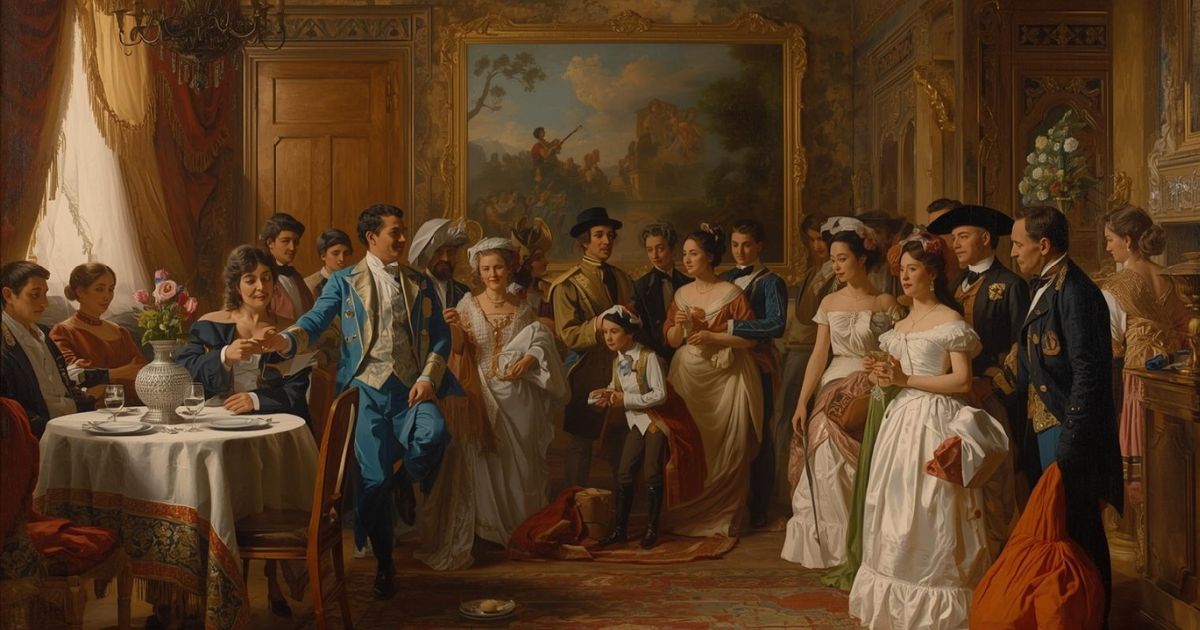
An excerpt from the original text.(complete · 4206 words)
he Espadañas
The fiesta is over. The people of the town have again found, as in
every other year, that their treasury is poorer, that they have worked,
sweated, and stayed awake much without really amusing themselves,
without gaining any new friends, and, in a word, that they have dearly
bought their dissipation and their headaches. But this matters nothing,
for the same will be done next year, the same the coming century,
since it has always been the custom.
In Capitan Tiago's house sadness reigns. All the windows are closed,
the inmates move about noiselessly, and only in the kitchen do they
dare to speak in natural tones. Maria Clara, the soul of the house,
lies sick in bed and her condition is reflected in all the faces,
as the sorrows of the mind may be read in the countenance of an
individual.
"Which seems best to you, Isabel, shall I make a poor-offering to the
cross of Tunasan or to the cross of Matahong?" asks the afflicted
father in a low voice. "The Tunasan cross grows while the Matahong
cross sweats which do you think is more miraculous?"
Aunt Isabel reflects, shakes her head, and murmurs, "To grow, to grow
is a greater miracle than to sweat. All of us sweat, but not all of
us grow."
"That's right, Isabel; but remember that to sweat for the wood of
which bench-legs are made to sweat--is not a small miracle. Come,
the best thing will be to make poor-offerings to both crosses, so
neither will resent it, and Maria will get better sooner. Are the
rooms ready? You know that with the doctors is coming a new gentleman,
a distant relative of Padre Damaso's. Nothing should be lacking."
At the other end of the dining-room are the two cousins, Sinang and
Victoria, who have come to keep the sick girl company. Andeng is
helping them clean a silver tea-set.
"Do you know Dr. Espadaña?" the foster-sister of Maria Clara asks
Victoria curiously.
"No," replies the latter, "the only thing that I know about him is
that he charges high, according to Capitan Tiago."
"Then he must be good!" exclaims Andeng. "The one who performed an
operation on Doña Maria charged high; so he was learned."
"Silly!" retorts Sinang. "Every one who charges high is not
learned. Look at Dr. Guevara; after performing a bungling operation
that cost the life of both mother and child, he charged the widower
fifty pesos. The thing to know is how to charge!"
"What do you know about it?" asks her cousin, nudging her.
"Don't I know? The husband, who is a poor sawyer, after losing his
wife had to lose his home also, for the alcalde, being a friend of
the doctor's, made him pay. Don't I know about it, when my father
lent him the money to make the journey to Santa Cruz?" [114]
The sound of a carriage stopping in front of the house put an end
to these conversations. Capitan Tiago, followed by Aunt Isabel, ran
down the steps to welcome the new arrivals: the Doctor Don Tiburcio
de Espadaña, his señora the Doctora Doña Victorina de los Reyes
de De Espadaña, and a young Spaniard of pleasant countenance and
agreeable aspect.
Doña Victorina was attired in a loose silk gown embroidered with
flowers and a hat with a huge parrot half-crushed between blue and
red ribbons. The dust of the road mingled with the rice-powder on
her cheeks seemed to accentuate her wrinkles. As at the time we saw
her in Manila, she now supported her lame husband on her arm.
"I have the pleasure of introducing to you our cousin, Don Alfonso
Linares de Espadaña," said Doña Victorina, indicating their young
companion. "The gentleman is a godson of a relative of Padre Damaso's
and has been private secretary to all the ministers."
The young man bowed politely and Capitan Tiago came very near to
kissing his hand.
While their numerous trunks and traveling-bags are being carried
in and Capitan Tiago is conducting them to their rooms, let us talk
a little of this couple whose acquaintance we made slightly in the
first chapters.
Doña Victorina was a lady of forty and five winters, which were
equivalent to thirty and two summers according to her arithmetical
calculations. She had been beautiful in her youth, having had, as
she used to say, 'good flesh,' but in the ecstasies of contemplating
herself she had looked with disdain on her many Filipino admirers,
since her aspirations were toward another race. She had refused to
bestow on any one her little white hand, not indeed from distrust,
for not a few times had she given jewelry and gems of great value to
various foreign and Spanish adventurers. Six months before the time of
our story she had seen realized her most beautiful dream,--the dream
of her whole life,--for which she might scorn the fond illusions
of her youth and even the promises of love that Capitan Tiago had
in other days whispered in her ear or sung in some serenade. Late,
it is true, had the dream been realized, but Doña Victorina, who,
although she spoke the language badly, was more Spanish than Augustina
of Saragossa, [115] understood the proverb, "Better late than never,"
and found consolation in repeating it to herself. "Absolute happiness
does not exist on earth," was another favorite proverb of hers,
but she never used both together before other persons.
Having passed her first, second, third, and fourth youth in casting
her nets in the sea of the world for the object of her vigils, she had
been compelled at last to content herself with what fate was willing
to apportion her. Had the poor woman been only thirty and one instead
of thirty and two summers--the difference according to her mode of
reckoning was great--she would have restored to Destiny the award it
offered her to wait for another more suited to her taste, but since
man proposes and necessity disposes, she saw herself obliged in her
great need for a husband to content herself with a poor fellow who had
been cast out from Estremadura [116] and who, after wandering about
the world for six or seven years like a modern Ulysses, had at last
found on the island of Luzon hospitality and a withered Calypso for
his better half. This unhappy mortal, by name Tiburcio Espadaña, was
only thirty-five years of age and looked like an old man, yet he was,
nevertheless, younger than Doña Victorina, who was only thirty-two. The
reason for this is easy to understand but dangerous to state.
Don Tiburcio had come to the Philippines as a petty official in the
Customs, but such had been his bad luck that, besides suffering
severely from seasickness and breaking a leg during the voyage,
he had been dismissed within a fortnight, just at the time when he
found himself without a cuarto. After his rough experience on the sea
he did not care to return to Spain without having made his fortune,
so he decided to devote himself to something. Spanish pride forbade
him to engage in manual labor, although the poor fellow would gladly
have done any kind of work in order to earn an honest living. But the
prestige of the Spaniards would not have allowed it, even though this
prestige did not protect him from want.
At first he had lived at the expense of some of his countrymen, but in
his honesty the bread tasted bitter, so instead of getting fat he grew
thin. Since he had neither learning nor money nor recommendations he
was advised by his countrymen, who wished to get rid of him, to go to
the provinces and pass himself off as a doctor of medicine. He refused
at first, for he had learned nothing during the short period that he
had spent as an attendant in a hospital, his duties there having been
to dust off the benches and light the fires. But as his wants were
pressing and as his scruples were soon laid to rest by his friends
he finally listened to them and went to the provinces. He began by
visiting some sick persons, and at first made only moderate charges,
as his conscience dictated, but later, like the young philosopher
of whom Samaniego [117] tells, he ended by putting a higher price
on his visits. Thus he soon passed for a great physician and would
probably have made his fortune if the medical authorities in Manila
had not heard of his exorbitant fees and the competition that he was
causing others. Both private parties and professionals interceded for
him. "Man," they said to the zealous medical official, "let him make
his stake and as soon as he has six or seven thousand pesos he can
go back home and live there in peace. After all, what does it matter
to you if he does deceive the unwary Indians? They should be more
careful! He's a poor devil--don't take the bread from his mouth--be a
good Spaniard!" This official was a good Spaniard and agreed to wink at
the matter, but the news soon reached the ears of the people and they
began to distrust him, so in a little while he lost his practise and
again saw himself obliged almost to beg his daily bread. It was then
that he learned through a friend, who was an intimate acquaintance of
Doña Victorina's, of the dire straits in which that lady was placed
and also of her patriotism and her kind heart. Don Tiburcio then saw
a patch of blue sky and asked to be introduced to her.
Doña Victorina and Don Tiburcio met: tarde venientibus ossa,
[118] he would have exclaimed had he known Latin! She was no longer
passable, she was passée. Her abundant hair had been reduced to a knot
about the size of an onion, according to her maid, while her face was
furrowed with wrinkles and her teeth were falling loose. Her eyes,
too, had suffered considerably, so that she squinted frequently in
looking any distance. Her disposition was the only part of her that
remained intact.
At the end of a half-hour's conversation they understood and accepted
each other. She would have preferred a Spaniard who was less lame,
less stuttering, less bald, less toothless, who slobbered less when he
talked, and who had more "spirit" and "quality," as she used to say,
but that class of Spaniards no longer came to seek her hand. She
had more than once heard it said that opportunity is pictured as
being bald, and firmly believed that Don Tiburcio was opportunity
itself, for as a result of his misfortunes he suffered from premature
baldness. And what woman is not prudent at thirty-two years of age?
Don Tiburcio, for his part, felt a vague melancholy when he thought of
his honeymoon, but smiled with resignation and called to his support
the specter of hunger. Never had he been ambitious or pretentious; his
tastes were simple and his desires limited; but his heart, untouched
till then, had dreamed of a very different divinity. Back there in his
youth when, worn out with work, he lay doom on his rough bed after
a frugal meal, he used to fall asleep dreaming of an image, smiling
and tender. Afterwards, when troubles and privations increased and
with the passing of years the poetical image failed to materialize,
he thought modestly of a good woman, diligent and industrious, who
would bring him a small dowry, to console him for the fatigues of
his toil and to quarrel with him now and then--yes, he had thought of
quarrels as a kind of happiness! But when obliged to wander from land
to land in search not so much of fortune as of some simple means of
livelihood for the remainder of his days; when, deluded by the stories
of his countrymen from overseas, he had set out for the Philippines,
realism gave, place to an arrogant mestiza or a beautiful Indian with
big black eyes, gowned in silks and transparent draperies, loaded
down with gold and diamonds, offering him her love, her carriages,
her all. When he reached Manila he thought for a time that his dream
was to be realized, for the young women whom he saw driving on the
Luneta and the Malecon in silver-mounted carriages had gazed at him
with some curiosity. Then after his position was gone, the mestiza and
the Indian disappeared and with great effort he forced before himself
the image of a widow, of course an agreeable widow! So when he saw
his dream take shape in part he became sad, but with a certain touch
of native philosophy said to himself, "Those were all dreams and in
this world one does not live on dreams!" Thus he dispelled his doubts:
she used rice-powder, but after their marriage he would break her
of the habit; her face had many wrinkles, but his coat was torn and
patched; she was a pretentious old woman, domineering and mannish,
but hunger was more terrible, more domineering and pretentious still,
and anyway, he had been blessed with a mild disposition for that very
end, and love softens the character. She spoke Spanish badly, but he
himself did not talk it well, as he had been told when notified of his
dismissal Moreover, what did it matter to him if she was an ugly and
ridiculous old woman? He was lame, toothless, and bald! Don Tiburcio
preferred to take charge of her rather than to become a public charge
from hunger. When some friends joked with him about it, he answered,
"Give me bread and call me a fool."
Don Tiburcio was one of those men who are popularly spoken of as
unwilling to harm a fly. Modest, incapable of harboring an unkind
thought, in bygone days he would have been made a missionary. His stay
in the country had not given him the conviction of grand superiority,
of great valor, and of elevated importance that the greater part
of his countrymen acquire in a few weeks. His heart had never been
capable of entertaining hate nor had he been able to find a single
filibuster; he saw only unhappy wretches whom he must despoil if he
did not wish to be more unhappy than they were. When he was threatened
with prosecution for passing himself off as a physician he was not
resentful nor did he complain. Recognizing the justness of the charge
against him, he merely answered, "But it's necessary to live!"
So they married, or rather, bagged each other, and went to Santa Ann
to spend their honeymoon. But on their wedding-night Doña Victorina
was attacked by a horrible indigestion and Don Tiburcio thanked God
and showed himself solicitous and attentive. A few days afterward,
however, he looked into a mirror and smiled a sad smile as he gazed
at his naked gums, for he had aged ten years at least.
Very well satisfied with her husband, Doña Victorina had a fine
set of false teeth made for him and called in the best tailors of
the city to attend to his clothing. She ordered carriages, sent to
Batangas and Albay for the best ponies, and even obliged him to keep a
pair for the races. Nor did she neglect her own person while she was
transforming him. She laid aside the native costume for the European
and substituted false frizzes for the simple Filipino coiffure, while
her gowns, which fitted her marvelously ill, disturbed the peace of
all the quiet neighborhood.
Her husband, who never went out on foot,--she did not care to have his
lameness noticed,--took her on lonely drives in unfrequented places to
her great sorrow, for she wanted to show him off in public, but she
kept quiet out of respect for their honeymoon. The last quarter was
coming on when he took up the subject of the rice-powder, telling her
that the use of it was false and unnatural. Doña Victorina wrinkled
up her eyebrows and stared at his false teeth. He became silent,
and she understood his weakness.
She placed a de before her husband's surname, since the de cost
nothing and gave "quality" to the name, signing herself "Victorina
de los Reyes de De Espadaña." This de was such a mania with her
that neither the stationer nor her husband could get it out of her
head. "If I write only one de it may be thought that you don't have
it, you fool!" she said to her husband. [119]
Soon she believed that she was about to become a mother, so she
announced to all her acquaintances, "Next month De Espadaña and I are
going to the Penyinsula. I don't want our son to be born here and
be called a revolutionist." She talked incessantly of the journey,
having memorized the names of the different ports of call, so that
it was a treat to hear her talk: "I'm going to see the isthmus in the
Suez Canal--De Espadaña thinks it very beautiful and De Espadaña has
traveled over the whole world." "I'll probably not return to this
land of savages." "I wasn't born to live here--Aden or Port Said
would suit me better--I've thought so ever since I was a girl." In
her geography Doña Victorina divided the world into the Philippines
and Spain; rather differently from the clever people who divide it
into Spain and America or China for another name.
Her husband realized that these things were barbarisms, but held his
peace to escape a scolding or reminders of his stuttering. To increase
the illusion of approaching maternity she became whimsical, dressed
herself in colors with a profusion of flowers and ribbons, and appeared
on the Escolta in a wrapper. But oh, the disenchantment! Three months
went by and the dream faded, and now, having no reason for fearing
that her son would be a revolutionist, she gave up the trip. She
consulted doctors, midwives, old women, but all in vain. Having to the
great displeasure of Capitan Tiago jested about St. Pascual Bailon,
she was unwilling to appeal to any saint. For this reason a friend
of her husband's remarked to her:
"Believe me, señora, you are the only strong-spirited person in
this tiresome country."
She had smiled, without knowing what strong-spirited meant, but that
night she asked her husband. "My dear," he answered, "the s-strongest
s-spirit that I know of is ammonia. My f-friend must have s-spoken
f-figuratively."
After that she would say on every possible occasion, "I'm the only
ammonia in this tiresome country, speaking figuratively. So Señor
N. de N., a Peninsular gentleman of quality, told me."
Whatever she said had to be done, for she had succeeded in dominating
her husband completely. He on his part did not put up any great
resistance and so was converted into a kind of lap-dog of hers. If
she was displeased with him she would not let him go out, and when
she was really angry she tore out his false teeth, thus leaving him
a horrible sight for several days.
It soon occurred to her that her husband ought to be a doctor of
medicine and surgery, and she so informed him.
"My dear, do you w-want me to be arrested?" he asked fearfully.
"Don't be a fool! Leave me to arrange it," she answered. "You're
not going to treat any one, but I want people to call you Doctor
and me Doctora, see?"
So on the following day Rodoreda [120] received an order to engrave on
a slab of black marble: DR. DE ESPADAÑA, SPECIALIST IN ALL KINDS OF
DISEASES. All the servants had to address them by their new titles,
and as a result she increased the number of frizzes, the layers of
rice-powder, the ribbons and laces, and gazed with more disdain than
ever on her poor and unfortunate countrywomen whose husbands belonged
to a lower grade of society than hers did. Day by day she felt more
dignified and exalted and, by continuing in this way, at the end of
a year she would have believed herself to be of divine origin.
These sublime thoughts, however, did not keep her from becoming older
and more ridiculous every day. Every time Capitan Tiago saw her and
recalled having made love to her in vain he forthwith sent a peso to
the church for a mass of thanksgiving. Still, he greatly respected her
husband on account of his title of specialist in all kinds of diseases
and listened attentively to the few phrases that he was able to stutter
out. For this reason and because this doctor was more exclusive than
others, Capitan Tiago had selected him to treat his daughter.
In regard to young Linares, that is another matter. When arranging for
the trip to Spain, Doña Victorina had thought of having a Peninsular
administrator, as she did not trust the Filipinos. Her husband
bethought himself of a nephew of his in Madrid who was studying law
and who was considered the brightest of the family. So they wrote to
him, paying his passage in advance, and when the dream disappeared
he was already on his way.
Such were the three persons who had just arrived. While they were
partaking of a late breakfast, Padre Salvi came in. The Espadañas
were already acquainted with him, and they introduced the blushing
young Linares with all his titles.
As was natural, they talked of Maria Clara, who was resting and
sleeping. They talked of their journey, and Doña Victorina exhibited
all her verbosity in criticising the customs of the provincials,--their
nipa houses, their bamboo bridges; without forgetting to mention to
the curate her intimacy with this and that high official and other
persons of "quality" who were very fond of her.
"If you had come two days ago, Doña Victorina," put in Capitan
Tiago during a slight pause, "you would have met his Excellency,
the Captain-General. He sat right there."
"What! How's that? His Excellency here! In your house? No!"
"I tell you that he sat right there. If you had only come two days
ago--"
"Ah, what a pity that Clarita did not get sick sooner!" she exclaimed
with real feeling. Then turning to Linares, "Do you hear, cousin? His
Excellency was here! Don't you see now that De Espadaña was right
when he told you that you weren't going to the house of a miserable
Indian? Because, you know, Don Santiago, in Madrid our cousin was
the friend of ministers and dukes and dined in the house of Count
El Campanario."
"The Duke of La Torte, Victorina," corrected her husband. [121]
"It's the same thing. If you will tell me--"
"Shall I find Padre Damaso in his town?" interrupted Linares,
addressing Padre Salvi. "I've been told that it's near here."
"He's right here and will be over in a little while," replied the
curate.
"How glad I am of that! I have a letter to him," exclaimed the youth,
"and if it were not for the happy chance that brings me here, I would
have come expressly to visit him."
In the meantime the happy chance had awakened.
"De Espadaña," said Doña Victorina, when the meal was over, "shall
we go in to see Clarita?" Then to Capitan Tiago, "Only for you, Don
Santiago, only for you! My husband only attends persons of quality,
and yet, and yet--! He's not like those here. In Madrid he only
visited persons of quality."
They adjourned to the sick girl's chamber. The windows were closed
from fear of a draught, so the room was almost dark, being only
dimly illuminated by two tapers which burned before an image of the
Virgin of Antipolo. Her head covered with a handkerchief saturated
in cologne, her body wrapped carefully in white sheets which swathed
her youthful form with many folds, under curtains of jusi and piña,
the girl lay on her kamagon bed. Her hair formed a frame around her
oval countenance and accentuated her transparent paleness, which
was enlivened only by her large, sad eyes. At her side were her two
friends and Andeng with a bouquet of tuberoses.
De Espadaña felt her pulse, examined her tongue, asked a few questions,
and said, as he wagged his head from side to side, "S-she's s-sick,
but s-she c-can be c-cured." Doña Victorina looked proudly at the
bystanders.
"Lichen with milk in the morning, syrup of marshmallow, two cynoglossum
pills!" ordered De Espadaña.
"Cheer up, Clarita!" said Doña Victorina, going up to her. "We've
come to cure you. I want to introduce our cousin."
Linares was so absorbed in the contemplation of those eloquent eyes,
which seemed to be searching for some one, that he did not hear Doña
Victorina name him.
"Señor Linares," said the curate, calling him out of his abstraction,
"here comes Padre Damaso."
It was indeed Padre Damaso, but pale and rather sad. On leaving his
bed his first visit was for Maria Clara. Nor was it the Padre Damaso
of former times, hearty and self-confident; now he moved silently
and with some hesitation.
Master this chapter. Complete your experience
Purchase the complete book to access all chapters and support classic literature
As an Amazon Associate, we earn a small commission from qualifying purchases at no additional cost to you.
Available in paperback, hardcover, and e-book formats
Let's Analyse the Pattern
When people with complementary desperate needs collaborate in maintaining lies that serve both parties while fooling neither.
Why This Matters
Connect literature to life
This chapter teaches how to spot when institutions hire obvious frauds because the fraud serves a hidden institutional need.
Practice This Today
Next time your workplace brings in expensive consultants or promotes obviously unqualified people, ask what institutional need this really serves - often it's providing cover for decisions already made.
Now let's explore the literary elements.
Key Quotes & Analysis
"All of us sweat, but not all of us grow."
Context: When deciding which miraculous cross to pray to for Maria Clara's recovery
This reveals the practical wisdom hidden in folk beliefs. Isabel recognizes that growth is rarer and more valuable than mere effort or suffering. It's a metaphor for how real progress is harder than just working hard.
In Today's Words:
Anyone can work hard and struggle, but actually improving your situation? That's the real miracle.
"They have dearly bought their dissipation and their headaches."
Context: Describing how the townspeople feel after the expensive fiesta
Rizal shows how tradition can trap people in cycles of poverty. They spend money they don't have on celebrations that don't actually bring joy, but they'll do it again because 'it's always been done.'
In Today's Words:
They paid way too much to feel terrible the next day.
"The same will be done next year, the same the coming century, since it has always been the custom."
Context: Explaining why people repeat financially destructive celebrations
This captures how tradition can become a prison. People continue harmful patterns not because they work, but because they've always been done. It's a critique of blind adherence to custom.
In Today's Words:
They'll keep making the same mistakes forever just because that's how it's always been done.
Thematic Threads
Status Performance
In This Chapter
Doña Victorina transforms herself and her husband into Spanish aristocrats through costume, titles, and behavior
Development
Builds on earlier themes of colonial status anxiety, now showing extreme lengths people go to for social positioning
In Your Life:
You might recognize this when someone at work suddenly adopts management speak and expensive clothes after a small promotion.
Survival Fraud
In This Chapter
Tiburcio practices medicine without training, charging high fees until forced to flee when discovered
Development
Continues the pattern of people using deception to escape poverty and gain social mobility
In Your Life:
You see this when people exaggerate credentials on resumes or claim expertise they don't have to get jobs they desperately need.
Desperate Compromise
In This Chapter
Both spouses settle for partners who meet their practical needs rather than their ideals
Development
New theme showing how social pressures force people into relationships based on necessity rather than love
In Your Life:
You might recognize this in marriages where both people clearly settled, but it works because each gets what they actually need most.
Colonial Mimicry
In This Chapter
Filipino woman completely adopts Spanish identity, rejecting her own culture for perceived superiority
Development
Deepens the exploration of how colonialism creates self-hatred and cultural rejection
In Your Life:
You see this when people completely change their accent, style, or behavior to fit into groups they perceive as higher status.
Power Dynamics
In This Chapter
Doña Victorina completely dominates her husband, even removing his teeth when angry
Development
Shows how people who feel powerless in society often seek absolute control in private relationships
In Your Life:
You might recognize this in relationships where the person who feels most insecure becomes the most controlling.
You now have the context. Time to form your own thoughts.
Discussion Questions
- 1
What specific needs does each person in the Espadaña marriage fulfill for the other, and how do they maintain their social performance?
analysis • surface - 2
Why does the community allow Tiburcio to practice fake medicine and Doña Victorina to claim Spanish nobility when everyone knows the truth?
analysis • medium - 3
Where do you see similar 'mutual delusion' arrangements in modern workplaces, families, or social media - where people collaborate in maintaining helpful lies?
application • medium - 4
When you encounter a situation where everyone is playing along with an obvious fiction, how do you decide whether to participate, challenge it, or quietly extract yourself?
application • deep - 5
What does the Espadaña marriage reveal about how desperation can make people willing partners in deception, and when might this be a survival strategy versus self-destruction?
reflection • deep
Critical Thinking Exercise
Map Your Own Mutual Delusions
Think of a relationship or situation in your life where both parties are getting something they need by maintaining a helpful fiction - maybe a workplace dynamic, family tradition, or social arrangement. Draw a simple diagram showing what each person really wants, what they're pretending, and what would happen if the truth came out completely.
Consider:
- •Consider whether this arrangement actually serves your long-term interests or just feels safer in the moment
- •Think about what external pressures might eventually force this fiction to collapse
- •Ask yourself if you have enough power in this dynamic to change it, or if you're dependent on keeping it going
Journaling Prompt
Write about a time when you realized you were participating in a mutual delusion. What needs was it meeting for everyone involved? How did you handle the discovery, and what would you do differently now?
Coming Up Next...
Chapter 43: Behind the Masks We Wear
With the fake doctor now examining Maria Clara and young Linares captivated by her beauty, new romantic complications emerge. Meanwhile, Padre Damaso arrives looking unusually pale and troubled, suggesting his recent confrontations have left their mark.



