
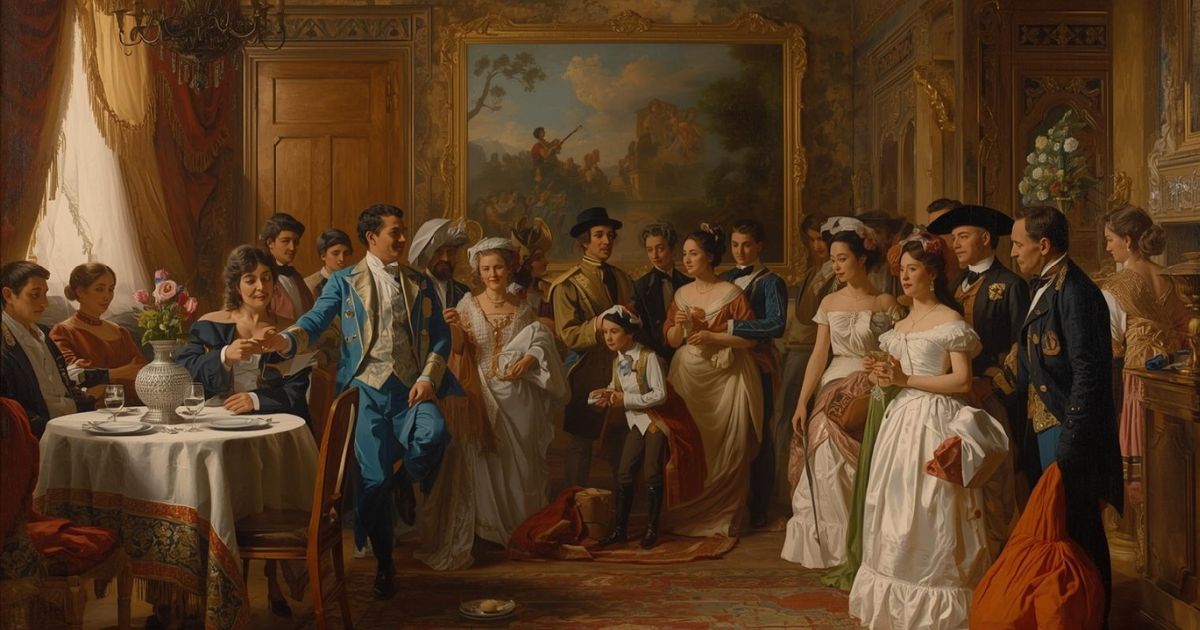
An excerpt from the original text.(complete · 2755 words)
ight and Might
Ten o'clock at night: the last rockets rose lazily in the dark sky
where a few paper balloons recently inflated with smoke and hot air
still glimmered like new stars. Some of those adorned with fireworks
took fire, threatening all the houses, so there might be seen on the
ridges of the roofs men armed with pails of water and long poles with
pieces of cloth on the ends. Their black silhouettes stood out in
the vague clearness of the air like phantoms that had descended from
space to witness the rejoicings of men. Many pieces of fireworks of
fantastic shapes--wheels, castles, bulls, carabaos--had been set off,
surpassing in beauty and grandeur anything ever before seen by the
inhabitants of San Diego.
Now the people were moving in crowds toward the plaza to attend the
theater for the last time, Here and there might be seen Bengal lights
fantastically illuminating the merry groups while the boys were
availing themselves of torches to hunt in the grass for unexploded
bombs and other remnants that could still be used. But soon the music
gave the signal and all abandoned the open places.
The great stage was brilliantly illuminated. Thousands of lights
surrounded the posts, hung from the roof, or sowed the floor with
pyramidal clusters. An alguazil was looking after these, and when he
came forward to attend to them the crowd shouted at him and whistled,
"There he is! there he is!"
In front of the curtain the orchestra players were tuning their
instruments and playing preludes of airs. Behind them was the space
spoken of by the correspondent in his letter, where the leading
citizens of the town, the Spaniards, and the rich visitors occupied
rows of chairs. The general public, the nameless rabble, filled
up the rest of the place, some of them bringing benches on their
shoulders not so much for seats as to make, up for their lack of
stature. This provoked noisy protests on the part of the benchless,
so the offenders got down at once; but before long they were up again
as if nothing had happened.
Goings and comings, cries, exclamations, bursts of laughter, a
serpent-cracker turned loose, a firecracker set off--all contributed
to swell the uproar. Here a bench had a leg broken off and the
people fell to the ground amid the laughter of the crowd. They were
visitors who had come from afar to observe and now found themselves
the observed. Over there they quarreled and disputed over a seat,
a little farther on was heard the noise of breaking glass; it
was Andeng carrying refreshments and drinks, holding the wide tray
carefully with both hands, but by chance she had met her sweetheart,
who tried to take advantage of the situation.
The teniente-mayor, Don Filipo, presided over the show, as the
gobernadorcillo was fond of monte. He was talking with old Tasio. "What
can I do? The alcalde was unwilling to accept my resignation. 'Don't
you feel strong enough to attend to your duties?' he asked me."
"How did you answer him?"
"'Señor Alcalde,' I answered, 'the strength of a teniente-mayor,
however insignificant it may be, is like all other authority it
emanates from higher spheres. The King himself receives his strength
from the people and the people theirs from God. That is exactly what
I lack, Señor Alcalde.' But he did not care to listen to me, telling
me that we would talk about it after the fiesta."
"Then may God help you!" said the old man, starting away.
"Don't you want to see the show?"
"Thanks, no! For dreams and nonsense I am sufficient unto myself," the
Sage answered with a sarcastic smile. "But now I think of it, has your
attention never been drawn to the character of our people? Peaceful,
yet fond of warlike shows and bloody fights; democratic, yet adoring
emperors, kings, and princes; irreligious, yet impoverishing itself
by costly religious pageants. Our women have gentle natures yet go
wild with joy when a princess flourishes a lance. Do you know to what
it is due? Well--"
The arrival of Maria Clara and her friends put an end to this
conversation. Don Filipo met them and ushered them to their
seats. Behind them came the curate with another Franciscan and some
Spaniards. Following the priests were a number of the townsmen who
make it their business to escort the friars. "May God reward them
also in the next life," muttered old Tasio as he went away.
The play began with Chananay and Marianito in Crispino é la
comare. All now had their eyes and ears turned to the stage, all but
one: Padre Salvi, who seemed to have gone there for no other purpose
than that of watching Maria Clara, whose sadness gave to her beauty an
air so ideal and interesting that it was easy to understand how she
might be looked upon with rapture. But the eyes of the Franciscan,
deeply hidden in their sunken sockets, spoke nothing of rapture. In
that gloomy gaze was to be read something desperately sad--with such
eyes Cain might have gazed from afar on the Paradise whose delights
his mother pictured to him!
The first scene was over when Ibarra entered. His appearance caused a
murmur, and attention was fixed on him and the curate. But the young
man seemed not to notice anything as he greeted Maria Clara and her
friends in a natural way and took a seat beside them.
The only one who spoke to him was Sinang. "Did you see the
fireworks?" she asked.
"No, little friend, I had to go with the Captain-General."
"Well, that's a shame! The curate was with us and told us stories
of the damned--can you imagine it!--to fill us with fear so that we
might not enjoy ourselves--can you imagine it!"
The curate arose and approached Don Filipo, with whom he began an
animated conversation. The former spoke in a nervous manner, the
latter in a low, measured voice.
"I'm sorry that I can't please your Reverence," said Don Filipo,
"but Señor Ibarra is one of the heaviest contributors and has a right
to be here as long as he doesn't disturb the peace."
"But isn't it disturbing the peace to scandalize good Christians? It's
letting a wolf enter the fold. You will answer for this to God and
the authorities!"
"I always answer for the actions that spring from my own will, Padre,"
replied Don Filipo with a slight bow. "But my little authority does not
empower me to mix in religious affairs. Those who wish to avoid contact
with him need not talk to him. Señor Ibarra forces himself on no one."
"But it's giving opportunity for danger, and he who loves danger
perishes in it."
"I don't see any danger, Padre. The alcalde and the Captain-General,
my superior officers, have been talking with him all the afternoon
and it's not for me to teach them a lesson."
"If you don't put him out of here, we'll leave."
"I'm very sorry, but I can't put any one out of here." The curate
repented of his threat, but it was too late to retract, so he made
a sign to his companion, who arose with regret, and the two went
out together. The persons attached to them followed their example,
casting looks of hatred at Ibarra.
The murmurs and whispers increased. A number of people approached
the young man and said to him, "We're with you, don't take any notice
of them."
"Whom do you mean by them?" Ibarra asked in surprise.
"Those who've just left to avoid contact with you."
"Left to avoid contact with me?"
"Yes, they say that you're excommunicated."
"Excommunicated?" The astonished youth did not know what to say. He
looked about him and saw that Maria Clara was hiding her face behind
her fan. "But is it possible?" he exclaimed finally. "Are we still
in the Dark Ages? So--"
He approached the young women and said with a change of tone, "Excuse
me, I've forgotten an engagement. I'll be back to see you home."
"Stay!" Sinang said to him. "Yeyeng is going to dance La
Calandria. She dances divinely."
"I can't, little friend, but I'll be back." The uproar increased.
Yeyeng appeared fancifully dressed, with the "Da usté su
permiso?" and Carvajal was answering her, "Pase usté adelante,"
when two soldiers of the Civil Guard went up to Don Filipo and ordered
him to stop the performance.
"Why?" asked the teniente-mayor in surprise.
"Because the alferez and his wife have been fighting and can't sleep."
"Tell the alferez that we have permission from the alcalde and that
against such permission no one in the town has any authority,
not even the gobernadorcillo himself, and he is my only superior."
"Well, the show must stop!" repeated the soldiers. Don Filipo turned
his back and they went away. In order not to disturb the merriment
he told no one about the incident.
After the selection of vaudeville, which was loudly applauded,
the Prince Villardo presented himself, challenging to mortal combat
the Moros who held his father prisoner. The hero threatened to cut
off all their heads at a single stroke and send them to the moon,
but fortunately for the Moros, who were disposing themselves for
the combat, a tumult arose. The orchestra suddenly ceased playing,
threw their instruments away, and jumped up on the stage. The valiant
Villardo, not expecting them and taking them for allies of the Moros,
dropped his sword and shield, and started to run. The Moros, seeing
that such a doughty Christian was fleeing, did not consider it improper
to imitate him. Cries, groans, prayers, oaths were heard, while the
people ran and pushed one another about. The lights were extinguished,
blazing lamps were thrown into the air. "Tulisanes! Tulisanes!" cried
some. "Fire, fire! Robbers!" shouted others. Women and children wept,
benches and spectators were rolled together on the ground amid the
general pandemonium.
The cause of all this uproar was two civil-guards, clubs in hand,
chasing the musicians in order to break up the performance. The
teniente-mayor, with the aid of the cuadrilleros, who were armed
with old sabers, managed at length to arrest them, in spite of their
resistance.
"Take them to the town hall!" cried Don Filipo. "Take care that they
don't get away!"
Ibarra had returned to look for Maria Clara. The frightened girls clung
to him pale and trembling while Aunt Isabel recited the Latin litany.
When the people were somewhat calmed down from their fright and had
learned the cause of the disturbance, they were beside themselves
with indignation. Stones rained on the squad of cuadrilleros who were
conducting the two offenders from the scene, and there were even those
who proposed to set fire to the barracks of the Civil Guard so as to
roast Doña Consolacion along with the alferez.
"That's what they're good for!" cried a woman, doubling up her fists
and stretching out her arms. "To disturb the town! They don't chase any
but honest folks! Out yonder are the tulisanes and the gamblers. Let's
set fire to the barracks!"
One man was beating himself on the arm and begging for
confession. Plaintive sounds issued from under the overturned
benches--it was a poor musician. The stage was crowded with actors
and spectators, all talking at the same time. There was Chananay
dressed as Leonor in Il Trovatore, talking in the language of the
markets to Ratia in the costume of a schoolmaster; Yeyeng, wrapped
in a silk shawl, was clinging to the Prince Villardo; while Balbino
and the Moros were exerting themselves to console the more or less
injured musicians. [112] Several Spaniards went from group to group
haranguing every one they met.
A large crowd was forming, whose intention Don Filipo seemed to be
aware of, for he ran to stop them. "Don't disturb the peace!" he
cried. "Tomorrow we'll ask for an accounting and we'll get
justice. I'll answer for it that we get justice!"
"No!" was the reply of several. "They did the same thing in Kalamba,
[113] the same promise was made, but the alcalde did nothing. We'll
take the law into our own hands! To the barracks!"
In vain the teniente-mayor pleaded with them. The crowd maintained its
hostile attitude, so he looked about him for help and noticed Ibarra.
"Señor Ibarra, as a favor! Restrain them while I get some
cuadrilleros."
"What can I do?" asked the perplexed youth, but the teniente-mayor was
already at a distance. He gazed about him seeking he knew not whom,
when accidentally he discerned Elias, who stood impassively watching
the disturbance.
Ibarra ran to him, caught him by the arm, and said to him in Spanish:
"For God's sake, do something, if you can! I can't do anything." The
pilot must have understood him, for he disappeared in the crowd. Lively
disputes and sharp exclamations were heard. Gradually the crowd began
to break up, its members each taking a less hostile attitude. It was
high time, indeed, for the soldiers were already rushing out armed
and with fixed bayonets.
Meanwhile, what had the curate been doing? Padre Salvi had not gone
to bed but had stood motionless, resting his forehead against the
curtains and gazing toward the plaza. From time to time a suppressed
sigh escaped him, and if the light of the lamp had not been so
dim, perhaps it would have been possible to see his eyes fill with
tears. Thus nearly an hour passed.
The tumult in the plaza awoke him from his reverie. With startled
eyes he saw the confused movements of the people, while their
voices came up to him faintly. A breathless servant informed him
of what was happening. A thought shot across his mind: in the midst
of confusion and tumult is the time when libertines take advantage
of the consternation and weakness of woman. Every one seeks to save
himself, no one thinks of any one else; a cry is not heard or heeded,
women faint, are struck and fall, terror and fright heed not shame,
under the cover of night--and when they are in love! He imagined
that he saw Crisostomo snatch the fainting Maria Clara up in his
arms and disappear into the darkness. So he went down the stairway by
leaps and bounds, and without hat or cane made for the plaza like a
madman. There he met some Spaniards who were reprimanding the soldiers,
but on looking toward the seats that the girls had occupied he saw
that they were vacant.
"Padre! Padre!" cried the Spaniards, but he paid no attention to
them as he ran in the direction of Capitan Tiago's. There he breathed
more freely, for he saw in the open hallway the adorable silhouette,
full of grace and soft in outline, of Maria Clara, and that of the
aunt carrying cups and glasses.
"Ah!" he murmured, "it seems that she has been taken sick only."
Aunt Isabel at that moment closed the windows and the graceful shadow
was no longer to be seen. The curate moved away without heeding the
crowd. He had before his eyes the beautiful form of a maiden sleeping
and breathing sweetly. Her eyelids were shaded by long lashes which
formed graceful curves like those of the Virgins of Raphael, the
little mouth was smiling, all the features breathed forth virginity,
purity, and innocence. That countenance formed a sweet vision in the
midst of the white coverings of her bed like the head of a cherub
among the clouds. His imagination went still further--but who can
write what a burning brain can imagine?
Perhaps only the newspaper correspondent, who concluded his account
of the fiesta and its accompanying incidents in the following manner:
"A thousand thanks, infinite thanks, to the opportune and active
intervention of the Very Reverend Padre Fray Bernardo Salvi, who,
defying every danger in the midst of the unbridled mob, without hat
or cane, calmed the wrath of the crowd, using only his persuasive
word with the majesty and authority that are never lacking to a
minister of a Religion of Peace. With unparalleled self-abnegation
this virtuous priest tore himself from sweet repose, such as every
good conscience like his enjoys, and rushed to protect his flock
from the least harm. The people of San Diego will hardly forget this
sublime deed of their heroic Pastor, remembering to hold themselves
grateful to him for all eternity!"
Master this chapter. Complete your experience
Purchase the complete book to access all chapters and support classic literature
As an Amazon Associate, we earn a small commission from qualifying purchases at no additional cost to you.
Available in paperback, hardcover, and e-book formats
Let's Analyse the Pattern
The Authority Overreach Pattern
When questioned, illegitimate authority escalates to force rather than admit error or follow proper procedures.
Why This Matters
Connect literature to life
This chapter teaches how to recognize when authority figures escalate conflicts to avoid admitting they're wrong.
Practice This Today
This week, notice when someone with power responds to reasonable questions with dramatic reactions—that's the pattern revealing itself.
Now let's explore the literary elements.
Key Quotes & Analysis
"He is a taxpayer and has not been disturbed by the alcalde"
Context: When Padre Salvi demands Ibarra's removal from the theater
Don Filipo asserts civil authority over religious authority, showing that even in colonial times, there were limits to Church power. He's standing up for proper procedure and individual rights.
In Today's Words:
He paid his dues and the real boss didn't say he couldn't be here.
"We have permission from the alcalde and we don't need any other"
Context: When civil guards try to shut down the performance
This shows the complexity of colonial authority - different Spanish officials often worked against each other. Don Filipo knows his legal ground and won't be intimidated by lower-ranking bullies.
In Today's Words:
We got approval from the person who actually has authority, so back off.
"Burn the barracks! Burn the barracks!"
Context: After the civil guards attack the peaceful celebration
The community's rage explodes when pushed too far. This shows how oppression builds until people reach a breaking point and want to destroy the symbols of their oppression.
In Today's Words:
We're done taking this - let's tear down everything that represents them.
Thematic Threads
Authority
In This Chapter
Both religious and civil authorities abuse power when challenged, using force instead of following proper procedures
Development
Evolved from earlier subtle corruption to open violence and intimidation
In Your Life:
You might face this when questioning unsafe work conditions or challenging unfair treatment from supervisors.
Community
In This Chapter
The townspeople unite against authority overreach, with some wanting to burn the guard barracks in retaliation
Development
Community solidarity strengthens as external pressure increases
In Your Life:
You might find unexpected allies when standing up to workplace bullying or neighborhood problems.
Class
In This Chapter
Don Filipo uses his position and knowledge of proper procedures to resist both priest and guards
Development
Class tensions now involve open confrontation rather than subtle maneuvering
In Your Life:
You might need to learn proper procedures and your rights to effectively challenge authority figures.
Identity
In This Chapter
Ibarra finds himself caught between worlds, needing Elias's help to navigate the growing hostility
Development
Ibarra's isolation increases as he becomes more dependent on unlikely allies
In Your Life:
You might find yourself needing help from unexpected sources when your usual support systems fail.
Obsession
In This Chapter
Padre Salvi's dangerous fixation on Maria Clara drives him to rush toward danger when he fears for her safety
Development
The priest's obsession becomes more reckless and potentially dangerous
In Your Life:
You might recognize unhealthy fixations in yourself or others that lead to poor decision-making.
You now have the context. Time to form your own thoughts.
Discussion Questions
- 1
What specific actions did Padre Salvi and the civil guards take when Don Filipo refused their demands, and how did the community respond?
analysis • surface - 2
Why do you think both the priest and the guards chose to escalate with force rather than admit they might be wrong or follow proper procedures?
analysis • medium - 3
Where have you seen this same pattern of authority figures doubling down with aggression when their power is questioned, rather than backing down or explaining themselves?
application • medium - 4
If you were in Don Filipo's position, facing pressure from both religious and civil authority, what specific steps would you take to protect yourself while standing your ground?
application • deep - 5
What does this chapter reveal about how people in power maintain control, and why some authority figures fear being questioned more than being wrong?
reflection • deep
Critical Thinking Exercise
Document the Escalation Pattern
Think of a recent situation where someone in authority escalated a conflict instead of addressing your legitimate concern. Map out the sequence: what was your original request, how did they respond, what happened when you persisted, and how it finally resolved. Then identify what you could have done differently knowing this escalation pattern.
Consider:
- •Authority figures often escalate because admitting error feels like losing face
- •Having witnesses and documentation changes the dynamic significantly
- •Building alliances before confrontation gives you more leverage than fighting alone
Journaling Prompt
Write about a time when you backed down from a legitimate position because someone in authority got aggressive. What would you do differently now, and what support system would you need to stand your ground safely?
Coming Up Next...
Chapter 41: Two Visitors with Different Motives
The aftermath of the fiesta chaos brings unexpected visitors to key players in the drama. These meetings will reveal hidden agendas and set the stage for the conflicts to come.



