
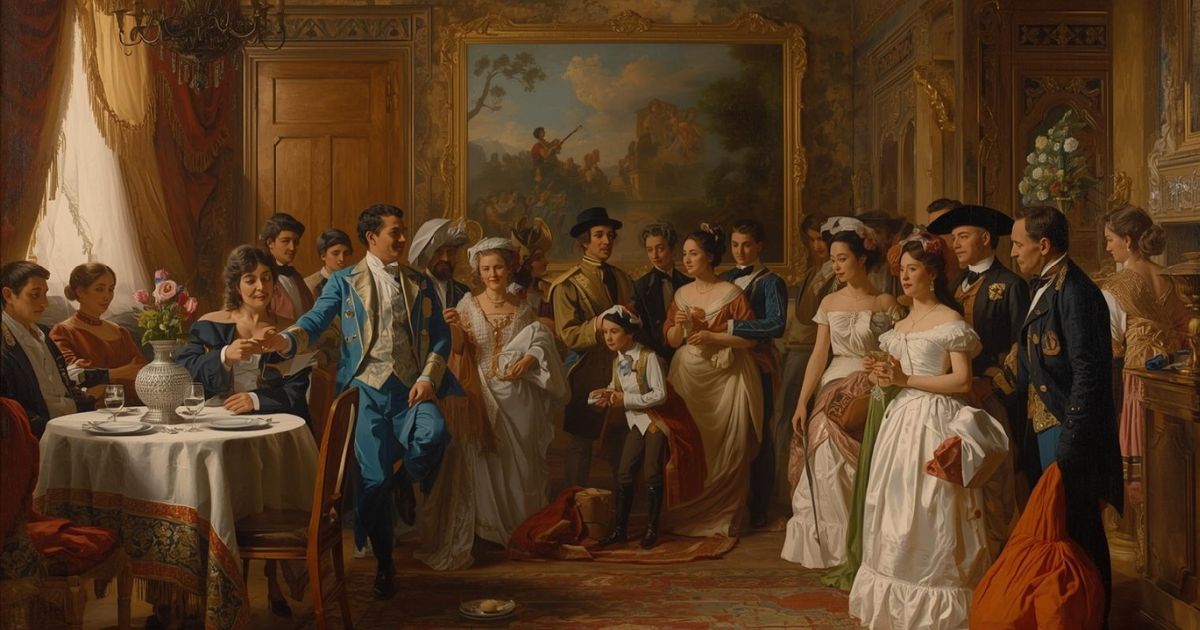
An excerpt from the original text.(complete · 2839 words)
is Excellency
"I Want to talk with that young man," said his Excellency to an
aide. "He has aroused all my interest."
"They have already gone to look for him, General. But here is a young
man from Manila who insists on being introduced. We told him that
your Excellency had no time for interviews, that you had not come
to give audiences, but to see the town and the procession, and he
answered that your Excellency always has time to dispense justice--"
His Excellency turned to the alcalde in wonder. "If I am not mistaken,"
said the latter with a slight bow, "he is the young man who this
morning had a quarrel with Padre Damaso over the sermon."
"Still another? Has this friar set himself to stir up the whole
province or does he think that he governs here? Show the young man
in." His Excellency paced nervously from one end of the sala to
the other.
In the hall were gathered various Spaniards mingled with soldiers
and officials of San Diego and neighboring towns, standing in groups
conversing or disputing. There were also to be seen all the friars,
with the exception of Padre Damaso, and they wanted to go in to pay
their respects to his Excellency.
"His Excellency the Captain-General begs your Reverences to wait a
moment," said the aide. "Come in, young man!" The Manilan who had
confounded Greek with Tagalog entered the room pale and trembling.
All were filled with surprise; surely his Excellency must be greatly
irritated to dare to make the friars wait! Padre Sibyla remarked,
"I haven't anything to say to him, I'm wasting my time here."
"I say the same," added an Augustinian. "Shall we go?"
"Wouldn't it be better that we find out how he stands?" asked Padre
Salvi. "We should avoid a scandal, and should be able to remind him
of his duties toward--religion."
"Your Reverences may enter, if you so desire," said the aide as
he ushered out the youth who did not understand Greek and whose
countenance was now beaming with satisfaction.
Fray Sibyla entered first, Padre Salvi, Padre Martin, and the other
priests following. They all made respectful bows with the exception
of Padre Sibyla, who even in bending preserved a certain air of
superiority. Padre Salvi on the other hand almost doubled himself
over the girdle.
"Which of your Reverences is Padre Damaso?" asked the Captain-General
without any preliminary greeting, neither asking them to be seated nor
inquiring about their health nor addressing them with the flattering
speeches to which such important personages are accustomed.
"Padre Damaso is not here among us, sir," replied Fray Sibyla in the
same dry tone as that used by his Excellency.
"Your Excellency's servant is in bed sick," added Padre Salvi
humbly. "After having the pleasure of welcoming you and of informing
ourselves concerning your Excellency's health, as is the duty of all
good subjects of the King and of every person of culture, we have
come in the name of the respected servant of your Excellency who has
had the misfortune--"
"Oh!" interrupted the Captain-General, twirling a chair about on one
leg and smiling nervously, "if all the servants of my Excellency were
like his Reverence, Padre Damaso, I should prefer myself to serve
my Excellency!"
The reverend gentlemen, who were standing up physically, did so
mentally at this interruption.
"Won't your Reverences be seated?" he added after a brief pause,
moderating his tone a little.
Capitan Tiago here appeared in full dress, walking on tiptoe and
leading by the hand Maria Clara, who entered timidly and with
hesitation. Still she bowed gracefully and ceremoniously.
"Is this young lady your daughter?" asked the Captain-General in
surprise.
"And your Excellency's, General," answered Capitan Tiago
seriously. [103]
The alcalde and the aides opened their eyes wide, but his Excellency
lost none of his gravity as he took the girl's hand and said affably,
"Happy are the fathers who have daughters like you, señorita! I have
heard you spoken of with respect and admiration and have wanted to
see you and thank you for your beautiful action of this afternoon. I
am informed of everything and when I make my report to his Majesty's
government I shall not forget your noble conduct. Meanwhile, permit me
to thank you in the name of his Majesty, the King, whom I represent
here and who loves peace and tranquillity in his loyal subjects,
and for myself, a father who has daughters of your age, and to propose
a reward for you."
"Sir--" answered the trembling Maria Clara.
His Excellency guessed what she wanted to say, and so continued:
"It is well, señorita, that you are at peace with your conscience and
content with the good opinion of your fellow-countrymen, with the
faith which is its own best reward and beyond which we should not
aspire. But you must not deprive me of an opportunity to show that
if Justice knows how to punish she also knows how to reward and that
she is not always blind!" The italicized words were all spoken in
a loud and significant tone.
"Señor Don Juan Crisostomo Ibarra awaits the orders of your
Excellency!" announced the aide in a loud voice.
Maria Clara shuddered.
"Ah!" exclaimed the Captain-General. "Allow me, señorita, to express
my desire to see you again before leaving the town, as I still have
some very important things to say to you. Señor Alcalde, you will
accompany me during the walk which I wish to take after the conference
that I will hold alone with Señor Ibarra."
"Your Excellency will permit us to inform you," began Padre Salvi
humbly, "that Señor Ibarra is excommunicated."
His Excellency cut short this speech, saying, "I am happy that I have
only to regret the condition of Padre Damaso, for whom I sincerely
desire a complete recovery, since at his age a voyage to Spain
on account of his health may not be very agreeable. But that depends
on him! Meanwhile, may God preserve the health of your Reverences!"
"And so much depends on him," murmured Padre Salvi as they
retired. "We'll see who makes that voyage soonest!" remarked another
Franciscan.
"I shall leave at once," declared the indignant Padre Sibyla.
"And we shall go back to our province," said the Augustinians. Neither
the Dominican nor the Augustinians could endure the thought that they
had been so coldly received on a Franciscan's account.
In the hall they met Ibarra, their amphitryon of a few hours before,
but no greetings were exchanged, only looks that said many things. But
when the friars had withdrawn the alcalde greeted him familiarly,
although the entrance of the aide looking for the young man left
no time for conversation. In the doorway he met Maria Clara; their
looks also said many things but quite different from what the friars'
eyes had expressed.
Ibarra was dressed in deep mourning, but presented himself serenely
and made a profound bow, even though the visit of the friars had not
appeared to him to be a good augury. The Captain-General advanced
toward him several steps.
"I take pleasure, Señor Ibarra, in shaking your hand. Permit me to
receive you in all confidence." His Excellency examined the youth
with marked satisfaction.
"Sir, such kindness--"
"Your surprise offends me, signifying as it does that you had not
expected to be well received. That is casting a doubt on my sense
of justice!"
"A cordial reception, sir, for an insignificant subject of his Majesty
like myself is not justice but a favor."
"Good, good," exclaimed his Excellency, seating himself and waving
Ibarra to a chair. "Let us enjoy a brief period of frankness. I am
very well satisfied with your conduct and have already recommended
you to his Majesty for a decoration on account of your philanthropic
idea of erecting a schoolhouse. If you had let me know, I would have
attended the ceremony with pleasure, and perhaps might have prevented
a disagreeable incident."
"It seemed to me such a small matter," answered the youth, "that I
did not think it worth while troubling your Excellency with it in the
midst of your numerous cares. Besides, my duty was to apply first to
the chief authority of my province."
His Excellency nodded with a satisfied air and went on in an even more
familiar tone: "In regard to the trouble you're had with Padre Damaso,
don't hold any fear or rancor, for they won't touch a hair of your head
while I govern the islands. As for the excommunication, I'll speak
to the Archbishop, since it is necessary for us to adjust ourselves
to circumstances. Here we can't laugh at such things in public as we
can in the Peninsula and in enlightened Europe. Nevertheless, be more
prudent in the future. You have placed yourself in opposition to the
religious orders, who must be respected on account of their influence
and their wealth. But I will protect you, for I like good sons,
I like to see them honor the memory of their fathers. I loved mine,
and, as God lives, I don't know what I would have done in your place!"
Then, changing the subject of conversation quickly, he asked, "I'm
told that you have just returned from Europe; were you in Madrid?"
"Yes, sir, several months."
"Perhaps you heard my family spoken of?"
"Your Excellency had just left when I had the honor of being introduced
to your family."
"How is it, then, that you came without bringing any recommendations
to me?"
"Sir," replied Ibarra with a bow, "because I did not come direct from
Spain and because I have heard your Excellency so well spoken of that
I thought a letter of recommendation might not only be valueless but
even offensive; all Filipinos are recommended to you."
A smile played about the old soldier's lips and he replied slowly, as
though measuring and weighing his words, "You flatter me by thinking
so, and--so it ought to be. Nevertheless, young man, you must know
what burdens weigh upon our shoulders here in the Philippines. Here
we, old soldiers, have to do and to be everything: King, Minister of
State, of War, of Justice, of Finance, of Agriculture, and of all
the rest. The worst part of it too is that in every matter we have
to consult the distant mother country, which accepts or rejects our
proposals according to circumstances there--and at times blindly. As we
Spaniards say, 'He who attempts many things succeeds in none.' Besides,
we generally come here knowing little about the country and leave
it when we begin to get acquainted with it. With you I can be frank,
for it would be useless to try to be otherwise. Even in Spain, where
each department has its own minister, born and reared in the locality,
where there are a press and a public opinion, where the opposition
frankly opens the eyes of the government and keeps it informed,
everything moves along imperfectly and defectively; thus it is a
miracle that here things are not completely topsyturvy in the lack
of these safeguards, and having to live and work under the shadow
of a most powerful opposition. Good intentions are not lacking to
us, the governing powers, but we find ourselves obliged to avail
ourselves of the eyes and arms of others whom ordinarily we do not
know and who perhaps, instead of serving their country, serve only
their own private interests. This is not our fault but the fault
of circumstances--the friars aid us not a little in getting along,
but they are not sufficient. You have aroused my interest and it is
my desire that the imperfections of our present system of government
be of no hindrance to you. I cannot look after everybody nor can
everybody come to me. Can I be of service to you in any way? Have
you no request to make?"
Ibarra reflected a moment before he answered. "Sir, my dearest wish
is the happiness of my country, a happiness which I desire to see
owed to the mother country and to the efforts of my fellow-citizens,
the two united by the eternal bonds of common aspirations and common
interests. What I would request can only be given by the government
after years of unceasing toil and after the introduction of definite
reforms."
His Excellency gazed at him for a few seconds with a searching look,
which Ibarra sustained with naturalness. "You are the first man that
I've talked to in this country!" he finally exclaimed, extending
his hand.
"Your Excellency has seen only those who drag themselves about in the
city; you have not visited the slandered huts of our towns or your
Excellency would have been able to see real men, if to be a man it
is sufficient to have a generous heart and simple customs."
The Captain-General rose and began to walk back and forth in the
room. "Señor Ibarra," he exclaimed, pausing suddenly, and the young man
also rose, "perhaps within a month I shall leave. Your education and
your mode of thinking are not for this country. Sell what you have,
pack your trunk, and come with me to Europe; the climate there will
be more agreeable to you."
"I shall always while I live preserve the memory of your Excellency's
kindness," replied Ibarra with emotion, "but I must remain in this
country where my fathers have lived."
"Where they have died you might say with more exactness! Believe
me, perhaps I know your country better than you yourself do. Ah,
now I remember," he exclaimed with a change of tone, "you are going
to marry an adorable young woman and I'm detaining you here! Go, go
to her, and that you may have greater freedom send her father to me,"
this with a smile. "Don't forget, though, that I want you to accompany
me in my walk."
Ibarra bowed and withdrew. His Excellency then called to his
aide. "I'm satisfied," he said, slapping the latter lightly on the
shoulder. "Today I've seen for the first time how it is possible for
one to be a good Spaniard without ceasing to be a good Filipino and
to love his country. Today I showed their Reverences that we are not
all puppets of theirs. This young man gave me the opportunity and I
shall soon have settled all my accounts with the friars. It's a pity
that some day or other this young man--But call the alcalde."
The alcalde presented himself immediately. As he entered, the
Captain-General said to him, "Señor Alcalde, in order to avoid any
repetition of scenes such as you witnessed this afternoon, scenes
that I regret, as they hurt the prestige of the government and of
all good Spaniards, allow me to recommend to your especial care
Señor Ibarra, so that you may afford him means for carrying out his
patriotic intentions and also that in the future you prevent his being
molested by persons of any class whatsoever, under any pretext at all."
The alcalde understood the reprimand and bowed to conceal his
confusion.
"Have the same order communicated to the alferez who commands in the
district here. Also, investigate whether that gentleman has affairs
of his own that are not sanctioned by the regulations. I've heard
more than one complaint in regard to that."
Capitan Tiago presented himself stiff and formal. "Don Santiago," said
his Excellency in an affable tone, "a little while ago I felicitated
you on the happiness of having a daughter such as the Señorita de los
Santos; now let me congratulate you on your future son-in-law. The
most virtuous of daughters is certainly worthy of the best citizen of
the Philippines. Is it permitted to know when the wedding will occur?"
"Sir!" stammered Capitan Tiago, wiping the perspiration from his
forehead.
"Come now, I see that there is nothing definitely arranged. If persons
are lacking to stand up with them, I shall take the greatest pleasure
in being one of them. That's for the purpose of ridding myself of the
feeling of disgust which the many weddings I've heretofore taken part
in have given me," he added, turning to the alcalde.
"Yes, sir," answered Capitan Tiago with a smile that would move
to pity.
Ibarra almost ran in search of Maria Clara--he had so many things
to tell her. Hearing merry voices in one of the rooms, he knocked
lightly on the door.
"Who's there?" asked the voice of Maria Clara.
"I!"
The voices became hushed and the door--did not open.
"It's I, may I come in?" called the young man, his heart beating
violently.
The silence continued. Then light footsteps approached the door and the
merry voice of Sinang murmured through the keyhole, "Crisostomo, we're
going to the theater tonight. Write what you have to say to Maria."
The footsteps retreated again as rapidly as they approached.
"What does this mean?" murmured Ibarra thoughtfully as he retired
slowly from the door.
Master this chapter. Complete your experience
Purchase the complete book to access all chapters and support classic literature
As an Amazon Associate, we earn a small commission from qualifying purchases at no additional cost to you.
Available in paperback, hardcover, and e-book formats
Let's Analyse the Pattern
The Power Vacuum Opportunity
When authorities clash, principled individuals can find unexpected protection by becoming useful symbols in larger power struggles.
Why This Matters
Connect literature to life
This chapter teaches how to recognize when institutional conflicts create unexpected opportunities for those caught in the middle.
Practice This Today
This week, notice when different levels of authority clash at your workplace—these moments often create openings for principled voices to gain influence.
Now let's explore the literary elements.
Key Quotes & Analysis
"Has this friar set himself to stir up the whole province or does he think that he governs here?"
Context: When learning about Padre Damaso's multiple conflicts with locals
This reveals the Captain-General's frustration with friars overstepping their religious role into civil governance. It shows that even the highest Spanish authority recognizes the priests have gone too far in their abuse of power.
In Today's Words:
Is this priest trying to cause trouble everywhere, or does he think he runs this place?
"Your Excellency always has time to dispense justice"
Context: When insisting on an audience despite being told the Captain-General was too busy
This shows how people appeal to authority figures by invoking their duty to fairness. It's a clever way to get attention by making it about the leader's reputation for justice rather than personal need.
In Today's Words:
You always make time to do what's right
"I want to talk with that young man. He has aroused all my interest."
Context: After hearing about Ibarra's confrontation with Padre Damaso
This demonstrates how standing up to corrupt authority can sometimes catch the attention of higher powers in a positive way. The Captain-General is intrigued by someone willing to challenge the friars' authority.
In Today's Words:
I need to meet this guy - he's got my attention
Thematic Threads
Power
In This Chapter
The Captain-General uses his authority to humble the friars and elevate Ibarra as a demonstration of who really controls the Philippines
Development
Evolved from showing religious power dominating social life to revealing how secular authority can challenge church influence
In Your Life:
You might see this when upper management uses your situation to send messages to middle management about who's really in charge
Identity
In This Chapter
Ibarra chooses to stay in the Philippines despite offers of European opportunities, defining himself through his homeland commitment
Development
Continued from earlier chapters where Ibarra struggled between European education and Filipino roots
In Your Life:
You face this when opportunities require you to choose between advancement and staying true to your community or values
Class
In This Chapter
The Captain-General recognizes Ibarra as an exceptional Filipino worthy of protection, but this very exceptionalism reinforces class divisions
Development
Building on themes of how education and wealth create different treatment within the same racial category
In Your Life:
You might experience this when you're treated as 'one of the good ones' in ways that separate you from your background
Relationships
In This Chapter
Maria Clara's refusal to see Ibarra shows how political conflicts damage personal connections, even when you're winning publicly
Development
Introduced here as a new complication to their previously smooth courtship
In Your Life:
You see this when standing up for principles at work creates tension with friends or family who want you to 'just go along'
Social Expectations
In This Chapter
The friars expect automatic deference from the Captain-General but are shocked to find their influence has limits
Development
Continued from earlier scenes showing how entrenched power assumes its own permanence
In Your Life:
You encounter this when people who usually get their way can't believe you're not following their usual script
You now have the context. Time to form your own thoughts.
Discussion Questions
- 1
Why does the Captain-General keep the friars waiting while he meets with Ibarra first?
analysis • surface - 2
What makes Ibarra valuable to the Captain-General in his power struggle with the church?
analysis • medium - 3
Where do you see this pattern today - someone caught between feuding authorities finding unexpected protection?
application • medium - 4
If you were in Ibarra's position, how would you balance accepting the Captain-General's protection while maintaining your principles?
application • deep - 5
What does Maria Clara's refusal to see Ibarra reveal about the personal costs of taking principled stands?
reflection • deep
Critical Thinking Exercise
Map Your Power Network
Think of a current situation where you're caught between conflicting authorities - maybe management versus union, family members in conflict, or competing department heads. Draw a simple map showing who has what kind of power and where the tensions lie. Then identify where you might find unexpected allies or protection.
Consider:
- •Look for authorities who benefit from your principled stance
- •Consider what kind of example you represent to each side
- •Remember that protection often comes with expectations or trade-offs
Journaling Prompt
Write about a time when you found unexpected support during a conflict. What made that person willing to help you, and what did you learn about navigating institutional politics?
Coming Up Next...
Chapter 38: The Sacred and the Absurd
The town prepares for its grand religious procession, but beneath the pageantry, tensions simmer as various factions position themselves for what's to come. Ibarra must navigate the public celebration while trying to understand Maria Clara's sudden distance.



