
An excerpt from the original text.(complete · 3347 words)
he Dinner
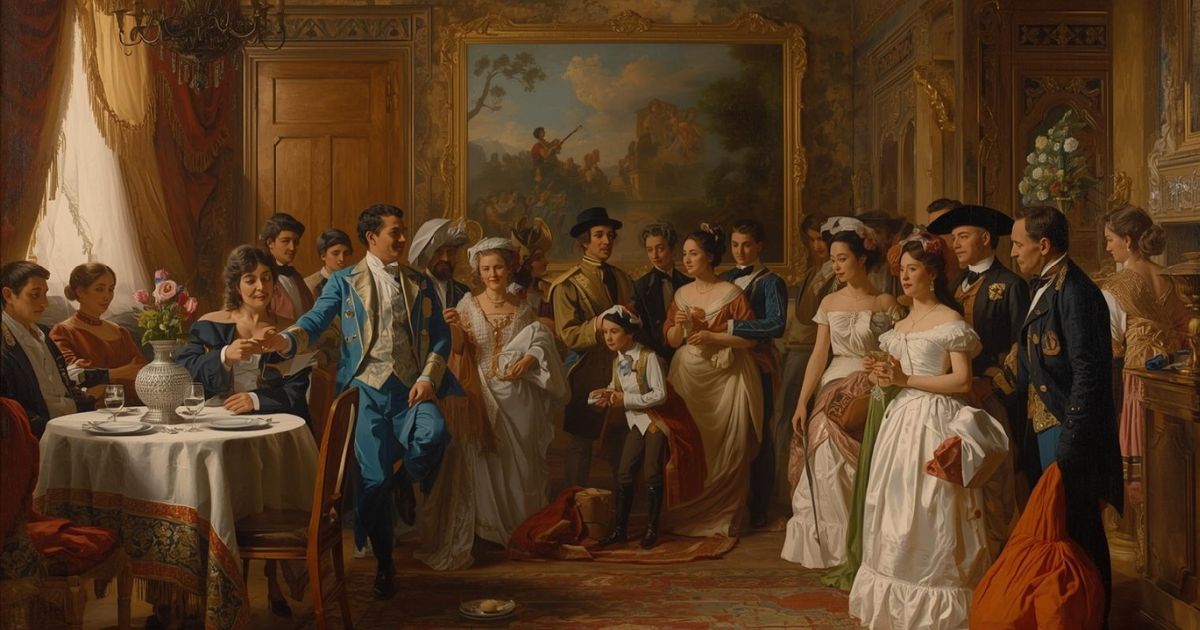
There in the decorated kiosk the great men of the province were
dining. The alcalde occupied one end of the table and Ibarra the
other. At the young man's right sat Maria Clara and at his left
the escribano. Capitan Tiago, the alferez, the gobernadorcillo, the
friars, the employees, and the few young ladies who had remained sat,
not according to rank, but according to their inclinations. The meal
was quite animated and happy.
When the dinner was half over, a messenger came in search of Capitan
Tiago with a telegram, to open which he naturally requested the
permission of the others, who very naturally begged him to do so. The
worthy capitan at first knitted his eyebrows, then raised them;
his face became pale, then lighted up as he hastily folded the paper
and arose.
"Gentlemen," he announced in confusion, "his Excellency the
Captain-General is coming this evening to honor my house." Thereupon he
set off at a run, hatless, taking with him the message and his napkin.
He was followed by exclamations and questions, for a cry of
"Tulisanes!" would not have produced greater effect. "But,
listen!" "When is he coming?" "Tell us about it!" "His Excellency!" But
Capitan Tiago was already far away.
"His Excellency is coming and will stay at Capitan Tiago's!" exclaimed
some without taking into consideration the fact that his daughter
and future son-in-law were present.
"The choice couldn't be better," answered the latter.
The friars gazed at one another with looks that seemed to say: "The
Captain-General is playing another one of his tricks, he is slighting
us, for he ought to stay at the convento," but since this was the
thought of all they remained silent, none of them giving expression
to it.
"I was told of this yesterday," said the alcalde, "but at that time
his Excellency had not yet fully decided."
"Do you know, Señor Alcalde, how long the Captain-General thinks of
staying here?" asked the alferez uneasily.
"With certainty, no. His Excellency likes to give surprises."
"Here come some more messages." These were for the alcalde,
the alferez, and the gobernadorcillo, and contained the same
announcement. The friars noted well that none came directed to
the curate.
"His Excellency will arrive at four this afternoon,
gentlemen!" announced the alcalde solemnly. "So we can finish our meal
in peace." Leonidas at Thermopylae could not have said more cheerfully,
"Tonight we shall sup with Pluto!"
The conversation again resumed its ordinary course.
"I note the absence of our great preacher," timidly remarked an
employee of inoffensive aspect who had not opened his mouth up to
the time of eating, and who spoke now for the first time in the
whole morning.
All who knew the history of Crisostomo's father made a movement and
winked, as if to say, "Get out! Fools rush in--" But some one more
charitably disposed answered, "He must be rather tired."
"Rather?" exclaimed the alferez. "He must be exhausted, and as they
say here, all fagged out. What a sermon it was!"
"A splendid sermon--wonderful!" said the escribano.
"Magnificent--profound!" added the correspondent.
"To be able to talk so much, it's necessary to have the lungs that he
has," observed Padre Manuel Martin. The Augustinian did not concede
him anything more than lungs.
"And his fertility of expression!" added Padre Salvi.
"Do you know that Señor Ibarra has the best cook in the
province?" remarked the alcalde, to cut short such talk.
"You may well say that, but his beautiful neighbor doesn't wish to
honor the table, for she is scarcely eating a bite," observed one of
the employees.
Maria Clara blushed. "I thank the gentleman, he troubles himself too
much on my account," she stammered timidly, "but--"
"But you honor it enough merely by being present," concluded the
gallant alcalde as he turned to Padre Salvi.
"Padre," he said in a loud voice, "I've observed that during the
whole day your Reverence has been silent and thoughtful."
"The alcalde is a great observer," remarked Fray Sibyla in a meaning
tone.
"It's a habit of mine," stammered the Franciscan. "It pleases me more
to listen than to talk."
"Your Reverence always takes care to win and not to lose," said the
alferez in a jesting tone.
Padre Salvi, however, did not take this as a joke, for his gaze
brightened a moment as he replied, "The alferez knows very well these
days that I'm not the one who is winning or losing most."
The alferez turned the hit aside with a forced laugh, pretending not
to take it to himself.
"But, gentlemen, I don't understand how it is possible to talk
of winnings and losses," interposed the alcalde. "What will these
amiable and discreet young ladies who honor us with their company
think of us? For me the young women are like the Æolian harps in the
middle of the night--it is necessary to listen with close attention
in order that their ineffable harmonies may elevate the soul to the
celestial spheres of the infinite and the ideal!"
"Your Honor is becoming poetical!" exclaimed the escribano gleefully,
and both emptied their wine-glasses.
"I can't help it," said the alcalde as he wiped his lips. "Opportunity,
while it doesn't always make the thief, makes the poet. In my youth
I composed verses which were really not bad."
"So your Excellency has been unfaithful to the Muses to follow Themis,"
emphatically declared our mythical or mythological correspondent.
"Pshaw, what would you have? To run through the entire social scale
was always my dream. Yesterday I was gathering flowers and singing
songs, today I wield the rod of justice and serve Humanity, tomorrow--"
"Tomorrow your Honor will throw the rod into the fire to warm yourself
by it in the winter of life, and take an appointment in the cabinet,"
added Padre Sibyla.
"Pshaw! Yes--no--to be a cabinet official isn't exactly my beau-ideal:
any upstart may become one. A villa in the North in which to spend the
summer, a mansion in Madrid, and some property in Andalusia for the
winter--there we shall live remembering our beloved Philippines. Of
me Voltaire would not say, 'We have lived among these people only to
enrich ourselves and to calumniate them.'"
The alcalde quoted this in French, so the employees, thinking that
his Honor had cracked a joke, began to laugh in appreciation of
it. Some of the friars did likewise, since they did not know that
the Voltaire mentioned was the same Voltaire whom they had so often
cursed and consigned to hell. But Padre Sibyla was aware of it and
became serious from the belief that the alcalde had said something
heretical or impious.
In the other kiosk the children were eating under the direction of
their teacher. For Filipino children they were rather noisy, since
at the table and in the presence of other persons their sins are
generally more of omission than of commission. Perhaps one who was
using the tableware improperly would be corrected by his neighbor
and from this there would arise a noisy discussion in which each
would have his partisans. Some would say the spoon, others the knife
or the fork, and as no one was considered an authority there would
arise the contention that God is Christ or, more clearly, a dispute
of theologians. Their fathers and mothers winked, made signs, nudged
one another, and showed their happiness by their smiles.
"Ya!" exclaimed a countrywoman to an old man who was mashing buyo in
his kalikut, "in spite of the fact that my husband is opposed to it,
my Andoy shall be a priest. It's true that we're poor, but we'll work,
and if necessary we'll beg alms. There are not lacking those who will
give money so that the poor may take holy orders. Does not Brother
Mateo, a man who does not lie, say that Pope Sextus was a herder of
carabaos in Batangas? Well then, look at my Andoy, see if he hasn't
already the face of a St. Vincent!" The good mother watered at the
mouth to see her son take hold of a fork with both hands.
"God help us!" added the old man, rolling his quid of buyo. "If
Andoy gets to be Pope we'll go to Rome he, he! I can still walk well,
and if I die--he, he!"
"Don't worry, granddad! Andoy won't forget that you taught him how
to weave baskets."
"You're right, Petra. I also believe that your son will be great, at
least a patriarch. I have never seen any one who learned the business
in a shorter time. Yes, he'll remember me when as Pope or bishop he
entertains himself in making baskets for his cook. He'll then say
masses for my soul--he, he!" With this hope the good old man again
filled his kalikut with buyo.
"If God hears my prayers and my hopes are fulfilled, I'll say to Andoy,
'Son, take away all our sins and send us to Heaven!' Then we shan't
need to pray and fast and buy indulgences. One whose son is a blessed
Pope can commit sins!"
"Send him to my house tomorrow, Petra," cried the old man
enthusiastically, "and I'll teach him to weave the nito!"
"Huh! Get out! What are you dreaming about, grand-dad? Do you still
think that the Popes even move their hands? The curate, being nothing
more than a curate, only works in the mass--when he turns around! The
Archbishop doesn't even turn around, for he says mass sitting down. So
the Pope--the Pope says it in bed with a fan! What are you thinking
about?"
"Of nothing more, Petra, than that he know how to weave the nito. It
would be well for him to be able to sell hats and cigar-cases so that
he wouldn't have to beg alms, as the curate does here every year in
the name of the Pope. It always fills me with compassion to see a
saint poor, so I give all my savings."
Another countryman here joined in the conversation, saying, "It's all
settled, cumare, [95] my son has got to be a doctor, there's nothing
like being a doctor!"
"Doctor! What are you talking about, cumpare?" retorted Petra. "There's
nothing like being a curate!"
"A curate, pish! A curate? The doctor makes lots of money, the sick
people worship him, cumare!"
"Excuse me! The curate, by making three or four turns and saying
deminos pabiscum, [96] eats God and makes money. All, even the women,
tell him their secrets."
"And the doctor? What do you think a doctor is? The doctor sees all
that the women have, he feels the pulses of the dalagas! I'd just
like to be a doctor for a week!"
"And the curate, perhaps the curate doesn't see what your doctor
sees? Better still, you know the saying, 'the fattest chicken and
the roundest leg for the curate!'"
"What of that? Do the doctors eat dried fish? Do they soil their
fingers eating salt?"
"Does the curate dirty his hands as your doctors do? He has great
estates and when he works he works with music and has sacristans to
help him."
"But the confessing, cumare? Isn't that work?"
"No work about that! I'd just like to be confessing everybody! While
we work and sweat to find out what our own neighbors are doing,
the curate does nothing more than take a seat and they tell him
everything. Sometimes he falls asleep, but he lets out two or three
blessings and we are again the children of God! I'd just like to be
a curate for one evening in Lent!"
"But the preaching? You can't tell me that it's not work. Just look
how the fat curate was sweating this morning," objected the rustic,
who felt himself being beaten into retreat.
"Preaching! Work to preach! Where's your judgment? I'd just like to
be talking half a day from the pulpit, scolding and quarreling with
everybody, without any one daring to reply, and be getting paid for
it besides. I'd just like to be the curate for one morning when those
who are in debt to me are attending mass! Look there now, how Padre
Damaso gets fat with so much scolding and beating."
Padre Damaso was, indeed, approaching with the gait of a heavy
man. He was half smiling, but in such a malignant way that Ibarra,
upon seeing him, lost the thread of his talk. The padre was greeted
with some surprise but with signs of pleasure on the part of all
except Ibarra. They were then at the dessert and the champagne was
foaming in the glasses.
Padre Damaso's smile became nervous when he saw Maria Clara seated
at Crisostomo's right. He took a seat beside the alcalde and said in
the midst of a significant silence, "Were you discussing something,
gentlemen? Go ahead!"
"We were at the toasts," answered the alcalde. "Señor Ibarra was
mentioning all who have helped him in his philanthropic enterprise
and was speaking of the architect when your Reverence--"
"Well, I don't know anything about architecture," interrupted Padre
Damaso, "but I laugh at architects and the fools who employ them. Here
you have it--I drew the plan of this church and it's perfectly
constructed, so an English jeweler who stopped in the convento one
day assured me. To draw a plan one needs only to have two fingers'
breadth of forehead."
"Nevertheless," answered the alcalde, seeing that Ibarra was silent,
"when we consider certain buildings, as, for example, this schoolhouse,
we need an expert."
"Get out with your experts!" exclaimed the priest with a sneer. "Only
a fool needs experts! One must be more of a brute than the Indians,
who build their own houses, not to know how to construct four walls
and put a roof on top of them. That's all a schoolhouse is!"
The guests gazed at Ibarra, who had turned pale, but he continued as
if in conversation with Maria Clara.
"But your Reverence should consider--"
"See now," went on the Franciscan, not allowing the alcalde to
continue, "look how one of our lay brothers, the most stupid that we
have, has constructed a hospital, good, pretty, and cheap. He made
them work hard and paid only eight cuartos a day even to those who
had to come from other towns. He knew how to handle them, not like
a lot of cranks and little mestizos who are spoiling them by paying
three or four reals."
"Does your Reverence say that he paid only eight
cuartos? Impossible!" The alcalde was trying to change the course of
the conversation.
"Yes, sir, and those who pride themselves on being good Spaniards
ought to imitate him. You see now, since the Suez Canal was opened,
the corruption that has come in here. Formerly, when we had to double
the Cape, neither so many vagabonds came here nor so many others went
from here to become vagabonds."
"But, Padre Damaso--"
"You know well enough what the Indian is--just as soon as he gets
a little learning he sets himself up as a doctor! All these little
fellows that go to Europe--"
"But, listen, your Reverence!" interrupted the alcalde, who was
becoming nervous over the aggressiveness of such talk.
"Every one ends up as he deserves," the friar continued. "The hand
of God is manifest in the midst of it all, and one must be blind
not to see it. Even in this life the fathers of such vipers receive
their punishment, they die in jail ha, ha! As we might say, they
have nowhere--"
But he did not finish the sentence. Ibarra, livid, had been following
him with his gaze and upon hearing this allusion to his father jumped
up and dropped a heavy hand on the priest's head, so that he fell back
stunned. The company was so filled with surprise and fright that no
one made any movement to interfere.
"Keep off!" cried the youth in a terrible voice, as he caught up a
sharp knife and placed his foot on the neck of the friar, who was
recovering from the shock of his fall. "Let him who values his life
keep away!"
The youth was beside himself. His whole body trembled and his eyes
rolled threateningly in their sockets. Fray Damaso arose with an
effort, but the youth caught him by the neck and shook him until he
again fell doubled over on his knees.
"Señor Ibarra! Señor Ibarra!" stammered some. But no one, not even
the alferez himself, dared to approach the gleaming knife, when they
considered the youth's strength and the condition of his mind. All
seemed to be paralyzed.
"You, here! You have been silent, now it is my turn! I have tried to
avoid this, but God brings me to it--let God be the judge!" The youth
was breathing laboriously, but with a hand of iron he held down the
Franciscan, who was struggling vainly to free himself.
"My heart beats tranquilly, my hand is sure," he began, looking
around him. "First, is there one among you, one who has not loved his
father, who was born in such shame and humiliation that he hates his
memory? You see? You understand this silence? Priest of a God of peace,
with your mouth full of sanctity and religion and your heart full of
evil, you cannot know what a father is, or you might have thought of
your own! In all this crowd which you despise there is not one like
you! You are condemned!"
The persons surrounding him, thinking that he was about to commit
murder, made a movement.
"Away!" he cried again in a threatening voice. "What, do you fear that
I shall stain my hands with impure blood? Have I not told you that
my heart beats tranquilly? Away from us! Listen, priests and judges,
you who think yourselves other men and attribute to yourselves other
rights: my father was an honorable man,--ask these people here, who
venerate his memory. My father was a good citizen and he sacrificed
himself for me and for the good of his country. His house was open
and his table was set for the stranger and the outcast who came to
him in distress! He was a Christian who always did good and who never
oppressed the unprotected or afflicted those in trouble. To this man
here he opened his doors, he made him sit at his table and called
him his friend. And how has this man repaid him? He calumniated him,
persecuted him, raised up against him all the ignorant by availing
himself of the sanctity of his position; he outraged his tomb,
dishonored his memory, and persecuted him even in the sleep of
death! Not satisfied with this, he persecutes the son now! I have
fled from him, I have avoided his presence. You this morning heard
him profane the pulpit, pointing me out to popular fanaticism, and I
held my peace! Now he comes here to seek a quarrel with me. To your
surprise, I have suffered in silence, but he again insults the most
sacred memory that there is for a son. You who are here, priests and
judges, have you seen your aged father wear himself out working for
you, separating himself from you for your welfare, have you seen him
die of sorrow in a prison sighing for your embrace, seeking some one
to comfort him, alone, sick, when you were in a foreign land? Have you
afterwards heard his name dishonored, have you found his tomb empty
when you went to pray beside it? No? You are silent, you condemn him!"
He raised his hand, but with the swiftness of light a girlish form
put itself between them and delicate fingers restrained the avenging
arm. It was Maria Clara. Ibarra stared at her with a look that seemed
to reflect madness. Slowly his clenched fingers relaxed, letting
fall the body of the Franciscan and the knife. Covering his face,
he fled through the crowd.
Master this chapter. Complete your experience
Purchase the complete book to access all chapters and support classic literature
As an Amazon Associate, we earn a small commission from qualifying purchases at no additional cost to you.
Available in paperback, hardcover, and e-book formats
Let's Analyse the Pattern
Systematic humiliation transforms patience into accumulated fury that eventually explodes destructively at the worst possible moment.
Why This Matters
Connect literature to life
This chapter teaches how unexpressed anger doesn't disappear but builds pressure until it explodes destructively.
Practice This Today
This week, notice when you swallow disrespect to 'keep the peace' - that's your early warning system to address the issue before it accumulates.
Now let's explore the literary elements.
Key Quotes & Analysis
"The choice couldn't be better"
Context: When others comment that the Captain-General will stay at Capitan Tiago's house
Shows Ibarra's grace under pressure and his genuine respect for his future father-in-law, even as tension builds. This politeness contrasts sharply with the explosion that's coming.
In Today's Words:
Good call - he picked the right place
"His Excellency is coming and will stay at Capitan Tiago's!"
Context: Excited reaction to news of the Captain-General's visit
Reveals how colonial society revolves around impressing Spanish authorities. The guests' excitement shows their desperation for approval from those in power.
In Today's Words:
Oh my God, the big boss is coming to stay at his house!
"The friars gazed at one another with looks..."
Context: As the dinner guests react to the Captain-General's impending visit
The unfinished sentence suggests tension and unspoken communication between the religious authorities. Their exchanged looks hint at political calculations and concern.
In Today's Words:
The priests gave each other those looks that said everything without saying anything
Thematic Threads
Dignity
In This Chapter
Ibarra's desperate defense of his father's honor reveals how attacks on dignity cut deeper than physical wounds
Development
Evolved from early chapters where Ibarra maintained composure despite provocations
In Your Life:
You might recognize this when someone questions your competence, family, or core values in front of others
Power
In This Chapter
Padre Damaso uses his religious authority to publicly humiliate someone who cannot fight back through normal channels
Development
Builds on earlier displays of clerical power over Filipino society
In Your Life:
You see this when supervisors, doctors, or authority figures abuse their position to belittle those beneath them
Breaking Point
In This Chapter
Months of patient endurance collapse into murderous rage in a single moment
Development
Introduced here as the climax of Ibarra's mounting frustrations
In Your Life:
You might experience this when you've been 'keeping the peace' until one comment makes you want to destroy everything
Love
In This Chapter
Maria Clara's intervention saves both men by breaking through rage with human connection
Development
Shows love's power to prevent destruction, building on their romantic bond
In Your Life:
You might find that the people who truly love you can reach you even in your darkest moments
Identity
In This Chapter
Ibarra's explosion represents Filipino dignity finally refusing to accept colonial humiliation
Development
Culmination of the tension between traditional submission and emerging self-respect
In Your Life:
You face this when deciding whether to keep accepting disrespect or finally stand up for who you are
You now have the context. Time to form your own thoughts.
Discussion Questions
- 1
What finally pushed Ibarra past his breaking point after months of staying calm?
analysis • surface - 2
Why do you think Ibarra chose to stay silent for so long instead of confronting Padre Damaso earlier?
analysis • medium - 3
Where do you see this pattern of accumulated anger exploding in workplaces, families, or communities today?
application • medium - 4
What early warning signs could have helped Ibarra handle his anger before it became dangerous?
application • deep - 5
What does this scene reveal about the difference between patience and suppression when dealing with disrespect?
reflection • deep
Critical Thinking Exercise
Map Your Pressure Points
Think about a situation where you've been swallowing frustration or disrespect. Draw a timeline showing how the pressure built up over time. Mark the small incidents that seemed manageable alone but added weight. Identify what your personal breaking point warning signs look like - tight jaw, sleepless nights, snapping at loved ones. Then brainstorm three specific actions you could take early in the timeline to address the problem before it explodes.
Consider:
- •Notice the difference between addressing problems early versus letting them pile up
- •Consider how your body and emotions signal when pressure is building
- •Think about whether staying quiet actually protects relationships or endangers them
Journaling Prompt
Write about a time when you exploded over something small because you'd been holding back about bigger issues. What would you do differently now, knowing how accumulated anger works?
Coming Up Next...
Chapter 35: The Town Divides
The aftermath of Ibarra's violent outburst will have immediate consequences. As news of the attack spreads, both his enemies and allies must decide where they stand, and Maria Clara faces an impossible choice between loyalty and survival.



