
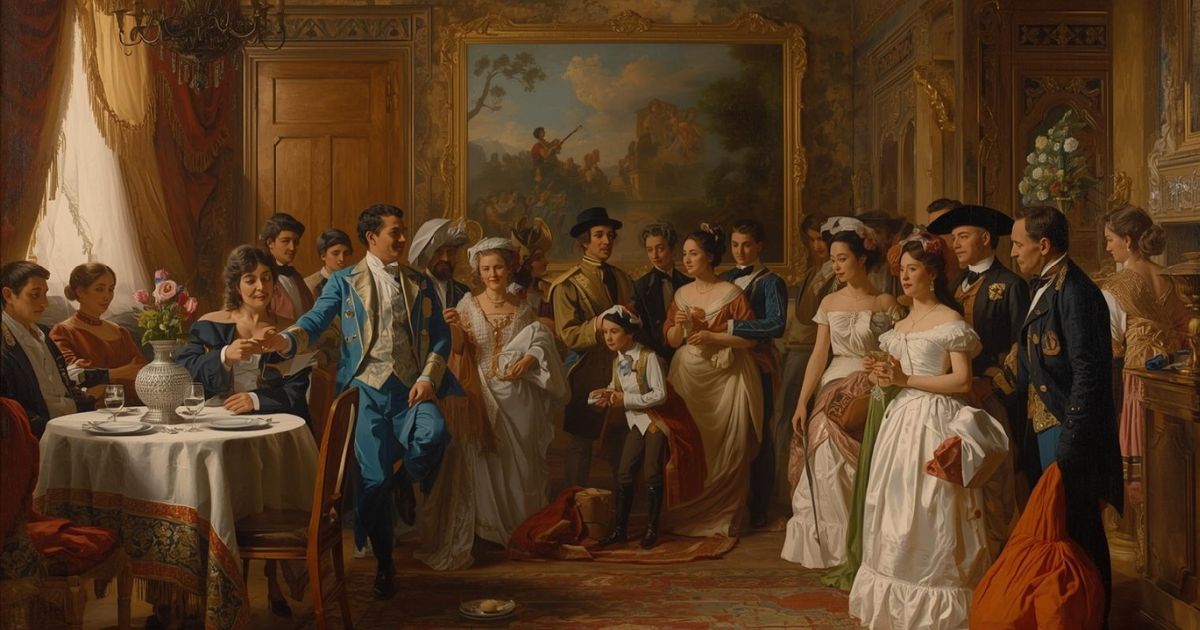
An excerpt from the original text.(complete · 3743 words)
he Meeting in the Town Hall
The hall was about twelve to fifteen meters long by eight to ten
wide. Its whitewashed walls were covered with drawings in charcoal,
more or less ugly and obscene, with inscriptions to complete their
meanings. Stacked neatly against the wall in one corner were to be
seen about a dozen old flint-locks among rusty swords and talibons, the
armament of the cuadrilleros. [66] At one end of the hall there hung,
half hidden by soiled red curtains, a picture of his Majesty, the King
of Spain. Underneath this picture, upon a wooden platform, an old chair
spread out its broken arms. In front of the chair was a wooden table
spotted with ink stains and whittled and carved with inscriptions
and initials like the tables in the German taverns frequented by
students. Benches and broken chairs completed the furniture.
This is the hall of council, of judgment, and of torture, wherein are
now gathered the officials of the town and its dependent villages. The
faction of old men does not mix with that of the youths, for they are
mutually hostile. They represent respectively the conservative and
the liberal parties, save that their disputes assume in the towns an
extreme character.
"The conduct of the gobernadorcillo fills me with distrust,"
Don Filipo, the teniente-mayor and leader of the liberal faction,
was saying to his friends. "It was a deep-laid scheme, this thing
of putting off the discussion of expenses until the eleventh
hour. Remember that we have scarcely eleven days left."
"And he has staved at the convento to hold a conference with the
curate, who is sick," observed one of the youths.
"It doesn't matter," remarked another. "We have everything
prepared. Just so the plan of the old men doesn't receive a majority--"
"I don't believe it will," interrupted Don Filipo, "as I shall present
the plan of the old men myself!"
"What! What are you saying?" asked his surprised hearers.
"I said that if I speak first I shall present the plan of our rivals."
"But what about our plan?"
"I shall leave it to you to present ours," answered Don Filipo
with a smile, turning toward a youthful cabeza de barangay. [67]
"You will propose it after I have been defeated."
"We don't understand you, sir," said his hearers, staring at him with
doubtful looks.
"Listen," continued the liberal leader in a low voice to several
near him. "This morning I met old Tasio and the old man said to me:
'Your rivals hate you more than they do your ideas. Do you wish that
a thing shall not be done? Then propose it yourself, and though it
were more useful than a miter, it would be rejected. Once they have
defeated you, have the least forward person in the whole gathering
propose what you want, and your rivals, in order to humiliate you,
will accept it.' But keep quiet about it."
"But--"
"So I will propose the plan of our rivals and exaggerate it to the
point of making it ridiculous. Ah, here come Señor Ibarra and the
schoolmaster."
These two young men saluted each of the groups without joining
either. A few moments later the gobernadorcillo, the very same
individual whom we saw yesterday carrying a bundle of candles, entered
with a look of disgust on his face. Upon his entrance the murmurs
ceased, every one sat down, and silence was gradually established,
as he took his seat under the picture of the King, coughed four or
five times, rubbed his hand over his face and head, rested his elbows
on the table, then withdrew them, coughed once more, and then the
whole thing over again.
"Gentlemen," he at last began in an unsteady voice, "I have been so
bold as to call you together here for this meeting--ahem! Ahem! We
have to celebrate the fiesta of our patron saint, San Diego, on the
twelfth of this month--ahem!--today is the second--ahem! Ahem!" At
this point a slow, dry cough cut off his speech.
A man of proud bearing, apparently about forty years of age, then
arose from the bench of the elders. He was the rich Capitan Basilio,
the direct contrast of Don Rafael, Ibarra's father. He was a man who
maintained that after the death of St. Thomas Aquinas the world had
made no more progress, and that since St. John Lateran had left it,
humanity had been retrograding.
"Gentlemen, allow me to speak a few words about such an interesting
matter," he began. "I speak first even though there are others here
present who have more right to do so than I have, but I speak first
because in these matters it seems to me that by speaking first one
does not take the first place--no more than that by speaking last does
one become the least. Besides, the things that I have to say are of
such importance that they should not be put off or last spoken of, and
accordingly I wish to speak first in order to give them due weight. So
you will allow me to speak first in this meeting where I see so many
notable persons, such as the present señor capitan, the former capitan;
my distinguished friend, Don Valentin, a former capitan; the friend
of my infancy, Don Julio; our celebrated captain of cuadrilleros,
Don Melchor; and many other personages, whom, for the sake of brevity,
I must omit to enumerate--all of whom you see present here. I beg of
you that I may be allowed a few words before any one else speaks. Have
I the good fortune to see my humble request granted by the meeting?"
Here the orator with a faint smile inclined his head respectfully. "Go
on, you have our undivided attention!" said the notables alluded to and
some others who considered Capitan Basilio a great orator. The elders
coughed in a satisfied way and rubbed their hands. After wiping the
perspiration from his brow with a silk handkerchief, he then proceeded:
"Now that you have been so kind and complaisant with my humble self as
to grant me the use of a few words before any one else of those here
present, I shall take advantage of this permission, so generously
granted, and shall talk. In imagination I fancy myself in the midst
of the august Roman senate, senatus populusque romanus, as was said
in those happy days which, unfortunately for humanity, will nevermore
return. I propose to the Patres Conscripti, as the learned Cicero
would say if he were in my place, I propose, in view of the short time
left, and time is money as Solomon said, that concerning this important
matter each one set forth his opinion clearly, briefly, and simply."
Satisfied with himself and flattered by the attention in the hall, the
orator took his seat, not without first casting a glance of superiority
toward Ibarra, who was seated in a corner, and a significant look at
his friends as if to say, "Aha! Haven't I spoken well?" His friends
reflected both of these expressions by staring at the youths as though
to make them die of envy.
"Now any one may speak who wishes that--ahem!" began the
gobernadorcillo, but a repetition of the cough and sighs cut short
the phrase.
To judge from the silence, no one wished to consider himself called
upon as one of the Conscript Fathers, since no one rose. Then Don
Filipo seized the opportunity and rose to speak. The conservatives
winked and made significant signs to each other.
"I rise, gentlemen, to present my estimate of expenses for the fiesta,"
he began. "We can't allow it," commented a consumptive old man,
who was an irreconcilable conservative.
"We'll vote against it," corroborated others. "Gentlemen!" exclaimed
Don Filipo, repressing a smile, "I haven't yet made known the plan
which we, the younger men, bring here. We feel sure that this
great plan will be preferred by all over any other that our opponents
think of or are capable of conceiving."
This presumptuous exordium so thoroughly irritated the minds of the
conservatives that they swore in their hearts to offer determined
opposition.
"We have estimated three thousand five hundred pesos for the expenses,"
went on Don Filipo. "Now then, with such a sum we shall be able to
celebrate a fiesta that will eclipse in magnificence any that has
been seen up to this time in our own or neighboring provinces."
"Ahem!" coughed some doubters. "The town of A---- has five thousand,
B---- has four thousand, ahem! Humbug!"
"Listen to me, gentlemen, and I'll convince you," continued the
unterrified speaker. "I propose that we erect a theater in the middle
of the plaza, to cost one hundred and fifty pesos."
"That won't be enough! It'll take one hundred and sixty," objected
a confirmed conservative.
"Write it down, Señor Director, two hundred pesos for the theater,"
said Don Filipo. "I further propose that we contract with a troupe
of comedians from Tondo for seven performances on seven successive
nights. Seven performances at two hundred pesos a night make fourteen
hundred pesos. Write down fourteen hundred pesos, Señor Director!"
Both the elders and the youths stared in amazement. Only those in
the secret gave no sign.
"I propose besides that we have magnificent fireworks; no little
lights and pin-wheels such as please children and old maids, nothing
of the sort. We want big bombs and immense rockets. I propose two
hundred big bombs at two pesos each and two hundred rockets at the
same price. We'll have them made by the pyrotechnists of Malabon."
"Huh!" grunted an old man, "a two-peso bomb doesn't frighten or deafen
me! They ought to be three-peso ones."
"Write down one thousand pesos for two hundred bombs and two hundred
rockets."
The conservatives could no longer restrain themselves. Some of them
rose and began to whisper together. "Moreover, in order that our
visitors may see that we are a liberal people and have plenty of
money," continued the speaker, raising his voice and casting a rapid
glance at the whispering group of elders, "I propose: first, four
hermanos mayores [68] for the two days of the fiesta; and second,
that each day there be thrown into the lake two hundred fried chickens,
one hundred stuffed capons, and forty roast pigs, as did Sylla,
a contemporary of that Cicero, of whom Capitan Basilio just spoke."
"That's it, like Sylla," repeated the flattered Capitan Basilio.
The surprise steadily increased.
"Since many rich people will attend and each one will bring thousands
of pesos, his best game-cocks, and his playing-cards, I propose that
the cockpit run for fifteen days and that license be granted to open
all gambling houses--"
The youths interrupted him by rising, thinking that he had gone
crazy. The elders were arguing heatedly.
"And, finally, that we may not neglect the pleasures of the soul--"
The murmurs and cries which arose all over the hall drowned his voice
out completely, and tumult reigned.
"No!" yelled an irreconcilable conservative. "I don't want him to
flatter himself over having run the whole fiesta, no! Let me speak! Let
me speak!"
"Don Filipo has deceived us," cried the liberals. "We'll vote against
his plan. He has gone over to the old men. We'll vote against him!"
The gobernadorcillo, more overwhelmed than ever, did nothing to restore
order, but rather was waiting for them to restore it themselves.
The captain of the cuadrilleros begged to be heard and was granted
permission to speak, but he did not open his mouth and sat down again
confused and ashamed.
By good fortune, Capitan Valentin, the most moderate of all
the conservatives, arose and said: "We cannot agree to what the
teniente-mayor has proposed, as it appears to be exaggerated. So many
bombs and so many nights of theatrical performances can only be desired
by a young man, such as he is, who can spend night after night sitting
up and listening to so many explosions without becoming deaf. I have
consulted the opinion of the sensible persons here and all of them
unanimously disapprove Don Filipo's plan. Is it not so, gentlemen?"
"Yes, yes!" cried the youths and elders with one voice. The youths
were delighted to hear an old man speak so.
"What are we going to do with four hermanos mayores?" went on the old
man. "What is the meaning of those chickens, capons, and roast pigs,
thrown into the lake? 'Humbug!' our neighbors would say. And afterwards
we should have to fast for six months! What have we to do with Sylla
and the Romans? Have they ever invited us to any of their festivities,
I wonder? I, at least, have never received any invitation from them,
and you can all see that I'm an old man!"
"The Romans live in Rome, where the Pope is," Capitan Basilio prompted
him in a low voice. "Now I understand!" exclaimed the old man calmly.
"They would make of their festivals watch-meetings, and the Pope
would order them to throw their food into the sea so that they might
commit no sin. But, in spite of all that, your plan is inadmissible,
impossible, a piece of foolishness!"
Being so stoutly opposed, Don Filipo had to withdraw his proposal. Now
that their chief rival had been defeated, even the worst of the
irreconcilable insurgents looked on with calmness while a young cabeza
de barangay asked for the floor.
"I beg that you excuse the boldness of one so young as I am in
daring to speak before so many persons respected for their age and
prudence and judgment in affairs, but since the eloquent orator,
Capitan Basilio, has requested every one to express his opinion,
let the authoritative words spoken by him excuse my insignificance."
The conservatives nodded their heads with satisfaction, remarking
to one another: "This young man talks sensibly." "He's modest." "He
reasons admirably."
"What a pity that he doesn't know very well how to gesticulate,"
observed Capitan Basilio. "But there's time yet! He hasn't studied
Cicero and he's still a young man!"
"If I present to you, gentlemen, any program or plan," the young
man continued, "I don't do so with the thought that you will find
it perfect or that you will accept it, but at the same time that I
once more bow to the judgment of all of you, I wish to prove to our
elders that our thoughts are always like theirs, since we take as
our own those ideas so eloquently expressed by Capitan Basilio."
"Well spoken! Well spoken!" cried the flattered conservatives. Capitan
Basilio made signs to the speaker showing him how he should stand and
how he ought to move his arm. The only one remaining impassive was the
gobernadorcillo, who was either bewildered or preoccupied; as a matter
of fact, he seemed to be both. The young man went on with more warmth:
"My plan, gentlemen, reduces itself to this: invent new shows that
are not common and ordinary, such as we see every day, and endeavor
that the money collected may not leave the town, and that it be not
wasted in smoke, but that it be used in some manner beneficial to all."
"That's right!" assented the youths. "That's what we want."
"Excellent!" added the elders.
"What should we get from a week of comedies, as the teniente-mayor
proposes? What can we learn from the kings of Bohemia and Granada, who
commanded that their daughters' heads be cut off, or that they should
be blown from a cannon, which later is converted into a throne? We
are not kings, neither are we barbarians; we have no cannon, and if
we should imitate those people, they would hang us on Bagumbayan. What
are those princesses who mingle in the battles, scattering thrusts and
blows about in combat with princes, or who wander alone over mountains
and through valleys as though seduced by the tikbálang? Our nature is
to love sweetness and tenderness in woman, and we would shudder at the
thought of taking the blood-stained hand of a maiden, even when the
blood was that of a Moro or a giant, so abhorred by us. We consider
vile the man who raises his hand against a woman, be he prince or
alferez or rude countryman. Would it not be a thousand times better
to give a representation of our own customs in order to correct our
defects and vices and to encourage our better qualities?"
"That's right! That's right!" exclaimed some of his faction.
"He's right," muttered several old men thoughtfully.
"I should never have thought of that," murmured Capitan Basilio.
"But how are you going to do it?" asked the irreconcilable.
"Very easily," answered the youth. "I have brought here two
dramas which I feel sure the good taste and recognized judgment of
the respected elders here assembled will find very agreeable and
entertaining. One is entitled 'The Election of the Gobernadorcillo,'
being a comedy in prose in five acts, written by one who is here
present. The other is in nine acts for two nights and is a fantastical
drama of a satirical nature, entitled 'Mariang Makiling,' [69] written
by one of the best poets of the province. Seeing that the discussion of
preparations for the fiesta has been postponed and fearing that there
would not be time enough left, we have secretly secured the actors
and had them learn their parts. We hope that with a week of rehearsal
they will have plenty of time to know their parts thoroughly. This,
gentlemen, besides being new, useful, and reasonable, has the great
advantage of being economical; we shall not need costumes, as those
of our daily life will be suitable."
"I'll pay for the theater!" shouted Capitan Basilio enthusiastically.
"If you need cuadrilleros, I'll lend you mine," cried their captain.
"And I--and I--if art old man is needed--" stammered another one,
swelling with pride.
"Accepted! Accepted!" cried many voices.
Don Filipo became pale with emotion and his eyes filled with tears.
"He's crying from spite," thought the irreconcilable, so he yelled,
"Accepted! Accepted without discussion!" Thus satisfied with revenge
and the complete defeat of his rival, this fellow began to praise
the young man's plan.
The latter continued his speech: "A fifth of the money collected may be
used to distribute a few prizes, such as to the best school child, the
best herdsman, farmer, fisherman, and so on. We can arrange for boat
races on the river and lake and for horse races on shore, we can raise
greased poles and also have other games in which our country people can
take part. I concede that on account of our long-established customs we
must have some fireworks; wheels and fire castles are very beautiful
and entertaining, but I don't believe it necessary to have bombs, as
the former speaker proposed. Two bands of music will afford sufficient
merriment and thus we shall avoid those rivalries and quarrels between
the poor musicians who come to gladden our fiesta with their work
and who so often behave like fighting-cocks, afterwards going away
poorly paid, underfed, and even bruised and wounded at times. With
the money left over we can begin the erection of a small building for
a schoolhouse, since we can't wait until God Himself comes down and
builds one for us, and it is a sad state of affairs that while we have
a fine cockpit our children study almost in the curate's stable. Such
are the outlines of my plan; the details can be worked out by all."
A murmur of pleasure ran through the hall, as nearly every one agreed
with the youth.
Some few muttered, "Innovations! Innovations! When we were young--"
"Let's adopt it for the time being and humiliate that fellow," said
others, indicating Don Filipo.
When silence was restored all were agreed. There was lacking only the
approval of the gobernadorcillo. That worthy official was perspiring
and fidgeting about. He rubbed his hand over his forehead and was at
length able to stammer out in a weak voice: "I also agree, but--ahem!"
Every one in the hall listened in silence.
"But what?" asked Capitan Basilio.
"Very agreeable," repeated the gobernadorcillo, "that is to say--I
don't agree--I mean--yes, but--" Here he rubbed his eyes with the
back of his hand. "But the curate," the poor fellow went on, "the
curate wants something else."
"Does the curate or do we ourselves pay for this fiesta? Has he given
a cuarto for it?" exclaimed a penetrating voice. All looked toward
the place whence these questions came and saw there the Sage Tasio.
Don Filipo remained motionless with his eyes fixed on the
gobernadorcillo.
"What does the curate want?" asked Capitan Basilio.
"Well, the padre wants six processions, three sermons, three high
masses, and if there is any money left, a comedy from Tondo with
songs in the intermissions."
"But we don't want that," said the youths and some of the old men.
"The curate wants it," repeated the gobernadorcillo. "I've promised
him that his wish shall be carried out."
"Then why did you have us assemble here?"
"F-for the very purpose of telling you this!"
"Why didn't you tell us so at the start?"
"I wanted to tell you, gentlemen, but Capitan Basilio spoke and I
haven't had a chance. The curate must be obeyed."
"He must be obeyed," echoed several old men.
"He must be obeyed or else the alcalde will put us all in jail,"
added several other old men sadly.
"Well then, obey him, and run the fiesta yourselves," exclaimed the
youths, rising. "We withdraw our contributions."
"Everything has already been collected," said the gobernadorcillo.
Don Filipo approached this official and said to him bitterly, "I
sacrificed my pride in favor of a good cause; you are sacrificing your
dignity as a man in favor of a bad one, and you've spoiled everything."
Ibarra turned to the schoolmaster and asked him, "Is there anything
that I can do for you at the capital of the province? I leave for
there immediately."
"Have you some business there?"
"We have business there!" answered Ibarra mysteriously.
On the way home, when Don Filipo was cursing his bad luck, old Tasio
said to him: "The blame is ours! You didn't protest when they gave
you a slave for a chief, and I, fool that I am, had forgotten it!"
Master this chapter. Complete your experience
Purchase the complete book to access all chapters and support classic literature
As an Amazon Associate, we earn a small commission from qualifying purchases at no additional cost to you.
Available in paperback, hardcover, and e-book formats
Let's Analyse the Pattern
Real power operates through visible figureheads while the true decision-makers remain hidden and untouchable.
Why This Matters
Connect literature to life
This chapter teaches how to identify when visible authority figures are just delivering decisions made by invisible powers above them.
Practice This Today
This week, notice when someone says 'that's just policy' or 'my hands are tied' - ask yourself who actually benefits from that policy and where the real decision-making power lies.
Now let's explore the literary elements.
Key Quotes & Analysis
"The conduct of the gobernadorcillo fills me with distrust. It was a deep-laid scheme, this thing of putting off the discussion of expenses until the eleventh hour."
Context: Filipo suspects the mayor is deliberately delaying the budget discussion to prevent real planning
This shows how Filipo recognizes political manipulation even from his own side. He understands that timing can be used as a weapon to control outcomes.
In Today's Words:
I don't trust how the boss waited until the last minute to talk about the budget - that's not an accident.
"We should have a Roman circus! Let us throw into the lake silver coins, not copper ones, and roasted pigs, not just rice cakes!"
Context: Filipo presents his deliberately over-the-top expensive proposal to shock the conservatives
This is Filipo's reverse psychology in action. He proposes something so ridiculously expensive that his real plan will seem modest and reasonable by comparison.
In Today's Words:
Let's go completely overboard and spend a fortune on this thing!
"Why should we not have our own theater? Why should we always have to import our entertainment?"
Context: The young man presents the liberals' real plan for local, educational entertainment
This represents the heart of the liberal philosophy - developing local talent and culture instead of depending on expensive foreign imports. It's about self-reliance and cultural pride.
In Today's Words:
Why can't we showcase our own people instead of always bringing in outsiders?
"But the curate has already decided everything. He wants the traditional processions and has arranged for a theatrical company from Manila."
Context: The mayor reveals that all their planning is meaningless because the priest has already made the decisions
This moment exposes the reality of colonial power - all the democratic discussion and clever maneuvering means nothing when the real authority has already spoken.
In Today's Words:
Actually, the big boss already decided what we're doing, so this whole meeting was pointless.
Thematic Threads
Hidden Authority
In This Chapter
The curate controls the festival through the gobernadorcillo without appearing at the meeting
Development
Introduced here as the invisible force behind colonial administration
In Your Life:
You might be arguing with someone who has no real power to change the situation you're fighting about.
Political Strategy
In This Chapter
Don Filipo uses reverse psychology to manipulate the conservatives into accepting his agenda
Development
Shows his evolution from earlier passive resistance to active maneuvering
In Your Life:
Sometimes getting what you want requires proposing what you don't want first.
Class Division
In This Chapter
Liberals want local culture and education while conservatives prefer expensive imported entertainment
Development
Deepens the ideological split introduced in earlier chapters
In Your Life:
Your values about money and culture often reveal which social class you identify with or aspire to join.
Colonial Control
In This Chapter
Spanish religious authority overrules local Filipino decision-making processes
Development
Reveals the mechanism behind the oppression shown throughout the novel
In Your Life:
Outside forces might be shaping your community's decisions in ways that aren't immediately obvious.
Wasted Effort
In This Chapter
The elaborate political maneuvering becomes meaningless when real authority intervenes
Development
Introduced here as the futility of working within a rigged system
In Your Life:
You might be putting tremendous energy into influencing people who can't actually change anything.
You now have the context. Time to form your own thoughts.
Discussion Questions
- 1
What was Don Filipo's strategy for getting his progressive festival plan approved, and why did it initially seem to work?
analysis • surface - 2
Why didn't Filipo's clever reverse psychology ultimately matter, and who really controlled the festival decisions?
analysis • medium - 3
Where have you seen this pattern of hidden authority - where the person you're dealing with isn't actually making the decisions?
application • medium - 4
When facing a situation where real power is hidden, what steps would you take to identify who actually makes the decisions?
application • deep - 5
What does this chapter reveal about the difference between appearing to have power and actually having power?
reflection • deep
Critical Thinking Exercise
Map the Real Power Structure
Think of a frustrating situation where you tried to change something but kept hitting walls. Draw a simple diagram showing who you thought had the power to make decisions versus who actually controlled the outcome. Include the visible decision-makers, the hidden influences, and the real beneficiaries of keeping things unchanged.
Consider:
- •Look for people who benefit financially or politically from the current system
- •Notice who stays quiet during debates or conflicts
- •Consider external pressures like regulations, corporate policies, or family expectations
Journaling Prompt
Write about a time when you discovered the person you were trying to convince had no real authority. How did you adjust your approach once you understood the actual power structure?
Coming Up Next...
Chapter 21: When the System Breaks a Mother
As political frustrations mount in the town, we turn to a more intimate story that reveals how personal tragedy and maternal sacrifice shape the community's deeper struggles.



