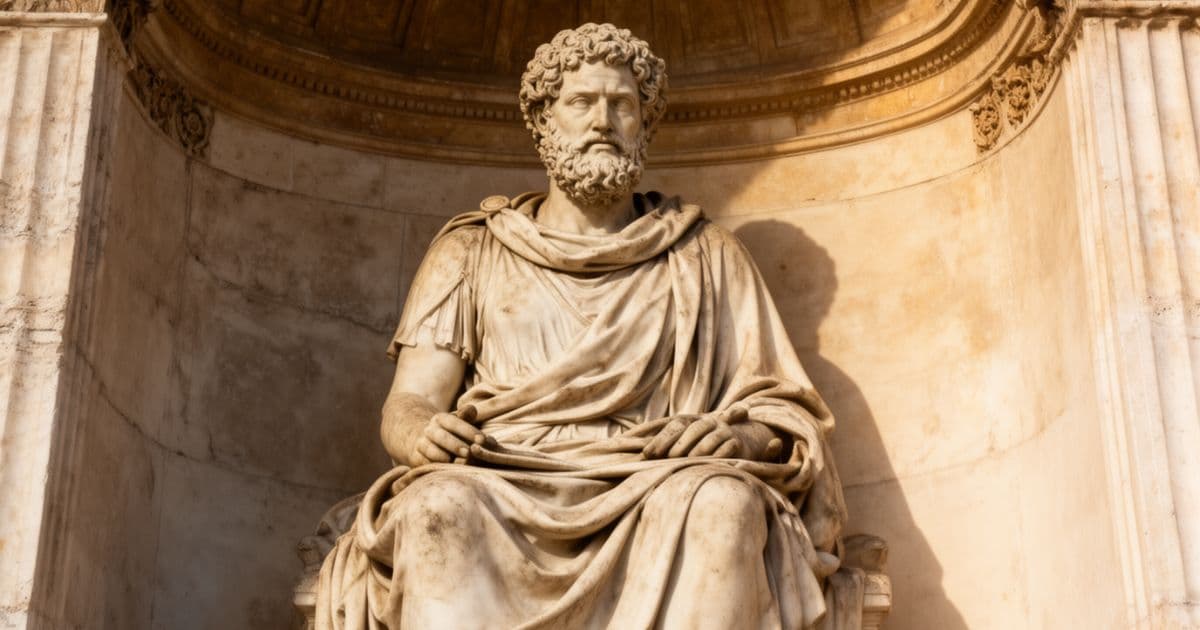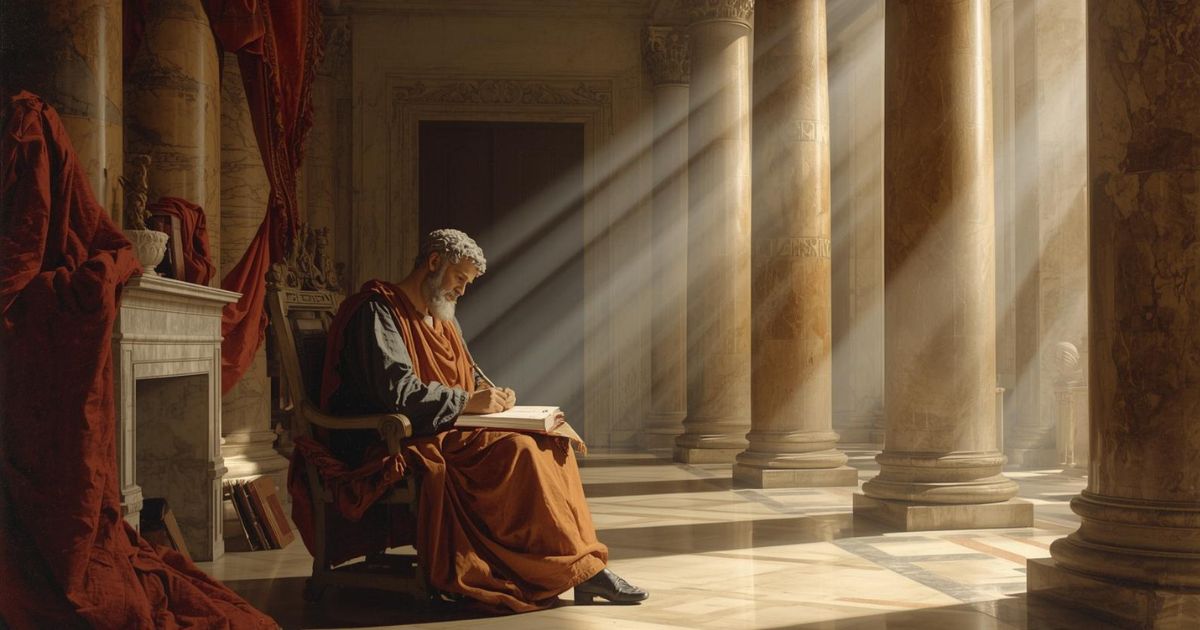
An excerpt from the original text.(complete · 1592 words)
←etter 96. On facing hardshipsMoral letters to Luciliusby Seneca, translated by Richard Mott GummereLetter 97. On the degeneracy of the ageLetter 98. On the fickleness of fortune→483739Moral letters to Lucilius — Letter 97. On the degeneracy of the ageRichard Mott GummereSeneca XCVII. ON THE DEGENERACY OF THE AGE 1. You are mistaken, my dear Lucilius, if you think that luxury, neglect of good manners, and other vices of which each man accuses the age in which he lives, are especially characteristic of our own epoch; no, they are the vices of mankind and not of the times. No era in history has ever been free from blame. Moreover, if you once begin to take account of the irregularities belonging to any particular era, you will find—to man’s shame be it spoken—that sin never stalked abroad more openly than in Cato’s very presence. 2. Would anyone believe that money changed hands in the trial when Clodius was defendant on the charge of secret adultery with Caesar’s wife, when he violated[1] the ritual of that sacrifice which is said to be offered on behalf of the people when all males are so rigorously removed outside the precinct, that even pictures of all male creatures are covered up? And yet, money was given to the jury, and, baser even than such a bargain, sexual crimes were demanded of married women and noble youths as a sort of additional contribution.[2] 3. The charge involved less sin than the acquittal; for the defendant on a charge of adultery parcelled out the adulteries, and was not sure of his own safety until he had made the jury criminals like himself. All this was done at the trial in which Cato gave evidence, although that was his sole part therein. I shall quote Cicero’s actual words,[3] because the facts are so bad as to pass belief: 4. “He made assignations, promises, pleas, and gifts. And more than this (merciful Heavens, what an abandoned state of affairs!) upon several of the jury, to round out their reward, he even bestowed the enjoyment of certain women and meetings with noble youths.” 5. It is superfluous to be shocked at the bribe; the additions to the bribe were worse. “Will you have the wife of that prig, A.? Very good. Or of B., the millionaire? I will guarantee that you shall lie with her. If you fail to commit adultery, condemn Clodius. That beauty whom you desire shall visit you. I assure you a night in that woman’s company without delay; my promise shall be carried out faithfully within the legal time of postponement.” It means more to parcel out such crimes than to commit them; it means blackmailing dignified matrons. 6. These jurymen in the Clodius trial had asked the Senate for a guard—a favour which would have been necessary only for a jury about to convict the accused; and their request had been granted. Hence the witty remark of Catulus after the defendant had been acquitted: “Why did you ask us for the guard? Were you afraid of having your money stolen from you?” And yet, amid jests like these he got off unpunished who before the trial was an adulterer, during the trial a pander, and who escaped conviction more vilely than he deserved it. 7. Do you believe that anything could be more disgraceful than such moral standards—when lust could not keep its hands either from religious worship or from the courts of law, when, in the very inquiry which was held in special session by order of the Senate, more crime was committed than investigated? The question at issue was whether one could be safe after committing adultery; it was shown that one could not be safe without committing adultery! 8. All this bargaining took place in the presence of Pompey and Caesar, of Cicero and Cato,—yes, that very Cato whose presence, it is said, caused the people to refrain from demanding the usual quips and cranks of naked actresses at the Floralia,[4]—if you can believe that men were stricter in their conduct at a festival than in a court-room! Such things will be done in the future, as they have been done in the past; and the licentiousness of cities will sometimes abate through discipline and fear, never of itself. 9. Therefore, you need not believe that it is we who have yielded most to lust and least to law. For the young men of to-day live far more simple lives than those of an epoch when a defendant would plead not guilty to an adultery charge before his judges, and his judges admit it before the defendant, when debauchery was practised to secure a verdict, and when Clodius, befriended by the very vices of which he was guilty, played the procurer during the actual hearing of the case. Could one believe this? He to whom one adultery brought condemnation was acquitted because of many. 10. All ages will produce men like Clodius, but not all ages men like Cato. We degenerate easily, because we lack neither guides nor associates in our wickedness, and the wickedness goes on of itself, even without guides or associates. The road to vice is not only downhill, but steep; and many men are rendered incorrigible by the fact that, while in all other crafts errors bring shame to good craftsmen and cause vexation to those who go astray, the errors of life are a positive source of pleasure. 11. The pilot is not glad when his ship is thrown on her beam-ends; the physician is not glad when he buries his patient; the orator is not glad when the defendant loses a case through the fault of his advocate; but on the other hand every man enjoys his own crimes. A. delights in an intrigue—for it was the very difficulty which attracted him thereto. B. delights in forgery and theft, and is only displeased with his sin when his sin has failed to hit the mark. And all this is the result of perverted habits. 12. Conversely, however, in order that you may know that there is an idea of good conduct present subconsciously in souls which have been led even into the most depraved ways, and that men are not ignorant of what evil is but indifferent—I say that all men hide their sins, and, even though the issue be successful, enjoy the results while concealing the sins themselves. A good conscience, however, wishes to come forth and be seen of men; wickedness fears the very shadows. 13. Hence I hold Epicurus’s saying[5] to be most apt: “That the guilty may haply remain hidden is possible, that he should be sure of remaining hidden is not possible,” or, if you think that the meaning can be made more clear in this way: “The reason that it is no advantage to wrong-doers to remain hidden is that even though they have the good fortune they have not the assurance of remaining so.” This is what I mean: crimes can be well guarded; free from anxiety they cannot be. 14. This view, I maintain, is not at variance with the principles of our school, if it be so explained. And why? Because the first and worst penalty for sin is to have committed sin; and crime, though Fortune deck it out with her favours, though she protect and take it in her charge, can never go unpunished; since the punishment of crime lies in the crime itself. But none the less do these second penalties press close upon the heels of the first—constant fear, constant terror, and distrust in one’s own security. Why, then, should I set wickedness free from such a punishment? Why should I not always leave it trembling in the balance? 15. Let us disagree with Epicurus on the one point, when he declares that there is no natural justice, and that crime should be avoided because one cannot escape the fear which results therefrom; let us agree with him on the other—that bad deeds are lashed by the whip of conscience, and that conscience is tortured to the greatest degree because unending anxiety drives and whips it on, and it cannot rely upon the guarantors of its own peace of mind. For this, Epicurus, is the very proof that we are by nature reluctant to commit crime, because even in circumstances of safety there is no one who does not feel fear. 16. Good luck frees many men from punishment, but no man from fear. And why should this be if it were not that we have ingrained in us a loathing for that which Nature has condemned? Hence even men who hide their sins can never count upon remaining hidden; for their conscience convicts them and reveals them to themselves. But it is the property of guilt to be in fear. It had gone ill with us, owing to the many crimes which escape the vengeance of the law and the prescribed punishments, were it not that those grievous offences against nature must pay the penalty in ready money, and that in place of suffering the punishment comes fear. Farewell. ↑ For the best account of this scandal see Plutarch, Caesar, ix. f. ↑ From stilla “a drop.” The phrase is equivalent to our proverbial “last straw.” ↑ Epp. ad Atticum, i. 16. ↑ A plebeian festival, held April 28, in honour of Flora, an Italian divinity connected with Ceres and Venus. For the story of Cato (55 B.C.) see Valer. Max. ii. 10. 8. ↑ Epic., Frag. 532 Usener.
Master this chapter. Complete your experience
Purchase the complete book to access all chapters and support classic literature
As an Amazon Associate, we earn a small commission from qualifying purchases at no additional cost to you.
Available in paperback, hardcover, and e-book formats
Let's Analyse the Pattern
The false belief that moral decay is accelerating when corruption has always existed but becomes more visible over time.
Why This Matters
Connect literature to life
This chapter teaches how to question claims that 'things used to be better' by examining what evidence actually supports those beliefs.
Practice This Today
This week, notice when someone says 'people used to be more honest/hardworking/respectful' and ask them for specific examples versus vague generalizations.
Now let's explore the literary elements.
Key Quotes & Analysis
"You are mistaken, my dear Lucilius, if you think that luxury, neglect of good manners, and other vices of which each man accuses the age in which he lives, are especially characteristic of our own epoch; no, they are the vices of mankind and not of the times."
Context: Opening his argument against Lucilius's complaint about their corrupt era
This directly challenges the universal human tendency to think our current problems are uniquely bad. Seneca argues that moral problems are constants of human nature, not products of specific time periods.
In Today's Words:
Every generation thinks they're living through the worst time in history, but people have always been people.
"The charge involved less sin than the acquittal; for the defendant on a charge of adultery was acquitted by means of adultery."
Context: Describing how Clodius's defense was more corrupt than his original crime
This reveals how corruption can spiral—the cover-up becomes worse than the crime. It shows the absurd lengths people go to avoid consequences.
In Today's Words:
The guy accused of cheating got off by arranging more cheating—the fix was dirtier than the original scandal.
"No era in history has ever been free from blame."
Context: Supporting his argument that moral decay isn't unique to any time period
A simple but profound observation about human nature. This helps readers recognize that feeling like society is falling apart is a normal human experience, not evidence of unique crisis.
In Today's Words:
There's never been a perfect time when everything was great and everyone was good.
Thematic Threads
Social Expectations
In This Chapter
Seneca challenges the expectation that society should be improving morally over time
Development
Building on earlier letters about not judging by appearances
In Your Life:
You might catch yourself thinking your workplace, neighborhood, or generation was 'better before' without examining the evidence.
Human Relationships
In This Chapter
The Clodius trial shows how power corrupts even intimate relationships, turning them into transactional tools
Development
Connects to previous discussions about authentic versus manipulative relationships
In Your Life:
You might recognize when people use personal connections or favors to avoid consequences for their actions.
Personal Growth
In This Chapter
Seneca argues that wrongdoing creates its own punishment through anxiety and fear of discovery
Development
Builds on earlier themes about internal versus external validation
In Your Life:
You might notice how guilt and worry follow you even when you escape formal consequences for mistakes.
Class
In This Chapter
Noble women and wealthy citizens using their status to corrupt justice shows how privilege enables moral decay
Development
Continues examination of how social position affects moral choices
In Your Life:
You might observe how people with connections or status get away with behavior that would destroy others.
Identity
In This Chapter
Seneca questions whether we define ourselves by imagined moral superiority over previous generations
Development
Introduced here as a new way to examine self-concept
In Your Life:
You might catch yourself feeling morally superior to past eras while ignoring present-day problems you participate in or ignore.
You now have the context. Time to form your own thoughts.
Discussion Questions
- 1
What specific examples does Seneca give to show that corruption isn't new to his generation?
analysis • surface - 2
Why does Seneca argue that moral crimes are different from other types of mistakes?
analysis • medium - 3
When have you heard someone claim that 'people today are worse than they used to be'? What specific complaints did they make?
application • medium - 4
How would you respond to a coworker who insists that 'nobody has work ethic anymore' compared to the past?
application • deep - 5
What does Seneca's observation about guilt creating its own punishment teach us about why people repeat harmful behaviors?
reflection • deep
Critical Thinking Exercise
Test the 'Good Old Days' Claim
Think of a time someone told you things were better 'back in the day' - whether about work, family values, safety, or respect. Pick one specific claim and research what was actually happening during that time period. Look for concrete evidence, not just nostalgic stories.
Consider:
- •What problems from that era might people be forgetting or minimizing?
- •Who benefited from the 'good old days' and who didn't have a voice then?
- •What evidence would prove or disprove this claim about the past being better?
Journaling Prompt
Write about a time when you caught yourself romanticizing the past. What were you trying to escape from in your present situation, and how did idealizing the past help or hurt your ability to deal with current challenges?
Coming Up Next...
Chapter 98: When Life Pulls the Rug Out
From moral corruption to life's ultimate uncertainty, Seneca next explores how depending on good fortune for happiness is like building a house on quicksand. He'll reveal why the things we think make us secure are actually the source of our greatest vulnerability.