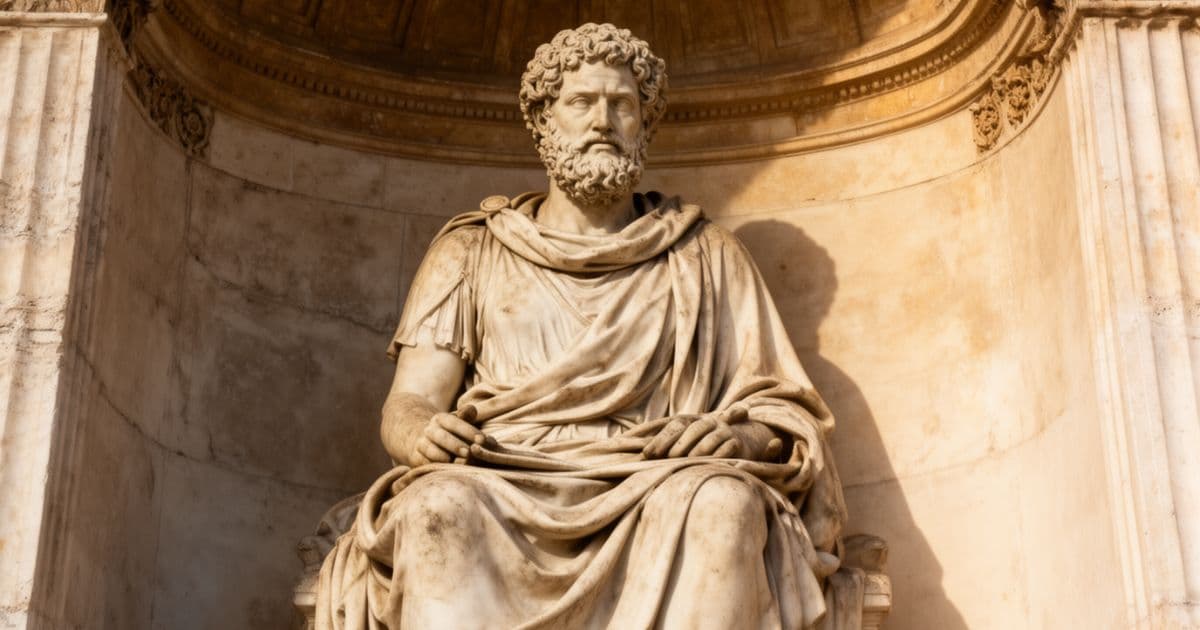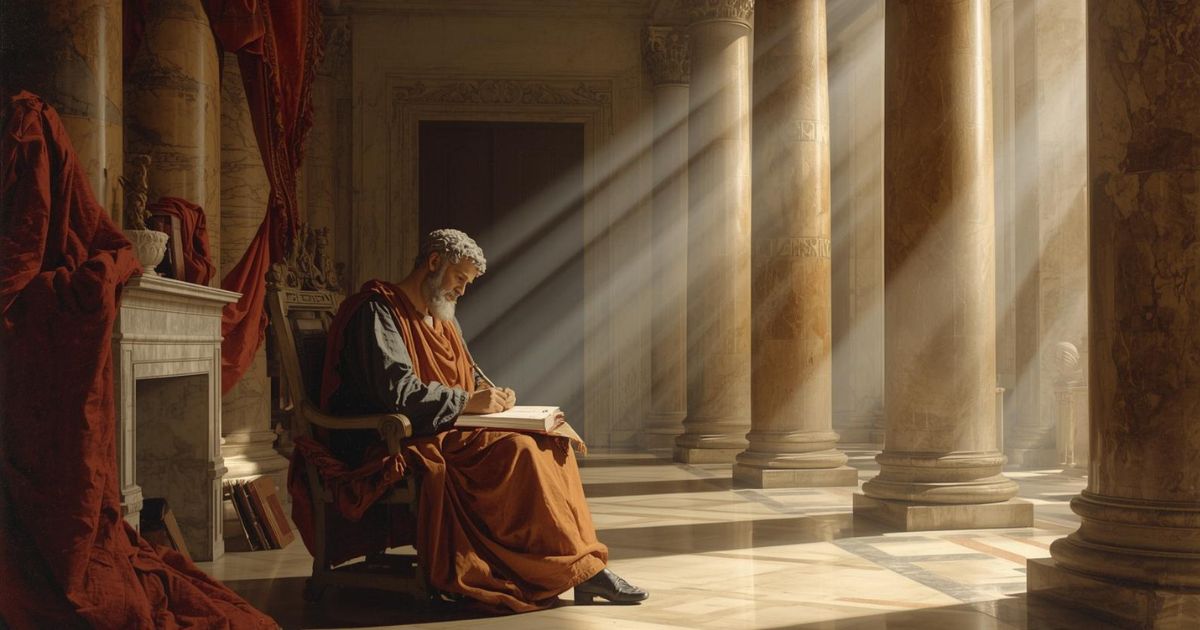
An excerpt from the original text.(complete · 7543 words)
←etter 94. On the value of adviceMoral letters to Luciliusby Seneca, translated by Richard Mott GummereLetter 95. On the usefulness of basic principlesLetter 96. On facing hardships→483670Moral letters to Lucilius — Letter 95. On the usefulness of basic principlesRichard Mott GummereSeneca XCV. ON THE USEFULNESS OF BASIC PRINCIPLES 1. You keep asking me to explain without postponement[1] a topic which I once remarked should be put off until the proper time, and to inform you by letter whether this department of philosophy which the Greeks call paraenetic,[2] and we Romans call the “preceptorial,” is enough to give us perfect wisdom. Now I know that you will take it in good part if I refuse to do so. But I accept your request all the more willingly, and refuse to let the common saying lose its point: Don’t ask for what you’ll wish you hadn’t got. 2. For sometimes we seek with effort that which we should decline if offered voluntarily. Call that fickleness or call it pettishness,[3]—we must punish the habit by ready compliance. There are many things that we would have men think that we wish, but that we really do not wish. A lecturer sometimes brings upon the platform a huge work of research, written in the tiniest hand and very closely folded; after reading off a large portion, he says: “I shall stop, if you wish;” and a shout arises: “Read on, read on!” from the lips of those who are anxious for the speaker to hold his peace then and there. We often want one thing and pray for another, not telling the truth even to the gods, while the gods either do not hearken, or else take pity on us. 3. But I shall without pity avenge myself and shall load a huge letter upon your shoulders; for your part, if you read it with reluctance, you may say: “I brought this burden upon myself,” and may class yourself among those men whose too ambitious wives drive them frantic, or those whom riches harass, earned by extreme sweat of the brow, or those who are tortured with the titles which they have sought by every sort of device and toil, and all others who are responsible for their own misfortunes. 4. But I must stop this preamble and approach the problem under consideration. Men say: “The happy life consists in upright conduct; precepts guide one to upright conduct; therefore precepts are sufficient for attaining the happy life.” But they do not always guide us to upright conduct; this occurs only when the will is receptive; and sometimes they are applied in vain, when wrong opinions obsess the soul. 5. Furthermore, a man may act rightly without knowing that he is acting rightly. For nobody, except he be trained from the start and equipped with complete reason, can develop to perfect proportions, understanding when he should do certain things, and to what extent, and in whose company, and how, and why. Without such training a man cannot strive with all his heart after that which is honourable, or even with steadiness or gladness, but will ever be looking back and wavering. 6. It is also said: “If honourable conduct results from precepts, then precepts are amply sufficient for the happy life; but the first of these statements is true; therefore the second is true also.” We shall reply to these words that honourable conduct is, to be sure, brought about by precepts, but not by precepts alone. 7. “Then,” comes the reply, “if the other arts are content with precepts, wisdom will also be content therewith; for wisdom itself is an art of living. And yet the pilot is made by precepts which tell him thus and so to turn the tiller, set his sails, make use of a fair wind, tack, make the best of shifting and variable breezes—all in the proper manner. Other craftsmen also are drilled by precepts; hence precepts will be able to accomplish the same result in the case of our craftsman in the art of living.” 8. Now all these arts are concerned with the tools of life, but not with life as a whole.[4] Hence there is much to clog these arts from without and to complicate them—such as hope, greed, fear. But that art[5] which professes to teach the art of life cannot be forbidden by any circumstance from exercising its functions; for it shakes off complications and pierces through obstacles. Would you like to know how unlike its status is to the other arts? In the case of the latter, it is more pardonable to err voluntarily rather than by accident; but in the case of wisdom the worst fault is to commit sin wilfully. 9. I mean something like this: A scholar will blush for shame, not if he makes a grammatical blunder intentionally, but if he makes it unintentionally; if a physician does not recognize that his patient is failing, he is a much poorer practitioner than if he recognizes the fact and conceals his knowledge. But in this art of living a voluntary mistake is the more shameful. Furthermore, many arts, aye and the most liberal of them all, have their special doctrines, and not mere precepts of advice—the medical profession, for example. There are the different schools of Hippocrates, of Asclepiades, of Themison.[6] 10. And besides, no art that concerns itself with theories can exist without its own doctrines; the Greeks call them dogmas, while we Romans may use the term “doctrines,” or “tenets,” or “adopted principles,”[7]—such as you will find in geometry or astronomy. But philosophy is both theoretic and practical; it contemplates and at the same time acts. You are indeed mistaken if you think that philosophy offers you nothing but worldly assistance; her aspirations are loftier than that. She cries: “I investigate the whole universe, nor am I content, keeping myself within a mortal dwelling, to give you favourable or unfavourable advice. Great matters invite and such as are set far above you. In the words of Lucretius:[8] 11. To thee shall I reveal the ways of heaven And the gods, spreading before thine eyes The atoms,—whence all things are brought to birth, Increased, and fostered by creative power, And eke their end when Nature casts them off. Philosophy, therefore, being theoretic, must have her doctrines. 12. And why? Because no man can duly perform right actions except one who has been entrusted with reason, which will enable him, in all cases, to fulfil all the categories of duty. These categories he cannot observe unless he receives precepts for every occasion, and not for the present alone. Precepts by themselves are weak and, so to speak, rootless if they be assigned to the parts and not to the whole. It is the doctrines which will strengthen and support us in peace and calm, which will include simultaneously the whole of life and the universe in its completeness. There is the same difference between philosophical doctrines and precepts as there is between elements and members;[9] the latter depend upon the former, while the former are the source both of the latter and of all things. 13. People say: “The old-style wisdom advised only what one should do and avoid;[10] and yet the men of former days were better men by far. When savants have appeared, sages have become rare. For that frank, simple virtue has changed into hidden and crafty knowledge; we are taught how to debate, not how to live.” 14. Of course, as you say, the old-fashioned wisdom, especially in its beginnings, was crude; but so were the other arts, in which dexterity developed with progress. Nor indeed in those days was there yet any need for carefully-planned cures. Wickedness had not yet reached such a high point, or scattered itself so broadcast. Plain vices could be treated by plain cures; now, however, we need defences erected with all the greater care, because of the stronger powers by which we are attacked. 15. Medicine once consisted of the knowledge of a few simples, to stop the flow of blood, or to heal wounds; then by degrees it reached its present stage of complicated variety. No wonder that in early days medicine had less to do! Men’s bodies were still sound and strong; their food was light and not spoiled by art and luxury, whereas when they began to seek dishes not for the sake of removing, but of rousing, the appetite, and devised countless sauces to whet their gluttony,—then what before was nourishment to a hungry man became a burden to the full stomach. 16. Thence come paleness, and a trembling of wine-sodden muscles, and a repulsive thinness, due rather to indigestion than to hunger. Thence weak tottering steps, and a reeling gait just like that of drunkenness. Thence dropsy, spreading under the entire skin, and the belly growing to a paunch through an ill habit of taking more than it can hold. Thence yellow jaundice, discoloured countenances, and bodies that rot inwardly, and fingers that grow knotty when the joints stiffen, and muscles that are numbed and without power of feeling, and palpitation of the heart with its ceaseless pounding. 17. Why need I mention dizziness? Or speak of pain in the eye and in the ear, itching and aching[11] in the fevered brain, and internal ulcers throughout the digestive system? Besides these, there are countless kinds of fever, some acute in their malignity, others creeping upon us with subtle damage, and still others which approach us with chills and severe ague. 18. Why should I mention the other innumerable diseases, the tortures that result from high living? Men used to be free from such ills, because they had not yet slackened their strength by indulgence, because they had control over themselves, and supplied their own needs.[12] They toughened their bodies by work and real toil, tiring themselves out by running or hunting or tilling the earth. They were refreshed by food in which only a hungry man could take pleasure. Hence, there was no need for all our mighty medical paraphernalia, for so many instruments and pill-boxes. For plain reasons they enjoyed plain health; it took elaborate courses to produce elaborate diseases. 19. Mark the number of things—all to pass down a single throat—that luxury mixes together, after ravaging land and sea. So many different dishes must surely disagree; they are bolted with difficulty and are digested with difficulty, each jostling against the other. And no wonder, that diseases which result from ill-assorted food are variable and manifold; there must be an overflow when so many unnatural combinations are jumbled together. Hence there are as many ways of being ill as there are of living. 20. The illustrious founder of the guild and profession of medicine[13] remarked that women never lost their hair or suffered from pain in the feet; and yet nowadays they run short of hair and are afflicted with gout. This does not mean that woman’s physique has changed, but that it has been conquered; in rivalling male indulgences they have also rivalled the ills to which men are heirs. 21. They keep just as late hours, and drink just as much liquor; they challenge men in wrestling and carousing; they are no less given to vomiting from distended stomachs and to thus discharging all their wine again; nor are they behind the men in gnawing ice, as a relief to their fevered digestions. And they even match the men in their passions, although they were created to feel love passively (may the gods and goddesses confound them!). They devise the most impossible varieties of unchastity, and in the company of men they play the part of men. What wonder, then, that we can trip up the statement of the greatest and most skilled physician, when so many women are gouty and bald! Because of their vices, women have ceased to deserve the privileges of their sex; they have put off their womanly nature and are therefore condemned to suffer the diseases of men. 22. Physicians of old time knew nothing about prescribing frequent nourishment and propping the feeble pulse with wine; they did not understand the practice of blood-letting and of easing chronic complaints with sweat-baths; they did not understand how, by bandaging ankles and arms, to recall to the outward parts the hidden strength which had taken refuge in the centre. They were not compelled to seek many varieties of relief, because the varieties of suffering were very few in number. 23. Nowadays, however, to what a stage have the evils of ill-health advanced! This is the interest which we pay on pleasures which we have coveted beyond what is reasonable and right. You need not wonder that diseases are beyond counting: count the cooks! All intellectual interests are in abeyance; those who follow culture lecture to empty rooms, in out-of-the-way places. The halls of the professor and the philosopher are deserted; but what a crowd there is in the cafés! How many young fellows besiege the kitchens of their gluttonous friends! 24. I shall not mention the troops of luckless boys who must put up with other shameful treatment after the banquet is over. I shall not mention the troops of catamites, rated according to nation and colour, who must all have the same smooth skin, and the same amount of youthful down on their cheeks, and the same way of dressing their hair, so that no boy with straight locks may get among the curly-heads. Nor shall I mention the medley of bakers, and the numbers of waiters who at a given signal scurry to carry in the courses. Ye gods! How many men are kept busy to humour a single belly! 25. What? Do you imagine that those mushrooms, the epicure’s poison, work no evil results in secret,[14] even though they have had no immediate effect? What? Do you suppose that your summer snow does not harden the tissue of the liver? What? Do you suppose that those oysters, a sluggish food fattened on slime, do not weigh one down with mud-begotten heaviness? What? Do you not think that the so-called “Sauce from the Provinces,”[15] the costly extract of poisonous fish, burns up the stomach with its salted putrefaction? What? Do you judge that the corrupted dishes which a man swallows almost burning from the kitchen fire, are quenched in the digestive system without doing harm? How repulsive, then, and how unhealthy are their belchings, and how disgusted men are with themselves when they breathe forth the fumes of yesterday’s debauch! You may be sure that their food is not being digested, but is rotting. 26. I remember once hearing gossip about a notorious dish into which everything over which epicures love to dally had been heaped together by a cookshop that was fast rushing into bankruptcy; there were two kinds of mussels, and oysters trimmed round at the line where they are edible, set off at intervals by sea-urchins; the whole was flanked by mullets cut up and served without the bones. 27. In these days we are ashamed of separate foods; people mix many flavours into one. The dinner table does work which the stomach ought to do. I look forward next to food being served masticated! And how little we are from it already when we pick out shells and bones and the cook performs the office of the teeth! They say: “It is too much trouble to take our luxuries one by one; let us have everything served at the same time and blended into the same flavour. Why should I help myself to a single dish? Let us have many coming to the table at once; the dainties of various courses should be combined and confounded. 28. Those who used to declare that this was done for display and notoriety should understand that it is not done for show, but that it is an oblation to our sense of duty! Let us have at one time, drenched in the same sauce, the dishes that are usually served separately. Let there be no difference: let oysters, sea-urchins, shell-fish, and mullets be mixed together and cooked in the same dish.” No vomited food could be jumbled up more helter-skelter. 29. And as the food itself is complicated, so the resulting diseases are complex, unaccountable, manifold, variegated; medicine has begun to campaign against them in many ways and by many rules of treatment. Now I declare to you that the same statement applies to philosophy. It was once more simple because men’s sins were on a smaller scale, and could be cured with but slight trouble; in the face, however, of all this moral topsy-turvy men must leave no remedy untried. And would that this pest might so at last be overcome! 30. We are mad, not only individually, but nationally. We check manslaughter and isolated murders; but what of war and the much-vaunted crime of slaughtering whole peoples? There are no limits to our greed, none to our cruelty. And as long as such crimes are committed by stealth and by individuals, they are less harmful and less portentous; but cruelties are practised in accordance with acts of senate and popular assembly, and the public is bidden to do that which is forbidden to the individual. 31. Deeds that would be punished by loss of life when committed in secret, are praised by us because uniformed generals have carried them out. Man, naturally the gentlest class of being, is not ashamed to revel in the blood of others, to wage war, and to entrust the waging of war to his sons, when even dumb beasts and wild beasts keep the peace with one another. 32. Against this overmastering and widespread madness philosophy has become a matter of greater effort, and has taken on strength in proportion to the strength which is gained by the opposition forces. It used to be easy to scold men who were slaves to drink and who sought out more luxurious food; it did not require a mighty effort to bring the spirit back to the simplicity from which it had departed only slightly. But now 33. One needs the rapid hand, the master-craft.[16] Men seek pleasure from every source. No vice remains within its limits; luxury is precipitated into greed. We are overwhelmed with forgetfulness of that which is honourable. Nothing that has an attractive value, is base. Man, an object of reverence in the eyes of man, is now slaughtered for jest and sport; and those whom it used to be unholy to train for the purpose of inflicting and enduring wounds, are thrust forth exposed and defenceless; and it is a satisfying spectacle to see a man made a corpse. 34. Amid this upset condition of morals, something stronger than usual is needed,—something which will shake off these chronic ills; in order to root out a deep-seated belief in wrong ideas, conduct must be regulated by doctrines. It is only when we add precepts, consolation, and encouragement to these, that they can prevail; by themselves they are ineffective. 35. If we would hold men firmly bound and tear them away from the ills which clutch them fast, they must learn what is evil and what is good. They must know that everything except virtue changes its name and becomes now good and now bad. Just as the soldier’s primary bond of union is his oath of allegiance and his love for the flag, and a horror of desertion, and just as, after this stage, other duties can easily be demanded of him, and trusts given to him when once the oath[17] has been administered; so it is with those whom you would bring to the happy life: the first foundations must be laid, and virtue worked into these men. Let them be held by a sort of superstitious worship of virtue; let them love her; let them desire to live with her, and refuse to live without her. 36. “But what, then,” people say, “have not certain persons won their way to excellence without complicated training? Have they not made great progress by obeying bare precepts alone[18]?” Very true; but their temperaments were propitious, and they snatched salvation as it were by the way. For just as the immortal gods did not learn virtue having been born with virtue complete, and containing in their nature the essence of goodness—even so certain men are fitted with unusual qualities and reach without a long apprenticeship that which is ordinarily a matter of teaching, welcoming honourable things as soon as they hear them. Hence come the choice minds which seize quickly upon virtue, or else produce it from within themselves. But your dull, sluggish fellow, who is hampered by his evil habits, must have this soul-rust incessantly rubbed off. 37. Now, as the former sort, who are inclined towards the good, can be raised to the heights more quickly: so the weaker spirits will be assisted and freed from their evil opinions if we entrust to them the accepted principles of philosophy; and you may understand how essential these principles are in the following way. Certain things sink into us, rendering us sluggish in some ways, and hasty in others. These two qualities, the one of recklessness and the other of sloth, cannot be respectively checked or roused unless we remove their causes, which are mistaken admiration and mistaken fear. As long as we are obsessed by such feelings, you may say to us: “You owe this duty to your father, this to your children, this to your friends, this to your guests”; but greed will always hold us back, no matter how we try. A man may know that he should fight for his country, but fear will dissuade him. A man may know that he should sweat forth his last drop of energy on behalf of his friends, but luxury will forbid. A man may know that keeping a mistress is the worst kind of insult to his wife, but lust will drive him in the opposite direction. 38. It will therefore be of no avail to give precepts unless you first remove the conditions that are likely to stand in the way of precepts; it will do no more good than to place weapons by your side and bring yourself near the foe without having your hands free to use those weapons. The soul, in order to deal with the precepts which we offer, must first be set free. 39. Suppose that a man is acting as he should; he cannot keep it up continuously or consistently, since he will not know the reason for so acting. Some of his conduct will result rightly because of luck or practice; but there will be in his hand no rule by which he may regulate his acts, and which he may trust to tell him whether that which he has done is right. One who is good through mere chance will not give promise of retaining such a character for ever. 40. Furthermore, precepts will perhaps help you to do what should be done; but they will not help you to do it in the proper way; and if they do not help you to this end, they do not conduct you to virtue. I grant you that, if warned, a man will do what he should; but that is not enough, since the credit lies, not in the actual deed, but in the way it is done. 41. What is more shameful than a costly meal which eats away the income even of a knight? Or what so worthy of the censor’s condemnation[19] as to be always indulging oneself and one’s “inner man,”[20] if I may speak as the gluttons do? And yet often has an inaugural dinner cost the most careful man a cool million! The very sum that is called disgraceful if spent on the appetite, is beyond reproach if spent for official purposes! For it is not luxury but an expenditure sanctioned by custom. 42. A mullet of monstrous size was presented to the Emperor Tiberius. They say it weighed four and one half pounds (and why should I not tickle the palates of certain epicures by mentioning its weight?). Tiberius ordered it to be sent to the fish-market and put up for sale, remarking: “I shall be taken entirely by surprise, my friends, if either Apicius[21] or P. Octavius[21] does not buy that mullet.” The guess came true beyond his expectation: the two men bid, and Octavius won, thereby acquiring a great reputation among his intimates because he had bought for five thousand sesterces a fish which the Emperor had sold, and which even Apicius did not succeed in buying. To pay such a price was disgraceful for Octavius, but not for the individual who purchased the fish in order to present it to Tiberius,—though I should be inclined to blame the latter as well; but at any rate he admired a gift of which he thought Caesar worthy. When people sit by the bedsides of their sick friends, we honour their motives. 43. But when people do this for the purpose of attaining a legacy,[22] they are like vultures waiting for carrion. The same act may be either shameful or honourable: the purpose and the manner make all the difference. Now each of our acts will be honourable if we declare allegiance to honour and judge honour and its results to be the only good that can fall to man’s lot; for other things are only temporarily good. 44. I think, then, that there should be deeply implanted a firm belief which will apply to life as a whole: this is what I call a “doctrine.” And as this belief is, so will be our acts and our thoughts. As our acts and our thoughts are, so will our lives be. It is not enough, when a man is arranging his existence as a whole, to give him advice about details. 45. Marcus Brutus, in the book which he has entitled Concerning Duty,[23] gives many precepts to parents, children, and brothers; but no one will do his duty as he ought, unless he has some principle to which he may refer his conduct. We must set before our eyes the goal of the Supreme Good, towards which we may strive, and to which all our acts and words may have reference—just as sailors must guide their course according to a certain star. 46. Life without ideals is erratic: as soon as an ideal is to be set up, doctrines begin to be necessary. I am sure you will admit that there is nothing more shameful than uncertain and wavering conduct, than the habit of timorous retreat. This will be our experience in all cases unless we remove that which checks the spirit and clogs it, and keeps it from making an attempt and trying with all its might. 47. Precepts are commonly given as to how the gods should be worshipped. But let us forbid lamps to be lighted on the Sabbath, since the gods do not need light, neither do men take pleasure in soot. Let us forbid men to offer morning salutation and to throng the doors of temples; mortal ambitions are attracted by such ceremonies, but God is worshipped by those who truly know Him. Let us forbid bringing towels and flesh-scrapers to Jupiter, and proffering mirrors to Juno;[24] for God seeks no servants. Of course not; he himself does service to mankind, everywhere and to all he is at hand to help. 48. Although a man hear what limit he should observe in sacrifice, and how far he should recoil from burdensome superstitions, he will never make sufficient progress until he has conceived a right idea of God,—regarding Him as one who possesses all things, and allots all things, and bestows them without price. 49. And what reason have the gods for doing deeds of kindness? It is their nature. One who thinks that they are unwilling to do harm, is wrong; they cannot do harm. They cannot receive or inflict injury; for doing harm is in the same category as suffering harm. The universal nature, all-glorious and all-beautiful, has rendered incapable of inflicting ill those whom it has removed from the danger of ill. 50. The first way to worship the gods is to believe in the gods; the next to acknowledge their majesty, to acknowledge their goodness without which there is no majesty. Also, to know that they are supreme commanders in the universe, controlling all things by their power and acting as guardians of the human race, even though they are sometimes unmindful of the individual. They neither give nor have evil but they do chasten and restrain certain persons and impose penalties, and sometimes punish by bestowing that which seems good outwardly. Would you win over the gods? Then be a good man. Whoever imitates them, is worshipping them sufficiently. 51. Then comes the second problem,—how to deal with men. What is our purpose? What precepts do we offer? Should we bid them refrain from bloodshed? What a little thing it is not to harm one whom you ought to help! It is indeed worthy of great praise, when man treats man with kindness! Shall we advise stretching forth the hand to the shipwrecked sailor, or pointing out the way to the wanderer, or sharing a crust with the starving? Yes, if I can only tell you first everything which ought to be afforded or withheld; meantime, I can lay down for mankind a rule, in short compass, for our duties in human relationships: 52. all that you behold, that which comprises both god and man, is one—we are the parts of one great body. Nature produced us related to one another, since she created us from the same source and to the same end. She engendered in us mutual affection, and made us prone to friendships. She established fairness and justice; according to her ruling, it is more wretched to commit than to suffer injury. Through her orders, let our hands be ready for all that needs to be helped. 53. Let this verse be in your heart and on your lips: I am a man; and nothing in man’s lot Do I deem foreign to me.[25] Let us possess things in common; for birth is ours in common. Our relations with one another are like a stone arch, which would collapse if the stones did not mutually support each other, and which is upheld in this very way. 54. Next, after considering gods and men, let us see how we should make use of things. It is useless for us to have mouthed out precepts, unless we begin by reflecting what opinion we ought to hold concerning everything—concerning poverty, riches, renown, disgrace, citizenship, exile. Let us banish rumour and set a value upon each thing, asking what it is and not what it is called. 55. Now let us turn to a consideration of the virtues. Some persons will advise us to rate prudence very high, to cherish bravery, and to cleave more closely, if possible, to justice than to all other qualities. But this will do us no good if we do not know what virtue is, whether it is simple or compound, whether it is one or more than one, whether its parts are separate or interwoven with one another; whether he who has one virtue possesses the other virtues also; and just what are the distinctions between them. 56. The carpenter does not need to inquire about his art in the light of its origin or of its function, any more than a pantomime need inquire about the art of dancing; if these arts understand themselves, nothing is lacking, for they do not refer to life as a whole. But virtue means the knowledge of other things besides herself: if we would learn virtue we must learn all about virtue. 57. Conduct will not be right unless the will to act is right; for this is the source of conduct. Nor, again, can the will be right without a right attitude of mind; for this is the source of the will. Furthermore, such an attitude of mind will not be found even in the best of men unless he has learned the laws of life as a whole and has worked out a proper judgment about everything, and unless he has reduced facts to a standard of truth. Peace of mind is enjoyed only by those who have attained a fixed and unchanging standard of judgment; the rest of mankind continually ebb and flow in their decisions, floating in a condition where they alternately reject things and seek them. 58. And what is the reason for this tossing to and fro? It is because nothing is clear to them, because they make use of a most unsure criterion—rumour. If you would always desire the same things,[26] you must desire the truth. But one cannot attain the truth without doctrines; for doctrines embrace the whole of life. Things good and evil, honourable and disgraceful, just and unjust, dutiful and undutiful, the virtues and their practice, the possession of comforts, worth and respect, health, strength, beauty, keenness of the senses—all these qualities call for one who is able to appraise them. One should be allowed to know at what value every object is to be rated on the list; 59. for sometimes you are deceived and believe that certain things are worth more than their real value; in fact, so badly are you deceived that you will find you should value at a mere pennyworth those things which we men regard as worth most of all—for example, riches, influence, and power. You will never understand this unless you have investigated the actual standard by which such conditions are relatively rated. As leaves cannot flourish by their own efforts, but need a branch to which they may cling and from which they may draw sap, so your precepts, when taken alone, wither away; they must be grafted upon a school of philosophy. 60. Moreover, those who do away with doctrines do not understand that these doctrines are proved by the very arguments through which they seem to disprove them. For what are these men saying? They are saying that precepts are sufficient to develop life, and that the doctrines of wisdom (in other words, dogmas) are superfluous. And yet this very utterance of theirs is a doctrine just as if I should now remark that one must dispense with precepts on the ground that they are superfluous, that one must make use of doctrines, and that our studies should be directed solely towards this end; thus, by my very statement that precepts should not be taken seriously, I should be uttering a precept. 61. There are certain matters in philosophy which need admonition; there are others which need proof, and a great deal of proof, too, because they are complicated and can scarcely be made clear with the greatest care and the greatest dialectic skill. If proofs are necessary, so are doctrines; for doctrines deduce the truth by reasoning. Some matters are clear, and others are vague: those which the senses and the memory can embrace are clear; those which are outside their scope are vague. But reason is not satisfied by obvious facts; its higher and nobler function is to deal with hidden things. Hidden things need proof; proof cannot come without doctrines; therefore, doctrines are necessary. 62. That which leads to a general agreement, and likewise to a perfect one,[27] is an assured belief in certain facts; but if, lacking this assurance, all things are adrift in our minds, then doctrines are indispensable; for they give to our minds the means of unswerving decision. 63. Furthermore, when we advise a man to regard his friends as highly as himself, to reflect that an enemy may become a friend,[28] to stimulate love in the friend, and to check hatred in the enemy, we add: “This is just and honourable.” Now the just and honourable element in our doctrines is embraced by reason; hence reason is necessary; for without it the doctrines cannot exist, either. 64. But let us unite the two. For indeed branches are useless without their roots, and the roots themselves are strengthened by the growths which they have produced. Everyone can understand how useful the hands are; they obviously help us. But the heart, the source of the hands growth and power and motion, is hidden. And I can say the same thing about precepts: they are manifest, while the doctrines of wisdom are concealed. And as only the initiated[29] know the more hallowed portion of the rites, so in philosophy the hidden truths are revealed only to those who are members and have been admitted to the sacred rites. But precepts and other such matters are familiar even to the uninitiated. 65. Posidonius holds that not only precept-giving (there is nothing to prevent my using this word), but even persuasion, consolation, and encouragement, are necessary. To these he adds the investigation of causes (but I fail to see why I should not dare to call it aetiology, since the scholars who mount guard over the Latin language thus use the term as having the right to do so). He remarks that it will also be useful to illustrate each particular virtue; this science Posidonius calls ethology, while others call it characterization.[30] It gives the signs and marks which belong to each virtue and vice, so that by them distinction may be drawn between like things. 66. Its function is the same as that of precept. For he who utters precepts says: “If you would have self-control, act thus and so!” He who illustrates, says “The man who acts thus and so, and refrains from certain other things, possesses self-control.” If you ask what the difference here is, I say that the one gives the precepts of virtue, the other its embodiment. These illustrations, or, to use a commercial term, these samples, have, I confess, a certain utility; just put them up for exhibition well recommended, and you will find men to copy them. 67. Would you, for instance, deem it a useful thing to have evidence given you by which you may recognize a thoroughbred horse, and not be cheated in your purchase or waste your time over a low-bred animal?[31] But how much more useful it is to know the marks of a surpassingly fine soul—marks which one may appropriate from another for oneself! 68. Straightway the foal of the high-bred drove, nursed up in the pastures, Marches with spirited step, and treads with a delicate motion; First on the dangerous pathway and into the threatening river, Trusting himself to the unknown bridge, without fear at its creakings, Neck thrown high in the air, and clear-cut head, and a belly Spare, back rounded, and breast abounding in courage and muscle. He, when the clashing of weapons is heard to resound in the distance, Leaps from his place, and pricks up his ears, and all in a tremble Pours forth the pent-up fire that lay close-shut in his nostrils.[32] 69. Vergil’s description, though referring to something else, might perfectly well be the portrayal of a brave man; at any rate, I myself should select no other simile for a hero. If I had to describe Cato, who was unterrified amid the din of civil war, who was first to attack the armies that were already making for the Alps, who plunged face-forward into the civil conflict, this is exactly the sort of expression and attitude which I should give him. 70. Surely none could “march with more spirited step” than one who rose against Caesar and Pompey at the same time and, when some were supporting Caesar’s party and others that of Pompey, issued a challenge to both leaders,[33] thus showing that the republic also had some backers. For it is not enough to say of Cato “without fear at its creakings.” Of course he is not afraid! He does not quail before real and imminent noises; in the face of ten legions, Gallic auxiliaries, and a motley host of citizens and foreigners, he utters words fraught with freedom, encouraging the Republic not to fail in the struggle for freedom, but to try all hazards; he declares that it is more honourable to fall into servitude than to fall in line with it. 71. What force and energy are his! What confidence he displays amid the general panic! He knows that he is the only one whose standing is not in question, and that men do not ask whether Cato is free, but whether he is still among the free. Hence his contempt for danger and the sword. What a pleasure it is to say, in admiration of the unflinching steadiness of a hero who did not totter when the whole state was in ruins: A breast abounding in courage and muscle! 72. It will be helpful not only to state what is the usual quality of good men, and to outline their figures and features, but also to relate and set forth what men there have been of this kind. We might picture that last and bravest wound of Cato’s, through which Freedom breathed her last; or the wise Laelius and his harmonious life with his friend Scipio; or the noble deeds of the Elder Cato at home and abroad; or the wooden couches of Tubero, spread at a public feast, goatskins instead of tapestry, and vessels of earthenware set out for the banquet before the very shrine of Jupiter! What else was this except consecrating poverty on the Capitol? Though I know no other deed of his for which to rank him with the Catos, is this one not enough? It was a censorship, not a banquet.[34] 73. How lamentably do those who covet glory fail to understand what glory is, or in what way it should be sought! On that day the Roman populace viewed the furniture of many men; it marvelled only at that of one! The gold and silver of all the others has been broken up and melted down times without number; but Tubero’s earthenware will endure throughout eternity. Farewell. ↑ Literally, to pay money on the spot or perform a task without delay. ↑ i.e., the department of “advice by precepts,” discussed in the preceding letter from another angle. The Greek term is nearest to the Latin sub-division hortatio. ↑ i.e., the pertness of a home-bred slave (verna). ↑ The argument here is similar to Ep. lxxxviii. 20 hae . . . artes ad instrumenta vitae plurimum conferunt, tamen ad virtutem non pertinent. ↑ i.e., philosophy. ↑ Hippocrates belonged to the “Clinical” School; Asclepiades and his pupil Themison to the “Methodical.” See Index of Proper Names. ↑ “Axioms” and “postulates.” ↑ i. 54 ff. ↑ Whether elementa and membra mean “letters and clauses” or “matter and forms of matter” is difficult to say. ↑ i.e., before the advent of any theoretical philosophy. ↑ verminatio, defined by Festus as cum corpus quodam minuto motu quasi a vermibus scindatur. ↑ For this sort of Golden Age reminiscence see Ep. xc. 5 ff. and note. ↑ Hippocrates. ↑ Mushrooms, as in the case of the Emperor Claudius, were a frequent aid to secret murder. ↑ The finest variety of garum was made from Spanish mackerel-roe. ↑ Vergil, Aen. viii. 442. ↑ Cf. Ep. xxxvii. 1 uri, vinciri, ferroque necari and note. ↑ i.e., not reinforced by general dogmas. ↑ The nota was the mark of disgrace which the censor registered when he struck a man’s name off the list of senators or knights. ↑ The genius was properly a man’s alter ego or “better self”: every man had his genius. For the colloquial use compare the “indulge genio” of the Roman poets. ↑ 21.0 21.1 See Index of Proper Names. ↑ A frequent vice under the Empire, nicknamed captatio. ↑ Περὶ καθήκοντος,—a subject handled by Panaetius, and by Cicero (De Officiis). ↑ i.e., the significant features of athletics and adornment for men and women respectively. ↑ Terence, Heautontimorumenos, 77. ↑ Cf. Ep. xciv. 12 and note. ↑ i.e., progressing from a φαντασία in general to a φαντασία καταληπτική. ↑ Seneca characteristically ignores the unpleasant half of the proverb: φιλεῖν ὡς μισήσων καὶ μισεῖν ὡς φιλήσων. ↑ e.g., in the mysteries of Eleusis, etc. ↑ For these terms see Spengel, Rhet. Graec., passim. Quintilian i. 9. 3 says ethologia personis continetur; and Cicero, De Orat. iii. 205, in a list of figures with which the orator should be familiar, includes characterismos, or descriptio. ↑ For the same figure, similarly applied, see Ep. lxxx. 9 and note. ↑ Vergil, Georg. iii. 75 ff. ↑ For example, Cato had from the first opposed any assumption of illegal power,—objecting to the consulship of Pompey and Crassus in 55 B.C., and to the conduct of Caesar throughout. His disapproval of both simultaneously is hinted in Plutarch’s Cato the Younger, liv. 4. ↑ The Latin term can hardly be reproduced, though “he did not regale but regulate” comes near it. Tubero’s act was that of a true censor morum.
Master this chapter. Complete your experience
Purchase the complete book to access all chapters and support classic literature
As an Amazon Associate, we earn a small commission from qualifying purchases at no additional cost to you.
Available in paperback, hardcover, and e-book formats
Let's Analyse the Pattern
Following moral guidelines without understanding their underlying purpose leads to inconsistent behavior and directionless living.
Why This Matters
Connect literature to life
This chapter teaches how to create core beliefs that guide consistent choices rather than following rules blindly or making arbitrary exceptions.
Practice This Today
This week, notice when you make different decisions in similar situations—ask yourself what principle you're actually serving and whether that principle aligns with who you want to be.
Now let's explore the literary elements.
Key Quotes & Analysis
"Don't ask for what you'll wish you hadn't got."
Context: Warning Lucilius about his persistent request for philosophical explanation
This captures the human tendency to demand answers we're not ready to handle. Seneca is gently warning that deep philosophical truth isn't always comfortable or what we expect when we ask for it.
In Today's Words:
Be careful what you ask for - you might not like the real answer.
"Precepts are like leaves that wither without the branch of philosophy to nourish them."
Context: Explaining why advice alone isn't enough for wisdom
This metaphor perfectly captures why surface-level advice fails without deeper understanding. Rules and tips can't sustain themselves without the underlying principles that give them meaning and strength.
In Today's Words:
Following rules without understanding why they matter is like trying to keep cut flowers alive - they'll die without roots.
"The same action can be noble in one man and shameful in another, depending on the motive that prompts it."
Context: Illustrating why we need principles, not just rules
This gets to the heart of why precepts alone fail us. Without understanding our motivations and having clear principles about what's truly good, we can't navigate the complexity of real moral choices.
In Today's Words:
It's not what you do that matters most - it's why you're doing it.
Thematic Threads
Class
In This Chapter
Seneca notes how moral corruption parallels social complexity—the wealthy create elaborate vices requiring stronger philosophical medicine
Development
Evolved from earlier discussions of wealth's dangers to focus on how class privilege enables moral confusion
In Your Life:
You might notice how different social settings pressure you to follow conflicting unspoken rules
Identity
In This Chapter
Without core doctrines, people become inconsistent actors playing different roles for different audiences
Development
Builds on previous themes about authentic self-knowledge by showing how principles create stable identity
In Your Life:
You might find yourself being different people in different situations without a consistent core
Social Expectations
In This Chapter
The same action receives praise or condemnation based on social context, revealing how external judgment replaces internal compass
Development
Deepens earlier warnings about seeking approval by showing how this leads to moral relativism
In Your Life:
You might catch yourself justifying identical behaviors differently depending on who's watching
Personal Growth
In This Chapter
True development requires understanding philosophical foundations, not just memorizing behavioral rules
Development
Advances from basic self-improvement advice to emphasize the need for underlying wisdom
In Your Life:
You might realize your personal development efforts lack coherent direction because you haven't defined your core values
You now have the context. Time to form your own thoughts.
Discussion Questions
- 1
Why does Seneca think simple moral rules like 'be honest' aren't enough to live well?
analysis • surface - 2
How does Seneca's dinner party example show that the same action can be right or wrong depending on the reason behind it?
analysis • medium - 3
Where do you see people following rules without understanding why those rules exist - at work, in relationships, or in parenting?
application • medium - 4
Think of a recent decision you made. What underlying principle guided you, or did you just follow what seemed like the 'right' rule?
application • deep - 5
What does this chapter suggest about why people make inconsistent choices even when they know the basic rules of right and wrong?
reflection • deep
Critical Thinking Exercise
Build Your Personal North Star
Think of three major areas where you make regular decisions: work, relationships, and money. For each area, write down one core principle that actually guides your choices (not what you think should guide them). Then test each principle: does it help you make consistent decisions, or do you find yourself making exceptions based on who's watching or what's convenient?
Consider:
- •Your real principles might be different from what you tell others or even tell yourself
- •Look for patterns in your actual decisions, not your stated beliefs
- •Notice when you make exceptions and ask why those situations felt different
Journaling Prompt
Write about a time when you followed a rule everyone expected you to follow, but it felt wrong or meaningless. What principle were you actually serving, and how might you handle a similar situation differently now?
Coming Up Next...
Chapter 96: Choosing Your Response to Life's Hardships
Having established why we need philosophical foundations, Seneca will turn to a more personal challenge: how to face hardships without losing our composure. The next letter promises practical wisdom for those moments when life hits hardest.