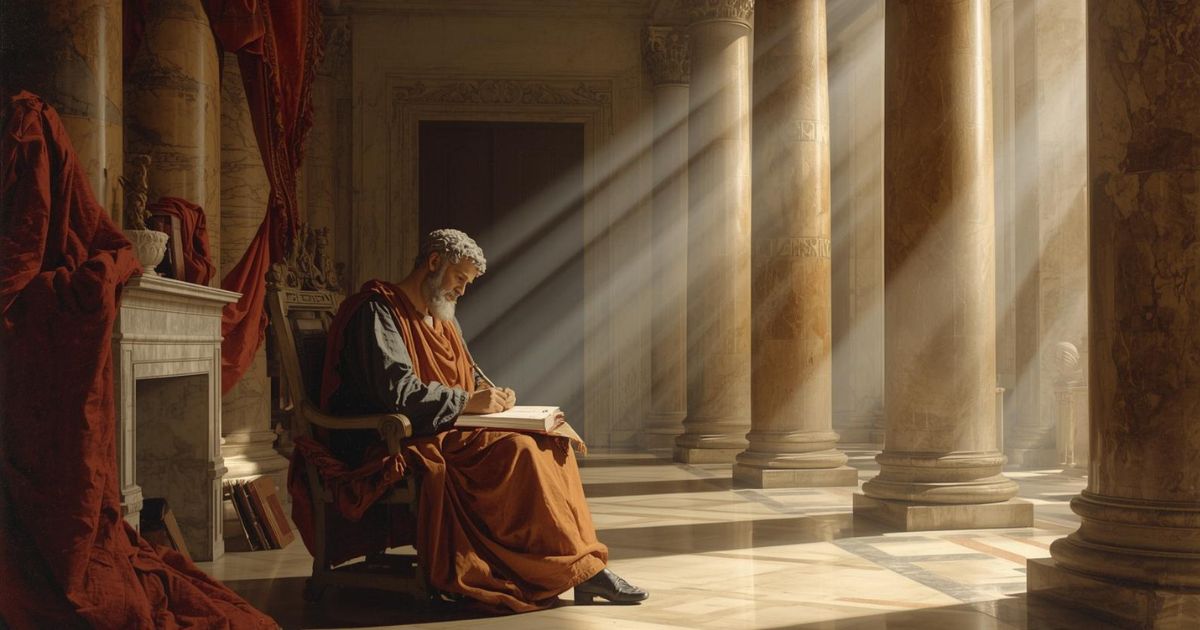
An excerpt from the original text.(complete · 1519 words)
←etter 83. On drunkennessMoral letters to Luciliusby Seneca, translated by Richard Mott GummereLetter 84. On gathering ideasLetter 85. On some vain syllogisms→483383Moral letters to Lucilius — Letter 84. On gathering ideasRichard Mott GummereSeneca LXXXIV. ON GATHERING IDEAS[1] 1. The journeys to which you refer—journeys that shake the laziness out of my system—I hold to be profitable both for my health and for my studies. You see why they benefit my health: since my passion for literature makes me lazy and careless about my body, I can take exercise by deputy; as for my studies, I shall show you why my journeys help them, for I have not stopped my reading in the slightest degree. And reading, I hold, is indispensable—primarily, to keep me from being satisfied with myself alone, and besides, after I have learned what others have found out by their studies, to enable me to pass judgment on their discoveries and reflect upon discoveries that remain to be made. Reading nourishes the mind and refreshes it when it is wearied with study; nevertheless, this refreshment is not obtained without study. 2. We ought not to confine ourselves either to writing or to reading; the one, continuous writing, will cast a gloom over our strength, and exhaust it; the other will make our strength flabby and watery. It is better to have recourse to them alternately, and to blend one with the other, so that the fruits of one’s reading may be reduced to concrete form by the pen. 3. We should follow, men say, the example of the bees, who flit about and cull the flowers that are suitable for producing honey, and then arrange and assort in their cells all that they have brought in; these bees, as our Vergil says, pack close the flowing honey, And swell their cells with nectar sweet.[2] 4. It is not certain whether the juice which they obtain from the flowers forms at once into honey, or whether they change that which they have gathered into this delicious object by blending something therewith and by a certain property of their breath. For some authorities believe that bees do not possess the art of making honey, but only of gathering it; and they say that in India honey has been found on the leaves of certain reeds, produced by a dew peculiar to that climate, or by the juice of the reed itself, which has an unusual sweetness, and richness.[3] And in our own grasses too, they say, the same quality exists, although less clear and less evident; and a creature born to fulfil such a function could hunt it out and collect it. Certain others maintain that the materials which the bees have culled from the most delicate of blooming and flowering plants is transformed into this peculiar substance by a process of preserving and careful storing away, aided by what might be called fermentation,—whereby separate elements are united into one substance. 5. But I must not be led astray into another subject than that which we are discussing. We also, I say, ought to copy these bees, and sift whatever we have gathered from a varied course of reading, for such things are better preserved if they are kept separate; then, by applying the supervising care with which our nature has endowed us,—in other words, our natural gifts,—we should so blend those several flavours into one delicious compound that, even though it betrays its origin, yet it nevertheless is clearly a different thing from that whence it came. This is what we see nature doing in our own bodies without any labour on our part; 6. the food we have eaten, as long as it retains its original quality and floats in our stomachs as an undiluted mass, is a burden;[4] but it passes into tissue and blood only when it has been changed from its original form. So it is with the food which nourishes our higher nature,—we should see to it that whatever we have absorbed should not be allowed to remain unchanged, or it will be no part of us. 7. We must digest it; otherwise it will merely enter the memory and not the reasoning power. Let us loyally welcome such foods and make them our own, so that something that is one may be formed out of many elements, just as one number is formed of several elements whenever, by our reckoning, lesser sums, each different from the others, are brought together. This is what our mind should do: it should hide away all the materials by which it has been aided, and bring to light only what it has made of them. 8. Even if there shall appear in you a likeness to him who, by reason of your admiration, has left a deep impress upon you, I would have you resemble him as a child resembles his father, and not as a picture resembles its original; for a picture is a lifeless thing. “What,” you say, “will it not be seen whose style you are imitating, whose method of reasoning, whose pungent sayings?” I think that sometimes it is impossible for it to be seen who is being imitated, if the copy is a true one; for a true copy stamps its own form upon all the features which it has drawn from what we may call the original, in such a way that they are combined into a unity. 9. Do you not see how many voices there are in a chorus? Yet out of the many only one voice results. In that chorus one voice takes the tenor, another the bass, another the baritone. There are women, too, as well as men, and the flute is mingled with them. In that chorus the voices of the individual singers are hidden; what we hear is the voices of all together. 10. To be sure, I am referring to the chorus which the old-time philosophers knew; in our present-day exhibitions[5] we have a larger number of singers than there used to be spectators in the theatres of old. All the aisles are filled with rows of singers; brass instruments surround the auditorium; the stage resounds with flutes and instruments of every description; and yet from the discordant sounds a harmony is produced. I would have my mind of such a quality as this; it should be equipped with many arts, many precepts, and patterns of conduct taken from many epochs of history; but all should blend harmoniously into one. 11. “How,” you ask, “can this be accomplished?” By constant effort, and by doing nothing without the approval of reason. And if you are willing to hear her voice, she will say to you: “Abandon those pursuits which heretofore have caused you to run hither and thither. Abandon riches, which are either a danger or a burden to the possessor. Abandon the pleasures of the body and of the mind; they only soften and weaken you. Abandon your quest for office; it is a swollen, idle, and empty thing, a thing that has no goal, as anxious to see no one outstrip it as to see no one at its heels. It is afflicted with envy, and in truth with a twofold envy; and you see how wretched a man’s plight is if he who is the object of envy feels envy also.” 12. Do you behold yonder homes of the great, yonder thresholds uproarious with the brawling of those who would pay their respects? They have many an insult[6] for you as you enter the door, and still more after you have entered. Pass by the steps that mount to rich men’s houses, and the porches rendered hazardous by the huge throng; for there you will be standing, not merely on the edge of a precipice but also on slippery ground. Instead of this, direct your course hither to wisdom, and seek her ways, which are ways of surpassing peace and plenty. 13. Whatever seems conspicuous in the affairs of men—however petty it may really be and prominent only by contrast with the lowest objects—is nevertheless approached by a difficult and toilsome pathway. It is a rough road that leads to the heights of greatness; but if you desire to scale this peak, which lies far above the range of Fortune, you will indeed look down from above upon all that men regard as most lofty, but none the less you can proceed to the top over level ground. Farewell. ↑ A considerable part of this letter is found in the preface to the Saturnalia of Macrobius, without any acknowledgement of indebtedness. ↑ Aeneid, i. 432 f. ↑ Cf. mel in harundinibus collectum (from India) in Pliny, N. H. xii. 32 (Summers). ↑ The same figure is used in reference to reading, in Ep. ii. 2 f., non prodest cibus nec corpori accedit, qui statim sumptus emittitur, etc. ↑ Commissio means an entertainment, or a concert; cf. Pliny, Panegyric 54, ludis et commissionibus. ↑ For such treatment cf. Juvenal iii. 152 f.— Nil habet infelix paupertas durius in se Quam quod ridiculos homines facit, etc.
Master this chapter. Complete your experience
Purchase the complete book to access all chapters and support classic literature
As an Amazon Associate, we earn a small commission from qualifying purchases at no additional cost to you.
Available in paperback, hardcover, and e-book formats
Let's Analyse the Pattern
Mistaking the accumulation of information for the development of wisdom, leading to mental clutter without practical understanding.
Why This Matters
Connect literature to life
This chapter teaches how to recognize when you're truly learning versus just collecting information.
Practice This Today
This week, notice when you feel 'informed' but can't actually apply what you've learned—then pause and process one piece thoroughly before consuming more.
Now let's explore the literary elements.
Key Quotes & Analysis
"We ought not to confine ourselves either to writing or to reading; the one, continuous writing, will cast a gloom over our strength, and exhaust it; the other will make our strength flabby and watery."
Context: Explaining why balance is needed in learning
Seneca warns against two extremes in learning - only consuming information makes you mentally soft, while only producing content burns you out. He advocates for a balanced approach that strengthens both input and output.
In Today's Words:
Don't just scroll through content all day, but don't try to create constantly either - you need both to actually learn anything.
"Reading nourishes the mind and refreshes it when it is wearied with study; nevertheless, this refreshment is not obtained without study."
Context: Describing the proper role of reading in learning
Reading isn't just entertainment or passive consumption - it's an active process that requires mental effort. True refreshment comes from engaging with ideas, not just letting them wash over you.
In Today's Words:
Reading good stuff can recharge your brain, but only if you're actually thinking about what you're reading, not just zoning out.
"It is better to have recourse to them alternately, and to blend one with the other, so that the fruits of one's reading may be reduced to concrete form by the pen."
Context: Advocating for combining reading with writing
The key to real learning is processing what you read by writing about it. This transforms abstract ideas into concrete understanding that you can actually use in your life.
In Today's Words:
Take notes, write about what you read, or explain it to someone else - that's how you actually learn instead of just collecting information.
Thematic Threads
Personal Growth
In This Chapter
Seneca emphasizes that real growth comes from processing and integrating knowledge, not just collecting it
Development
Builds on earlier themes about self-examination by showing how to actually develop wisdom
In Your Life:
You might recognize this when you feel overwhelmed by advice but unclear on what to actually do
Class
In This Chapter
Seneca warns against pursuing wealth and status, suggesting wisdom offers more lasting security than material success
Development
Continues his critique of social climbing while offering an alternative path to respect and security
In Your Life:
You see this when choosing between a higher-paying job that drains you versus work that builds your skills and knowledge
Identity
In This Chapter
The letter emphasizes developing your own voice rather than just imitating others, even respected thinkers
Development
Extends earlier themes about authentic self-presentation by showing how to build genuine expertise
In Your Life:
You experience this when learning to trust your own judgment instead of always deferring to experts or authority figures
Social Expectations
In This Chapter
Seneca challenges the expectation that learning means impressing others with what you know
Development
Deepens his critique of performative behavior by focusing on internal versus external validation of knowledge
In Your Life:
You might notice this when you feel pressure to sound smart in conversations rather than actually understanding the topic
You now have the context. Time to form your own thoughts.
Discussion Questions
- 1
Seneca compares learning to how bees make honey. What's the difference between what bees collect and what they create?
analysis • surface - 2
Why does Seneca say that only reading makes your thinking 'weak and watery' while only writing 'exhausts' you?
analysis • medium - 3
Think about your workplace training or social media consumption. Where do you see people collecting information without digesting it?
application • medium - 4
When you learn something new—whether from a conversation, training, or article—how could you 'digest' it instead of just storing it?
application • deep - 5
What does this chapter reveal about the difference between appearing smart and actually being wise?
reflection • deep
Critical Thinking Exercise
Transform Your Information Diet
Choose something you recently read, watched, or learned—maybe from work training, a news article, or a conversation. Write down the main points, then transform them: What does this mean for your specific situation? How could you apply one piece immediately? What questions does it raise about your own experience?
Consider:
- •Focus on one piece of information rather than trying to process everything at once
- •Ask yourself what you would tell someone else about this topic in your own words
- •Think about how this connects to something you already know or have experienced
Journaling Prompt
Write about a time when you felt overwhelmed by information but couldn't figure out how to use it. What would you do differently now?
Coming Up Next...
Chapter 85: When Emotions Take Control
Seneca shifts from practical learning advice to tackle some thorny logical puzzles, promising to challenge Lucilius with the kind of philosophical problems that test both reasoning skills and patience.