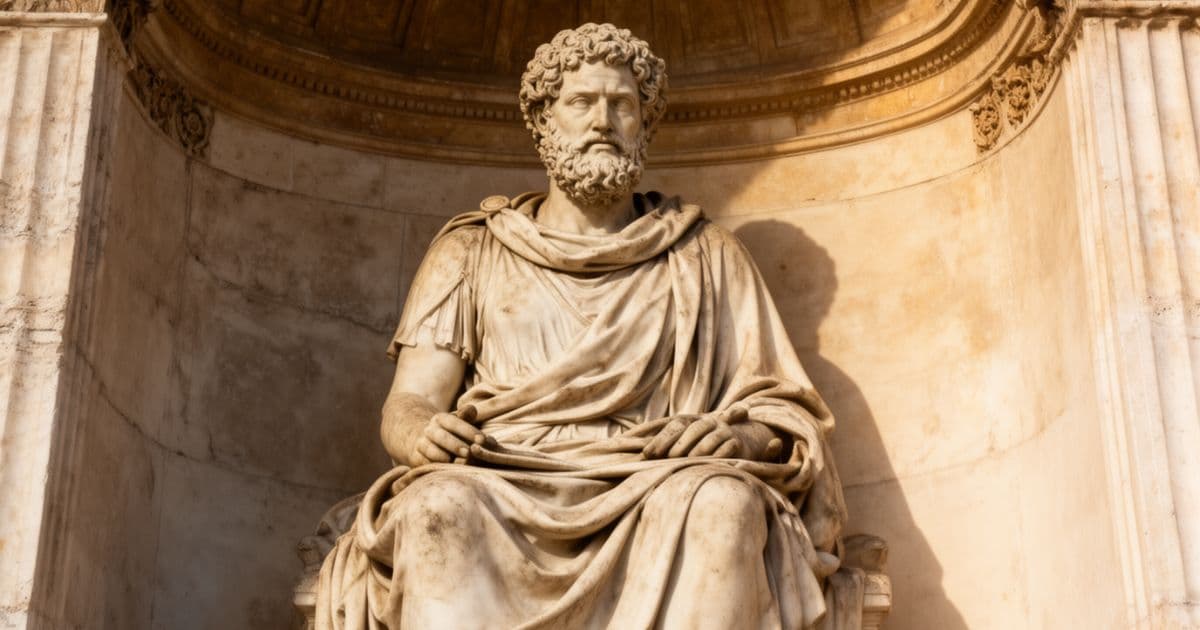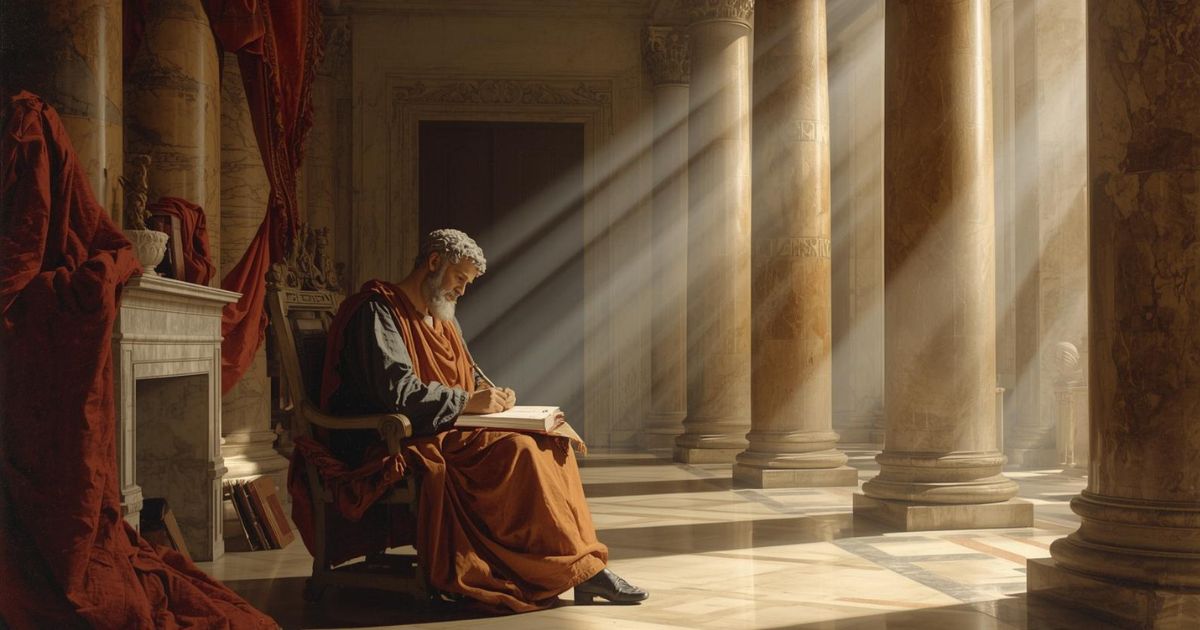
An excerpt from the original text.(complete · 3084 words)
←etter 81. On benefitsMoral letters to Luciliusby Seneca, translated by Richard Mott GummereLetter 82. On the natural fear of deathLetter 83. On drunkenness→483381Moral letters to Lucilius — Letter 82. On the natural fear of deathRichard Mott GummereSeneca LXXXII. ON THE NATURAL FEAR OF DEATH 1. I have already ceased to be anxious about you. “Whom then of the gods,” you ask, “have you found as your voucher?”[1] A god, let me tell you, who deceives no one,—a soul in love with that which is upright and good. The better part of yourself is on safe ground. Fortune can inflict injury upon you; what is more pertinent is that I have no fears lest you do injury to yourself. Proceed as you have begun, and settle yourself in this way of living, not luxuriously, but calmly. 2. I prefer to be in trouble rather than in luxury; and you had better interpret the term “in trouble” as popular usage is wont to interpret it: living a “hard,” “rough,” “toilsome” life. We are wont to hear the lives of certain men praised as follows, when they are objects of unpopularity: “So-and-So lives luxuriously”; but by this they mean: “He is softened by luxury.” For the soul is made womanish by degrees, and is weakened until it matches the ease and laziness in which it lies. Lo, is it not better for one who is really a man even to become hardened[2]? Next, these same dandies fear that which they have made their own lives resemble. Much difference is there between lying idle and lying buried[3]! 3. “But,” you say, “is it not better even to lie idle than to whirl round in these eddies of business distraction?” Both extremes are to be deprecated—both tension and sluggishness. I hold that he who lies on a perfumed couch is no less dead than he who is dragged along by the executioner’s hook. Leisure without study is death; it is a tomb for the living man. 4. What then is the advantage of retirement? As if the real causes of our anxieties did not follow us across the seas! What hiding-place is there, where the fear of death does not enter? What peaceful haunts are there, so fortified and so far withdrawn that pain does not fill them with fear? Wherever you hide yourself, human ills will make an uproar all around. There are many external things which compass us about, to deceive us or to weigh upon us; there are many things within which, even amid solitude, fret and ferment. 5. Therefore, gird yourself about with philosophy, an impregnable wall. Though it be assaulted by many engines, Fortune can find no passage into it. The soul stands on unassailable ground, if it has abandoned external things; it is independent in its own fortress; and every weapon that is hurled falls short of the mark. Fortune has not the long reach with which we credit her; she can seize none except him that clings to her. 6. Let us then recoil from her as far as we are able. This will be possible for us only through knowledge of self and of the world[4] of Nature. The soul should know whither it is going and whence it came, what is good for it and what is evil, what it seeks and what it avoids, and what is that Reason which distinguishes between the desirable and the undesirable, and thereby tames the madness of our desires and calms the violence of our fears. 7. Some men flatter themselves that they have checked these evils by themselves even without the aid of philosophy; but when some accident catches them off their guard, a tardy confession of error is wrung from them. Their boastful words perish from their lips when the torturer commands them to stretch forth their hands, and when death draws nearer! You might say to such a man: “It was easy for you to challenge evils that were not near-by; but here comes pain, which you declared you could endure; here comes death, against which you uttered many a courageous boast! The whip cracks, the sword flashes: Ah now, Aeneas, thou must needs be stout And strong of heart!”[5] 8. This strength of heart, however, will come from constant study, provided that you practise, not with the tongue but with the soul, and provided that you prepare yourself to meet death. To enable yourself to meet death, you may expect no encouragement or cheer from those who try to make you believe, by means of their hair-splitting logic, that death is no evil. For I take pleasure, excellent Lucilius, in poking fun at the absurdities of the Greeks, of which, to my continual surprise, I have not yet succeeded in ridding myself. 9. Our master Zeno[6] uses a syllogism like this: “No evil is glorious; but death is glorious; therefore death is no evil.” A cure, Zeno! I have been freed from fear; henceforth I shall not hesitate to bare my neck on the scaffold. Will you not utter sterner words instead of rousing a dying man to laughter? Indeed, Lucilius, I could not easily tell you whether he who thought that he was quenching the fear of death by setting up this syllogism was the more foolish, or he who attempted to refute it, just as if it had anything to do with the matter! 10. For the refuter himself proposed a counter-syllogism, based upon the proposition that we regard death as “indifferent,”—one of the things which the Greeks call ἀδιάφορα.[7] “Nothing,” he says, “that is indifferent can be glorious; death is glorious; therefore death is not indifferent.” You comprehend the tricky fallacy which is contained in this syllogism: mere death is, in fact, not glorious; but a brave death is glorious. And when you say: “Nothing that is indifferent is glorious,” I grant you this much, and declare that nothing is glorious except as it deals with indifferent things. I classify as “indifferent,”—that is, neither good nor evil—sickness, pain, poverty, exile, death. 11. None of these things is intrinsically glorious; but nothing can be glorious apart from them. For it is not poverty that we praise, it is the man whom poverty cannot humble or bend. Nor is it exile that we praise, it is the man who withdraws into exile in the spirit in which he would have sent another into exile. It is not pain that we praise, it is the man whom pain has not coerced. One praises not death, but the man whose soul death takes away before it can confound it. 12. All these things are in themselves neither honourable nor glorious; but any one of them that virtue has visited and touched is made honourable and glorious by virtue; they merely lie in between,[8] and the decisive question is only whether wickedness or virtue has laid hold upon them. For instance, the death which in Cato’s case is glorious, is in the case of Brutus[9] forthwith base and disgraceful. For this Brutus, condemned to death, was trying to obtain postponement; he withdrew a moment in order to ease himself; when summoned to die and ordered to bare his throat, he exclaimed: “I will bare my throat, if only I may live!” What madness it is to run away, when it is impossible to turn back! “I will bare my throat, if only I may live!” He came very near saying also: “even under Antony!” This fellow deserved indeed to be consigned to life! 13. But, as I was going on to remark, you see that death in itself is neither an evil nor a good; Cato experienced death most honourably, Brutus most basely. Everything, if you add virtue, assumes a glory which it did not possess before. We speak of a sunny room, even though the same room is pitch-dark at night. 14. It is the day which fills it with light, and the night which steals the light away; thus it is with the things which we call indifferent and “middle,”[10] like riches, strength, beauty, titles, kingship, and their opposites,—death, exile, ill-health, pain, and all such evils, the fear of which upsets us to a greater or less extent; it is the wickedness or the virtue that bestows the name of good or evil. An object is not by its own essence either hot or cold; it is heated when thrown into a furnace, and chilled when dropped into water. Death is honourable when related to that which is honourable; by this I mean virtue and a soul that despises the worst hardships. 15. Furthermore, there are vast distinctions among these qualities which we call “middle.” For example, death is not so indifferent as the question whether your hair should be worn evenly or unevenly. Death belongs among those things which are not indeed evils, but still have in them a semblance of evil; for there are implanted in us love of self, a desire for existence and self-preservation, and also an abhorrence of dissolution, because death seems to rob us of many goods and to withdraw us from the abundance to which we have become accustomed. And there is another element which estranges us from death: we are already familiar with the present, but are ignorant of the future into which we shall transfer ourselves, and we shrink from the unknown. Moreover, it is natural to fear the world of shades, whither death is supposed to lead. 16. Therefore, although death is something indifferent, it is nevertheless not a thing which we can easily ignore. The soul must be hardened by long practice, so that it may learn to endure the sight and the approach of death. Death ought to be despised more than it is wont to be despised. For we believe too many of the stories about death. Many thinkers have striven hard to increase its ill repute; they have portrayed the prison in the world below and the land overwhelmed by everlasting night, where Within his blood-stained cave Hell’s warder huge Doth sprawl his ugly length on half-crunched bones, And terrifies the disembodied ghosts With never-ceasing bark.[11] Even if you can win your point and prove that these are mere stories and that nothing is left for the dead to fear, another fear steals upon you. For the fear of going to the underworld is equalled by the fear of going nowhere. 17. In the face of these notions, which long-standing opinion has dinned in our ears, how can brave endurance of death be anything else than glorious, and fit to rank among the greatest accomplishments of the human mind? For the mind will never rise to virtue if it believes that death is an evil; but it will so rise if it holds that death is a matter of indifference. It is not in the order of nature that a man shall proceed with a great heart to a destiny which he believes to be evil; he will go sluggishly and with reluctance. But nothing glorious can result from unwillingness and cowardice; virtue does nothing under compulsion. 18. Besides, no deed that a man does is honourable unless he has devoted himself thereto and attended to it with all his heart, rebelling against it with no portion of his being. When, however, a man goes to face an evil, either through fear of worse evils or in the hope of goods whose attainment is of sufficient moment to him that he can swallow the one evil which he must endure,—in that case the judgment of the agent is drawn in two directions. On the one side is the motive which bids him carry out his purpose; on the other, the motive which restrains him and makes him flee from something which has aroused his apprehension or leads to danger. Hence he is torn in different directions; and if this happens, the glory of his act is gone. For virtue accomplishes its plans only when the spirit is in harmony with itself. There is no element of fear in any of its actions. Yield not to evils, but, still braver, go Where’er thy fortune shall allow.[12] 19. You cannot “still braver go,” if you are persuaded that those things are the real evils. Root out this idea from your soul; otherwise your apprehensions will remain undecided and will thus check the impulse to action. You will be pushed into that towards which you ought to advance like a soldier. Those of our school, it is true, would have men think that Zeno’s syllogism[13] is correct, but that the second[13] I mentioned, which is set up against his, is deceptive and wrong. But I for my part decline to reduce such questions to a matter of dialectical rules or to the subtleties of an utterly worn-out system. Away, I say, with all that sort of thing, which makes a man feel, when a question is propounded to him, that he is hemmed in, and forces him to admit a premiss, and then makes him say one thing in his answer when his real opinion is another.[14] When truth is at stake, we must act more frankly; and when fear is to be combated, we must act more bravely. 20. Such questions, which the dialecticians involve in subtleties, I prefer to solve and weigh rationally, with the purpose of winning conviction and not of forcing the judgment. When a general is about to lead into action an army prepared to meet death for their wives and children, how will he exhort them to battle? I remind you of the Fabii,[15] who took upon a single clan a war which concerned the whole state. I point out to you the Lacedaemonians in position at the very pass of Thermopylae! They have no hope of victory, no hope of returning. The place where they stand is to be their tomb. 21. In what language do you encourage them to bar the way with their bodies and take upon themselves the ruin of their whole tribe, and to retreat from life rather than from their post? Shall you say: “That which is evil is not glorious; but death is glorious; therefore death is not an evil”? What a powerful discourse! After such words, who would hesitate to throw himself upon the serried spears of the foemen, and die in his tracks? But take Leonidas: how bravely did he address his men! He said: “Fellow-soldiers, let us to our breakfast, knowing that we shall sup in Hades!”[16] The food of these men did not grow lumpy in their mouths, or stick in their throats, or slip from their fingers; eagerly did they accept the invitation to breakfast, and to supper also! 22. Think, too, of the famous Roman general;[17] his soldiers had been dispatched to seize a position, and when they were about to make their way through a huge army of the enemy, he addressed them with the words: “You must go now, fellow-soldiers, to yonder place, whence there is no ’must’ about your returning!” You see, then, how straightforward and peremptory virtue is; but what man on earth can your deceptive logic make more courageous or more upright? Rather does it break the spirit, which should never be less straitened or forced to deal with petty and thorny problems than when some great work is being planned. 23. It is not the Three Hundred,[18]—it is all mankind that should be relieved of the fear of death. But how can you prove to all those men that death is no evil? How can you overcome the notions of all our past life,—notions with which we are tinged from our very infancy? What succour can you discover for man’s helplessness? What can you say that will make men rush, burning with zeal, into the midst of danger? By what persuasive speech can you turn aside this universal feeling of fear, by what strength of wit can you turn aside the conviction of the human race which steadfastly opposes you? Do you propose to construct catchwords for me, or to string together petty syllogisms? It takes great weapons to strike down great monsters. 24. You recall the fierce serpent in Africa, more frightful to the Roman legions than the war itself, and assailed in vain by arrows and slings; it could not be wounded even by “Pythius,”[19] since its huge size, and the toughness which matched its bulk, made spears, or any weapon hurled by the hand of man, glance off. It was finally destroyed by rocks equal in size to millstones. Are you, then, hurling petty weapons like yours even against death? Can you stop a lion’s charge by an awl?[20] Your arguments are indeed sharp; but there is nothing sharper than a stalk of grain. And certain arguments are rendered useless and unavailing by their very subtlety. Farewell. ↑ One who incurs liability by taking upon himself the debt of another. It is part of the process known as intercessio. ↑ Rather than mollis. ↑ Conditivum (more frequently and properly conditorium) is a grim jest. The word is mostly found in an adjectival sense applying to fruits and grain stored for later use. ↑ Compare Arnold’s nineteenth-century definition of culture. ↑ Vergil, Aeneid, vi. 261. ↑ Frag. 196 von Arnim. ↑ Defined by the Greeks as “things which have no direct connexion either with happiness or unhappiness.” See Cicero, De Finibus, iii. 50 ff. ↑ i.e., are “indifferent” (cf. § 14 indifferentia ac media dicuntur). ↑ Presumably D. Junius Brutus, who finally incurred the enmity of both Octavian and Antony. He was ignominiously put to death by a Gaul while fleeing to join M. Brutus in Macedonia. ↑ media: a technical word in Stoic philosophy, meaning neither good or bad. ↑ See Vergil, Aeneid, vi. 400 f. and viii. 296 f. ↑ Vergil, Aeneid, vi. 95 f., the advice of the Sibyl to Aeneas. ↑ 13.0 13.1 Cf. §§ 9 and 10. ↑ Cf. Ep. xlviii. 4 ff. ↑ Cf. Livy, ii. 49. 1 familiam unam subisse civitatis onus. ↑ Οὕτως ἀριστᾶτε ὡς ἐν ᾅδου δειπνήσοντες,—quoted by Stobaeus, Plutarch, and Diodorus. Cicero says (Tusc. i. 101) hodie apud inferos fortasse cenabimus. ↑ Calpurnius, in Sicily, during the first Punic war. Cf. Livy, xxii. 60. 11. ↑ The soldiers of Leonidas. ↑ An especially large machine for assaulting walls; a nickname, like the modern “Long Tom.” ↑ Cf. Ep. lxxxv. 1 pudet in aciem descendere pro dis hominibusque susceptam subula armatum.
Master this chapter. Complete your experience
Purchase the complete book to access all chapters and support classic literature
As an Amazon Associate, we earn a small commission from qualifying purchases at no additional cost to you.
Available in paperback, hardcover, and e-book formats
Let's Analyse the Pattern
Refusing to think about difficult realities makes us mentally soft and unprepared when those realities inevitably arrive.
Why This Matters
Connect literature to life
This chapter teaches how to distinguish between what happens to you and how you choose to handle it—a crucial skill for resilience.
Practice This Today
This week, when something disappointing happens, pause and ask: 'What's the event, and what's my response?' Notice how you can control one but not the other.
Now let's explore the literary elements.
Key Quotes & Analysis
"I prefer to be in trouble rather than in luxury"
Context: Seneca is explaining his philosophy of life to Lucilius
This captures the core Stoic idea that comfort makes us weak while challenges make us strong. Seneca isn't promoting suffering for its own sake, but recognizing that difficulty builds character while ease erodes it.
In Today's Words:
I'd rather deal with real problems than get soft from having it too easy
"The soul is made womanish by degrees, and is weakened until it matches the ease and laziness in which it lies"
Context: Warning about how luxury corrupts character over time
Using the gender assumptions of his time, Seneca argues that constant comfort gradually weakens our ability to handle difficulty. It's a process that happens slowly, making it dangerous because we don't notice it happening.
In Today's Words:
When life's too easy for too long, you lose your ability to handle anything tough
"Death is neither good nor evil - it is neutral"
Context: Explaining the Stoic position on death's moral status
This is the central philosophical point of the letter. By removing moral judgment from death itself, Seneca frees us to focus on how we live and how we face death, which are the things we can actually control.
In Today's Words:
Death isn't good or bad - it just is. What matters is how you handle it
Thematic Threads
Class
In This Chapter
Seneca argues that luxury and comfort make people weak, while those who face hardship develop strength and courage
Development
Builds on earlier themes about how wealth can corrupt character, now specifically linking comfort to cowardice
In Your Life:
You might notice that your most comfortable periods don't build the skills you need for your hardest challenges
Identity
In This Chapter
How we face death reveals who we really are—Cato died with honor, Brutus begged pathetically, showing their true characters
Development
Extends the theme of authentic self versus performed self, now tested at life's ultimate moment
In Your Life:
You might recognize that crisis moments reveal your real values, not the ones you claim to have
Personal Growth
In This Chapter
Growth comes from practicing difficult things regularly, not from avoiding them until crisis forces your hand
Development
Reinforces the consistent theme that virtue requires practice and preparation, not just good intentions
In Your Life:
You might see that the conversations or decisions you're avoiding are exactly what you need to practice
Social Expectations
In This Chapter
Society encourages us to avoid thinking about death and difficulty, but this social comfort makes us individually weak
Development
Continues exploring how social norms can conflict with personal development and wisdom
In Your Life:
You might notice pressure to avoid 'negative' topics that actually need discussion in your family or workplace
Human Relationships
In This Chapter
Our fear of death often stems from attachment to people and familiar things, which is natural but can become paralyzing
Development
Develops the theme of how our connections to others shape our fears and decisions
In Your Life:
You might recognize that some of your biggest fears involve losing the people or stability you depend on
You now have the context. Time to form your own thoughts.
Discussion Questions
- 1
Seneca compares living in luxury to being already dead. What specific similarities does he point out between a pampered life and death?
analysis • surface - 2
Why does Seneca think philosophical arguments about death being 'not evil' are useless? What does he say we need instead?
analysis • medium - 3
Where do you see people avoiding difficult conversations about death, money, or other hard topics in your own community? What usually happens when the crisis hits anyway?
application • medium - 4
Seneca says we need 'big weapons to fight big monsters.' If you had to prepare someone you care about for a major life challenge, how would you build their strength beforehand rather than just giving them clever sayings?
application • deep - 5
What does the difference between Cato's and Brutus's deaths reveal about how our daily choices shape who we become in crisis moments?
reflection • deep
Critical Thinking Exercise
Practice the Difficult Conversation
Think of one important topic you've been avoiding with someone close to you—maybe money, health, future plans, or family responsibilities. Write down exactly what you would say to start that conversation, focusing on honest facts rather than worst-case fears. Then identify what specific small step you could take this week to begin building strength for handling this topic.
Consider:
- •Focus on what you can control rather than what scares you most
- •Consider how avoiding this conversation might be making both of you weaker
- •Think about what 'mental muscle' you need to build before the crisis hits
Journaling Prompt
Write about a time when you avoided a difficult conversation and later wished you had faced it sooner. What would you do differently now, knowing what Seneca teaches about building strength through practice?
Coming Up Next...
Chapter 83: Why Logic Fails Against Real Vice
After confronting our deepest fear, Seneca shifts to a more immediate concern: how we lose control of ourselves through drink. He'll examine what drunkenness reveals about our character and why temporary escapes often create permanent problems.