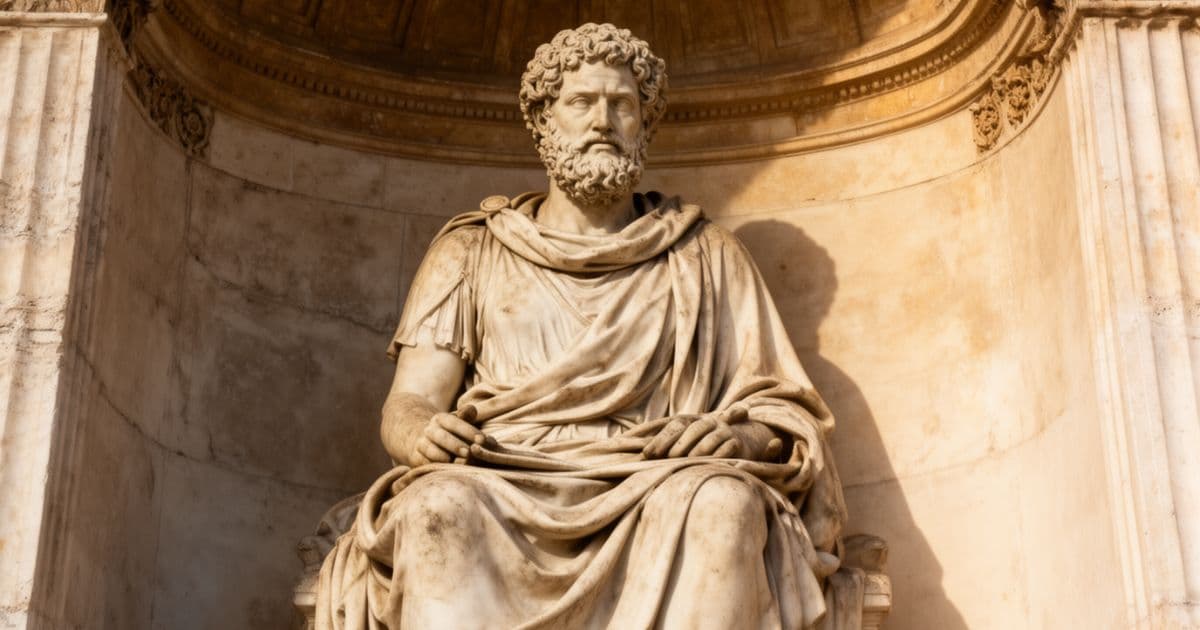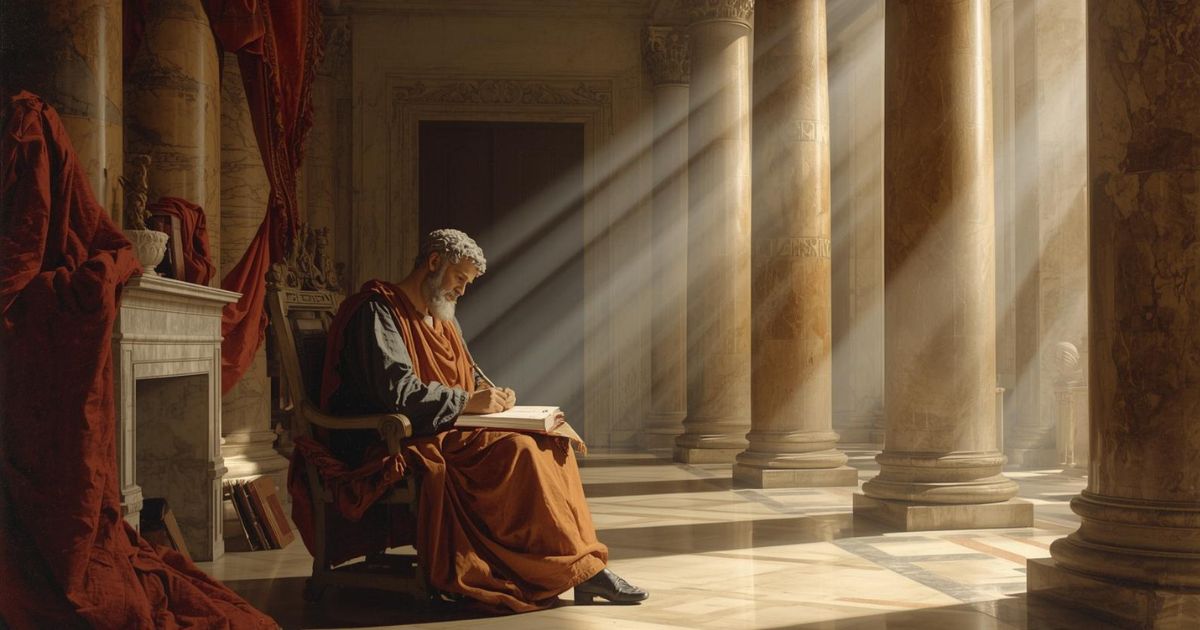
An excerpt from the original text.(complete · 1603 words)
←etter 55. On Vatia's villaMoral letters to Luciliusby Seneca, translated by Richard Mott GummereLetter 56. On quiet and studyLetter 57. On the trials of travel→483031Moral letters to Lucilius — Letter 56. On quiet and studyRichard Mott GummereSeneca LVI. ON QUIET AND STUDY 1. Beshrew me if I think anything more requisite than silence for a man who secludes himself in order to study! Imagine what a variety of noises reverberates about my ears! I have lodgings right over a bathing establishment. So picture to yourself the assortment of sounds, which are strong enough to make me hate my very powers of hearing! When your strenuous gentleman, for example, is exercising himself by flourishing leaden weights; when he is working hard, or else pretends to be working hard, I can hear him grunt; and whenever he releases his imprisoned breath, I can hear him panting in wheezy and high-pitched tones. Or perhaps I notice some lazy fellow, content with a cheap rubdown, and hear the crack of the pummeling hand on his shoulder, varying in sound according as the hand is laid on flat or hollow. Then, perhaps, a professional[1] comes along, shouting out the score; that is the finishing touch. 2. Add to this the arresting of an occasional roysterer or pickpocket, the racket of the man who always likes to hear his own voice in the bathroom,[2] or the enthusiast who plunges into the swimming-tank with unconscionable noise and splashing. Besides all those whose voices, if nothing else, are good, imagine the hair-plucker with his penetrating, shrill voice,—for purposes of advertisement,—continually giving it vent and never holding his tongue except when he is plucking the armpits and making his victim yell instead. Then the cake-seller with his varied cries, the sausageman, the confectioner, and all the vendors of food hawking their wares, each with his own distinctive intonation. 3. So you say: “What iron nerves or deadened ears, you must have, if your mind can hold out amid so many noises, so various and so discordant, when our friend Chrysippus[3] is brought to his death by the continual good-morrows that greet him!” But I assure you that this racket means no more to me than the sound of waves or falling water; although you will remind me that a certain tribe once moved their city merely because they could not endure the din of a Nile cataract.[4] 4. Words seem to distract me more than noises; for words demand attention, but noises merely fill the ears and beat upon them. Among the sounds that din round me without distracting, I include passing carriages, a machinist in the same block, a saw-sharpener near by, or some fellow who is demonstrating with little pipes and flutes at the Trickling Fountain,[5] shouting rather than singing. 5. Furthermore, an intermittent noise upsets me more than a steady one. But by this time I have toughened my nerves against all that sort of thing, so that I can endure even a boatswain marking the time in high-pitched tones for his crew. For I force my mind to concentrate, and keep it from straying to things outside itself; all outdoors may be bedlam, provided that there is no disturbance within, provided that fear is not wrangling with desire in my breast, provided that meanness and lavishness are not at odds, one harassing the other. For of what benefit is a quiet neighbourhood, if our emotions are in an uproar? 6. ’Twas night, and all the world was lulled to rest.[6] This is not true; for no real rest can be found when reason has not done the lulling. Night brings our troubles to the light, rather than banishes them; it merely changes the form of our worries. For even when we seek slumber, our sleepless moments are as harassing as the daytime. Real tranquillity is the state reached by an unperverted mind when it is relaxed. 7. Think of the unfortunate man who courts sleep by surrendering his spacious mansion to silence, who, that his ear may be disturbed by no sound, bids the whole retinue of his slaves be quiet and that whoever approaches him shall walk on tiptoe; he tosses from this side to that and seeks a fitful slumber amid his frettings! 8. He complains that he has heard sounds, when he has not heard them at all. The reason, you ask? His soul is in an uproar; it must be soothed, and its rebellious murmuring checked. You need not suppose that the soul is at peace when the body is still. Sometimes quiet means disquiet. We must therefore rouse ourselves to action and busy ourselves with interests that are good, as often as we are in the grasp of an uncontrollable sluggishness. 9. Great generals, when they see that their men are mutinous, check them by some sort of labour or keep them busy with small forays. The much occupied man has no time for wantonness, and it is an obvious commonplace that the evils of leisure can be shaken off by hard work. Although people may often have thought that I sought seclusion because I was disgusted with politics and regretted my hapless and thankless position,[7] yet, in the retreat to which apprehension and weariness have driven me, my ambition sometimes develops afresh. For it is not because my ambition was rooted out that it has abated, but because it was wearied or perhaps even put out of temper by the failure of its plans. 10. And so with luxury, also, which sometimes seems to have departed, and then when we have made a profession of frugality, begins to fret us and, amid our economies, seeks the pleasures which we have merely left but not condemned. Indeed, the more stealthily it comes, the greater is its force. For all unconcealed vices are less serious; a disease also is farther on the road to being cured when it breaks forth from concealment and manifests its power. So with greed, ambition, and the other evils of the mind,—you may be sure that they do most harm when they are hidden behind a pretence of soundness. 11. Men think that we are in retirement, and yet we are not. For if we have sincerely retired, and have sounded the signal for retreat, and have scorned outward attractions, then, as I remarked above,[8] no outward thing will distract us; no music of men or of birds[9] can interrupt good thoughts, when they have once become steadfast and sure. 12. The mind which starts at words or at chance sounds is unstable and has not yet withdrawn into itself; it contains within itself an element of anxiety and rooted fear, and this makes one a prey to care, as our Vergil says: I, whom of yore no dart could cause to flee, Nor Greeks, with crowded lines of infantry. Now shake at every sound, and fear the air, Both for my child and for the load I bear.[10] 13. This man in his first state is wise; he blenches neither at the brandished spear, nor at the clashing armour of the serried foe, nor at the din of the stricken city. This man in his second state lacks knowledge fearing for his own concerns, he pales at every sound; any cry is taken for the battle-shout and overthrows him; the slightest disturbance renders him breathless with fear. It is the load that makes him afraid.[11] 14. Select anyone you please from among your favourites of Fortune, trailing their many responsibilities, carrying their many burdens, and you will behold a picture of Vergil’s hero, “fearing both for his child and for the load he bears.” You may therefore be sure that you are at peace with yourself, when no noise reaches you, when no word shakes you out of yourself, whether it be of flattery or of threat, or merely an empty sound buzzing about you with unmeaning din. 15. “What then?” you say, “is it not sometimes a simpler matter just to avoid the uproar?” I admit this. Accordingly, I shall change from my present quarters. I merely wished to test myself and to give myself practice. Why need I be tormented any longer, when Ulysses found so simple a cure for his comrades[12] even against the songs of the Sirens? Farewell. ↑ Pilicrepus probably means “ball-counter,”—one who keeps a record of the strokes. Compare our “billiard-marker.” ↑ This was especially true of poets, cf. Horace, Sat. i. 4. 76 suave locus voci resonat conclusus, and Martial, iii. 44. ↑ It is nowhere else related of the famous Stoic philosopher Chrysippus that he objected to the salutations of his friends; and, besides, the morning salutation was a Roman, not a Greek, custom. Lipsius, therefore, was probably right when he proposed to read here, for Chrysippus, Crispus, one of Seneca’s friends; cf. Epigr. 6. ↑ The same story is told in Naturalis Quaestiones, iv. 2. 5. ↑ A cone-shaped fountain, resembling a turning-post (meta) in the circus, from which the water spouted through many jets; hence the “sweating” (sudans). Its remains may still be seen now not far from the Colosseum on the Velia. ↑ A fragment from the Argonautica of Varro Atacinus. ↑ See Introduction, page viii. ↑ § 4 of this letter. ↑ An allusion to the Sirens and Ulysses, cf. § 15 below. ↑ Aeneas is escaping from Troy, Aeneid, ii. 726 ff. ↑ Aeneas carries Anchises; the rich man carries his burden of wealth. ↑ Not merely by stopping their ears with wax, but also by bidding them row past the Sirens as quickly as possible. Odyssey, xii. 182.
Master this chapter. Complete your experience
Purchase the complete book to access all chapters and support classic literature
As an Amazon Associate, we earn a small commission from qualifying purchases at no additional cost to you.
Available in paperback, hardcover, and e-book formats
Let's Analyse the Pattern
Attributing internal emotional disturbance to external circumstances while avoiding the real internal work that needs to be done.
Why This Matters
Connect literature to life
This chapter teaches how to identify when environmental complaints mask unresolved personal conflicts.
Practice This Today
This week, notice when external annoyances bother you more on some days than others—that's your signal to examine what internal stress might be amplifying the irritation.
Now let's explore the literary elements.
Key Quotes & Analysis
"I think nothing more requisite than silence for a man who secludes himself in order to study"
Context: Opening the letter while surrounded by bathhouse noise
This seems like Seneca is just complaining about noise, but it's actually setting up his deeper point. He's about to show that silence isn't really what we need - inner peace is.
In Today's Words:
You need quiet to focus and think clearly
"Words distract more than noise; for noise merely fills the ears, but words claim attention"
Context: Explaining why conversation bothers him more than random sounds
This reveals the key insight - it's not about volume, it's about what demands our mental energy. Random noise is just background, but words make us think and respond.
In Today's Words:
I can tune out traffic noise, but when someone's talking, I can't help but listen
"No man can have all he wants, but a man can refrain from wanting what he has not got, and cheerfully make the best of a bird in the hand"
Context: Reflecting on contentment and managing desires
This captures the Stoic approach to happiness - stop chasing what you don't have and appreciate what you do have. It's about changing your perspective, not your circumstances.
In Today's Words:
You can't have everything you want, but you can want what you have
Thematic Threads
Self-Awareness
In This Chapter
Seneca recognizes that his sensitivity to noise reflects his internal state, not the environment itself
Development
Building on earlier themes of honest self-examination, now applied to emotional triggers
In Your Life:
Notice when small annoyances feel overwhelming—it often signals deeper unresolved stress.
Class
In This Chapter
The wealthy man with silent servants still can't sleep, showing money can't buy internal peace
Development
Continues exploring how external status symbols fail to address internal struggles
In Your Life:
Your peace of mind isn't determined by your living situation or income level.
Personal Growth
In This Chapter
Seneca admits his own ongoing struggles with ambition and luxury even in retirement
Development
Reinforces that growth is continuous work, not a destination reached
In Your Life:
Personal development means acknowledging setbacks and hidden patterns, not achieving perfection.
Responsibility
In This Chapter
Using Aeneas as example—how carrying responsibility for others changes your sensitivity to threats
Development
Introduced here as new dimension of how circumstances affect our internal state
In Your Life:
Taking care of others naturally makes you more alert to potential problems and disruptions.
Control
In This Chapter
Distinguishing between what we can control (internal response) versus what we cannot (external noise)
Development
Core Stoic principle applied specifically to environmental stressors
In Your Life:
Focus energy on managing your reactions rather than trying to control your surroundings.
You now have the context. Time to form your own thoughts.
Discussion Questions
- 1
Seneca sits in a noisy apartment above a bathhouse but claims the chaos doesn't always bother him. What does he discover about when noise becomes a problem versus when it doesn't?
analysis • surface - 2
Why does Seneca say that even a wealthy man with silent servants still can't sleep peacefully? What's the real source of his restlessness?
analysis • medium - 3
Think about a time when small annoyances felt overwhelming versus when the same things didn't bother you. What was different about your internal state in those moments?
application • medium - 4
Seneca uses the example of Aeneas—once fearless in battle, now jumping at every sound because he carries responsibility for his father and son. How do our internal burdens change what we perceive as threatening?
analysis • deep - 5
When you find yourself constantly irritated by your environment—coworkers, family, neighbors—how can you tell whether the problem is truly external or if you're projecting internal conflict outward?
application • deep
Critical Thinking Exercise
Track Your Trigger Patterns
For the next three days, notice when external things irritate you—traffic, noise, other people's behavior, technology glitches. Each time, pause and ask: 'What's going on inside me right now?' Write down the external trigger and what internal state might be amplifying it. Look for patterns between your stress levels, unresolved problems, and environmental sensitivity.
Consider:
- •Notice if certain internal states (hunger, fatigue, relationship stress) make you more reactive to the same external triggers
- •Pay attention to whether the same environmental factors bother you differently on different days
- •Consider whether you're using external complaints to avoid addressing internal issues that feel harder to control
Journaling Prompt
Write about a recurring environmental complaint in your life (noisy neighbors, messy family members, difficult coworkers). What internal conflict or unmet need might this external focus be helping you avoid? What would change if you addressed the internal issue first?
Coming Up Next...
Chapter 57: Fear and the Natural Response
Having explored the connection between inner peace and external chaos, Seneca prepares for a journey from Baiae to Naples. But travel in ancient Rome brings its own challenges and philosophical lessons about discomfort, adaptation, and what we're really trying to escape when we change locations.