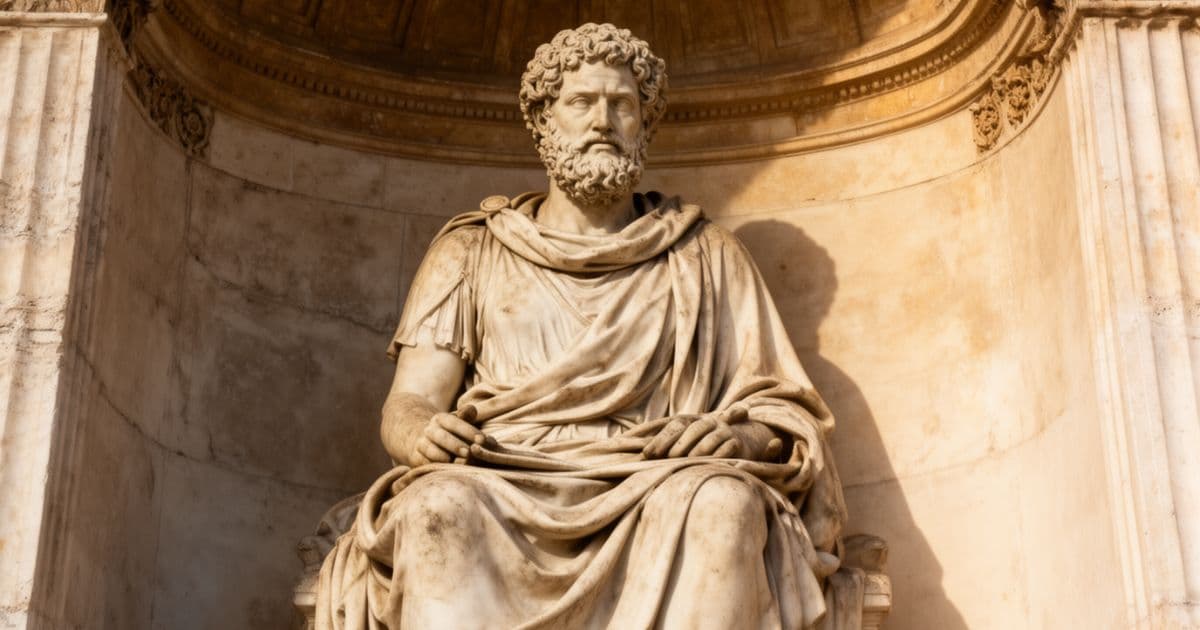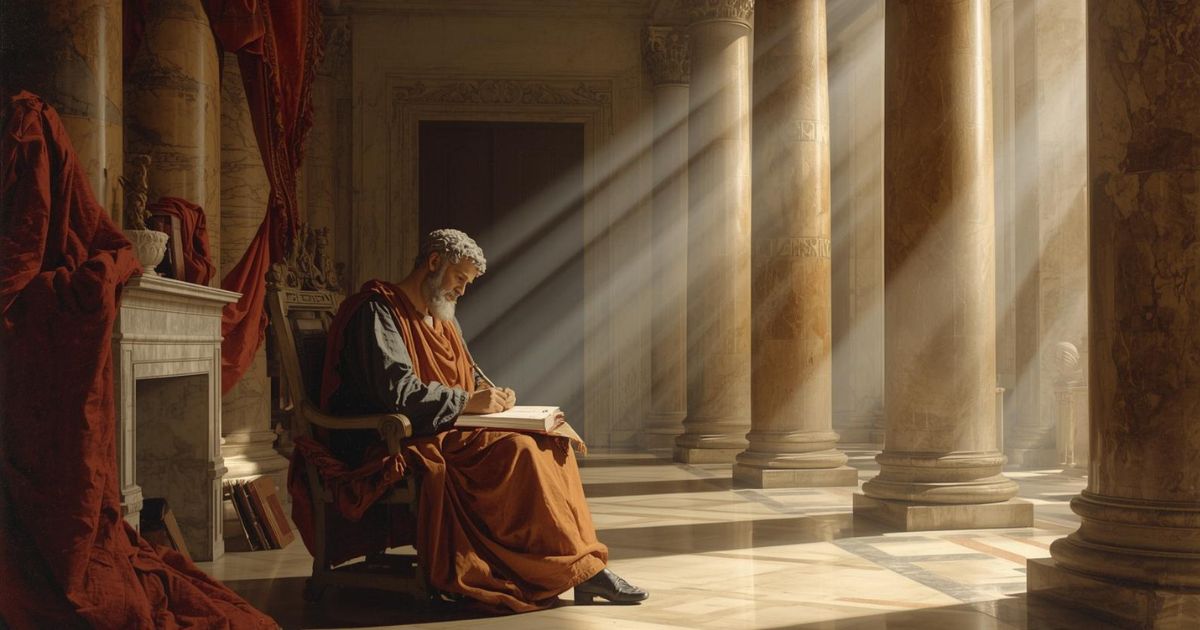
An excerpt from the original text.(complete · 1713 words)
←etter 21. On the renown which my writings will bring youMoral letters to Luciliusby Seneca, translated by Richard Mott GummereLetter 22. On the futility of half-way measuresLetter 23. On the true joy which comes from philosophy→482888Moral letters to Lucilius — Letter 22. On the futility of half-way measuresRichard Mott GummereSeneca XXII. ON THE FUTILITY OF HALF-WAY MEASURES 1. You understand by this time that you must withdraw yourself from those showy and depraved pursuits; but you still wish to know how this may be accomplished. There are certain things which can be pointed out only by someone who is present. The physician cannot prescribe by letter the proper time for eating or bathing; he must feel the pulse. There is an old adage about gladiators,—that they plan their fight in the ring; as they intently watch, something in the adversary’s glance, some movement of his hand, even some slight bending of his body, gives a warning. 2. We can formulate general rules and commit them to writing, as to what is usually done, or ought to be done; such advice may be given, not only to our absent friends, but also to succeeding generations. In regard, however, to that second[1] question,—when or how your plan is to be carried out,—no one will advise at long range; we must take counsel in the presence of the actual situation. 3. You must be not only present in the body, but watchful in mind, if you would avail yourself of the fleeting opportunity. Accordingly, look about you for the opportunity; if you see it, grasp it, and with all your energy and with all your strength devote yourself to this task,—to rid yourself of those business duties. Now listen carefully to the opinion which I shall offer; it is my opinion that you should withdraw either from that kind of existence, or else from existence altogether. But I likewise maintain that you should take a gentle path, that you may loosen rather than cut the knot which you have bungled so badly in tying,—provided that if there shall be no other way of loosening it, you may actually cut it. No man is so faint-hearted that he would rather hang in suspense for ever than drop once for all. 4. Meanwhile,—and this is of first importance,—do not hamper yourself; be content with the business into which you have lowered yourself, or, as you prefer to have people think, have tumbled. There is no reason why you should be struggling on to something further; if you do, you will lose all grounds of excuse, and men will see that it was not a tumble. The usual explanation which men offer is wrong: “I was compelled to do it. Suppose it was against my will; I had to do it.” But no one is compelled to pursue prosperity at top speed; it means something to call a halt,—even if one does not offer resistance,—instead of pressing eagerly after favouring fortune. 5. Shall you then be put out with me, if I not only come to advise you, but also call in others to advise you,—wiser heads than my own, men before whom I am wont to lay any problem upon which I am pondering? Read the letter of Epicurus[2] which bears on this matter; it is addressed to Idomeneus. The writer asks him to hasten as fast as he can, and beat a retreat before some stronger influence comes between and takes from him the liberty to withdraw. 6. But he also adds that one should attempt nothing except at the time when it can be attempted suitably and seasonably. Then, when the long-sought occasion comes, let him be up and doing. Epicurus forbids[3] us to doze when we are meditating escape; he bids us hope for a safe release from even the hardest trials, provided that we are not in too great a hurry before the time, nor too dilatory when the time arrives. 7. Now, I suppose, you are looking for a Stoic motto also. There is really no reason why anyone should slander that school to you on the ground of its rashness; as a matter of fact, its caution is greater than its courage. You are perhaps expecting the sect to utter such words as these: “It is base to flinch under a burden. Wrestle with the duties which you have once undertaken. No man is brave and earnest if he avoids danger, if his spirit does not grow with the very difficulty of his task.” 8. Words like these will indeed be spoken to you, if only your perseverance shall have an object that is worth while, if only you will not have to do or to suffer anything unworthy of a good man; besides, a good man will not waste himself upon mean and discreditable work or be busy merely for the sake of being busy. Neither will he, as you imagine, become so involved in ambitious schemes that he will have continually to endure their ebb and flow. Nay, when he sees the dangers, uncertainties, and hazards in which he was formerly tossed about, he will withdraw,—not turning his back to the foe, but falling back little by little to a safe position. 9. From business, however, my dear Lucilius, it is easy to escape, if only you will despise the rewards of business. We are held back and kept from escaping by thoughts like these: “What then? Shall I leave behind me these great prospects? Shall I depart at the very time of harvest? Shall I have no slaves at my side? no retinue for my litter? no crowd in my reception-room?” Hence men leave such advantages as these with reluctance; they love the reward of their hardships, but curse the hardships themselves. 10. Men complain about their ambitions as they complain about their mistresses; in other words, if you penetrate their real feelings, you will find, not hatred, but bickering. Search the minds of those who cry down what they have desired, who talk about escaping from things which they are unable to do without; you will comprehend that they are lingering of their own free will in a situation which they declare they find it hard and wretched to endure. 11. It is so, my dear Lucilius; there are a few men whom slavery holds fast, but there are many more who hold fast to slavery. If, however, you intend to be rid of this slavery; if freedom is genuinely pleasing in your eyes; and if you seek counsel for this one purpose,—that you may have the good fortune to accomplish this purpose without perpetual annoyance,—how can the whole company of Stoic thinkers fail to approve your course? Zeno, Chrysippus, and all their kind will give you advice that is temperate, honourable, and suitable. 12. But if you keep turning round and looking about, in order to see how much you may carry away with you, and how much money you may keep to equip yourself for the life of leisure, you will never find a way out. No man can swim ashore and take his baggage with him. Rise to a higher life, with the favour of the gods; but let it not be favour of such a kind as the gods give to men when with kind and genial faces they bestow magnificent ills, justified in so doing by the one fact that the things which irritate and torture have been bestowed in answer to prayer. 13. I was just putting the seal upon this letter; but it must be broken again, in order that it may go to you with its customary contribution, bearing with it some noble word. And lo, here is one that occurs to my mind; I do not know whether its truth or its nobility of utterance is the greater. “Spoken by whom?” you ask. By Epicurus;[4] for I am still appropriating other men’s belongings. 14. The words are: “Everyone goes out of life just as if he had but lately entered it.” Take anyone off his guard,—young, old, or middle-aged; you will find that all are equally afraid of death, and equally ignorant of life. No one has anything finished, because we have kept putting off into the future all our undertakings.[5] No thought in the quotation given above pleases me more than that it taunts old men with being infants. 15. “No one,” he says, “leaves this world in a different manner from one who has just been born.” That is not true; for we are worse when we die than when we were born; but it is our fault, and not that of Nature. Nature should scold us, saying: “What does this mean? I brought you into the world without desires or fears, free from superstition, treachery and the other curses. Go forth as you were when you entered!” 16. A man has caught the message of wisdom, if he can die as free from care as he was at birth; but as it is, we are all a-flutter at the approach of the dreaded end. Our courage fails us, our cheeks blanch; our tears fall, though they are unavailing. But what is baser than to fret at the very threshold of peace? 17. The reason, however, is, that we are stripped of all our goods, we have jettisoned our cargo of life and are in distress; for no part of it has been packed in the hold; it has all been heaved overboard and has drifted away. Men do not care how nobly they live, but only how long, although it is within the reach of every man to live nobly, but within no man’s power to live long. Farewell. ↑ The first question, “Shall I withdraw from the world?” has been answered, apparently by Lucilius himself. The second was, “How can I accomplish this?” Seneca pretends to answer it, although he feels that this should be done in personal conference rather than by writing. ↑ See the preceeding letter of Seneca. ↑ Frag. 133 Usener. ↑ Frag. 495 Usener. ↑ i.e., the old man is like the infant in this, also,—that he can look back upon nothing which he has finished, because he has always put off finishing things.
Master this chapter. Complete your experience
Purchase the complete book to access all chapters and support classic literature
As an Amazon Associate, we earn a small commission from qualifying purchases at no additional cost to you.
Available in paperback, hardcover, and e-book formats
Let's Analyse the Pattern
Trying to gradually escape fundamentally wrong situations often makes you more trapped by creating the illusion of progress while keeping you invested in the system.
Why This Matters
Connect literature to life
This chapter teaches how to recognize when you're trying to fix something that needs to be abandoned entirely.
Practice This Today
This week, notice when you're making the same complaint repeatedly—ask yourself if you're trying to improve a situation or escape a system.
Now let's explore the literary elements.
Key Quotes & Analysis
"There is an old adage about gladiators - that they plan their fight in the ring; as they intently watch, something in the adversary's glance, some movement of his hand, even some slight bending of his body, gives a warning."
Context: Explaining why some life decisions can't be made from a distance
This metaphor shows that timing and presence matter more than perfect planning. Just as gladiators had to read their opponents in real-time, we need to be alert and present to seize the right moment for major life changes.
In Today's Words:
You can't plan everything from your couch - sometimes you have to be in the situation, paying attention, ready to act when you see your opening.
"You must be not only present in the body, but watchful in mind, if you would avail yourself of the fleeting opportunity."
Context: Warning Lucilius about the need for mental alertness when making changes
Seneca emphasizes that physical presence isn't enough - you need mental engagement and awareness. Opportunities for real change are brief and require full attention to recognize and act upon.
In Today's Words:
Don't just show up - pay attention. The moment when you can actually change things comes and goes fast, so you better be ready.
"We were born to work together. We were born to be a complement to one another."
Context: Discussing human interdependence and the futility of complete isolation
Even while advocating for withdrawal from corrupt pursuits, Seneca reminds us that humans are fundamentally social beings. The goal isn't to become a hermit, but to choose better associations.
In Today's Words:
You can't do everything alone, and you shouldn't try to. The point is picking better people to work with, not cutting everyone out.
Thematic Threads
Decisive Action
In This Chapter
Seneca argues that some knots must be cut, not untied—certain life situations require complete breaks rather than gradual changes
Development
Building on earlier themes of courage, now focusing specifically on the courage to make clean breaks
In Your Life:
You might recognize this in relationships or jobs where you keep trying small fixes instead of admitting the whole situation needs to end
Self-Deception
In This Chapter
People claim they're trapped by circumstances while secretly clinging to the benefits their suffering provides
Development
Deepening the theme of how we lie to ourselves about our choices and motivations
In Your Life:
You might catch yourself complaining about situations you could leave but won't because you're attached to what they give you
Timing
In This Chapter
Seneca quotes Epicurus about waiting for the right moment but acting decisively when it arrives
Development
Introduced here as a practical consideration in major life changes
In Your Life:
You might recognize when you're using 'waiting for the right time' as an excuse versus genuine strategic patience
Mortality
In This Chapter
Everyone dies as confused as they were born because we postpone what really matters
Development
Recurring theme of death as motivation for authentic living, now focused on the cost of delay
In Your Life:
You might feel the weight of time wasted on situations that don't serve your deeper purposes
Attachment
In This Chapter
People complain about their burdens while secretly being attached to them, like difficult lovers they won't leave
Development
Building on earlier discussions of what we cling to and why
In Your Life:
You might notice how you complain about things you're actually reluctant to give up completely
You now have the context. Time to form your own thoughts.
Discussion Questions
- 1
What does Seneca mean when he says some knots need to be cut rather than untied?
analysis • surface - 2
Why does Seneca think people stay trapped in situations they complain about constantly?
analysis • medium - 3
Where do you see the 'swimmer's fallacy' - trying to escape while carrying all your baggage - in modern life?
application • medium - 4
Think of someone you know who keeps making small changes instead of addressing their real problem. What keeps them stuck?
application • deep - 5
What does this chapter reveal about why people postpone the changes they know they need to make?
reflection • deep
Critical Thinking Exercise
The Half-Exit Audit
Think of one area in your life where you've been making small improvements or compromises instead of addressing the bigger issue. Map out what small changes you've tried, what benefits you're still getting from staying, and what excuses you tell yourself. Be honest about whether you're trying to untie a knot that needs to be cut.
Consider:
- •What rewards or benefits am I afraid to lose if I make a clean break?
- •How have my small improvements actually made me more invested in staying?
- •What would I tell a friend in my exact situation?
Journaling Prompt
Write about a time when you finally made a clean break from something instead of trying to fix it gradually. What made you realize half-measures weren't working? How did it feel to cut the knot completely?
Coming Up Next...
Chapter 23: Finding Joy That Actually Lasts
After delivering this harsh medicine about decisive action, Seneca shifts to a warmer topic—the genuine joy that comes from philosophical wisdom. He'll explore what true happiness looks like when you've finally made those difficult choices.