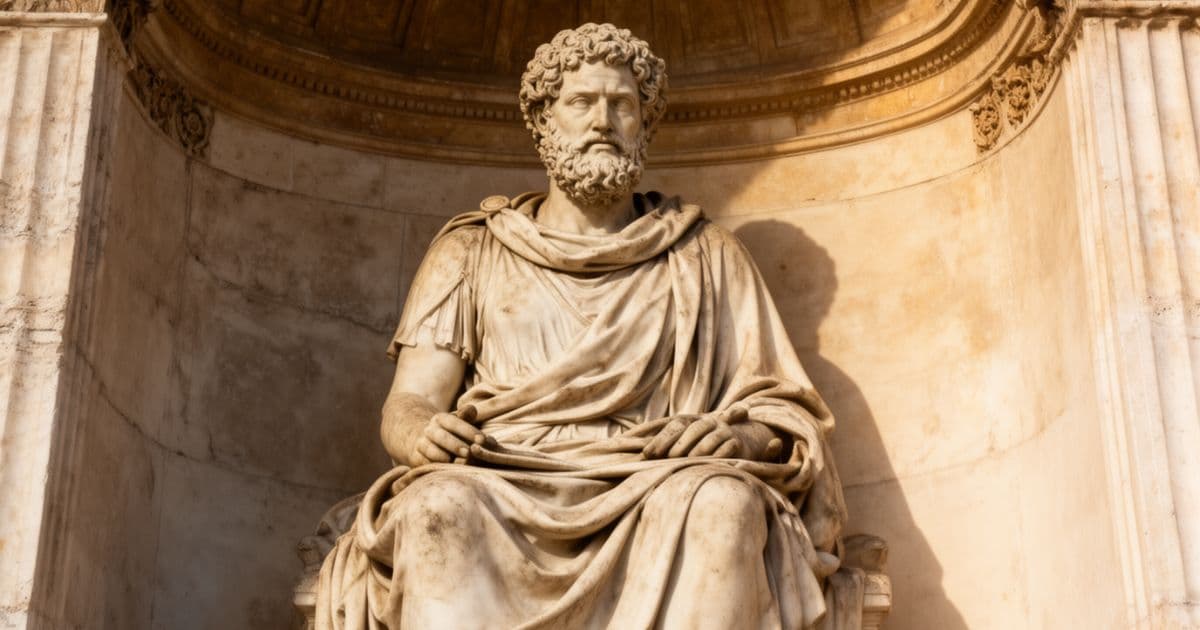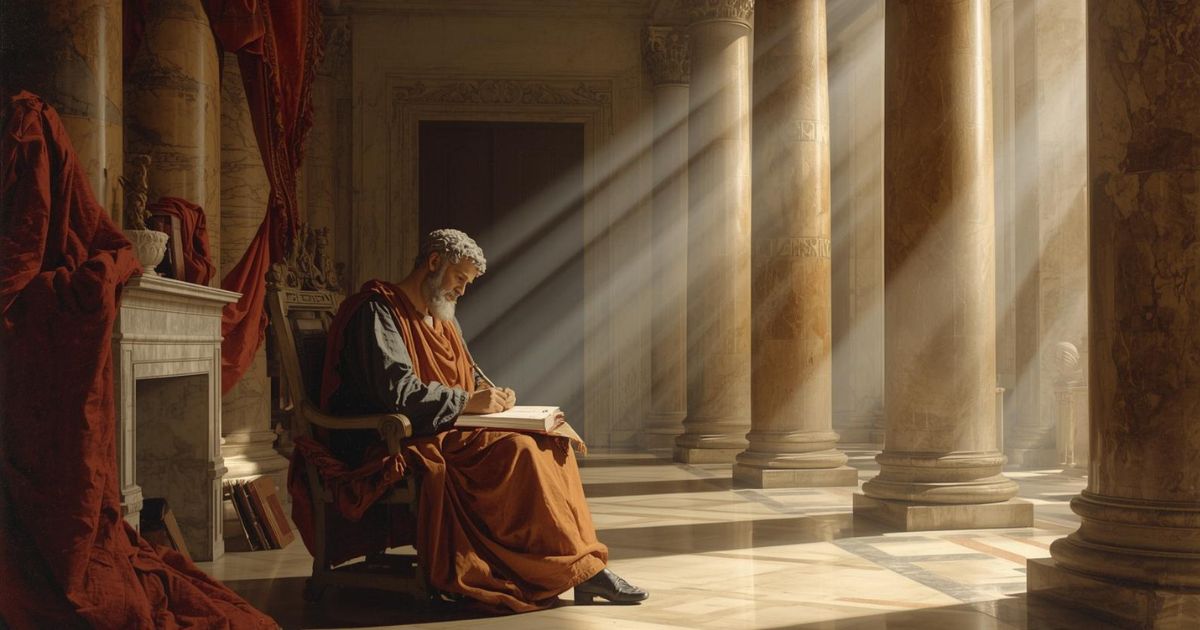
An excerpt from the original text.(complete · 969 words)
←etter 15. On brawn and brainsMoral letters to Luciliusby Seneca, translated by Richard Mott GummereLetter 16. On philosophy, the guide of lifeLetter 17. On philosophy and riches→482852Moral letters to Lucilius — Letter 16. On philosophy, the guide of lifeRichard Mott GummereSeneca XVI. ON PHILOSOPHY, THE GUIDE OF LIFE 1. It is clear to you, I am sure, Lucilius, that no man can live a happy life, or even a supportable life, without the study of wisdom; you know also that a happy life is reached when our wisdom is brought to completion, but that life is at least endurable even when our wisdom is only begun. This idea, however, clear though it is, must be strengthened and implanted more deeply by daily reflection; it is more important for you to keep the resolutions you have already made than to go on and make noble ones. You must persevere, must develop new strength by continuous study, until that which is only a good inclination becomes a good settled purpose. 2. Hence you no longer need to come to me with much talk and protestations; I know that you have made great progress. I understand the feelings which prompt your words; they are not feigned or specious words. Nevertheless I shall tell you what I think,—that at present I have hopes for you, but not yet perfect trust. And I wish that you would adopt the same attitude towards yourself; there is no reason why you should put confidence in yourself too quickly and readily. Examine yourself; scrutinize and observe yourself in divers ways; but mark, before all else, whether it is in philosophy or merely in life itself[1] that you have made progress. 3. Philosophy is no trick to catch the public; it is not devised for show. It is a matter, not of words, but of facts. It is not pursued in order that the day may yield some amusement before it is spent, or that our leisure may be relieved of a tedium that irks us. It moulds and constructs the soul; it orders our life, guides our conduct, shows us what we should do and what we should leave undone; it sits at the helm and directs our course as we waver amid uncertainties. Without it, no one can live fearlessly or in peace of mind. Countless things that happen every hour call for advice; and such advice is to be sought in philosophy. 4. Perhaps someone will say: “How can philosophy help me, if Fate exists? Of what avail is philosophy, if God rules the universe? Of what avail is it, if Chance governs everything? For not only is it impossible to change things that are determined, but it is also impossible to plan beforehand against what is undetermined; either God has forestalled my plans, and decided what I am to do, or else Fortune gives no free play to my plans.” 5. Whether the truth, Lucilius, lies in one or in all of these views, we must be philosophers; whether Fate binds us down by an inexorable law, or whether God as arbiter of the universe has arranged everything, or whether Chance drives and tosses human affairs without method, philosophy ought to be our defence. She will encourage us to obey God cheerfully, but Fortune defiantly; she will teach us to follow God and endure Chance. 6. But it is not my purpose now to be led into a discussion as to what is within our own control,—if foreknowledge is supreme, or if a chain of fated events drags us along in its clutches, or if the sudden and the unexpected play the tyrant over us; I return now to my warning and my exhortation, that you should not allow the impulse of your spirit to weaken and grow cold. Hold fast to it and establish it firmly, in order that what is now impulse may become a habit of the mind. 7. If I know you well, you have already been trying to find out, from the very beginning of my letter, what little contribution it brings to you. Sift the letter, and you will find it. You need not wonder at any genius of mine; for as yet I am lavish only with other men’s property.—But why did I say “other men”? Whatever is well said by anyone is mine.—This also is a saying of Epicurus:[2] “If you live according to nature, you will never be poor; if you live according to opinion, you will never be rich.” 8. Nature’s wants are slight; the demands of opinion are boundless. Suppose that the property of many millionaires is heaped up in your possession. Assume that fortune carries you far beyond the limits of a private income, decks you with gold, clothes you in purple, and brings you to such a degree of luxury and wealth that you can bury the earth under your marble floors; that you may not only possess, but tread upon, riches. Add statues, paintings, and and whatever any art has devised for the satisfaction of luxury; you will only learn from such things to crave still greater. 9. Natural desires are limited; but those which spring from false opinion can have no stopping-point. The false has no limits. When you are travelling on a road, there must be an end; but when astray, your wanderings are limitless. Recall your steps, therefore, from idle things, and when you would know whether that which you seek is based upon a natural or upon a misleading desire, consider whether it can stop at any definite point. If you find, after having travelled far, that there is a more distant goal always in view, you may be sure that this condition is contrary to nature. Farewell. ↑ i.e., have merely advanced in years. ↑ Frag. 201 Usener.
Master this chapter. Complete your experience
Purchase the complete book to access all chapters and support classic literature
As an Amazon Associate, we earn a small commission from qualifying purchases at no additional cost to you.
Available in paperback, hardcover, and e-book formats
Let's Analyse the Pattern
Natural needs have clear endpoints while manufactured desires expand infinitely, creating perpetual dissatisfaction no matter what you achieve.
Why This Matters
Connect literature to life
This chapter teaches how to identify whether your wants have clear endpoints or will keep expanding no matter what you achieve.
Practice This Today
This week, notice when you want something and ask: 'What would enough look like?' If you can't define a clear stopping point, you're chasing a manufactured desire that won't satisfy.
Now let's explore the literary elements.
Key Quotes & Analysis
"No man can live a happy life, or even a supportable life, without the study of wisdom"
Context: Opening the letter to establish why philosophy matters for everyone
This isn't about academic study - it's about developing practical wisdom for navigating life's challenges. Seneca argues that without some framework for making decisions, life becomes unbearable.
In Today's Words:
You need some kind of life philosophy to get through this world without losing your mind
"It is more important for you to keep the resolutions you have already made than to go on and make noble ones"
Context: Advising Lucilius about building consistent habits rather than just good intentions
Classic wisdom about follow-through being more valuable than grand plans. Seneca knows that real change comes from daily practice, not from making impressive commitments.
In Today's Words:
Stop making new goals and actually stick to the ones you already made
"There is no reason why you should put confidence in yourself too quickly"
Context: Warning Lucilius against overconfidence in his philosophical progress
Seneca balances encouragement with realism. He recognizes progress but warns against the trap of thinking you've got it all figured out before you've really been tested.
In Today's Words:
Don't get cocky - you're doing better but you're not there yet
Thematic Threads
Social Expectations
In This Chapter
Seneca distinguishes between what nature requires versus what society demands, showing how external pressures create artificial needs
Development
Building on earlier themes about living for others' approval, now focusing on how this creates insatiable desires
In Your Life:
You might recognize this when you want something primarily because others expect it or have it
Personal Growth
In This Chapter
Philosophy as practical wisdom for making better decisions rather than academic knowledge
Development
Continues Seneca's emphasis on philosophy as life navigation tool, now specifically for desire management
In Your Life:
You see growth when you can pause before wanting something and ask whether it serves a real need
Class
In This Chapter
Recognition that wealth doesn't solve the desire problem—rich people just want more expensive things
Development
Introduced here as economic reality that transcends income levels
In Your Life:
You might notice that people with more money often seem just as stressed about not having enough
Identity
In This Chapter
Learning to separate your true needs from desires manufactured by comparison and status-seeking
Development
Builds on earlier identity themes by showing how desires can hijack authentic self-knowledge
In Your Life:
You experience this when you realize you wanted something mainly to feel like a certain type of person
You now have the context. Time to form your own thoughts.
Discussion Questions
- 1
According to Seneca, what's the difference between natural needs and manufactured desires? Can you give an example of each from your own life?
analysis • surface - 2
Why does Seneca argue that manufactured desires can never be satisfied, no matter how much you achieve or acquire?
analysis • medium - 3
Where do you see this pattern of endless wanting in modern life—at work, in relationships, on social media, or in consumer culture?
application • medium - 4
Think about a current goal or desire you have. How would you test whether it's a natural need with a clear endpoint or a manufactured desire that might keep expanding?
application • deep - 5
What does Seneca's insight reveal about why some people feel empty despite having 'everything' while others find contentment with less?
reflection • deep
Critical Thinking Exercise
The Endpoint Test
Choose something you currently want—a purchase, job change, relationship goal, or lifestyle upgrade. Write down exactly what success would look like and when you'd stop wanting more. If you can't define a clear stopping point, you've identified a manufactured desire. Then dig deeper: what natural need might be hiding underneath this endless want?
Consider:
- •Be honest about whether you can truly picture being satisfied with your stated goal
- •Notice if your definition of 'enough' keeps shifting as you think about it
- •Consider what you're really trying to solve or feel through this desire
Journaling Prompt
Write about a time when you got something you really wanted but found yourself immediately wanting more. What was the natural need you were actually trying to meet, and how might you address it more directly?
Coming Up Next...
Chapter 17: Money Won't Buy You Wisdom
In the next letter, Seneca dives deeper into the relationship between philosophy and wealth, challenging common assumptions about what we really need to cast away to achieve wisdom. He'll explore what it truly means to strive toward a sound mind with 'top speed and whole strength.'