An excerpt from the original text.(complete · 1883 words)
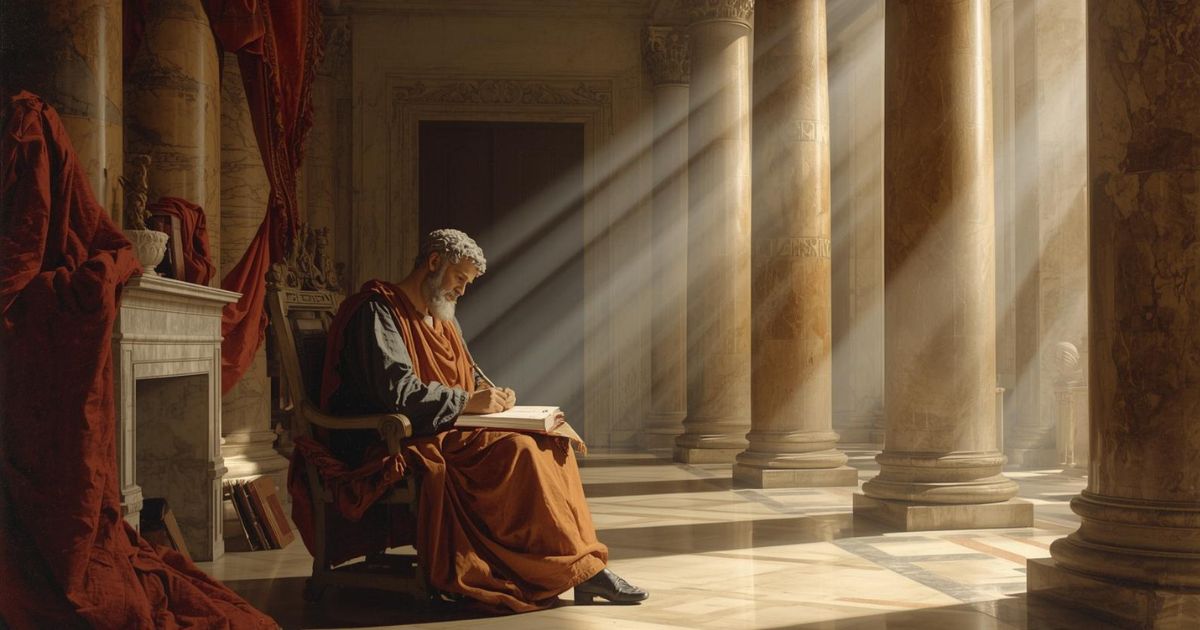
←etter 122. On darkness as a veil for wickednessMoral letters to Luciliusby Seneca, translated by Richard Mott GummereLetter 123. On the conflict between pleasure and virtueLetter 124. On the true good as attained by reason→484101Moral letters to Lucilius — Letter 123. On the conflict between pleasure and virtueRichard Mott GummereSeneca CXXIII. ON THE CONFLICT BETWEEN PLEASURE AND VIRTUE 1. Wearied with the discomfort rather than with the length of my journey, I have reached my Alban villa late at night, and I find nothing in readiness except myself. So I am getting rid of fatigue at my writing-table: I derive some good from this tardiness on the part of my cook and my baker. For I am communing with myself on this very topic—that nothing is heavy if one accepts it with a light heart, and that nothing need provoke one’s anger if one does not add to one’s pile of troubles by getting angry. 2. My baker is out of bread; but the overseer, or the house-steward, or one of my tenants can supply me therewith. “Bad bread!” you say. But just wait for it; it will become good. Hunger will make even such bread delicate and of the finest flavour. For that reason I must not eat until hunger bids me; so I shall wait and shall not eat until I can either get good bread or else cease to be squeamish about it. 3. It is necessary that one grow accustomed to slender fare: because there are many problems of time and place which will cross the path even of the rich man and one equipped for pleasure, and bring him up with a round turn. To have whatsoever he wishes is in no man’s power; it is in his power not to wish for what he has not, but cheerfully to employ what comes to him. A great step towards independence is a good-humoured stomach, one that is willing to endure rough treatment. 4. You cannot imagine how much pleasure I derive from the fact that my weariness is becoming reconciled to itself; I am asking for no slaves to rub me down, no bath, and no other restorative except time. For that which toil has accumulated, rest can lighten. This repast, whatever it may be, will give me more pleasure than an inaugural banquet.[1] 5. For I have made trial of my spirit on a sudden—a simpler and a truer test. Indeed, when a man has made preparations and given himself a formal summons to be patient, it is not equally clear just how much real strength of mind he possesses; the surest proofs are those which one exhibits off-hand, viewing one’s own troubles not only fairly but calmly, not flying into fits of temper or wordy wranglings, supplying one’s own needs by not craving something which was really due, and reflecting that our habits may be unsatisfied, but never our own real selves. 6. How many things are superfluous we fail to realize until they begin to be wanting; we merely used them not because we needed them but because we had them. And how much do we acquire simply because our neighbours have acquired such things, or because most men possess them! Many of our troubles may be explained from the fact that we live according to a pattern, and, instead of arranging our lives according to reason, are led astray by convention. There are things which, if done by the few, we should refuse to imitate; yet when the majority have begun to do them, we follow along—just as if anything were more honourable because it is more frequent! Furthermore, wrong views, when they have become prevalent, reach, in our eyes, the standard of righteousness. 7. Everyone now travels with Numidian outriders preceding him, with a troop of slave-runners to clear the way; we deem it disgraceful to have no attendants who will elbow crowds from the road, or will prove, by a great cloud of dust, that a high dignitary is approaching! Everyone now possesses mules that are laden with crystal and myrrhine cups carved by skilled artists of great renown; it is disgraceful for all your baggage to be made up of that which can be rattled along without danger. Everyone has pages who ride along with ointment-covered faces, so that the heat or the cold will not harm their tender complexions; it is disgraceful that none of your attendant slave-boys should show a healthy cheek, not covered with cosmetics. 8. You should avoid conversation with all such persons: they are the sort that communicate and engraft their bad habits from one to another. We used to think that the very worst variety of these men were those who vaunted their words; but there are certain men who vaunt their wickedness. Their talk is very harmful; for even though it is not at once convincing, yet they leave the seeds of trouble in the soul, and the evil which is sure to spring into new strength follows us about even when we have parted from them. 9. Just as those who have attended a concert[2] carry about in their heads the melodies and the charm of the songs they have heard—a proceeding which interferes with their thinking and does not allow them to concentrate upon serious subjects,—even so the speech of flatterers and enthusiasts over that which is depraved sticks in our minds long after we have heard them talk. It is not easy to rid the memory of a catching tune; it stays with us, lasts on, and comes back from time to time. Accordingly, you should close your ears against evil talk, and right at the outset, too; for when such talk has gained an entrance and the words are admitted and are in our minds, they become more shameless. 10. And then we begin to speak as follows: “Virtue, Philosophy, Justice—this is a jargon of empty words. The only way to be happy is to do yourself well. To eat, drink, and spend your money is the only real life, the only way to remind yourself that you are mortal. Our days flow on, and life—which we cannot restore—hastens away from us. Why hesitate to come to our senses? This life of ours will not always admit pleasures; meantime, while it can do so, while it clamours for them, what profit lies in imposing thereupon frugality? Therefore get ahead of death, and let anything that death will filch from you be squandered now upon yourself. You have no mistress, no favourite slave to make your mistress envious; you are sober when you make your daily appearance in public; you dine as if you had to show your account-book to ‘Papa’; but that is not living, it is merely going shares in someone else’s existence. 11. And what madness it is to be looking out for the interests of your heir, and to deny yourself everything, with the result that you turn friends into enemies by the vast amount of the fortune you intend to leave! For the more the heir is to get from you, the more he will rejoice in your taking-off! All those sour fellows who criticize other men’s lives in a spirit of priggishness and are real enemies to their own lives, playing schoolmaster to the world—you should not consider them as worth a farthing, nor should you hesitate to prefer good living to a good reputation.” 12. These are voices which you ought to shun just as Ulysses did; he would not sail past them until he was lashed to the mast. They are no less potent; they lure men from country, parents, friends, and virtuous ways; and by a hope that, if not base, is ill-starred, they wreck them upon a life of baseness. How much better to follow a straight course and attain a goal where the words “pleasant” and “honourable” have the same meaning![3] 13. This end will be possible for us if we understand that there are two classes of objects which either attract us or repel us. We are attracted by such things as riches, pleasures, beauty, ambition, and other such coaxing and pleasing objects; we are repelled by toil, death, pain, disgrace, or lives of greater frugality. We ought therefore to train ourselves so that we may avoid a fear of the one or a desire for the other. Let us fight in the opposite fashion: let us retreat from the objects that allure, and rouse ourselves to meet the objects that attack. 14. Do you not see how different is the method of descending a mountain from that employed in climbing upwards? Men coming down a slope bend backwards; men ascending a steep place lean forward. For, my dear Lucilius, to allow yourself to put your body’s weight ahead when coming down, or, when climbing up, to throw it backward is to comply with vice. The pleasures take one down hill but one must work upwards toward that which is rough and hard to climb; in the one case let us throw our bodies forward, in the others let us put the check-rein on them. 15. Do you believe me to be stating now that only those men bring ruin to our ears, who praise pleasure, who inspire us with fear of pain—that element which is in itself provocative of fear? I believe that we are also injured by those who masquerade under the disguise of the Stoic school and at the same time urge us on into vice. They boast that only the wise man and the learned is a lover.[4] “He alone has wisdom in this art; the wise man too is best skilled in drinking and feasting. Our study ought to be this alone: up to what age the bloom of love can endure!” 16. All this may be regarded as a concession to the ways of Greece; we ourselves should preferably turn our attention to words like these: “No man is good by chance. Virtue is something which must be learned. Pleasure is low, petty, to be deemed worthless, shared even by dumb animals—the tiniest and meanest of whom fly towards pleasure. Glory is an empty and fleeting thing, lighter than air. Poverty is an evil to no man unless he kick against the goads. Death is not an evil; why need you ask? Death alone is the equal privilege of mankind. Superstition is the misguided idea of a lunatic; it fears those whom it ought to love; it is an outrage upon those whom it worships. For what difference is there between denying the gods and dishonouring them?” 17. You should learn such principles as these, nay rather you should learn them by heart; philosophy ought not to try to explain away vice. For a sick man, when his physician bids him live recklessly, is doomed beyond recall. Farewell. ↑ i.e., a dinner given by an official when he entered upon (adeo) his office. ↑ For symphonia see Ep. li. 4 and note. Compare also the commissiones, orchestral exhibitions, composed of many voices, flutes, and brass instruments, Ep. lxxxiv. 10. ↑ i.e., to live by Stoicism rather than by Epicureanism. ↑ Meaning, in line with the Stoic paradoxes, that only the sage knows how to be rightly in love.
Master this chapter. Complete your experience
Purchase the complete book to access all chapters and support classic literature
As an Amazon Associate, we earn a small commission from qualifying purchases at no additional cost to you.
Available in paperback, hardcover, and e-book formats
Let's Analyse the Pattern
We unconsciously absorb the values and expectations of those around us, gradually corrupting our judgment until we're living by other people's standards instead of our own.
Why This Matters
Connect literature to life
This chapter teaches how to recognize when casual conversations are actually pressure campaigns designed to change your behavior.
Practice This Today
This week, notice when conversations with certain people make your previous choices suddenly feel inadequate or embarrassing.
Now let's explore the literary elements.
Key Quotes & Analysis
"Nothing is heavy if one accepts it with a light heart, and nothing need provoke one's anger if one does not add to one's pile of troubles by getting angry."
Context: Reflecting on arriving at his villa to find nothing prepared
This captures the core Stoic principle that our reaction to events matters more than the events themselves. Getting angry about inconvenience only creates more suffering.
In Today's Words:
Don't make a bad situation worse by having a bad attitude about it.
"Hunger will make even such bread delicate and of the finest flavour."
Context: Explaining why he won't eat until he's truly hungry
Shows how our perspective changes based on our real needs versus our wants. When we're actually hungry, any food becomes satisfying.
In Today's Words:
When you really need something, you stop being picky about it.
"It is necessary that one grow accustomed to slender fare: because there are many occasions when the fortune of a man of the highest respectability does not supply him with what is sufficient."
Context: Explaining why we should practice living with less
Even successful people face unexpected hardships. Training ourselves to be content with less prepares us for life's inevitable challenges.
In Today's Words:
Practice living on less now, because even good situations don't last forever.
Thematic Threads
Social Expectations
In This Chapter
Seneca warns how society pressures us to live with elaborate displays of wealth and comfort because that's what's expected
Development
Builds on earlier themes about external validation, now showing how social pressure operates through casual influence
In Your Life:
You might feel pressure to spend money on things you don't need because everyone around you considers them normal.
Class
In This Chapter
The letter reveals how class distinctions are maintained through lifestyle expectations - servants, expensive travel, material displays
Development
Expands earlier class discussions to show how class pressure operates through social conformity rather than direct commands
In Your Life:
You might feel ashamed of your practical choices when surrounded by people who spend more freely.
Personal Growth
In This Chapter
Seneca advocates training ourselves to move toward difficulty rather than pleasure, building real strength through deliberate practice
Development
Continues the theme of intentional development, now focusing on resisting social corruption through disciplined choice
In Your Life:
You might need to consciously choose harder paths that align with your values instead of easier ones that please others.
Identity
In This Chapter
The chapter shows how our sense of self gets corrupted when we absorb other people's definitions of what constitutes a good life
Development
Deepens earlier identity themes by showing how external influences can literally change who we think we are
In Your Life:
You might find yourself wanting things you never cared about before, simply because people around you value them.
Human Relationships
In This Chapter
Seneca warns about the danger of conversations with people whose values corrupt our judgment, comparing them to sirens
Development
Introduces the idea that relationships themselves can be toxic if they consistently undermine our principles
In Your Life:
You might need to limit time with people whose casual conversations consistently make you question your solid life choices.
You now have the context. Time to form your own thoughts.
Discussion Questions
- 1
When Seneca arrives at his unprepared villa, how does he respond differently than most people would?
analysis • surface - 2
Why does Seneca compare social influences to catchy songs and the sirens from Ulysses?
analysis • medium - 3
Where do you see people around you living beyond their means because 'that's what everyone does'?
application • medium - 4
How would you 'bind yourself to your principles' when friends or coworkers make your choices feel inadequate?
application • deep - 5
What does this chapter reveal about how we unconsciously absorb the values of people around us?
reflection • deep
Critical Thinking Exercise
Track Your Influence Network
List the five people you spend the most time talking to (in person, online, or on the phone). For each person, write down what they typically complain about, what they spend money on, and what they consider 'normal' or 'necessary.' Then honestly assess: are their casual comments making you feel inadequate about choices that used to feel fine?
Consider:
- •Notice which conversations leave you feeling like your choices aren't enough
- •Pay attention to how people describe their spending as 'needs' rather than wants
- •Consider whether you're absorbing their definitions of success without realizing it
Journaling Prompt
Write about a time when someone's casual comment about money, lifestyle, or possessions made you question a choice you'd previously felt good about. How did that conversation change your thinking, and do you want it to?
Coming Up Next...
Chapter 124: True Good Comes from Reason
In the final letter of this collection, Seneca turns to the ultimate question: what is the true good that reason can attain? He'll explore how ancient wisdom can guide us toward lasting fulfillment, even when we feel ashamed to learn such fundamental truths.