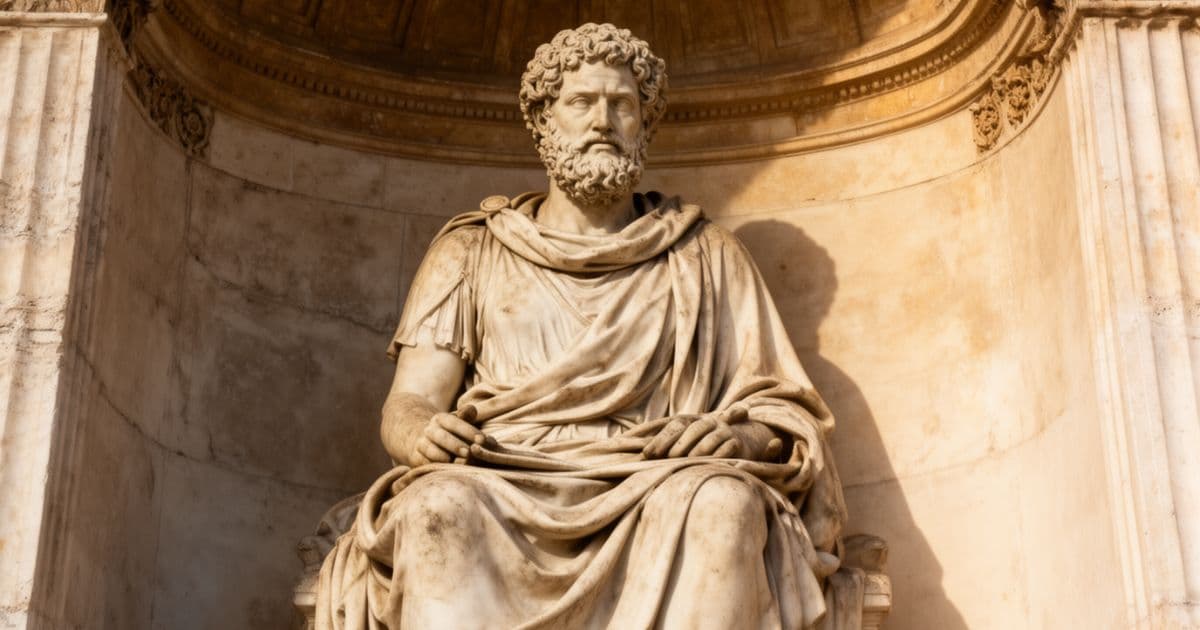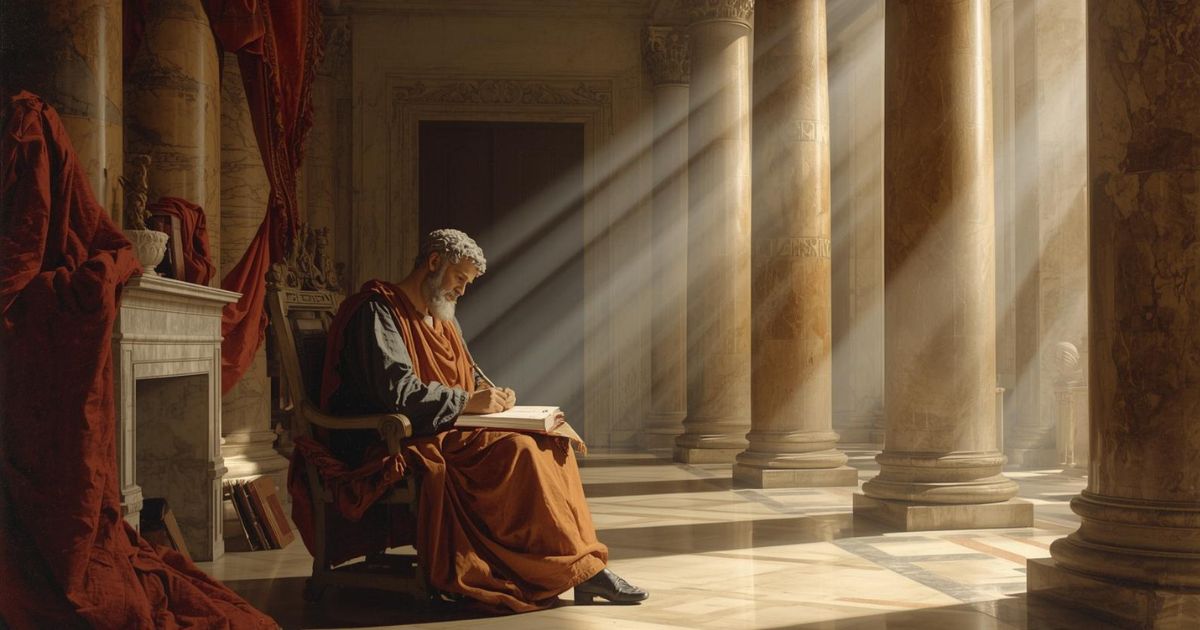
An excerpt from the original text.(complete · 1999 words)
←etter 109. On the fellowship of wise menMoral letters to Luciliusby Seneca, translated by Richard Mott GummereLetter 110. On true and false richesLetter 111. On the vanity of mental gymnastics→483909Moral letters to Lucilius — Letter 110. On true and false richesRichard Mott GummereSeneca CX. ON TRUE AND FALSE RICHES 1. From my villa at Nomentum[1] I send you greeting and bid you keep a sound spirit within you—in other words, gain the blessing of all the gods, for he is assured of their grace and favour who has become a blessing to himself. Lay aside for the present the belief of certain persons—that a god is assigned to each one of us as a sort of attendant—not a god of regular rank, but one of a lower grade—one of those whom Ovid calls “plebeian gods.”[2] Yet, while laying aside this belief, I would have you remember that our ancestors, who followed such a creed, have become Stoics; for they have assigned a Genius or a Juno to every individual.[3] 2. Later on we shall investigate whether the gods have enough time on their hands to care for the concerns of private individuals; in the meantime, you must know that whether we are allotted to special guardians, or whether we are neglected and consigned to Fortune, you can curse a man with no heavier curse than to pray that he may be at enmity with himself. There is no reason, however, why you should ask the gods to be hostile to anyone whom you regard as deserving of punishment; they are hostile to such a person, I maintain, even though he seems to be advanced by their favour. 3. Apply careful investigation, considering how our affairs actually stand, and not what men say of them; you will then understand that evils are more likely to help us than to harm us. For how often has so-called affliction been the source and the beginning of happiness! How often have privileges which we welcomed with deep thanksgiving built steps for themselves to the top of a precipice, still uplifting men who were already distinguished—just as if they had previously stood in a position whence they could fall in safety! 4. But this very fall has in it nothing evil, if you consider the end,[4] after which nature lays no man lower. The universal limit is near; yes, there is near us the point where the prosperous man is upset, and the point where the unfortunate is set free. It is we ourselves that extend both these limits, lengthening them by our hopes and by our fears. If, however, you are wise, measure all things according to the state of man; restrict at the same time both your joys and your fears. Moreover, it is worth while not to rejoice at anything for long, so that you may not fear anything for long. 5. But why do I confine the scope of this evil? There is no reason why you should suppose that anything is to be feared. All these things which stir us and keep us a-flutter, are empty things. None of us has sifted out the truth; we have passed fear on to one another; none has dared to approach the object which caused his dread, and to understand the nature of his fear—aye, the good behind it. That is why falsehood and vanity still gain credit—because they are not refuted. 6. Let us account it worth while to look closely at the matter; then it will be clear how fleeting, how unsure, and how harmless are the things which we fear. The disturbance in our spirits is similar to that which Lucretius detected: Like boys who cower frightened in the dark, So grown-ups in the light of day feel fear.[5] What, then? Are we not more foolish than any child, we who “in the light of day feel fear”? 7. But you were wrong, Lucretius; we are not afraid in the daylight; we have turned everything into a state of darkness. We see neither what injures nor what profits us; all our lives through we blunder along, neither stopping nor treading more carefully on this account. But you see what madness it is to rush ahead in the dark. Indeed, we are bent on getting ourselves called back[6] from a greater distance; and though we do not know our goal, yet we hasten with wild speed in the direction whither we are straining. 8. The light, however, may begin to shine, provided we are willing. But such a result can come about only in one way—if we acquire by knowledge this familiarity with things divine and human, if we not only flood ourselves but steep ourselves therein, if a man reviews the same principles even though he understands them and applies them again and again to himself, if he has investigated what is good, what is evil, and what has falsely been so entitled; and, finally, if he has investigated honour and baseness, and Providence. 9. The range of the human intelligence is not confined within these limits; it may also explore outside the universe—its destination and its source, and the ruin towards which all nature hastens so rapidly. We have withdrawn the soul from this divine contemplation and dragged it into mean and lowly tasks, so that it might be a slave to greed, so that it might forsake the universe and its confines, and, under the command of masters who try all possible schemes, pry beneath the earth and seek what evil it can dig up therefrom—discontented with that which was freely offered to it. 10. Now God, who is the Father of us all, has placed ready to our hands those things which he intended for our own good; he did not wait for any search on our part, and he gave them to us voluntarily. But that which would be injurious, he buried deep in the earth. We can complain of nothing but ourselves; for we have brought to light the materials for our destruction, against the will of Nature, who hid them from us. We have bound over our souls to pleasure, whose service is the source of all evil; we have surrendered ourselves to self-seeking and reputation, and to other aims which are equally idle and useless. 11. What, then, do I now encourage you to do? Nothing new—we are not trying to find cures for new evils—but this first of all: namely, to see clearly for yourself what is necessary and what is superfluous. What is necessary will meet you everywhere; what is superfluous has always to be hunted out—and with great endeavour. 12. But there is no reason why you should flatter yourself over-much if you despise gilded couches and jewelled furniture. For what virtue lies in despising useless things? The time to admire your own conduct is when you have come to despise the necessities. You are doing no great thing if you can live without royal pomp, if you feel no craving for boars which weigh a thousand pounds, or for flamingo tongues, or for the other absurdities of a luxury that already wearies of game cooked whole, and chooses different bits from separate animals; I shall admire you only when you have learned to scorn even the common sort of bread, when you have made yourself believe that grass grows for the needs of men as well as of cattle, when you have found out that food from the treetop[7] can fill the belly—into which we cram things of value as if it could keep what it has received. We should satisfy our stomachs without being over-nice. How does it matter what the stomach receives, since it must lose whatever it has received? 13. You enjoy the carefully arranged dainties which are caught on land and sea; some are more pleasing if they are brought fresh to the table, others, if after long feeding and forced fattening they almost melt and can hardly retain their own grease. You like the subtly devised flavour of these dishes. But I assure you that such carefully chosen and variously seasoned dishes, once they have entered the belly, will be overtaken alike by one and the same corruption. Would you despise the pleasures of eating? Then consider its result! 14. I remember some words of Attalus, which elicited general applause: “Riches long deceived me. I used to be dazed when I caught some gleam of them here and there. I used to think that their hidden influence matched their visible show. But once, at a certain elaborate entertainment, I saw embossed work in silver and gold equalling the wealth of a whole city, and colours and tapestry devised to match objects which surpassed the value of gold or of silver—brought not only from beyond our own borders, but from beyond the borders of our enemies; on one side were slave-boys notable for their training and beauty, on the other were throngs of slave-women, and all the other resources that a prosperous and mighty empire could offer after reviewing its possessions. 15. What else is this, I said to myself, than a stirring-up of man’s cravings, which are in themselves provocative of lust? What is the meaning of all this display of money? Did we gather merely to learn what greed was? For my own part I left the place with less craving than I had when I entered. I came to despise riches, not because of their uselessness, but because of their pettiness. 16. Have you noticed how, inside a few hours, that programme, however slow-moving and carefully arranged, was over and done? Has a business filled up this whole life of ours, which could not fill up a whole day? “I had another thought also: the riches seemed to me to be as useless to the possessors as they were to the onlookers. 17. Accordingly, I say to myself, whenever a show of that sort dazzles my eyes, whenever I see a splendid palace with a well-groomed corps of attendants and beautiful bearers carrying a litter: Why wonder? Why gape in astonishment? It is all show; such things are displayed, not possessed; while they please they pass away. 18. Turn thyself rather to the true riches. Learn to be content with little, and cry out with courage and with greatness of soul: ‘We have water, we have porridge; let us compete in happiness with Jupiter himself.’ And why not, I pray thee, make this challenge even without porridge and water? For it is base to make the happy life depend upon silver and gold, and just as base to make it depend upon water and porridge. ‘But,’ some will say, ‘what could I do without such things?’ 19. Do you ask what is the cure for want? It is to make hunger satisfy hunger; for, all else being equal, what difference is there in the smallness or the largeness of the things that force you to be a slave? What matter how little it is that Fortune can refuse to you? 20. Your very porridge and water can fall under another’s jurisdiction; and besides, freedom comes, not to him over whom Fortune has slight power, but to him over whom she has no power at all. This is what I mean: you must crave nothing, if you would vie with Jupiter; for Jupiter craves nothing.” This is what Attalus told us. If you are willing to think often of these things, you will strive not to seem happy, but to be happy, and, in addition, to seem happy to yourself rather than to others. Farewell. ↑ Cf. Ep. civ. 1. ↑ Metam. i. 595,—a Roman interpretation, along the lines of the Di Indigetes. ↑ Every man had his Genius, and every woman her Juno. In the case of the Stoics, God dwelt in every soul. ↑ i.e., death, in Stoic language. ↑ De Rerum Nat. ii. 55 f. ↑ i.e., to the starting-point. ↑ i.e., acorns, etc.
Master this chapter. Complete your experience
Purchase the complete book to access all chapters and support classic literature
As an Amazon Associate, we earn a small commission from qualifying purchases at no additional cost to you.
Available in paperback, hardcover, and e-book formats
Why This Matters
Connect literature to life
This chapter teaches how to recognize when displays of wealth are actually displays of insecurity and spiritual poverty.
Practice This Today
This week, notice when people use material possessions to communicate their worth—and ask yourself what they might be trying to prove or hide.
Now let's explore the literary elements.
Key Quotes & Analysis
"You can curse a man with no heavier curse than to pray that he may be at enmity with himself."
Context: While discussing whether gods watch over individuals, Seneca points out the worst possible fate.
This reveals that our internal relationship with ourselves is more important than any external blessing or curse. Being at war with yourself is the ultimate suffering because you can never escape your own mind.
In Today's Words:
The worst thing that can happen to someone is hating themselves - that's a hell they carry everywhere.
"All that filled a lifetime could not fill a day."
Context: Reflecting on how the elaborate feast, despite representing years of wealth accumulation, was over in hours.
This captures the emptiness of material pursuits - we spend our whole lives chasing things that provide only momentary satisfaction. The disproportion between effort and reward reveals the futility of seeking happiness through possessions.
In Today's Words:
You can spend your whole life working for stuff that doesn't even make one day truly meaningful.
"God has placed near at hand all that we really need; but what we seek to our own hurt lies buried deep."
Context: Explaining why humans suffer - we ignore what's easily available and pursue what's harmful.
This suggests that happiness and peace are naturally accessible, but we complicate our lives by chasing difficult, destructive goals. We literally have to dig deep and work hard to find ways to make ourselves miserable.
In Today's Words:
Everything you actually need to be happy is right there, but instead we go looking for trouble.
Thematic Threads
Class
In This Chapter
Seneca exposes how displays of wealth are performances, not genuine security—the elaborate party was all show, gone in hours
Development
Builds on earlier themes of social expectations by revealing the emptiness behind class markers
In Your Life:
You might recognize this when you feel pressure to buy things to fit in or appear successful at work or social gatherings.
Identity
In This Chapter
The chapter shows how we mistake our possessions for our identity, becoming slaves to maintaining an image
Development
Deepens the exploration of authentic self versus performed self from previous letters
In Your Life:
You might catch yourself defining your worth by what you own rather than who you are as a person.
Social Expectations
In This Chapter
Attalus's party represents society's pressure to equate worth with wealth and consumption
Development
Continues examining how external pressures shape our choices and values
In Your Life:
You might feel this pressure when colleagues discuss expensive purchases or when family members judge success by material markers.
Personal Growth
In This Chapter
True growth means learning to need nothing external for happiness, competing with Jupiter in contentment
Development
Advances the theme that real development happens internally, not through acquisition
In Your Life:
You might experience this growth when you find genuine satisfaction in simple pleasures rather than always wanting more.
Human Relationships
In This Chapter
The chapter implies that chasing luxury distances us from genuine connection and divine contemplation
Development
Introduces how materialism corrupts our ability to form authentic bonds
In Your Life:
You might notice relationships becoming more about comparing possessions than sharing meaningful experiences together.
You now have the context. Time to form your own thoughts.
Discussion Questions
- 1
What did Attalus experience at the wealthy man's party, and how did it change his perspective on luxury?
analysis • surface - 2
Why does Seneca argue that depending on external things for happiness makes us slaves, even if we can afford those things?
analysis • medium - 3
Where do you see people today chasing displays of wealth or status that don't actually bring lasting satisfaction?
application • medium - 4
How would you test Seneca's claim that you could be happy with just water and porridge - what would that experiment look like in your own life?
application • deep - 5
What does this chapter reveal about why humans consistently mistake temporary pleasure for genuine happiness?
reflection • deep
Critical Thinking Exercise
Track Your Dependency Map
Make two lists: things you think you need to be happy, and things you actually need to survive. For each item on your happiness list, write down what happens to your mood when you can't have it. This isn't about judging yourself - it's about seeing the pattern clearly.
Consider:
- •Notice the difference between wanting something and needing it for your well-being
- •Pay attention to which dependencies feel like choices versus which feel like chains
- •Consider how much mental energy you spend maintaining or worrying about these things
Journaling Prompt
Write about a time when you got something you really wanted but found it didn't change your life the way you expected. What did that teach you about the relationship between getting things and feeling satisfied?
Coming Up Next...
Chapter 111: Real Wisdom vs Mental Gymnastics
Next, Seneca turns his sharp wit toward intellectual show-offs and mental gymnastics. He'll explore why some people prefer to dazzle with clever wordplay rather than pursue actual wisdom—and why this might be the most dangerous trap of all.