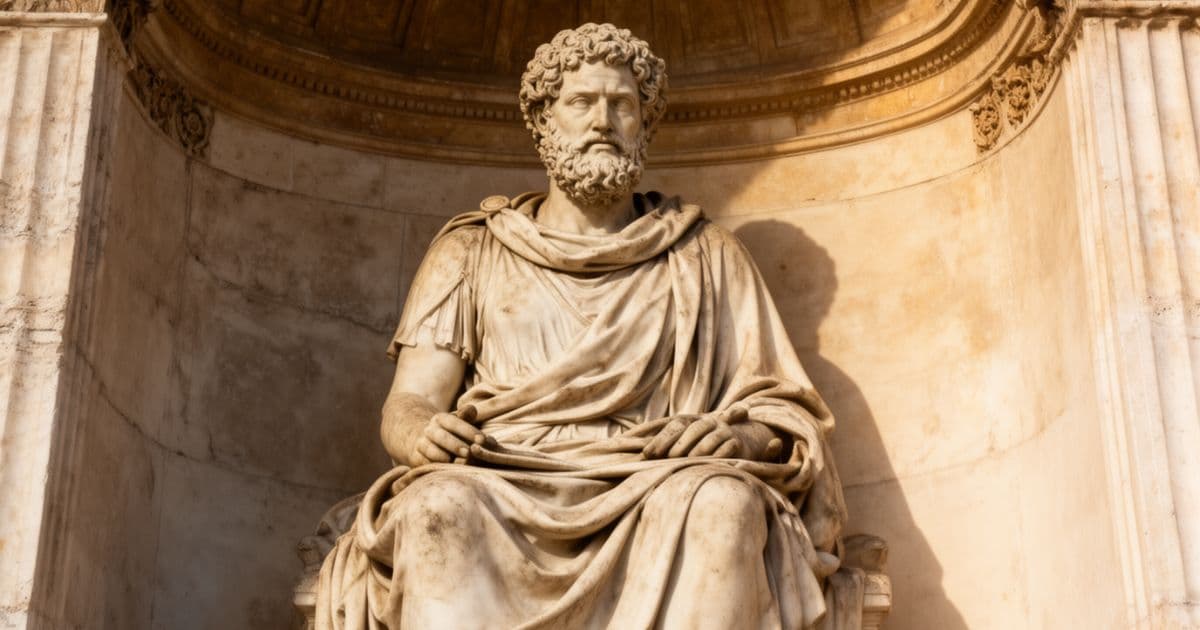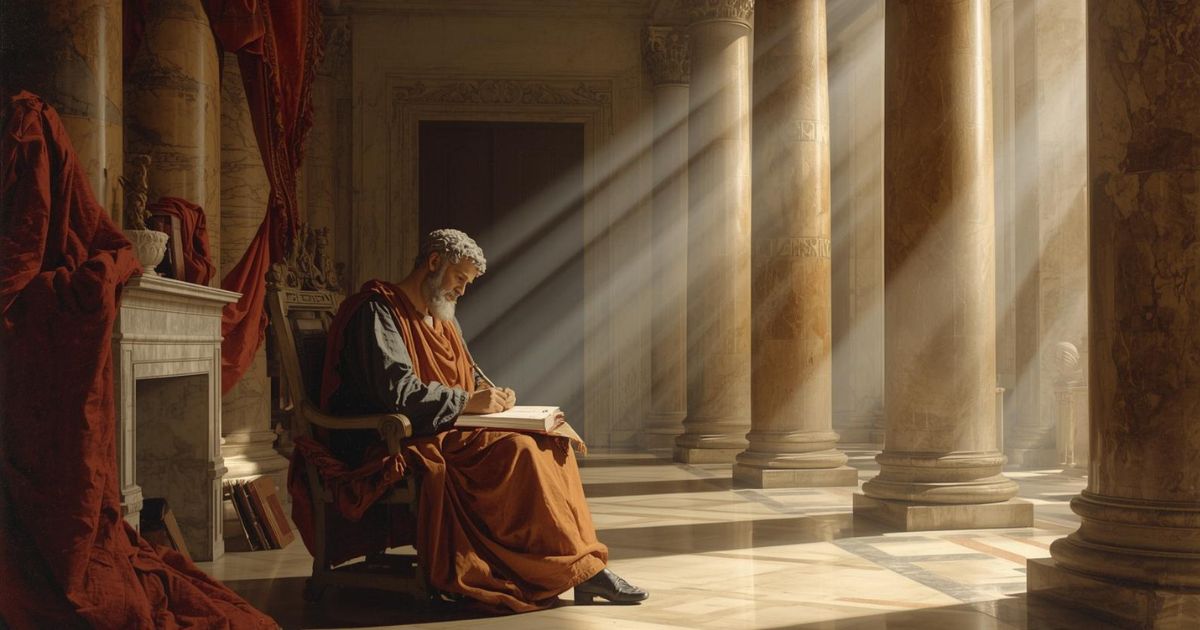
An excerpt from the original text.(complete · 1472 words)
←etter 99. On consolation to the bereavedMoral letters to Luciliusby Seneca, translated by Richard Mott GummereLetter 100. On the writings of FabianusLetter 101. On the futility of planning ahead→483742Moral letters to Lucilius — Letter 100. On the writings of FabianusRichard Mott GummereSeneca C. ON THE WRITINGS OF FABIANUS 1. You write me that you have read with the greatest eagerness the work by Fabianus Papirius entitled The Duties of a Citizen, and that it did not come up to your expectations; then, forgetting that you are dealing with a philosopher, you proceed to criticize his style. Suppose, now, that your statement is true—that he pours forth rather than places his words; let me, however, tell you at the start that this trait of which you speak has a peculiar charm, and that it is a grace appropriate to a smoothly-gliding style. For, I maintain, it matters a great deal whether it tumbles forth, or flows along. Moreover, there is a deal of difference in this regard also—as I shall make clear to you: 2. Fabianus seems to me to have not so much an “efflux” as a “flow” of words:[1] so copious is it, without confusion, and yet not without speed. This is indeed what his style declares and announces—that he has not spent a long time in working his matter over and twisting it into shape. But even supposing the facts are as you would have them; the man was building up character rather than words, and was writing those words for the mind rather than for the ear. 3. Besides, had he been speaking them in his own person, you would not have had time to consider the details—the whole work would have so swept you along. For as a rule that which pleases by its swiftness is of less value when taken in hand for reading. Nevertheless, this very quality, too, of attracting at first sight is a great advantage, no matter whether careful investigation may discover something to criticize. 4. If you ask me, I should say that he who has forced approval is greater than he who has earned it; and yet I know that the latter is safer, I know that he can give more confident guarantees for the future. A meticulous manner of writing does not suit the philosopher; if he is timid as to words, when will he ever be brave and steadfast, when will he ever really show his worth? 5. Fabianus’s style was not careless, it was assured. That is why you will find nothing shoddy in his work: his words are well chosen and yet not hunted for; they are not unnaturally inserted and inverted, according to the present-day fashion; but they possess distinction, even though they are taken from ordinary speech. There you have honourable and splendid ideas, not fettered into aphorisms, but spoken with greater freedom. We shall of course notice passages that are not sufficiently pruned, not constructed with sufficient care, and lacking the polish which is in vogue nowadays; but after regarding the whole, you will see that there are no futile subtleties of argument. 6. There may, doubtless, be no variety of marbles, no water-supply[2] which flows from one apartment to another, no “pauper-rooms,”[3] or any other device that luxury adds when ill content with simple charms; but, in the vulgar phrase, it is “a good house to live in.” Furthermore, opinions vary with regard to the style. Some wish it to be polished down from all roughness; and some take so great a pleasure in the abrupt manner that they would intentionally break up any passage which may by chance spread itself out more smoothly, scattering the closing words in such a way that the sentences may result unexpectedly. 7. Read Cicero: his style has unity; it moves with a modulated pace, and is gentle without being degenerate. The style of Asinius Pollio, on the other hand, is “bumpy,” jerky, leaving off when you least expect it.[4] And finally, Cicero always stops gradually; while Pollio breaks off, except in the very few cases where he cleaves to a definite rhythm and a single pattern. 8. In addition to this, you say that everything in Fabianus seems to you commonplace and lacking in elevation; but I myself hold that he is free from such a fault. For that style of his is not commonplace, but simply calm and adjusted to his peaceful and well-ordered mind—not on a low level but on an even plane. There is lacking the verve and spur of the orator (for which you are looking), and a sudden shock of epigrams.[5] But look, please, at the whole work, how well-ordered it is: there is a distinction in it. His style does not possess, but will suggest, dignity. 9. Mention someone whom you may rank ahead of Fabianus. Cicero, let us say, whose books on philosophy are almost as numerous as those of Fabianus. I will concede this point; but it is no slight thing to be less than the greatest. Or Asinius Pollio, let us say. I will yield again, and content myself by replying: “It is a distinction to be third in so great a field.” You may also include Livy; for Livy wrote both dialogues (which should be ranked as history no less than as philosophy), and works which professedly deal with philosophy. I shall yield in the case of Livy also. But consider how many writers Fabianus outranks, if he is surpassed by three only—and those three the greatest masters of eloquence! 10. But, it may be said, he does not offer everything: though his style is elevated, it is not strong; though it flows forth copiously, it lacks force and sweep; it is not translucent, but it is lucid. “One would fail,” you urge, “to find therein any rugged denunciation of vice, any courageous words in the face of danger, any proud defiance of Fortune, any scornful threats against self-seeking. I wish to see luxury rebuked, lust condemned, waywardness crushed out. Let him show us the keenness of oratory, the loftiness of tragedy, the subtlety of comedy.” You wish him to rely on that pettiest of things, phraseology; but he has sworn allegiance to the greatness of his subject and draws eloquence after him as a sort of shadow, but not of set purpose. 11. Our author will doubtless not investigate every detail, nor subject it to analysis, nor inspect and emphasize each separate word. This I admit. Many phrases will fall short, or will fail to strike home, and at times the style will slip along indolently; but there will be plenty of light throughout the work; there will be long stretches which will not weary the reader. And, finally, he will offer this quality of making it clear to you that he meant what he wrote. You will understand that his aim was to have you know what pleased him, rather than that he should please you. All his work makes for progress and for sanity, without any search for applause. 12. I do not doubt that his writings are of the kind I have described, although I am harking back to him rather than retaining a sure memory of him, and although the general tone of his writings remains in my mind, not from a careful and recent perusal, but in outline, as is natural after an acquaintance of long ago. But certainly, whenever I heard him lecture, such did his work seem to me—not solid but full, the kind which would inspire young men of promise and rouse their ambition to become like him, without making them hopeless of surpassing him; and this method of encouragement seems to me the most helpful of all. For it is disheartening to inspire in a man the desire, and to take away from him the hope, of emulation. At any rate, his language was fluent, and though one might not approve every detail, the general effect was noble. Farewell. ↑ i.e., his style is like a river rather than a torrent. ↑ Concisura: from concido, to “cut into sections,” “distribute” (of water-pipes). ↑ Cf. Ep. xviii. 7, and Martial iii. 48:Pauperis extruxit cellam, sed vendidit Oluspraedia; nunc cellam pauperis Olus habet.Rich men sometimes fitted up in their palaces an imitation “poor man’s cabin” by way of contrast to their other rooms or as a gesture towards simple living; Seneca uses the phrase figuratively for certain devices in composition. ↑ Quintilian x. 1. 113 says: multa in Asinio Pollione inventio, summa diligentia, adeo ut quibusdam etiam nimia videatur; et consilii et animi satis; a nitore et iucunditate Ciceronis ita longe abest, ut videri possit saeculo prior. ↑ The wording here resembles strikingly that of the Elder Seneca, Controv. ii. pr. 2 deerat illi (sc. Fabiano) oratorium robur et ille pugnatorius mucro.
Master this chapter. Complete your experience
Purchase the complete book to access all chapters and support classic literature
As an Amazon Associate, we earn a small commission from qualifying purchases at no additional cost to you.
Available in paperback, hardcover, and e-book formats
Let's Analyse the Pattern
When we prioritize sounding impressive over being authentic, we lose our power to create genuine connection and change.
Why This Matters
Connect literature to life
This chapter teaches how to evaluate whether communication criticism targets effectiveness or just appearance.
Practice This Today
This week, notice when someone criticizes how you say something versus what you're actually trying to accomplish—ask yourself if changing your style would improve your results or just your image.
Now let's explore the literary elements.
Key Quotes & Analysis
"The man was building up character rather than words"
Context: Defending Fabianus against criticism of his writing style
This captures the core Stoic principle that developing virtue and wisdom matters more than crafting impressive sentences. Fabianus wrote to transform people, not entertain them.
In Today's Words:
He was trying to help people become better, not win a writing contest
"It matters a great deal whether it tumbles forth, or flows along"
Context: Distinguishing between chaotic and natural writing styles
Seneca argues that there's a difference between careless rambling and natural expression. Fabianus's style flows naturally because it comes from genuine conviction.
In Today's Words:
There's a big difference between word-vomit and speaking from the heart
"He has not spent a long time in working his matter over and twisting it into shape"
Context: Explaining why Fabianus's writing seems unpolished
This suggests that Fabianus wrote from authentic understanding rather than laboring over every word for effect. His naturalness is a strength, not a weakness.
In Today's Words:
He didn't overthink every word because he knew what he wanted to say
Thematic Threads
Authenticity
In This Chapter
Seneca defends Fabianus's natural, unpolished writing style as more authentic than crafted performance
Development
Building on earlier themes of genuine self-expression versus social performance
In Your Life:
You might catch yourself editing texts multiple times to sound smarter instead of just saying what you mean
Social Expectations
In This Chapter
Lucilius expects philosophical writing to meet certain stylistic standards, missing the substance
Development
Continues the theme of how external expectations can distort our judgment
In Your Life:
You might judge someone's intelligence by how they speak rather than what they're actually saying
Purpose
In This Chapter
Fabianus writes to change minds, not win applause—his purpose shapes his style
Development
Reinforces the importance of clarity about our true goals
In Your Life:
You might realize you're doing things to look good rather than to accomplish your actual goals
Character
In This Chapter
Seneca argues that Fabianus's writing style reflects his genuine character rather than carelessness
Development
Continues the theme that true character shows through authentic expression
In Your Life:
You might notice how your natural way of communicating reveals who you really are
Judgment
In This Chapter
Seneca challenges Lucilius's criteria for evaluating philosophical writing
Development
Extends earlier themes about questioning conventional standards of success
In Your Life:
You might reconsider what standards you use to judge whether something is valuable or worthwhile
You now have the context. Time to form your own thoughts.
Discussion Questions
- 1
Why does Seneca defend Fabianus against Lucilius's criticism about his writing style?
analysis • surface - 2
What's the difference between writing that 'tumbles forth' chaotically and writing that 'flows' naturally, according to Seneca?
analysis • medium - 3
Where do you see people prioritizing impressive presentation over clear communication in your daily life?
application • medium - 4
Think of a time when you tried too hard to sound smart or polished. How did it affect your ability to connect with others?
reflection • deep - 5
What does this chapter reveal about the tension between authenticity and the desire for approval?
reflection • deep
Critical Thinking Exercise
Authentic Voice Audit
Choose three different ways you communicate regularly - maybe texting friends, talking to your boss, and posting on social media. Write a few sentences describing how your voice changes in each situation. Notice where you sound most like yourself and where you're performing for an audience. Consider what you gain and lose in each mode.
Consider:
- •Pay attention to word choice - do you use bigger words to sound smarter?
- •Notice your tone - are you more formal, casual, or trying to be funny?
- •Think about your goals - are you trying to impress, connect, or get something done?
Journaling Prompt
Write about a situation where you wish you had spoken more authentically. What held you back from using your natural voice, and how might things have been different if you had?
Coming Up Next...
Chapter 101: Death Doesn't Wait for Your Plans
Seneca turns from evaluating others' work to examining the futility of making elaborate future plans. He explores why our daily reminders of human fragility should reshape how we approach tomorrow.