
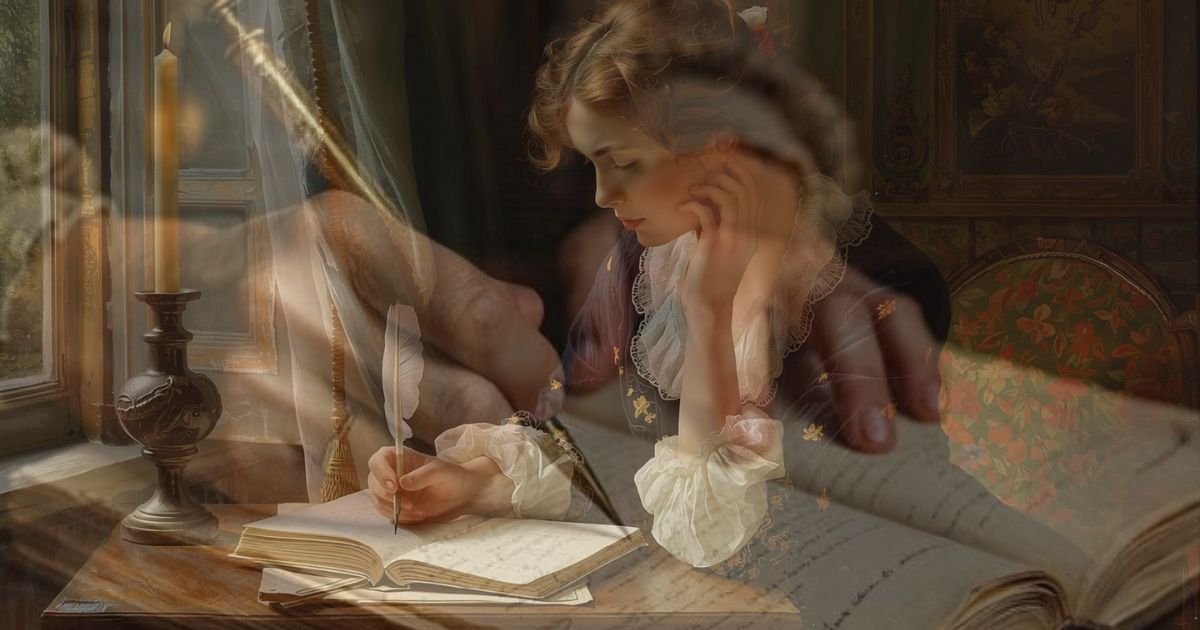
An excerpt from the original text.(complete · 1463 words)
R. VILLARS TO LADY HOWARD Berry Hill, Dorsetshire.
YOUR Ladyship did but too well foresee the perplexity and uneasiness
of which Madame Duval's letter has been productive. However, I ought
rather to be thankful that I have so many years remained unmolested,
than repine at my present embarrassment; since it proves, at least,
that this wretched woman is at length awakened to remorse.
In regard to my answer, I must humbly request your Ladyship to write
to this effect: "That I would not, upon any account, intentionally
offend Madame Duval; but that I have weighty, nay unanswerable
reasons for detaining her grand-daughter at present in England;
the principal of which is, that it was the earnest desire of one
to whose will she owes implicit duty. Madame Duval may be assured,
that she meets with the utmost attention and tenderness; that her
education, however short of my wishes, almost exceeds my abilities;
and I flatter myself, when the time arrives that she shall pay her
duty to her grand-mother, Madame Duval will find no reason to be
dissatisfied with what has been done for her."
Your Ladyship will not, I am sure, be surprised at this answer. Madame
Duval is by no means a proper companion or guardian for a young woman:
she is at once uneducated and unprincipled; ungentle in temper, and
unamiable in her manners. I have long known that she has persuaded
herself to harbour an aversion for me-Unhappy woman! I can only regard
her as an object of pity!
I dare not hesitate at a request from Mrs. Mirvan; yet, in complying
with it, I shall, for her own sake, be as concise as I possibly can;
since the cruel transactions which preceded the birth of my ward can
afford no entertainment to a mind so humane as her's.
Your Ladyship may probably have heard, that I had the honour to
accompany Mr. Evelyn, the grandfather of my young charge, when
upon his travels, in the capacity of a tutor. His unhappy marriage,
immediately upon his return to England, with Madame Duval, then a
waiting-girl at a tavern, contrary to the advice and entreaties of
all his friends, among whom I was myself the most urgent, induced
him to abandon his native land, and fix his abode in France.
Thither he was followed by shame and repentance; feelings which
his heart was not framed to support; for, notwithstanding he had
been too weak to resist the allurements of beauty, which nature,
though a niggard to her of every other boon, had with a lavish hand
bestowed on his wife; yet he was a young man of excellent character,
and, till thus unaccountably infatuated, of unblemished conduct. He
survived this ill-judged marriage but two years. Upon his death-bed,
with an unsteady hand, he wrote me the following note:
"My friend, forget your resentment, in favour of your humanity;-a
father, trembling for the welfare of his child, bequeaths her to your
care. O Villars! hear! pity! And relieve me!"
Had my circumstances permitted me, I should have answered these words
by an immediate journey to Paris; but I was obliged to act by the
agency of a friend, who was upon the spot, and present at the opening
of the will.
Mr. Evelyn left to me a legacy of a thousand pounds, and the sole
guardianship of his daughter's person till her eighteenth year;
conjuring me, in the most affecting terms, to take the charge of her
education till she was able to act with propriety for herself; but,
in regard to fortune, he left her wholly dependent on her mother,
to whose tenderness he earnestly recommended her.
Thus, though he would not, to a woman low-bred and illiberal as
Mrs. Evelyn, trust the conduct and morals of his daughter, he
nevertheless thought proper to secure to her the respect and duty
to which, from her own child, were certainly her due; but unhappily,
it never occurred to him that the mother, on her part, could fail in
affection or justice.
Miss Evelyn, Madam, from the second to the eighteenth year of her
life, was brought up under my care, and, except when at school
under my roof. I need not speak to your Ladyship of the virtues
of that excellent young creature. She loved me as her father; nor
was Mrs. Villars less valued by her; while to me she became so dear,
that her loss was little less afflicting than that which I have since
sustained of Mrs. Villars herself.
At that period of her life we parted; her mother, then married to
Monsieur Duval, sent for her to Paris. How often have I since regretted
that I did not accompany her thither! Protected and supported by me,
the misery and disgrace which awaited her might perhaps have been
avoided. But, to be brief-Madame Duval, at the instigation of her
husband, earnestly, or rather tyrannically, endeavoured to effect a
union between Miss Evelyn and one of his nephews. And, when she found
her power inadequate to her attempt, enraged at her non-compliance,
she treated her with the grossest unkindness, and threatened her with
poverty and ruin.
Miss Evelyn, to whom wrath and violence had hitherto been strangers,
soon grew weary of such usage; and rashly, and without a witness,
consented to a private marriage with Sir John Belmont, a very
profligate young man, who had but too successfully found means to
insinuate himself into her favour. He promised to conduct her to
England-he did.-O, Madam, you know the rest!-Disappointed of the
fortune he expected, by the inexorable rancour of the Duvals, he
infamously burnt the certificate of their marriage, and denied that
they had ever been united.
She flew to me for protection. With what mixed transports of joy and
anguish did I again see her! By my advice, she endeavoured to procure
proofs of her marriage-but in vain; her credulity had been no match
for his art.
Every body believed her innocent, from the guiltless tenor of her
unspotted youth, and from the known libertinism of her barbarous
betrayer. Yet her sufferings were too acute for her slender frame;
and the same moment that gave birth to her infant, put an end at once
to the sorrows and the life of its mother.
The rage of Madame Duval at her elopement, abated not while this
injured victim of cruelty yet drew breath. She probably intended, in
time, to have pardoned her; but time was not allowed. When she was
informed of her death, I have been told, that the agonies of grief
and remorse, with which she was seized, occasioned her a severe fit
of illness. But, from the time of her recovery to the date of her
letter to your Ladyship, I had never heard that she manifested any
desire to be made acquainted with the circumstances which attended
the death of Lady Belmont, and the birth of her helpless child.
That child, Madam, shall never, while life is lent me, know the loss
she has sustained. I have cherished, succoured, and supported her,
from her earliest infancy to her sixteenth year; and so amply has she
repaid my care and affection, that my fondest wish is now circumscribed
by the desire of bestowing her on one who may be sensible of her worth,
and then sinking to eternal rest in her arms.
Thus it has happened, that the education of the father, daughter,
and grand-daughter, has devolved on me. What infinite misery have the
two first caused me! Should the fate of the dear survivor be equally
adverse, how wretched will be the end of my cares-the end of my days!
Even had Madame Duval merited the charge she claims, I fear my
fortitude would have been unequal to such a parting; but being such
as she is, not only my affection, but my humanity, recoils, at the
barbarous idea of deserting the sacred trust reposed in me. Indeed,
I could but ill support her former yearly visits to the respectable
mansion at Howard Grove: pardon me, dear Madam, and do not think me
insensible of the honour which your Ladyship's condescension confers
upon us both; but so deep is the impression which the misfortunes
of her mother have made on my heart, that she does not, even for
a moment, quit my sight without exciting apprehensions and terrors
which almost overpower me. Such, Madam, is my tenderness, and such
my weakness!-But she is the only tie I have upon earth, and I trust
to your Ladyship's goodness not to judge of my feelings with severity.
I beg leave to present my humble respects to Mrs. and Miss Mirvan;
and have the honour to be, Madam, your Ladyship's most obedient and
most humble servant, ARTHUR VILLARS.
Master this chapter. Complete your experience
Purchase the complete book to access all chapters and support classic literature
As an Amazon Associate, we earn a small commission from qualifying purchases at no additional cost to you.
Available in paperback, hardcover, and e-book formats
Let's Analyse the Pattern
When past trauma makes us so afraid of potential harm that we prevent necessary growth and risk-taking in those we care about.
Why This Matters
Connect literature to life
This chapter teaches how to identify when fear-based protection has become harmful limitation.
Practice This Today
This week, notice when you or others use 'I'm just trying to protect you' as justification for preventing someone's growth or independence.
Now let's explore the literary elements.
Key Quotes & Analysis
", I ought rather to be thankful that I have so many years remained unmolested, than repine at my present embarrassment; since it proves, at"
Context: Opening his letter to Lady Howard about Madame Duval's demand for Evelina
This reveals Villars' defensive mindset - he's been dreading this confrontation for years. The word 'unmolested' shows he sees Madame Duval as a threat, not family. He's trying to stay positive but clearly feels cornered.
In Today's Words:
I should be grateful I've had peace this long instead of complaining about this mess I'm in now.
"swer. Madame Duval is by no means a proper companion or guardian for a young woman: she is at once uneducated and unprincipled; ungentle in temper, and unamiable in her manners. I have long known that she"
Context: Explaining to Lady Howard why he won't send Evelina to her grandmother
Villars systematically destroys Madame Duval's character, listing everything that makes her unfit as a guardian. This isn't just personal dislike - he's building a case for why keeping Evelina away is actually protective, not selfish.
In Today's Words:
Madame Duval would be a terrible influence - she's ignorant, has no morals, has anger issues, and treats people badly.
"hat it was the earnest desire of one to whose will she owes implicit duty."
Context: His proposed response to Madame Duval about why Evelina must stay in England
Villars invokes the dead grandfather's wishes as his trump card. By framing this as honoring a patriarch's dying wish, he makes opposition seem disrespectful. It's a clever way to use family hierarchy against Madame Duval's demands.
In Today's Words:
Her grandfather specifically wanted this, and she has to respect his wishes.
Thematic Threads
Generational Trauma
In This Chapter
Villars carries the weight of watching two generations make destructive choices, shaping his fear about Evelina's future
Development
Introduced here as the driving force behind all protective decisions
In Your Life:
You might recognize this in how your family's past struggles influence your current choices and fears.
Class Vulnerability
In This Chapter
Caroline's lack of fortune made her vulnerable to abandonment; class differences destroyed her grandfather's judgment
Development
Introduced here as both protection and trap
In Your Life:
You see this when financial insecurity makes you or others targets for exploitation or forces desperate choices.
Duty vs. Care
In This Chapter
Social expectations say family duty requires sending Evelina to her grandmother, but genuine care suggests this would be harmful
Development
Introduced here as central moral conflict
In Your Life:
You face this when what your family expects conflicts with what you know is actually best for someone you love.
Male Authority
In This Chapter
Villars holds complete power over Evelina's fate; past men (grandfather, Sir John) made decisions that destroyed women's lives
Development
Introduced here as both protective and potentially limiting force
In Your Life:
You might see this in how authority figures in your life make decisions 'for your own good' without consulting your actual needs.
Identity Formation
In This Chapter
Evelina's identity is shaped entirely by others' choices and protection, with no agency in her own story yet
Development
Introduced here as the central challenge she must eventually face
In Your Life:
You recognize this when you realize your sense of self has been shaped more by others' fears and expectations than your own experiences.
You now have the context. Time to form your own thoughts.
Discussion Questions
- 1
What specific events from the past make Mr. Villars so reluctant to send Evelina to her grandmother?
analysis • surface - 2
How did Mr. Villars' experience watching Caroline's destruction shape his approach to protecting Evelina?
analysis • medium - 3
Where do you see this pattern of protective paralysis in your own life or community—someone so afraid of past hurt repeating that they prevent all growth?
application • medium - 4
If you were advising Mr. Villars, how would you help him balance protecting Evelina with allowing her to develop independence?
application • deep - 5
What does this chapter reveal about how trauma can be passed down through generations, even when people have the best intentions?
reflection • deep
Critical Thinking Exercise
Map Your Protection Patterns
Think of someone you care about deeply. Write down three specific ways you try to protect them, then honestly assess: which of these protections help them grow stronger, and which might be holding them back? For each protective behavior, identify what past experience or fear is driving it.
Consider:
- •Consider the difference between preparing someone for challenges versus preventing all challenges
- •Notice whether your protection serves their growth or your own anxiety
- •Think about what skills they need to develop to handle difficulties independently
Journaling Prompt
Write about a time when someone's overprotectiveness (yours or someone else's) prevented growth or learning. What would graduated exposure to risk have looked like instead?
Coming Up Next...
Chapter 3: The London Invitation
Several months pass, and the pressure from Madame Duval intensifies. Villars must make a decision about Evelina's future that could change everything.



