
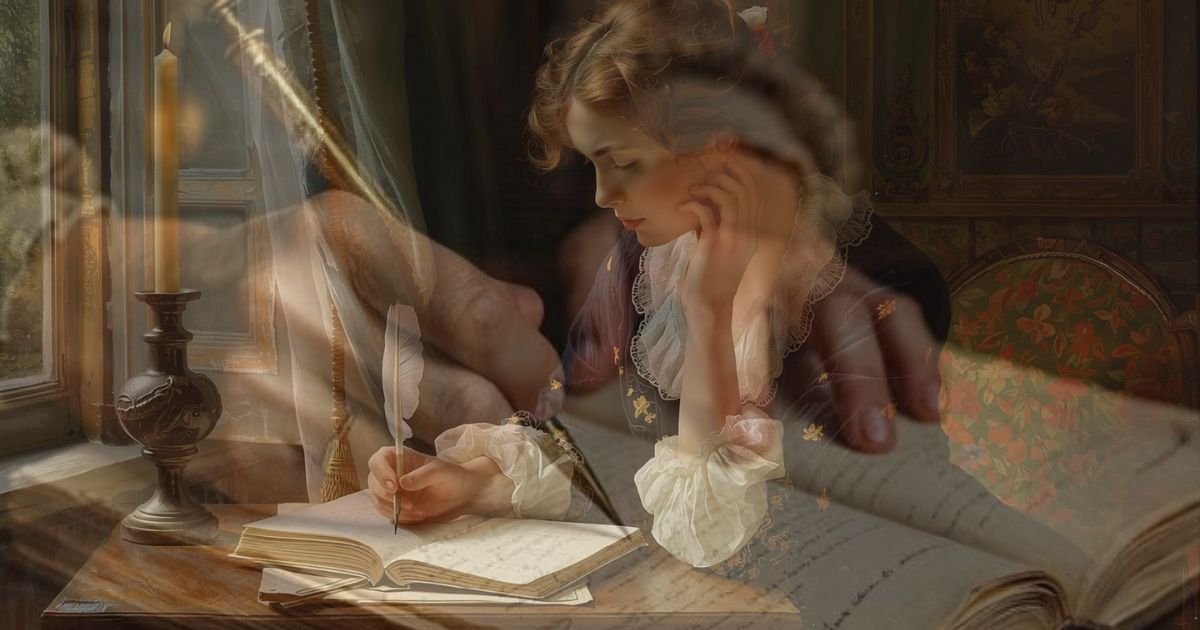
An excerpt from the original text.(complete · 1787 words)
VELINA IN CONTINUATION Friday Morning, April 15.
SIR CLEMENT WILLOUGHBY called here yesterday at noon, and Captain
Mirvan invited him to dinner. For my part I spent the day in a manner
the most uncomfortable imaginable.
I found Madame Duval at breakfast in bed, though Monsieur Du Bois was
in the chamber; which so much astonished me, that I was, involuntarily,
retiring, without considering how odd an appearance my retreat would
have, when Madame Duval called me back, and laughed very heartily at
my ignorance of foreign customs.
The conversation, however, very soon took a more serious turn; for
she began, with great bitterness, to inveigh against the barbarous
brutality of that fellow the Captain, and the horrible ill-breeding
of the English in general, declaring, she should make her escape
with all expedition from so beastly a nation. But nothing can be more
strangely absurd, than to hear politeness recommended in language so
repugnant to it as that of Madame Duval.
She lamented, very mournfully, the fate of her Lyons silk; and
protested she had rather have parted with all the rest of her wardrobe,
because it was the first gown she had bought to wear upon leaving off
her weeds. She has a very bad cold, and Monsieur Du Bois is so hoarse,
he can hardly speak.
She insisted upon my staying with her all day; as she intended, she
said, to introduce me to some of my own relations. I would very fain
have excused myself, but she did not allow me any choice.
Till the arrival of these relations, one continued series of questions
on her side, and of answers on mine, filled up all the time we
passed together. Her curiosity was insatiable; she inquired into
every action of my life, and every particular that had fallen under
my observation in the lives of all I knew. Again, she was so cruel
as to avow the most inveterate rancour against the sole benefactor
her deserted child and grand-child have met with; and such was the
indignation her ingratitude raised, that I would actually have quitted
her presence and house, had she not, in a manner the most peremptory,
absolutely forbid me. But what, good Heaven! can induce her to such
shocking injustice? O, my friend and father! I have no command of
myself when this subject is started.
She talked very much of taking me to Paris, and said I greatly
wanted the polish of a French education. She lamented that I had
been brought up in the country, which, she observed, had given me
a very bumpkinish air. However, she bid me not despair, for she had
known many girls much worse than me, who had become very fine ladies
after a few years residence abroad; and she particularly instanced
a Miss Polly Moore, daughter of a chandler's-shop woman, who, by an
accident not worth relating, happened to be sent to Paris, where,
from an awkward ill-bred girl, she so much improved, that she has
since been taken for a woman of quality.
The relations to whom she was pleased to introduce me, consisted
of a Mr. Branghton, who is her nephew, and three of his children,
the eldest of which is a son, and the two younger are daughters.
Mr. Branghton appears about forty years of age. He does not seem
to want a common understanding, though he is very contracted and
prejudiced: he has spent his whole time in the city, and I believe
feels a great contempt for all who reside elsewhere.
His son seems weaker in his understanding, and more gay in his
temper; but his gaiety is that of a foolish, overgrown school-boy,
whose mirth consists in noise and disturbance. He disdains his father
for his close attention to business, and love of money; though he
seems himself to have no talents, spirit, or generosity, to make him
superior to either. His chief delight appears to be tormenting and
ridiculing his sisters; who, in return, most heartily despise him.
Miss Branghton, the eldest daughter, is by no means ugly; but looks
proud, ill-tempered, and conceited. She hates the city, though without
knowing why; for it is easy to discover she has lived no where else.
Miss Polly Branghton is rather pretty, very foolish, very ignorant,
very giddy, and, I believe, very good-natured.
The first half-hour was allotted to making themselves comfortable;
for they complained of having had a very dirty walk, as they came on
foot from Snow Hill, where Mr. Branghton keeps a silversmith's shop;
and the young ladies had not only their coats to brush, and shoes to
dry, but to adjust their head-dress, which their bonnets had totally
discomposed.
The manner in which Madame Duval was pleased to introduce me to this
family extremely shocked me. "Here, my dears," said she, "here's a
relation you little thought of; but you must know, my poor daughter
Caroline had this child after she run away from me,-though I never
knew nothing of it, not I, for a long while after; for they took care
to keep it a secret from me, though the poor child has never a friend
in the world besides."
"Miss seems very tender-hearted, aunt," said Miss Polly; "and to be
sure she's not to blame for her mama's undutifulness, for she couldn't
help it."
"Lord, no," answered she, "and I never took no notice of it to her:
for, indeed, as to that, my own poor daughter wasn't so much to blame
as you may think; for she'd never have gone astray, if it had not
been for that meddling old parson I told you of."
"If aunt pleases," said young Mr. Branghton, "we'll talk o' somewhat
else, for Miss looks very uneasy-like."
The next subject that was chosen was the age of the three young
Branghtons and myself. The son is twenty; the daughters upon hearing
that I was seventeen, said that was just the age of Miss Polly; but
their brother, after a long dispute, proved that she was two years
older, to the great anger of both sisters, who agreed that he was
very ill-natured and spiteful.
When this point was settled, the question was put, Which was
tallest?-We were desired to measure, as the Branghtons were all of
different opinions. None of them, however, disputed my being the
tallest in the company; but, in regard to one another, they were
extremely quarrelsome: the brother insisted upon their measuring fair,
and not with heads and heels; but they would by no means consent to
lose those privileges of our sex; and therefore the young man was cast,
as shortest; though he appealed to all present upon the injustice of
the decree.
This ceremony over, the young ladies begun, very freely, to examine
my dress, and to interrogate me concerning it. "This apron's
your own work, I suppose, Miss? but these sprigs a'n't in fashion
now. Pray, if it is not impertinent, what might you give a yard for
this lutestring?-Do you make your own caps, Miss?" and many other
questions equally interesting and well-bred.
Then they asked me how I liked London? and whether I should not think
the country a very dull place, when I returned thither? "Miss must
try if she can't get a good husband," said Mr. Branghton, "and then
she may stay and live here."
The next topic was public places, or rather the theatres, for they
knew of no other; and the merits and defects of all the actors and
actresses were discussed: the young man here took the lead, and seemed
to be very conversant on the subject. But during this time, what was
my concern, and, suffer me to add, my indignation, when I found, by
some words I occasionally heard, that Madame Duval was entertaining
Mr. Branghton with all the most secret and cruel particulars of my
situation! The eldest daughter was soon drawn to them by the recital;
the youngest and the son still kept their places; intending, I believe,
to divert me, though the conversation was all their own.
In a few minutes, Miss Branghton coming suddenly up to her sister,
exclaimed, "Lord, Polly, only think! Miss never saw her papa!"
"Lord, how odd!" cried the other; "why, then, Miss, I suppose you
wouldn't know him?"
This was quite too much for me; I rose hastily, and ran out of
the room: but I soon regretted I had so little command of myself;
for the two sisters both followed, and insisted upon comforting me,
notwithstanding my earnest intreaties to be left alone.
As soon as I returned to the company, Madame Duval said, "Why, my dear,
what was the matter with you? why did you run away so?"
This question almost made me run again, for I knew not how to
answer it. But, is it not very extraordinary, that she can put me
in situations so shocking, and then wonder to find me sensible of
any concern?
Mr. Branghton junior now inquired of me, whether I had seen the Tower,
or St. Paul's church? and upon my answering in the negative, they
proposed making a party to shew them to me. Among other questions,
they also asked, if I had ever seen such a thing as an opera? I told
them I had. "Well," said Mr. Branghton, "I never saw one in my life,
so long as I've lived in London; and I never desire to see one,
if I live here as much longer."
"Lord, papa," cried Miss Polly, "why not? you might as well for once,
for the curiosity of the thing: besides, Miss Pomfret saw one, and
she says it was very pretty."
"Miss will think us very vulgar," said Miss Branghton, "to live in
London, and never have been to an opera; but it's no fault of mine,
I assure you, Miss, only papa don't like to go."
The result was, that a party was proposed, and agreed to, for some
early opportunity. I did not dare contradict them; but I said
that my time, while I remained in town, was at the disposal of
Mrs. Mirvan. However, I am sure I will not attend them, if I can
possibly avoid doing so.
When we parted, Madame Duval desired to see me the next day; and the
Branghtons told me, that the first time I went towards Snow Hill,
they should be very glad if I would call upon them.
I wish we may not meet again till that time arrives.
I am sure I shall not be very ambitious of being known to any more of
my relations, if they have any resemblance to those whose acquaintance
I have been introduced to already.
Master this chapter. Complete your experience
Purchase the complete book to access all chapters and support classic literature
As an Amazon Associate, we earn a small commission from qualifying purchases at no additional cost to you.
Available in paperback, hardcover, and e-book formats
Let's Analyse the Pattern
Using blood relations to justify forcing someone into harmful or uncomfortable situations while positioning resistance as ingratitude.
Why This Matters
Connect literature to life
This chapter teaches how to recognize when someone uses family loyalty or social obligation to justify putting you in harmful situations.
Practice This Today
This week, notice when someone says 'but they're family' or 'you should' to pressure you into accepting bad behavior—that's often manipulation disguised as duty.
Now let's explore the literary elements.
Key Quotes & Analysis
". I found Madame Duval at breakfast in bed, though Monsieur Du Bois was in the chamber; which so much astonished me, that I was, involuntarily, retiring, without considering how"
Context: Evelina walks in on an inappropriate scene that shocks her
This shows the clash between Evelina's proper upbringing and Madame Duval's loose morals. Evelina's shock reveals how different their values are, and her instinct to retreat shows her good judgment about improper situations.
In Today's Words:
I walked in and saw something that made me super uncomfortable, so I tried to back out of there fast
". But nothing can be more strangely absurd, than to hear politeness recommended in language so repugnant to it as that of Madame Duval. She lamented, v"
Context: Madame Duval complains about others' bad manners while being rude herself
This perfectly captures the hypocrisy of someone who criticizes others for the exact behavior they're displaying. It shows Evelina's growing awareness of Madame Duval's contradictions and lack of self-awareness.
In Today's Words:
It's ridiculous to hear someone preach about good manners while being completely rude themselves
"l day; as she intended, she said, to introduce me to some of my own relations."
Context: Madame Duval announces her plan to force Evelina to meet the Branghtons
This innocent-sounding statement sets up the chapter's main conflict. The word 'intended' shows this isn't a request but a decision already made, revealing Madame Duval's controlling nature and lack of consideration for Evelina's feelings.
In Today's Words:
She decided she was going to make me meet some family members whether I wanted to or not
Thematic Threads
Class
In This Chapter
The Branghtons represent Evelina's fears about her lower-class origins—they're vulgar, judgmental, and lack social grace
Development
Deepens from earlier subtle class anxieties to direct confrontation with her 'shameful' background
In Your Life:
You might recognize this when you feel embarrassed by family members' behavior in professional or social settings.
Identity
In This Chapter
Evelina must confront the gap between who she's become and where she came from when faced with the Branghtons
Development
Evolves from internal identity confusion to external identity challenge through family exposure
In Your Life:
You might feel this tension when returning home after education or career advancement changes how you see yourself.
Family Dysfunction
In This Chapter
Madame Duval forces toxic family reunions while remaining oblivious to the emotional damage she causes
Development
Introduced here as a major theme showing how family can be more harmful than helpful
In Your Life:
You might experience this when relatives expect you to maintain relationships that drain or hurt you.
Social Expectations
In This Chapter
The assumption that blood relations automatically create obligations and that Evelina must accept the Branghtons' intrusion
Development
Builds on earlier themes of social pressure but now focuses specifically on family obligations
In Your Life:
You might feel this pressure when expected to attend family events or maintain relationships that don't serve you.
Boundaries
In This Chapter
Evelina struggles to assert her right to choose her relationships when faced with family demands and guilt
Development
Introduced here as Evelina begins learning she can say no to people who claim authority over her
In Your Life:
You might need this skill when family members assume access to your time, money, or emotional energy without earning it.
You now have the context. Time to form your own thoughts.
Discussion Questions
- 1
Why does Madame Duval think introducing Evelina to the Branghtons is a good idea, and what does she completely miss about how this affects Evelina?
analysis • surface - 2
How do the Branghtons use their blood relationship to claim immediate rights over Evelina's time and attention, even though they've never met her before?
analysis • medium - 3
Where do you see this pattern of 'forced family loyalty' in modern workplaces, relationships, or community situations?
application • medium - 4
If you were Evelina's friend, what specific advice would you give her about setting boundaries with the Branghtons while still managing Madame Duval's expectations?
application • deep - 5
What does this chapter reveal about the difference between family relationships that are earned through care versus those that are demanded through blood ties?
reflection • deep
Critical Thinking Exercise
Map the Manipulation Pattern
Think of a time when someone used 'family duty' or 'team loyalty' to pressure you into accepting uncomfortable or harmful behavior. Write down the exact words they used to make you feel guilty for having boundaries. Then identify what they were really asking you to sacrifice for their convenience.
Consider:
- •Notice how guilt and obligation language sounds caring but actually dismisses your feelings
- •Pay attention to who benefits most from you 'keeping the peace' or 'being understanding'
- •Consider whether this person shows the same loyalty and consideration they demand from you
Journaling Prompt
Write about a relationship where you've felt pressured to accept poor treatment because of shared history, family ties, or group loyalty. What would change if you required that relationship to be earned through current behavior rather than claimed through past connections?
Coming Up Next...
Chapter 18: A Private Moment with Lord Orville
Evelina returns to the Mirvans, but her ordeal with the Branghtons is far from over. The social complications of her new family connections are about to create even more awkward situations.



