
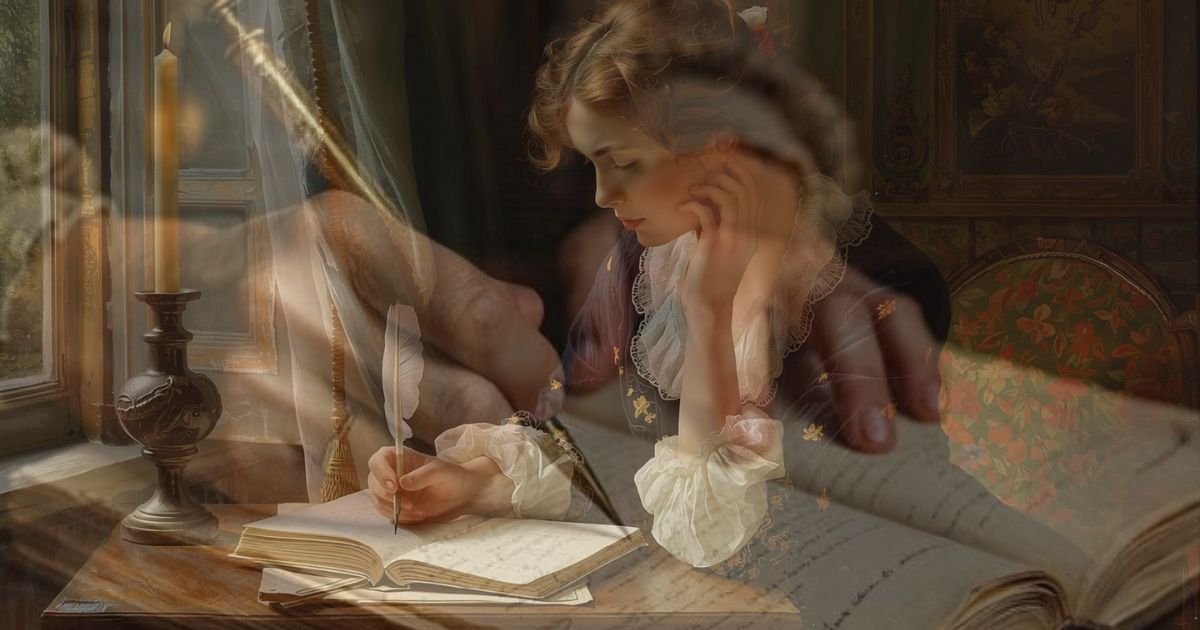
An excerpt from the original text.(complete · 2718 words)
VELINA IN CONTINUATION Queen Ann Street, April 5, Tuesday Morning.
I HAVE a vast deal to say, and shall give all this morning to my pen.
As to my plan of writing every evening the adventures of the day,
I find it impracticable; for the diversions here are so very late,
that if I begin my letters after them, I could not go to bed at all.
We passed a most extraordinary evening. A private ball this was called,
so I expected to have seen about four or five couple; but Lord! my
dear Sir, I believe I saw half the world! Two very large rooms were
full of company; in one were cards for the elderly ladies, and in
the other were the dancers. My mamma Mirvan, for she always calls me
her child, said she would sit with Maria and me till we were provided
with partners, and then join the card-players.
The gentlemen, as they passed and repassed, looked as if they thought
we were quite at their disposal, and only waiting for the honour of
their commands; and they sauntered about, in a careless, indolent
manner, as if with a view to keep us in suspense. I don't speak of
this in regard to Miss Mirvan and myself only, but to the ladies in
general: and I thought it so provoking, that I determined in my own
mind that, far from humouring such airs, I would rather not dance
at all, than with any one who would seem to think me ready to accept
the first partner who would condescend to take me.
Not long after, a young man, who had for some time looked at us with a
kind of negligent impertinence, advanced on tiptoe towards me; he had
a set smile on his face, and his dress was so foppish, that I really
believed he even wished to be stared at; and yet he was very ugly.
Bowing almost to the ground with a sort of swing, and waving his
hand, with the greatest conceit, after a short and silly pause, he
said, "Madam-may I presume?"-and stopt, offering to take my hand. I
drew it back, but could scarce forbear laughing. "Allow me, Madam,"
continued he, affectedly breaking off every half moment, "the honour
and happiness-if I am not so unhappy as to address you too late-to
have the happiness and honour-"
Again he would have taken my hand; but bowing my head, I begged to
be excused, and turned to Miss Mirvan to conceal my laughter. He then
desired to know if I had already engaged myself to some more fortunate
man? I said No, and that I believed I should not dance at all. He would
keep himself he told me, disengaged, in hopes I should relent; and
then, uttering some ridiculous speeches of sorrow and disappointment,
though his face still wore the same invariable smile, he retreated.
It so happened, as we have since recollected, that during this little
dialogue Mrs. Mirvan was conversing with the lady of the house. And
very soon after, another gentleman, who seemed about six-and-twenty
years old, gaily but not foppishly dressed, and indeed extremely
handsome, with an air of mixed politeness and gallantry, desired to
know if I was engaged, or would honour him with my hand. So he was
pleased to say, though I am sure I know not what honour he could
receive from me; but these sort of expressions, I find, are used
as words of course, without any distinction of persons, or study
of propriety.
Well, I bowed, and I am sure I coloured; for indeed I was frightened
at the thoughts of dancing before so many people, all strangers, and,
which was worse, with a stranger: however, that was unavoidable;
for, though I looked round the room several times, I could not see
one person that I knew. And so he took my hand, and led me to join
in the dance.
The minuets were over before we arrived, for we were kept late by
the milliners making us wait for our things.
He seemed very desirous of entering into conversation with me; but
I was seized with such a panic, that I could hardly speak a word,
and nothing but the shame of so soon changing my mind prevented my
returning to my seat, and declining to dance at all.
He appeared to be surprised at my terror, which I believe was but
too apparent: however, he asked no questions, though I fear he must
think it very strange, for I did not choose to tell him it was owing
to my never before dancing but with a school-girl.
His conversation was sensible and spirited; his air, and address
were open and noble; his manners gentle, attentive, and infinitely
engaging; his person is all elegance, and his countenance the most
animated and expressive I have ever seen.
In a short time we were joined by Miss Mirvan, who stood next couple
to us. But how I was startled when she whispered me that my partner
was a nobleman! This gave me a new alarm: how will he be provoked,
thought I, when he finds what a simple rustic he has honoured with
his choice! one whose ignorance of the world makes her perpetually
fear doing something wrong!
That he should be so much my superior in every way, quite disconcerted
me; and you will suppose my spirits were not much raised, when I
heard a lady, in passing us, say, "This is the most difficult dance
I ever saw."
"O dear, then" cried Maria to her partner, "with your leave, I'll
sit down till the next."
"So will I too, then," cried I, "for I am sure I can hardly stand."
"But you must speak to your partner first," answered she; for he
had turned aside to talk with some gentlemen. However, I had not
sufficient courage to address him; and so away we all three tript,
and seated ourselves at another end of the room.
But, unfortunately for me, Miss Mirvan soon after suffered herself to
be prevailed upon to attempt the dance; and just as she rose to go,
she cried, "My dear, yonder is your partner, Lord Orville walking
about the room in search of you."
"Don't leave me then, dear girl!" cried I; but she was obliged to
go. And now I was more uneasy than ever; I would have given the world
to have seen Mrs. Mirvan, and begged of her to make my apologies;
for what, thought I, can I possibly say to him in excuse for running
away? He must either conclude me a fool, or half mad; for any one
brought up in the great world, and accustomed to its ways, can have
no idea of such sort of fears as mine.
My confusion increased when I observed that he was every where seeking
me, with apparent perplexity and surprise; but when, at last, I saw
him move towards the place where I sat, I was ready to sink with
shame and distress. I found it absolutely impossible to keep my seat,
because I could not think of a word to say for myself; and so I rose,
and walked hastily towards the card-room, resolving to stay with
Mrs. Mirvan the rest of the evening, and not to dance at all. But
before I could find her, Lord Orville saw and approached me.
He begged to know if I was not well? You may easily imagine how much
I was embarrassed. I made no answer; but hung my head like a fool,
and looked on my fan.
He then, with an air the most respectfully serious, asked if he had
been so unhappy as to offend me?
"No, indeed!" cried I; and, in hopes of changing the discourse, and
preventing his further inquiries, I desired to know if he had seen
the young lady who had been conversing with me?
No;-but would I honour him with any commands to her?
"O, by no means!"
Was there any other person with whom I wished to speak?
I said no, before I knew I had answered at all.
Should he have the pleasure of bringing me any refreshment?
I bowed, almost involuntarily. And away he flew.
I was quite ashamed of being so troublesome, and so much above
myself as these seeming airs made me appear; but indeed I was too
much confused to think or act with any consistency.
If he had not been as swift as lightning, I don't know whether I
should not have stolen away again; but he returned in a moment. When
I had drank a glass of lemonade, he hoped, he said, that I would
again honour him with my hand, as a new dance was just begun. I had
not the presence of mind to say a single word, and so I let him once
more lead me to the place I had left.
Shocked to find how silly, how childish a part I had acted, my former
fears of dancing before such a company, and with such a partner,
returned more forcibly than ever. I suppose he perceived my uneasiness;
for he entreated me to sit down again if dancing was disagreeable to
me. But I was quite satisfied with the folly I had already shewn; and
therefore declined his offer, though I was really scarce able to stand.
Under such conscious disadvantages, you may easily imagine my dear Sir,
how ill I acquitted myself. But, though I both expected and deserved
to find him very much mortified and displeased at his ill fortune in
the choice he had made; yet, to my very great relief, he appeared to
be even contented, and very much assisted and encouraged me. These
people in high life have too much presence of mind, I believe, to
seem disconcerted, or out of humour, however they may feel: for had
I been the person of the most consequence in the room, I could not
have met with more attention and respect.
When the dance was over, seeing me still very much flurried, he led
me to a seat, saying that he would not suffer me to fatigue myself
from politeness.
And then, if my capacity, or even, if my spirits had been better, in
how animated a conversation I might have been engaged! it was then
I saw that the rank of Lord Orville was his least recommendation,
his understanding and his manners being far more distinguished. His
remarks upon the company in general were so apt, so just, so lively,
I am almost surprised myself that they did not reanimate me; but,
indeed, I was too well convinced of the ridiculous part I had myself
played before so nice an observer, to be able to enjoy his pleasantry:
so self-compassion gave me feeling for others. Yet I had not the
courage to attempt either to defend them or to rally in my turn;
but listened to him in silent embarrassment.
When he found this, he changed the subject, and talked of public
places, and public performers; but he soon discovered that I was
totally ignorant of them.
He then, very ingeniously, turned the discourse to the amusements
and occupations of the country.
It now struck me that he was resolved to try whether or not I was
capable of talking upon any subject. This put so great a restraint
upon my thoughts, that I was unable to go further than a monosyllable,
and not ever so far, when I could possibly avoid it.
We were sitting in this manner, he conversing with all gaiety, I
looking down with all foolishness, when that fop who had first asked
me to dance, with a most ridiculous solemnity approached, and, after
a profound bow or two, said, "I humbly beg pardon, Madam,-and of you
too, my Lord,-for breaking in upon such agreeable conversation-which
must, doubtless, be more delectable-than what I have the honour
to offer-but-"
I interrupted him-I blush for my folly,-with laughing; yet I could not
help it; for, added to the man's stately foppishness, (and he actually
took snuff between every three words) when I looked around at Lord
Orville, I saw such extreme surprise in his face,-the cause of which
appeared so absurd, that I could not for my life preserve my gravity.
I had not laughed before from the time I had left Miss Mirvan, and I
had much better have cried then; Lord Orville actually stared at me;
the beau, I know not his name, looked quite enraged. "Refrain-Madam,"
said he, with an important air, "a few moments refrain!-I have but
a sentence to trouble you with.-May I know to what accident I must
attribute not having the honour of your hand?"
"Accident, Sir!" repeated I, much astonished.
"Yes, accident, Madam;-for surely,-I must take the liberty to
observe-pardon me, Madam,-it ought to be no common one-that should
tempt a lady-so young a one too,-to be guilty of ill-manners."
A confused idea now for the first time entered my head, of something
I had heard of the rules of an assembly; but I was never at one
before,-I have only danced at school,-and so giddy and heedless I
was, that I had not once considered the impropriety of refusing one
partner, and afterwards accepting another. I was thunderstruck at the
recollection: but, while these thoughts were rushing into my head,
Lord Orville with some warmth, said, "This Lady, Sir, is incapable
of meriting such an accusation!"
The creature-for I am very angry with him-made a low bow and with a
grin the most malicious I ever saw, "My Lord," said he, "far be it
from me to accuse the lady, for having the discernment to distinguish
and prefer-the superior attractions of your Lordship."
Again he bowed and walked off.
Was ever any thing so provoking? I was ready to die with shame. "What
a coxcomb!" exclaimed Lord Orville: while I, without knowing what
I did, rose hastily, and moving off, "I can't imagine," cried I,
"where Mrs. Mirvan has hid herself!"
"Give me leave to see," answered he. I bowed and sat down again,
not daring to meet his eyes; for what must he think of me, between
my blunder, and the supposed preference?
He returned in a moment, and told me that Mrs. Mirvan was at cards,
but would be glad to see me; and I went immediately. There was but
one chair vacant; so, to my great relief, Lord Orville presently left
us. I then told Mrs. Mirvan my disasters; and she good-naturedly
blamed herself for not having better instructed me; but said, she had
taken it for granted that I must know such common customs. However,
the man may, I think, be satisfied with his pretty speech and carry
his resentment no farther.
In a short time Lord Orville returned. I consented, with the best grace
I could, to go down another dance, for I had had time to recollect
myself; and therefore resolved to use some exertion, and, if possible,
to appear less a fool than I had hitherto done; for it occurred to me,
that, insignificant as I was, compared to a man of his rank and figure;
yet, since he had been so unfortunate as to make choice of me for a
partner, why I should endeavour to make the best of it.
The dance, however, was short, and he spoke very little; so I had no
opportunity of putting my resolution in practice. He was satisfied, I
suppose, with his former successless efforts to draw me out or, rather,
I fancied he had been inquiring who I was. This again disconcerted me;
and the spirits I had determined to exert, again failed me. Tired,
ashamed, and mortified, I begged to sit down till we returned home,
which I did soon after. Lord Orville did me the honour to hand me to
the coach, talking all the way of the honour I had done him! O these
fashionable people!
Well, my dear Sir, was it not a strange evening? I could not help
being thus particular, because, to me, every thing is so new. But it
is now time to conclude. I am, with all love and duty, your EVELINA.
Master this chapter. Complete your experience
Purchase the complete book to access all chapters and support classic literature
As an Amazon Associate, we earn a small commission from qualifying purchases at no additional cost to you.
Available in paperback, hardcover, and e-book formats
Let's Analyse the Pattern
Every social environment has unwritten rules that insiders assume everyone knows, creating barriers for newcomers who must learn through costly mistakes.
Why This Matters
Connect literature to life
This chapter teaches how to recognize that every social environment operates on unspoken codes that gatekeep insider versus outsider status.
Practice This Today
This week, notice when you feel confused by others' reactions to your perfectly reasonable behavior—that confusion often signals you've hit an invisible rule.
Now let's explore the literary elements.
Key Quotes & Analysis
"yers. The gentlemen, as they passed and repassed, looked as if they thought we were quite at their disposal, and only waiting for the honour of their commands; and they sauntered a"
Context: Observing how men behave at the ball before asking women to dance
Reveals Evelina's sharp eye for male entitlement and arrogance. She recognizes that many men treat women like objects waiting to be chosen rather than people with their own preferences.
In Today's Words:
These guys acted like we were just sitting there hoping they'd pick us
"h airs, I would rather not dance at all, than with any one who would seem to think me ready to accept the first partner who would condescend to take me. Not long after, a"
Context: Her internal resolve after watching the men's arrogant behavior
Shows Evelina's pride and self-respect. She refuses to be treated as desperate or grateful for any attention, even though this stance will get her in trouble.
In Today's Words:
I'd rather sit this out than dance with someone who thinks he's doing me a favor
"You have used me very ill, Miss, so you have, after refusing to dance with me, to accept the very first partner who should offer"
Context: Publicly confronting Evelina for her supposed breach of etiquette
Demonstrates how social rules were used to control and shame women. Lovel's public attack reveals his wounded ego and sense of entitlement to female attention.
In Today's Words:
You totally disrespected me by turning me down and then saying yes to the next guy
Thematic Threads
Class
In This Chapter
Social rules serve as class barriers—knowing the ballroom etiquette marks you as belonging to the upper class
Development
Evolving from earlier chapters where class differences were more obvious to subtle cultural codes
In Your Life:
You might feel this when starting a new job where everyone seems to know unspoken protocols about everything from lunch breaks to email signatures.
Social Anxiety
In This Chapter
Evelina's panic and flight response when overwhelmed by unfamiliar social pressure
Development
Deepening from her general nervousness to specific performance anxiety in high-stakes situations
In Your Life:
You might recognize this in situations like parent-teacher conferences, medical appointments, or family gatherings where you feel judged and out of place.
Kindness vs. Cruelty
In This Chapter
Lord Orville shows grace toward Evelina's mistakes while the first man publicly shames her
Development
Establishing a pattern of how different characters respond to vulnerability
In Your Life:
You see this in how people treat service workers, new employees, or anyone making an honest mistake—it reveals their true character.
Learning Through Failure
In This Chapter
Evelina's mortifying evening becomes education about social navigation
Development
Building on her earlier sheltered life to show real-world learning is often painful
In Your Life:
You might experience this when any new situation—from dating to parenting to changing careers—teaches you through uncomfortable trial and error.
Identity
In This Chapter
Evelina struggles between her authentic self and what society expects her to perform
Development
Continuing her journey of figuring out who she is versus who she should be
In Your Life:
You face this when deciding whether to speak up in meetings, set boundaries with family, or present your true self in new relationships.
You now have the context. Time to form your own thoughts.
Discussion Questions
- 1
What specific mistakes did Evelina make at the ball, and why didn't she know she was making them?
analysis • surface - 2
Why do you think social groups create unwritten rules that newcomers can't possibly know in advance?
analysis • medium - 3
Where have you encountered invisible rules in your own life - at work, school, healthcare, or social situations?
application • medium - 4
How do you tell the difference between someone who's genuinely trying to help you learn the rules versus someone who enjoys watching you fail?
application • deep - 5
What does Lord Orville's response to Evelina's mistakes reveal about how secure people treat others who are still learning?
reflection • deep
Critical Thinking Exercise
Decode Your Environment
Think of a situation where you felt lost or made social mistakes - a new job, meeting your partner's family, or navigating a medical appointment. Write down three unwritten rules you discovered the hard way. Then identify who could have been your 'Lord Orville' - someone with insider knowledge who might have helped you navigate more smoothly.
Consider:
- •Focus on rules that seemed obvious to insiders but were invisible to you
- •Consider how the consequences of breaking these rules affected your confidence
- •Think about whether anyone tried to help you understand the culture
Journaling Prompt
Write about a time when you were the insider and someone new made mistakes in your environment. How did you respond? What would you do differently now?
Coming Up Next...
Chapter 12: Overheard Conversations and Wounded Pride
Evelina continues processing her disastrous debut, but there's more social navigation ahead. Will she learn from her mistakes, or are there more unwritten rules waiting to trip her up?



