
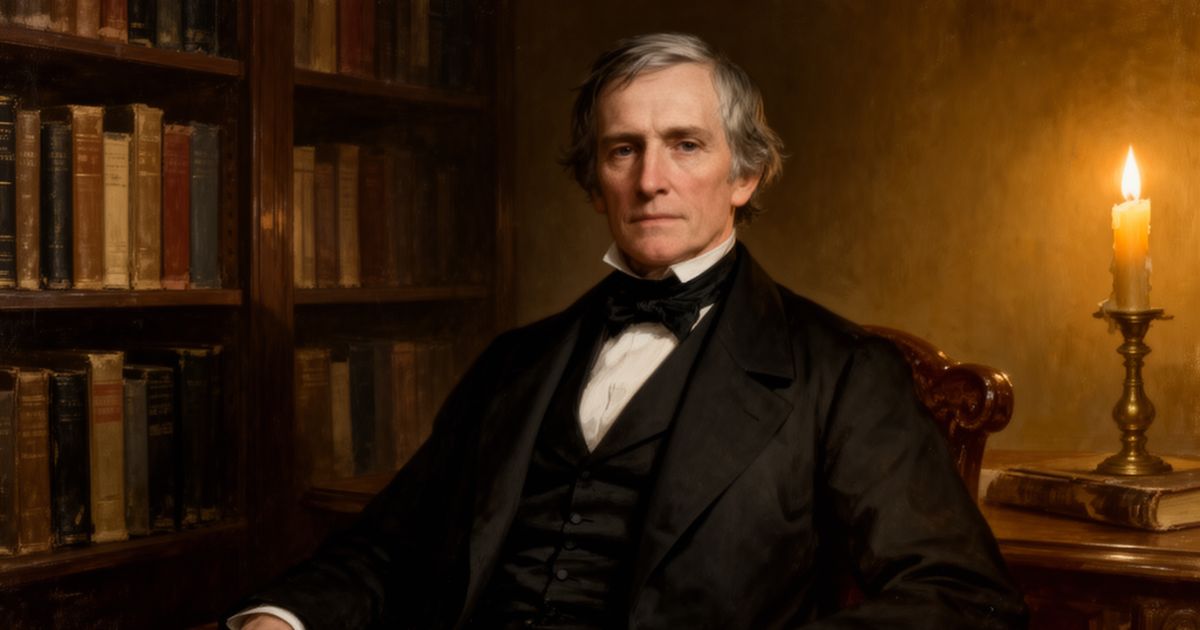
An excerpt from the original text.(complete · 8040 words)
erves himself with metals, wood, stone, glass, gum, cotton, silk and
wool; honors himself with architecture;[372] writes laws, and
contrives to execute his will through the hands of many nations; and,
especially, establishes a select society, running through all the
countries of intelligent men, a self-constituted aristocracy, or
fraternity of the best, which, without written law, or exact usage of
any kind, perpetuates itself, colonizes every new-planted island, and
adopts and makes its own whatever personal beauty or extraordinary
native endowment anywhere appears.
2. What fact more conspicuous in modern history, than the creation of
the gentleman? Chivalry[373] is that, and loyalty is that, and, in
English literature, half the drama, and all the novels, from Sir
Philip Sidney[374] to Sir Walter Scott,[375] paint this figure. The
word gentleman, which, like the word Christian, must hereafter
characterize the present and the few preceding centuries, by the
importance attached to it, is a homage to personal and incommunicable
properties. Frivolous and fantastic additions have got associated with
the name, but the steady interest of mankind in it must be attributed
to the valuable properties which it designates. An element which
unites all the most forcible persons of every country; makes them
intelligible and agreeable to each other, and is somewhat so precise,
that it is at once felt if an individual lack the masonic sign,[376]
cannot be any casual product, but must be an average result of the
character and faculties universally found in men. It seems a certain
permanent average; as the atmosphere is a permanent composition,
whilst so many gases are combined only to be decompounded. Comme il
faut, is the Frenchman's description of good society, as we must
be. It is a spontaneous fruit of talents and feelings of precisely
that class who have most vigor, who take the lead in the world of this
hour, and, though far from pure, far from constituting the gladdest
and highest tone of human feeling, is as good as the whole society
permits it to be. It is made of the spirit, more than of the talent of
men, and is a compound result, into which every great force enters as
an ingredient, namely, virtue, wit, beauty, wealth, and power.
3. There is something equivocal in all the words in use to express the
excellence of manners and social cultivation, because the qualities
are fluxional, and the last effect is assumed by the senses as the
cause. The word gentleman has not any correlative abstract[377] to
express the quality. Gentility is mean, and gentilesse[378] is
obsolete. But we must keep alive in the vernacular the distinction
between fashion, a word of narrow and often sinister meaning, and
the heroic character which the gentleman imports. The usual words,
however, must be respected: they will be found to contain the root of
the matter. The point of distinction in all this class of names, as
courtesy, chivalry, fashion, and the like, is, that the flower and
fruit, not the grain of the tree, are contemplated. It is beauty which
is the aim this time, and not worth. The result is now in question,
although our words intimate well enough the popular feeling, that the
appearance supposes a substance. The gentleman is a man of truth, lord
of his own actions, and expressing that lordship in his behavior, not
in any manner dependent and servile either on persons, or opinions, or
possessions. Beyond this fact of truth and real force, the word
denotes good-nature and benevolence: manhood first, and then
gentleness. The popular notion certainly adds a condition of ease and
fortune; but that is a natural result of personal force and love, that
they should possess and dispense the goods of the world. In times of
violence, every eminent person must fall in with many opportunities to
approve his stoutness and worth; therefore every man's name that
emerged at all from the mass in the feudal ages,[379] rattles in our
ear like a flourish of trumpets. But personal force never goes out of
fashion. That is still paramount to-day, and, in the moving crowd of
good society, the men of valor and reality are known, and rise to
their natural place. The competition is transferred from war to
politics and trade, but the personal force appears readily enough in
these new arenas.
4. Power first, or no leading class. In politics and in trade,
bruisers and pirates are of better promise than talkers and clerks.
God knows[380] that all sorts of gentlemen knock at the door; but
whenever used in strictness, and with any emphasis, the name will be
found to point at original energy. It describes a man standing in his
own right, and working after untaught methods. In a good lord, there
must first be a good animal, at least to the extent of yielding the
incomparable advantage of animal spirits.[381] The ruling class must
have more, but they must have these, giving in every company the sense
of power,[382] which makes things easy to be done which daunt the
wise. The society of the energetic class, in their friendly and
festive meetings, is full of courage, and of attempts, which
intimidate the pale scholar. The courage which girls exhibit is like a
battle of Lundy's Lane,[383] or a sea-fight. The intellect relies on
memory to make some supplies to face these extemporaneous squadrons.
But memory is a base mendicant with basket and badge, in the presence
of these sudden masters. The rulers of society must be up to the work
of the world, and equal to their versatile office: men of the right
Cæsarian pattern,[384] who have great range of affinity. I am far from
believing the timid maxim[385] of Lord Falkland,[386] ("That for
ceremony there must go two to it; since a bold fellow will go through
the cunningest forms,") and am of opinion that the gentleman is the
bold fellow whose forms are not to be broken through; and only that
plenteous nature is rightful master, which is the complement of
whatever person it converses with. My gentleman gives the law where he
is; he will outpray saints in chapel, outgeneral veterans in the
field, and outshine all courtesy in the hall. He is good company for
pirates, and good with academicians; so that it is useless to fortify
yourself against him; he has the private entrance to all minds, and I
could as easily exclude myself as him. The famous gentlemen of Asia
and Europe have been of this strong type: Saladin,[387] Sapor,[388]
the Cid,[389] Julius Cæsar,[390] Scipio,[391] Alexander,[392]
Pericles,[393] and the lordliest personages. They sat very carelessly
in their chairs, and were too excellent themselves to value any
condition at a high rate.
5. A plentiful fortune is reckoned necessary, in the popular judgment,
to the completion of this man of the world: and it is a material deputy
which walks through the dance which the first has led. Money is not
essential, but this wide affinity is, which transcends the habits of
clique and caste, and makes itself felt by men of all classes. If the
aristocrat is only valid in fashionable circles, and not with truckmen,
he will never be a leader in fashion; and if the man of the people
cannot speak on equal terms with the gentleman, so that the gentleman
shall perceive that he is already really of his own order, he is not to
be feared. Diogenes,[394] Socrates,[395] and Epaminondas[396] are
gentlemen of the best blood, who have chosen the condition of poverty,
when that of wealth was equally open to them. I use these old names, but
the men I speak of are my contemporaries.[397] Fortune will not supply
to every generation one of these well-appointed knights, but every
collection of men furnishes some example of the class: and the politics
of this country, and the trade of every town, are controlled by these
hardy and irresponsible doers, who have invention to take the lead, and
a broad sympathy which puts them in fellowship with crowds, and makes
their action popular.
6. The manners of this class are observed and caught with devotion by
men of taste. The association of these masters with each other, and
with men intelligent of their merits, is mutually agreeable and
stimulating. The good forms, the happiest expressions of each, are
repeated and adopted. By swift consent, everything superfluous is
dropped, everything graceful is renewed. Fine manners[398] show
themselves formidable to the uncultivated man. They are a subtler
science of defence to parry and intimidate; but once matched by the
skill of the other party, they drop the point of the sword,--points
and fences disappear, and the youth finds himself in a more
transparent atmosphere, wherein life is a less troublesome game, and
not a misunderstanding rises between the players. Manners aim to
facilitate life, to get rid of impediments, and bring the man pure to
energize. They aid our dealing and conversation, as a railway aids
traveling, by getting rid of all avoidable obstructions of the road,
and leaving nothing to be conquered but pure space. These forms very
soon become fixed, and a fine sense of propriety is cultivated with
more heed, that it becomes a badge of social and civil distinctions.
Thus grows up Fashion, an equivocal semblance, the most puissant, the
most fantastic and frivolous, the most feared and followed, and which
morals and violence assault in vain.
7. There exists a strict relation between the class of power, and the
exclusive and polished circles. The last are always filled or filling
from the first. The strong men usually give some allowance even to the
petulances of fashion, for that affinity they find in it.
Napoleon,[399] child of the revolution, destroyer of the old
noblesse,[400] never ceased to court the Faubourg St. Germain:[401]
doubtless with the feeling, that fashion is a homage to men of his
stamp. Fashion, though in a strange way, represents all manly virtue.
It is a virtue gone to seed: it is a kind of posthumous honor. It does
not often caress the great, but the children of the great: it is a
hall of the Past. It usually sets its face against the great of this
hour. Great men are not commonly in its halls: they are absent in the
field: they are working, not triumphing. Fashion is made up of their
children; of those, who, through the value and virtue of somebody,
have acquired lustre to their name, marks of distinction, means of
cultivation and generosity, and, in their physical organization, a
certain health and excellence, which secures to them, if not the
highest power to work, yet high power to enjoy. The class of power,
the working heroes, the Cortez,[402] the Nelson,[403] the Napoleon,
see that this is the festivity and permanent celebration of such as
they; that fashion is funded talent; is Mexico,[404] Marengo,[405] and
Trafalgar[406][407] beaten out thin; that the brilliant names of
fashion run back to just such busy names as their own, fifty or sixty
years ago. They are the sowers, their sons shall be the reapers, and
their sons, in the ordinary course of things, must yield the
possession of the harvest, to new competitors with keener eyes and
stronger frames. The city is recruited from the country. In the year
1805, it is said, every legitimate monarch in Europe was imbecile. The
city would have died out, rotted, and exploded, long ago, but that it
was reinforced from the fields. It is only country which came to town
day before yesterday, that is city and court to-day.
8. Aristocracy and fashion are certain inevitable results. These
mutual selections are indestructible. If they provoke anger in the
least favored class, and the excluded majority revenge themselves on
the excluding minority, by the strong hand, and kill them, at once a
new class finds itself at the top, as certainly as cream rises in a
bowl of milk: and if the people should destroy class after class,
until two men only were left, one of these would be the leader, and
would be involuntarily served and copied by the other. You may keep
this minority out of sight and out of mind, but it is tenacious of
life, and is one of the estates of the realm.[408] I am the more
struck with this tenacity, when I see its work. It respects the
administration of such unimportant matters, that we should not look
for any durability in its rule. We sometimes meet men under some
strong moral influence, as a patriotic, a literary, a religious
movement, and feel that the moral sentiment rules man and nature. We
think all other distinctions and ties will be slight and fugitive,
this of caste or fashion, for example; yet come from year to year, and
see how permanent that is, in this Boston or New York life of man,
where, too, it has not the lease countenance from the law of the land.
Not in Egypt or in India a firmer or more impassable line. Here are
associations whose ties go over, and under, and through it, a meeting
of merchants, a military corps, a college-class, a fire-club, a
professional association, a political, a religious convention;--the
persons seem to draw inseparably near; yet that assembly once
dispersed, its members will not in the year meet again. Each returns
to his degree in the scale of good society, porcelain remains
porcelain, and earthen earthen. The objects of fashion may be
frivolous, or fashion may be objectless, but the nature of this union
and selection can be neither frivolous nor accidental. Each man's rank
in that perfect graduation depends on some symmetry in his structure,
or some agreement in his structure to the symmetry of society. Its
doors unbar instantaneously to a natural claim of their own kind. A
natural gentleman finds his way in, and will keep the oldest patrician
out, who has lost his intrinsic rank. Fashion understands itself;
good-breeding and personal superiority of whatever country readily
fraternize with those of every other. The chiefs of savage tribes have
distinguished themselves in London and Paris, by the purity of their
tournure.[409]
9. To say what good of fashion we can,--it rests on reality, and hates
nothing so much as pretenders;--to exclude and mystify pretenders, and
send them into everlasting "Coventry,"[410] is its delight. We
contemn, in turn, every other gift of men of the world; but the habit,
even in little and the least matters, of not appealing to any but our
own sense of propriety, constitutes the foundation of all chivalry.
There is almost no kind of self-reliance, so it be sane and
proportioned, which fashion does not occasionally adopt, and give it
the freedom of its saloons. A sainted soul is always elegant, and, if
it will, passes unchallenged into the most guarded ring. But so will
Jock the teamster pass, in some crisis that brings him thither, and
find favor, as long as his head is not giddy with the new
circumstance, and the iron shoes do not wish to dance in waltzes and
cotillions. For there is nothing settled in manners, but the laws of
behavior yield to the energy of the individual. The maiden at her
first ball, the countryman at a city dinner, believes that there is a
ritual according to which every act and compliment must be performed,
or the failing party must be cast out of this presence. Later, they
learn that good sense and character make their own forms every moment,
and speak or abstain, to take wine or refuse it, stay or go, sit in a
chair or sprawl with children on the floor, or stand on their head, or
what else soever, in a new and aboriginal way: and that strong will is
always in fashion, let who will be unfashionable. All that fashion
demands is composure, and self-content. A circle of men perfectly
well-bred would be a company of sensible persons, in which every man's
native manners and character appear. If the fashionist have not this
quality, he is nothing. We are such lovers of self-reliance, that we
excuse in man many sins, if he will show us a complete satisfaction in
his position, which asks no leave to be of mine, or any man's good
opinion. But any deference to some eminent man or woman of the world,
forfeits all privilege of nobility. He is an underling: I have nothing
to do with him; I will speak with his master. A man should not go
where he cannot carry his whole sphere or society with him,--not
bodily, the whole circle of his friends, but atmospherically. He
should preserve in a new company the same attitude of mind and reality
of relation, which his daily associates draw him to, else he is shorn
of his best beams, and will be an orphan in the merriest club. "If you
could see Vich Ian Vohr with his tail on![411]--" But Vich Ian Vohr
must always carry his belongings in some fashion, if not added as
honor, then severed as disgrace.
10. There will always be in society certain persons who are
mercuries[412] of its approbation, and whose glance will at any time
determine for the curious their standing in the world. These are the
chamberlains of the lesser gods. Accept their coldness as an omen of
grace with the loftier deities, and allow them all their privilege.
They are clear in their office, nor could they be thus formidable,
without their own merits. But do not measure the importance of this
class by their pretension, or imagine that a fop can be the dispenser
of honor and shame. They pass also at their just rate; for how can
they otherwise, in circles which exist as a sort of herald's
office[413] for the sifting of character?
11. As the first thing man requires of man is reality, so that appears
in all the forms of society. We pointedly, and by name, introduce the
parties to each other. Know you before all heaven and earth, that this
is Andrew, and this is Gregory;--they look each other in the eye; they
grasp each other's hand, to identify and signalize each other. It is a
great satisfaction. A gentleman never dodges; his eyes look straight
forward, and he assures the other party, first of all, that he has
been met. For what is it that we seek, in so many visits and
hospitalities? Is it your draperies, pictures, and decorations? Or, do
we not insatiably ask. Was a man in the house? I may easily go into a
great household where there is much substance, excellent provision for
comfort, luxury, and taste, and yet not encounter there any
Amphitryon,[414] who shall subordinate these appendages. I may go into
a cottage, and find a farmer who feels that he is the man I have come
to see, and fronts me accordingly. It was therefore a very natural
point of old feudal etiquette, that a gentleman who received a visit,
though it were of his sovereign, should not leave his roof, but should
wait his arrival at the door of his house. No house, though it were
the Tuileries,[415] or the Escurial,[416] is good for anything without
a master. And yet we are not often gratified by this hospitality.
Everybody we know surrounds himself with a fine house, fine books,
conservatory, gardens, equipage, and all manner of toys, as screens to
interpose between himself and his guests. Does it not seem as if man
was of a very sly, elusive nature, and dreaded nothing so much as a
full renconter front to front with his fellow? It were unmerciful, I
know, quite to abolish the use of these screens, which are of eminent
convenience, whether the guest is too great, or too little. We call
together many friends who keep each other in play, or by luxuries and
ornaments we amuse the young people, and guard our retirement. Or if,
perchance, a searching realist comes to our gate, before whose eyes we
have no care to stand, then again we run to our curtain, and hide
ourselves as Adam[417] at the voice of the Lord God in the garden.
Cardinal Caprara,[418] the Pope's[419] legate at Paris, defended
himself from the glances of Napoleon, by an immense pair of green
spectacles. Napoleon remarked them, and speedily managed to rally them
off: and yet Napoleon, in his turn, was not great enough, with eight
hundred thousand troops at his back, to face a pair of free-born eyes,
but fenced himself with etiquette, and within triple barriers of
reserve: and, as all the world knows from Madame de Stael,[420] was
wont, when he found himself observed, to discharge his face of all
expression. But emperors and rich men are by no means the most
skillful masters of good manners. No rent roll nor army-list can
dignify skulking and dissimulations: and the first point of courtesy
must always be truth, as really all forms of good-breeding point that
way.
12. I have just been reading, in Mr. Hazlitt's[421] translation,
Montaigne's[422] account of his journey into Italy, and am struck with
nothing more agreeably than the self-respecting fashions of the time.
His arrival in each place, the arrival of a gentleman of France, is an
event of some consequence. Wherever he goes, he pays a visit to
whatever prince or gentleman of note resides upon his road, as a duty
to himself and to civilization. When he leaves any house in which he
has lodged for a few weeks, he causes his arms to be painted and hung
up as a perpetual sign to the house, as was the custom of gentlemen.
13. The complement of this graceful self-respect, and that of all the
points of good breeding I most require and insist upon, is deference.
I like that every chair should be a throne, and hold a king. I prefer
a tendency to stateliness, to an excess of fellowship. Let the
incommunicable objects of nature and the metaphysical isolation of man
teach us independence. Let us not be too much acquainted. I would have
a man enter his house through a hall filled with heroic and sacred
sculptures, that he might not want the hint of tranquillity and
self-poise.[423] We should meet each morning, as from foreign
countries, and spending the day together, should depart at night, as
into foreign countries. In all things I would have the island of a man
inviolate. Let us sit apart as the gods, talking from peak to peak all
round Olympus. No degree of affection need invade this religion. This
is myrrh and rosemary to keep the other sweet. Lovers should guard
their strangeness. If they forgive too much, all slides into confusion
and meanness. It is easy to push this deference to a Chinese
etiquette;[424] but coolness and absence of heat and haste indicate
fine qualities. A gentleman makes no noise: a lady is serene
Proportionate is our disgust at those invaders who fill a studious
house with blast and running, to secure some paltry convenience. Not
less I dislike a low sympathy of each with his neighbors's needs. Must
we have a good understanding with one another's palates? as foolish
people who have lived long together, know when each wants salt or
sugar. I pray my companion, if he wishes for bread, to ask me for
bread, and if he wishes for sassafras or arsenic, to ask me for them,
and not to hold out his plate, as if I knew already. Every natural
function can be dignified by deliberation and privacy. Let us leave
hurry to slaves. The compliments and ceremonies of our breeding should
recall,[425] however remotely, the grandeur of our destiny.
14. The flower of courtesy does not very well bide handling, but if we
dare to open another leaf, and explore what parts go to its
conformation, we shall find also an intellectual quality. To the
leaders of men, the brain as well as the flesh and the heart must
furnish a proportion. Defect in manners is usually the defect of fine
perceptions. Men are too coarsely made for the delicacy of beautiful
carriage and customs. It is not quite sufficient to good breeding, a
union of kindness and independence. We imperatively require a
perception of, and a homage to, beauty in our companions. Other
virtues are in request in the field and work yard, but a certain
degree of taste is not to be spared in those we sit with. I could
better eat with one who did not respect the truth or the laws, than
with a sloven and unpresentable person. Moral qualities rule the
world, but at short distances the senses are despotic. The same
discrimination of fit and fair runs out, if with less rigor, into all
parts of life. The average spirit of the energetic class is good
sense, acting under certain limitations and to certain ends. It
entertains every natural gift. Social in its nature, it respects
everything which tends to unite men. It delights in measure.[426] The
love of beauty is mainly the love of measure or proportion. The person
who screams, or uses the superlative degree, or converses with heat,
puts whole drawing-rooms to flight. If you wish to be loved, love
measure. You must have genius, or a prodigious usefulness, if you will
hide the want of measure. This perception comes in to polish and
perfect the parts of the social instrument. Society will pardon much
to genius and special gifts, but, being in its nature a convention, it
loves what is conventional, or what belongs to coming together. That
makes the good and bad of manners, namely, what helps or hinders
fellowship. For, fashion is not good sense absolute, but relative; not
good sense private, but good sense entertaining company. It hates
corners and sharp points of character, hates quarrelsome, egotistical,
solitary, and gloomy people; hates whatever can interfere with total
blending of parties; whilst it values all peculiarities as in the
highest degree refreshing, which can consist with good fellowship. And
besides the general infusion of wit to heighten civility, the direct
splendor of intellectual power is ever welcome in fine society as the
costliest addition to its rule and its credit.
15. The dry light must shine in to adorn our festival, but it must be
tempered and shaded, or that will also offend. Accuracy is essential
to beauty, and quick perceptions to politeness, but not too quick
perceptions. One may be too punctual and too precise. He must leave
the omniscience of business at the door, when he comes into the palace
of beauty. Society loves creole natures,[427] and sleepy, languishing
manners, so that they cover sense, grace, and good-will: the air of
drowsy strength, which disarms criticism; perhaps, because such a
person seems to reserve himself for the best of the game, and not
spend himself on surfaces; an ignoring eye, which does not see the
annoyances, shifts, and inconveniences, that cloud the brow and
smother the voice of the sensitive.
16. Therefore, besides personal force and so much perception as
constitutes unerring taste, society demands in its patrician class,
another element already intimated, which it significantly terms
good-nature, expressing all degrees of generosity, from the lowest
willingness and faculty to oblige, up to the heights of magnanimity
and love. Insight we must have, or we shall run against one another,
and miss the way to our food; but intellect is selfish and barren. The
secret of success in society, is a certain heartiness and sympathy. A
man who is not happy in the company, cannot find any word in his
memory that will fit the occasion. All his information is a little
impertinent. A man who is happy there, finds in every turn of the
conversation equally lucky occasions for the introduction of that
which he has to say. The favorites of society, and what it calls
whole souls, are able men, and of more spirit than wit, who have no
uncomfortable egotism, but who exactly fill the hour and the company,
contented and contenting, at a marriage or a funeral, a ball or a
jury, a water-party or a shooting-match. England, which is rich in
gentlemen, furnished, in the beginning of the present century, a good
model of that genius which the world loves, in Mr. Fox,[428] who
added to his great abilities the most social disposition, and real
love of men. Parliamentary history has few better passages than the
debate, in which Burke[429] and Fox separated in the House of Commons;
when Fox urged on his old friend the claims of old friendship with
such tenderness, that the house was moved to tears. Another anecdote
is so close to my matter, that I must hazard the story. A tradesman
who had long dunned him for a note of three hundred guineas, found him
one day counting gold, and demanded payment. "No," said Fox, "I owe
this money to Sheridan[430]: it is a debt of honor: if an accident
should happen to me, he has nothing to show." "Then," said the
creditor, "I change my debt into a debt of honor," and tore the note
in pieces. Fox thanked the man for his confidence, and paid him,
saying, "his debt was of older standing, and Sheridan must wait."
Lover of liberty, friend of the Hindoo, friend of the African slave,
he possessed a great personal popularity; and Napoleon said of him on
the occasion of his visit to Paris, in 1805, "Mr. Fox will always hold
the first place in an assembly at the Tuileries."
17. We may easily seem ridiculous in our eulogy of courtesy, whenever
we insist on benevolence as its foundation. The painted phantasm
Fashion rises to cast a species of derision on what we say. But I will
neither be driven from some allowance to Fashion as a symbolic
institution, nor from the belief that love is the basis of courtesy.
"We must obtain that, if we can; but by all means we must affirm
this. Life owes much of its spirit to these sharp contrasts. Fashion
which affects to be honor, is often, in all men's experience, only a
ballroom code. Yet, so long as it is the highest circle, in the
imagination of the best heads on the planet, there is something
necessary and excellent in it; for it is not to be supposed that men
have agreed to be the dupes of anything preposterous; and the respect
which these mysteries inspire in the most rude and sylvan characters,
and the curiosity with which details of high life are read, betray the
universality of the love of cultivated manners. I know that a comic
disparity would be felt, if we should enter the acknowledged 'first
circles,' and apply these terrific standards of justice, beauty, and
benefit, to the individuals actually found there. Monarchs and heroes,
sages and lovers, these gallants are not. Fashion has many classes and
many rules of probation and admission; and not the best alone. There
is not only the right of conquest, which genius pretends,--the
individual, demonstrating his natural aristocracy best of the
best;--but less claims will pass for the time; for Fashion loves
lions, and points, like Circe,[431] to her horned company. This
gentleman is this afternoon arrived from Denmark; and that is my Lord
Ride, who came yesterday from Bagdad; here is Captain Friese, from
Cape Turnagain, and Captain Symmes,[432] from the interior of the
earth; and Monsieur Jovaire, who came down this morning in a balloon;
Mr. Hobnail, the reformer; and Reverend Jul Bat, who has converted
the whole torrid zone in his Sunday school; and Signer Torre del
Greco, who extinguished Vesuvius by pouring into it the Bay of Naples;
Spahr, the Persian ambassador; and Tul Wil Shan, the exiled nabob of
Nepaul, whose saddle is the new moon.--But these are monsters of one
day, and to-morrow will be dismissed to their holes and dens; for, in
these rooms every chair is waited for. The artist, the scholar, and,
in general, the clerisy,[433] wins its way up into these places, and
gets represented here, somewhat on this footing of conquest. Another
mode is to pass through all the degrees, spending a year and a day in
St. Michael's Square,[434] being steeped in Cologne water,[435] and
perfumed, and dined, and introduced, and properly grounded in all the
biography, and politics, and anecdotes of the boudoirs.
18. Yet these fineries may have grace and wit. Let there be grotesque
sculpture about the gates and offices of temples. Let the creed and
commandments even have the saucy homage of parody. The forms of
politeness universally express benevolence in superlative degrees.
What if they are in the mouths of selfish men, and used as means of
selfishness? What if the false gentleman almost bows the true out of
the world? What if the false gentleman contrives so to address his
companion, as civilly to exclude all others from his discourse, and
also to make them feel excluded? Real service will not lose its
nobleness. All generosity is not merely French and sentimental; nor is
it to be concealed, that living blood and a passion of kindness does
at last distinguish God's gentleman from Fashion's. The epitaph of Sir
Jenkin Grout is not wholly unintelligible to the present age. "Here
lies Sir Jenkin Grout, who loved his friend, and persuaded his enemy:
what his mouth ate, his hand paid for: what his servants robbed, he
restored: if a woman gave him pleasure, he supported her in pain: he
never forgot his children: and whoso touched his finger, drew after it
his whole body." Even the line of heroes is not utterly extinct. There
is still ever some admirable person in plain clothes, standing on the
wharf, who jumps in to rescue a drowning man; there is still some
absurd inventor of charities; some guide and comforter of runaway
slaves; some friend of Poland;[436] some Philhellene;[437] some
fanatic who plants shade-trees for the second and third generation,
and orchards when he is grown old; some well-concealed piety; some
just man happy in an ill-fame; some youth ashamed of the favors of
fortune, and impatiently casting them on other shoulders. And these
are the centers of society, on which it returns for fresh impulses.
These are the creators of Fashion, which is an attempt to organize
beauty of behavior. The beautiful and the generous are in the theory,
the doctors and apostles of this church: Scipio, and the Cid, and Sir
Philip Sidney, and Washington, and every pure and valiant heart, who
worshiped Beauty by word and by deed. The persons who constitute the
natural aristocracy, are not found in the actual aristocracy, or only
on its edge; as the chemical energy of the spectrum is found to be
greatest just outside of the spectrum. Yet that is the infirmity of
the seneschals, who do not know their sovereign, when he appears. The
theory of society supposes the existence and sovereignty of these. It
divines afar off their coming. It says with the elder gods,--
"As Heaven and Earth are fairer far[438]
Than Chaos and blank Darkness, though once chiefs;
And as we show beyond that Heaven and Earth,
In form and shape compact and beautiful;
So, on our heels a fresh perfection treads;
A power, more strong in beauty, born of us,
And fated to excel us, as we pass
In glory that old Darkness:
... for, 'tis the eternal law,
That first in beauty shall be first in might."
19. Therefore, within the ethnical circle of good society, there is a
narrower and higher circle, concentration of its light, and flower of
courtesy, to which there is always a tacit appeal of pride and
reference, as to its inner and imperial court, the parliament of love
and chivalry. And this is constituted of those persons in whom heroic
dispositions are native, with the love of beauty, the delight in
society, and the power to embellish the passing day. If the
individuals who compose the purest circles of aristocracy in Europe,
the guarded blood of centuries, should pass in review, in such manner
as that we could, leisurely and critically, inspect their behavior, we
might find no gentleman, and no lady; for although excellent specimens
of courtesy and high-breeding would gratify us in the assemblage, in
the particulars, we should detect offense. Because, elegance comes of
no breeding, but of birth. There must be romance of character, or the
most fastidious exclusion of impertinencies will not avail. It must be
genius which takes that direction: it must be not courteous, but
courtesy. High behavior is as rare in fiction as it is in fact. Scott
is praised for the fidelity with which he painted the demeanor and
conversation of the superior classes. Certainly, kings and queens,
nobles and great ladies, had some right to complain of the absurdity
that had been put in their mouths, before the days of Waverley;[439]
but neither does Scott's dialogue bear criticism. His lords brave each
other in smart epigrammatic speeches, but the dialogue is in costume,
and does not please on the second reading; it is not warm with life.
In Shakespeare alone, the speakers do not strut and bridle, the
dialogue is easily great, and he adds to so many titles that of being
the best-bred man in England, and in Christendom. Once or twice in a
lifetime we are permitted to enjoy the charm of noble manners, in the
presence of a man or woman who have no bar in their nature, but whose
character emanates freely in their word and gesture. A beautiful form
is better than a beautiful face: a beautiful behavior is better than a
beautiful form: it gives a higher pleasure than statues or pictures;
it is the finest of the fine arts. A man is but a little thing in the
midst of the objects of nature, yet, by the moral quality radiating
from his countenance, he may abolish all considerations of magnitude,
and in his manners equal the majesty of the world. I have seen an
individual whose manners though wholly within the conventions of
elegant society, were never learned there, but were original and
commanding, and held out protection and prosperity; one who did not
need the aid of a court-suit, but carried the holiday in his eye; who
exhilarated the fancy by flinging wide the doors of new modes of
existence; who shook off the captivity of etiquette, with happy,
spirited bearing, good-natured and free as Robin Hood;[440] yet with
the port of an emperor,--if need be, calm, serious, and fit to stand
the gaze of millions.
20. The open air and the fields, the street and public chambers, are
the places where Man executes his will; let him yield or divide the
scepter at the door of the house. Woman, with her instinct of
behavior, instantly detects in man a love of trifles, any coldness or
imbecility, or, in short, any want of that large, flowing, and
magnanimous deportment, which is indispensable as an exterior in the
hall. Our American institutions have been friendly to her, and at this
moment I esteem it a chief felicity of this country, that it excels in
women. A certain awkward consciousness of inferiority in the men, may
give rise to the new chivalry in behalf of Woman's Rights. Certainly,
let her be as much better placed in the laws and in social forms, as
the most zealous reformer can ask, but I confide so entirely in her
inspiring and musical nature, that I believe only herself can show us
how she shall be served. The wonderful generosity of her sentiments
raises her at times into heroical and godlike regions, and verifies
the pictures of Minerva,[441] Juno,[442] or Polymnia;[443] and, by the
firmness with which she treads her upward path, she convinces the
coarsest calculators that another road exists than that which their
feet know. But besides those who make good in our imagination the
place of muses and of Delphic Sibyls,[444] are there not women who
fill our vase with wine and roses to the brim, so that the wine runs
over and fills the house with perfume; who inspire us with courtesy;
who unloose our tongues, and we speak; who anoint our eyes, and we
see? We say things we never thought to have said; for once, our walls
of habitual reserve vanished, and left us at large; we were children
playing with children in a wide field of flowers. Steep us, we cried,
in these influences, for days, for weeks, and we shall be sunny poets,
and will write out in many-colored words the romance that you are. Was
it Hafiz[445] or Firdousi[446] that said of his Persian Lilla, "She
was an elemental force, and astonished me by her amount of life, when
I saw her day after day radiating, every instant, redundant joy and
grace on all around her.[447] She was a solvent powerful to reconcile
all heterogeneous persons into one society; like air or water, an
element of such a great range of affinities, that it combines readily
with a thousand substances. Where she is present, all others will be
more than they are wont. She was a unit and whole, so that whatsoever
she did, became her. She had too much sympathy and desire to please,
than that you could say, her manners were marked with dignity, yet no
princess could surpass her clear and erect demeanor on each occasion.
She did not study the Persian grammar, nor the books of the seven
poets, but all the poems of the seven seemed to be written upon her.
For, though the bias of her nature was not to thought, but to
sympathy, yet was she so perfect in her own nature, as to meet
intellectual persons by the fullness of her heart, warming them by her
sentiments; believing, as she did, that by dealing nobly with all, all
would show themselves noble."
21. I know that this Byzantine[448] pile of chivalry of Fashion, which
seems so fair and picturesque to those who look at the contemporary
facts for science or for entertainment, is not equally pleasant to all
spectators. The constitution of our society makes it a giant's castle
to the ambitious youth who have not found their names enrolled in its
Golden Book,[449] and whom it has excluded from its coveted honors and
privileges. They have yet to learn that its seeming grandeur is
shadowy and relative: it is great by their allowance: its proudest
gates will fly open at the approach of their courage and virtue. For
the present distress, however, of those who are predisposed to suffer
from the tyrannies of this caprice, there are easy remedies. To remove
your residence a couple of miles, or at most four, will commonly
relieve the most extreme susceptibility. For, the advantages which
fashion values are plants which thrive in very confined localities,
in a few streets, namely. Out of this precinct, they go for nothing;
are of no use in the farm, in the forest, in the market, in war, in
the nuptial society, in the literary or scientific circle, at sea, in
friendship, in the heaven of thought or virtue.
22. But we have lingered long enough in these painted courts. The
worth of the thing signified must vindicate our taste for the emblem.
Everything that is called fashion and courtesy humbles itself before
the cause and fountain of honor, creator of titles and dignities,
namely, the heart of love. This is the royal blood, this the fire,
which, in all countries and contingencies, will work after its kind
and conquer ind expand all that approaches it. This gives new meanings
to every fact. This impoverishes the rich, suffering no grandeur but
its own. What is rich? Are you rich enough to help anybody? to
succor the unfashionable and the eccentric? rich enough to make the
Canadian in his wagon, the itinerant with his consul's paper which
commends him "To the charitable," the swarthy Italian with his few
broken words of English, the lame pauper hunted by overseers from town
to town, even the poor insane or besotted wreck of man or woman, feel
the noble exception of your presence and your house, from the general
bleakness and stoniness; to make such feel that they were greeted with
a voice which made them both remember and hope? What is vulgar, but to
refuse the claim on acute and conclusive reasons? What is gentle, but
to allow it, and give their heart and yours lone holiday from the
national caution? Without the rich heart, wealth is an ugly beggar.
The king of Schiraz[450] could not afford to be so bountiful as the
poor Osman[451] who dwelt at his gate. Osman had a humanity so broad
and deep, that although his speech was so bold and free with the
Koran[452] as to disgust all the dervishes, yet was there never a poor
outcast, eccentric, or insane man, some fool who had cut off his
beard, or who had been mutilated under a vow, or had a pet madness in
his brain, but fled at once to him,--that great heart lay there so
sunny and hospitable in the center of the country,--that it seemed as
if the instinct of all sufferers drew them to his side. And the
madness which he harbored, he did not share. Is not this to be rich?
this only to be rightly rich?
23. But I shall hear without pain, that I play the courtier very ill,
and talk of that which I do not well understand. It is easy to see,
that what is called by distinction society and fashion, has good laws
as well as bad, has much that is necessary, and much that is absurd.
Too good for banning, and too bad for blessing, it reminds us of a
tradition of the pagan mythology, in any attempt to settle its
character. "I overheard Jove,[453] one day," said Silenus,[454]
"talking of destroying the earth; he said, it had failed; they were
all rogues and vixens, who went from bad to worse, as fast as the days
succeeded each other. Minerva said, she hoped not; they were only
ridiculous little creatures, with this odd circumstance, that they had
a blur, or indeterminate aspect, seen far or seen near; if you called
them bad, they would appear so; if you called them good, they would
appear so; and there was no one person or action among them, which
would not puzzle her owl,[455] much more all Olympus, to know whether
it was fundamentally bad or good."
GIFTS[456]
Gifts of one who loved me--
'Twas high time they came;
When he ceased to love me,
Time they stopped for shame.
1. It is said that the world is in a state of bankruptcy, that the
world owes the world more than the world can pay, and ought to go into
chancery,[457] and be sold. I do not think this general insolvency,
which involves in some sort all the population, to be the reason of
the difficulty experienced at Christmas and New Year, and other times,
in bestowing gifts; since it is always so pleasant to be generous,
though very vexatious to pay debts. But the impediment lies in the
choosing. If, at any time, it comes into my head that a present is due
from me to somebody, I am puzzled what to give, until the opportunity
is gone. Flowers and fruits are always fit presents; flowers, because
they are a proud assertion that a ray of beauty outvalues all the
utilities of the world. These gay natures contrast with the somewhat
stern countenance of ordinary nature: they are like music heard out of
a work-house. Nature does not cocker us:[458] we are children, not
pets: she is not fond: everything is dealt to us without fear or
favor, after severe universal laws. Yet these delicate flowers look
like the frolic and interference of love and beauty. Men use to tell
us that we love flattery, even though we are not deceived by it,
Master this chapter. Complete your experience
Purchase the complete book to access all chapters and support classic literature
As an Amazon Associate, we earn a small commission from qualifying purchases at no additional cost to you.
Available in paperback, hardcover, and e-book formats
Let's Analyse the Pattern
The more you try to impress others through performance, the less genuine connection you create; true social power comes from authentic presence.
Why This Matters
Connect literature to life
This chapter teaches how to distinguish between people who are performing confidence and those who possess genuine self-assurance.
Practice This Today
This week, notice when someone's trying too hard to impress you versus when they're simply being present—watch how differently you respond to each approach.
Now let's explore the literary elements.
Key Quotes & Analysis
"The word gentleman, which, like the word Christian, must hereafter characterize the present and the few preceding centuries, by the importance attached to it, is a homage to personal and incommunicable properties."
Context: Explaining why the concept of 'gentleman' became so important in his era
Emerson argues that society's obsession with being a 'gentleman' shows we value inner qualities that can't be bought or taught. It's about recognizing that some people just have that special something.
In Today's Words:
We care so much about being a 'good person' because we know real character comes from within and can't be faked.
"An element which unites all the most forcible persons of every country; makes them intelligible and agreeable to each other"
Context: Describing how true gentlemen recognize each other across cultural boundaries
Real character transcends nationality, class, or background. People with genuine strength and integrity can connect with each other regardless of their differences.
In Today's Words:
Authentic people recognize other authentic people, no matter where they're from or what they do for a living.
"It is at once felt if an individual lack the masonic sign"
Context: Explaining how quickly we can spot someone who's pretending to be something they're not
You can instantly tell when someone is putting on an act versus being genuine. There's something unmistakable about authentic confidence and character.
In Today's Words:
You know right away when someone's being fake - they just don't have that real energy.
Thematic Threads
Class
In This Chapter
True gentility comes from character and presence, not wealth or breeding
Development
Builds on earlier themes about natural aristocracy versus inherited status
In Your Life:
You might notice how some wealthy people seem desperate for approval while some working-class folks command natural respect
Identity
In This Chapter
Authentic self-knowledge creates magnetic personal presence
Development
Develops the self-reliance theme into social application
In Your Life:
You might recognize the difference between trying to be someone else versus being confidently yourself
Social Expectations
In This Chapter
Real courtesy adapts to each situation rather than following rigid rules
Development
Introduced here as contrast to conformity
In Your Life:
You might see how the most socially skilled people adjust their approach based on who they're with
Personal Growth
In This Chapter
Inner security allows you to focus outward on others' needs
Development
Extends individual development into interpersonal skills
In Your Life:
You might notice how your own insecurities make you self-focused while confidence lets you be generous
Human Relationships
In This Chapter
Genuine connection requires vulnerability and presence, not performance
Development
Introduced here as foundation for meaningful social bonds
In Your Life:
You might recognize that your best relationships are with people who don't try to impress you
You now have the context. Time to form your own thoughts.
Discussion Questions
- 1
According to Emerson, what's the difference between someone with good manners and someone who's just following etiquette rules?
analysis • surface - 2
Why does Emerson think that trying too hard to impress people actually makes you less impressive?
analysis • medium - 3
Think about someone you know who makes everyone feel comfortable. What do they do differently than people who seem fake or try-hard?
application • medium - 4
When you're in a new social situation, how can you tell if you're being authentic or performing? What would change if you focused on making others comfortable instead of managing your own image?
application • deep - 5
What does this chapter reveal about why some people naturally become leaders while others with more credentials or money don't?
reflection • deep
Critical Thinking Exercise
Map Your Social Comfort Zones
Think of three different social situations: one where you feel completely comfortable, one where you feel moderately nervous, and one where you feel like you're performing or trying to impress. For each situation, write down what you do differently - how you talk, what you focus on, how you treat others. Notice the pattern between your comfort level and your ability to focus on others versus yourself.
Consider:
- •Pay attention to where your attention goes - inward to self-monitoring or outward to genuine interest in others
- •Notice how your body language and voice change when you're performing versus when you're relaxed
- •Consider how others respond to you differently in each scenario
Journaling Prompt
Write about a time when you felt completely authentic in a social situation. What made that possible? How did others respond to you, and how might you recreate those conditions more often?
Coming Up Next...
Chapter 7: The Art of Giving and Receiving
After exploring the art of social grace, Emerson turns to a more intimate challenge: the delicate art of gift-giving. Why do we struggle so much to choose the right present, and what do our gifts reveal about the true nature of generosity and human connection?



