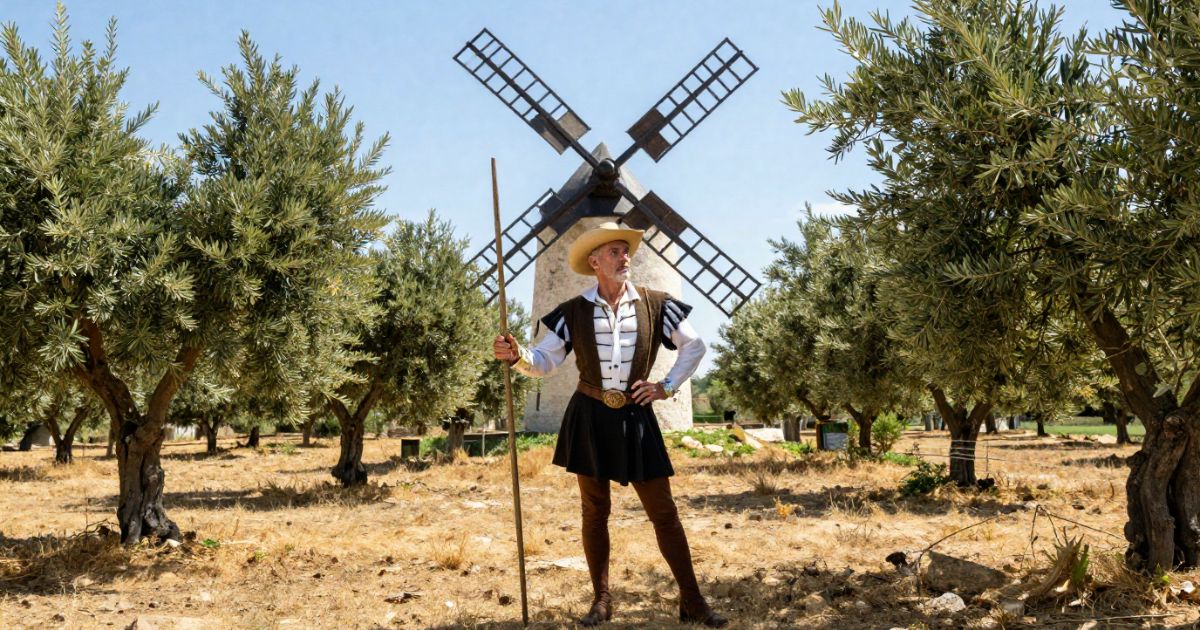
An excerpt from the original text.(complete · 2673 words)
HEREIN IT IS SHOWN WHO MASTER PEDRO AND HIS APE WERE, TOGETHER WITH
THE MISHAP DON QUIXOTE HAD IN THE BRAYING ADVENTURE, WHICH HE DID NOT
CONCLUDE AS HE WOULD HAVE LIKED OR AS HE HAD EXPECTED
Cide Hamete, the chronicler of this great history, begins this chapter
with these words, “I swear as a Catholic Christian;” with regard to
which his translator says that Cide Hamete’s swearing as a Catholic
Christian, he being—as no doubt he was—a Moor, only meant that, just as
a Catholic Christian taking an oath swears, or ought to swear, what is
true, and tell the truth in what he avers, so he was telling the truth,
as much as if he swore as a Catholic Christian, in all he chose to
write about Quixote, especially in declaring who Master Pedro was and
what was the divining ape that astonished all the villages with his
divinations. He says, then, that he who has read the First Part of this
history will remember well enough the Gines de Pasamonte whom, with
other galley slaves, Don Quixote set free in the Sierra Morena: a
kindness for which he afterwards got poor thanks and worse payment from
that evil-minded, ill-conditioned set. This Gines de Pasamonte—Don
Ginesillo de Parapilla, Don Quixote called him—it was that stole Dapple
from Sancho Panza; which, because by the fault of the printers neither
the how nor the when was stated in the First Part, has been a puzzle to
a good many people, who attribute to the bad memory of the author what
was the error of the press. In fact, however, Gines stole him while
Sancho Panza was asleep on his back, adopting the plan and device that
Brunello had recourse to when he stole Sacripante’s horse from between
his legs at the siege of Albracca; and, as has been told, Sancho
afterwards recovered him. This Gines, then, afraid of being caught by
the officers of justice, who were looking for him to punish him for his
numberless rascalities and offences (which were so many and so great
that he himself wrote a big book giving an account of them), resolved
to shift his quarters into the kingdom of Aragon, and cover up his left
eye, and take up the trade of a puppet-showman; for this, as well as
juggling, he knew how to practise to perfection. From some released
Christians returning from Barbary, it so happened, he bought the ape,
which he taught to mount upon his shoulder on his making a certain
sign, and to whisper, or seem to do so, in his ear. Thus prepared,
before entering any village whither he was bound with his show and his
ape, he used to inform himself at the nearest village, or from the most
likely person he could find, as to what particular things had happened
there, and to whom; and bearing them well in mind, the first thing he
did was to exhibit his show, sometimes one story, sometimes another,
but all lively, amusing, and familiar. As soon as the exhibition was
over he brought forward the accomplishments of his ape, assuring the
public that he divined all the past and the present, but as to the
future he had no skill. For each question answered he asked two reals,
and for some he made a reduction, just as he happened to feel the pulse
of the questioners; and when now and then he came to houses where
things that he knew of had happened to the people living there, even if
they did not ask him a question, not caring to pay for it, he would
make the sign to the ape and then declare that it had said so and so,
which fitted the case exactly. In this way he acquired a prodigious
name and all ran after him; on other occasions, being very crafty, he
would answer in such a way that the answers suited the questions; and
as no one cross-questioned him or pressed him to tell how his ape
divined, he made fools of them all and filled his pouch. The instant he
entered the inn he knew Don Quixote and Sancho, and with that knowledge
it was easy for him to astonish them and all who were there; but it
would have cost him dear had Don Quixote brought down his hand a little
lower when he cut off King Marsilio’s head and destroyed all his
horsemen, as related in the preceeding chapter.
So much for Master Pedro and his ape; and now to return to Don Quixote
of La Mancha. After he had left the inn he determined to visit, first
of all, the banks of the Ebro and that neighbourhood, before entering
the city of Saragossa, for the ample time there was still to spare
before the jousts left him enough for all. With this object in view he
followed the road and travelled along it for two days, without meeting
any adventure worth committing to writing until on the third day, as he
was ascending a hill, he heard a great noise of drums, trumpets, and
musket-shots. At first he imagined some regiment of soldiers was
passing that way, and to see them he spurred Rocinante and mounted the
hill. On reaching the top he saw at the foot of it over two hundred
men, as it seemed to him, armed with weapons of various sorts, lances,
crossbows, partisans, halberds, and pikes, and a few muskets and a
great many bucklers. He descended the slope and approached the band
near enough to see distinctly the flags, make out the colours and
distinguish the devices they bore, especially one on a standard or
ensign of white satin, on which there was painted in a very life-like
style an ass like a little sard, with its head up, its mouth open and
its tongue out, as if it were in the act and attitude of braying; and
round it were inscribed in large characters these two lines—
They did not bray in vain,
Our alcaldes twain.
From this device Don Quixote concluded that these people must be from
the braying town, and he said so to Sancho, explaining to him what was
written on the standard. At the same time be observed that the man who
had told them about the matter was wrong in saying that the two who
brayed were regidors, for according to the lines of the standard they
were alcaldes. To which Sancho replied, “Señor, there’s nothing to
stick at in that, for maybe the regidors who brayed then came to be
alcaldes of their town afterwards, and so they may go by both titles;
moreover, it has nothing to do with the truth of the story whether the
brayers were alcaldes or regidors, provided at any rate they did bray;
for an alcalde is just as likely to bray as a regidor.” They perceived,
in short, clearly that the town which had been twitted had turned out
to do battle with some other that had jeered it more than was fair or
neighbourly.
Don Quixote proceeded to join them, not a little to Sancho’s
uneasiness, for he never relished mixing himself up in expeditions of
that sort. The members of the troop received him into the midst of
them, taking him to be someone who was on their side. Don Quixote,
putting up his visor, advanced with an easy bearing and demeanour to
the standard with the ass, and all the chief men of the army gathered
round him to look at him, staring at him with the usual amazement that
everybody felt on seeing him for the first time. Don Quixote, seeing
them examining him so attentively, and that none of them spoke to him
or put any question to him, determined to take advantage of their
silence; so, breaking his own, he lifted up his voice and said, “Worthy
sirs, I entreat you as earnestly as I can not to interrupt an argument
I wish to address to you, until you find it displeases or wearies you;
and if that come to pass, on the slightest hint you give me I will put
a seal upon my lips and a gag upon my tongue.”
They all bade him say what he liked, for they would listen to him
willingly.
With this permission Don Quixote went on to say, “I, sirs, am a
knight-errant whose calling is that of arms, and whose profession is to
protect those who require protection, and give help to such as stand in
need of it. Some days ago I became acquainted with your misfortune and
the cause which impels you to take up arms again and again to revenge
yourselves upon your enemies; and having many times thought over your
business in my mind, I find that, according to the laws of combat, you
are mistaken in holding yourselves insulted; for a private individual
cannot insult an entire community; unless it be by defying it
collectively as a traitor, because he cannot tell who in particular is
guilty of the treason for which he defies it. Of this we have an
example in Don Diego Ordoñez de Lara, who defied the whole town of
Zamora, because he did not know that Vellido Dolfos alone had committed
the treachery of slaying his king; and therefore he defied them all,
and the vengeance and the reply concerned all; though, to be sure,
Señor Don Diego went rather too far, indeed very much beyond the limits
of a defiance; for he had no occasion to defy the dead, or the waters,
or the fishes, or those yet unborn, and all the rest of it as set
forth; but let that pass, for when anger breaks out there’s no father,
governor, or bridle to check the tongue. The case being, then, that no
one person can insult a kingdom, province, city, state, or entire
community, it is clear there is no reason for going out to avenge the
defiance of such an insult, inasmuch as it is not one. A fine thing it
would be if the people of the clock town were to be at loggerheads
every moment with everyone who called them by that name,—or the
Cazoleros, Berengeneros, Ballenatos, Jaboneros, or the bearers of all
the other names and titles that are always in the mouth of the boys and
common people! It would be a nice business indeed if all these
illustrious cities were to take huff and revenge themselves and go
about perpetually making trombones of their swords in every petty
quarrel! No, no; God forbid! There are four things for which sensible
men and well-ordered States ought to take up arms, draw their swords,
and risk their persons, lives, and properties. The first is to defend
the Catholic faith; the second, to defend one’s life, which is in
accordance with natural and divine law; the third, in defence of one’s
honour, family, and property; the fourth, in the service of one’s king
in a just war; and if to these we choose to add a fifth (which may be
included in the second), in defence of one’s country. To these five, as
it were capital causes, there may be added some others that may be just
and reasonable, and make it a duty to take up arms; but to take them up
for trifles and things to laugh at and be amused by rather than
offended, looks as though he who did so was altogether wanting in
common sense. Moreover, to take an unjust revenge (and there cannot be
any just one) is directly opposed to the sacred law that we
acknowledge, wherein we are commanded to do good to our enemies and to
love them that hate us; a command which, though it seems somewhat
difficult to obey, is only so to those who have in them less of God
than of the world, and more of the flesh than of the spirit; for Jesus
Christ, God and true man, who never lied, and could not and cannot lie,
said, as our law-giver, that his yoke was easy and his burden light; he
would not, therefore, have laid any command upon us that it was
impossible to obey. Thus, sirs, you are bound to keep quiet by human
and divine law.”
“The devil take me,” said Sancho to himself at this, “but this master
of mine is a theologian; or, if not, faith, he’s as like one as one egg
is like another.”
Don Quixote stopped to take breath, and, observing that silence was
still preserved, had a mind to continue his discourse, and would have
done so had not Sancho interposed with his smartness; for he, seeing
his master pause, took the lead, saying, “My lord Don Quixote of La
Mancha, who once was called the Knight of the Rueful Countenance, but
now is called the Knight of the Lions, is a gentleman of great
discretion who knows Latin and his mother tongue like a bachelor, and
in everything that he deals with or advises proceeds like a good
soldier, and has all the laws and ordinances of what they call combat
at his fingers’ ends; so you have nothing to do but to let yourselves
be guided by what he says, and on my head be it if it is wrong. Besides
which, you have been told that it is folly to take offence at merely
hearing a bray. I remember when I was a boy I brayed as often as I had
a fancy, without anyone hindering me, and so elegantly and naturally
that when I brayed all the asses in the town would bray; but I was none
the less for that the son of my parents who were greatly respected; and
though I was envied because of the gift by more than one of the high
and mighty ones of the town, I did not care two farthings for it; and
that you may see I am telling the truth, wait a bit and listen, for
this art, like swimming, once learnt is never forgotten;” and then,
taking hold of his nose, he began to bray so vigorously that all the
valleys around rang again.
One of those, however, that stood near him, fancying he was mocking
them, lifted up a long staff he had in his hand and smote him such a
blow with it that Sancho dropped helpless to the ground. Don Quixote,
seeing him so roughly handled, attacked the man who had struck him
lance in hand, but so many thrust themselves between them that he could
not avenge him. Far from it, finding a shower of stones rained upon
him, and crossbows and muskets unnumbered levelled at him, he wheeled
Rocinante round and, as fast as his best gallop could take him, fled
from the midst of them, commending himself to God with all his heart to
deliver him out of this peril, in dread every step of some ball coming
in at his back and coming out at his breast, and every minute drawing
his breath to see whether it had gone from him. The members of the
band, however, were satisfied with seeing him take to flight, and did
not fire on him. They put up Sancho, scarcely restored to his senses,
on his ass, and let him go after his master; not that he was
sufficiently in his wits to guide the beast, but Dapple followed the
footsteps of Rocinante, from whom he could not remain a moment
separated. Don Quixote having got some way off looked back, and seeing
Sancho coming, waited for him, as he perceived that no one followed
him. The men of the troop stood their ground till night, and as the
enemy did not come out to battle, they returned to their town exulting;
and had they been aware of the ancient custom of the Greeks, they would
have erected a trophy on the spot.
Master this chapter. Complete your experience
Purchase the complete book to access all chapters and support classic literature
As an Amazon Associate, we earn a small commission from qualifying purchases at no additional cost to you.
Available in paperback, hardcover, and e-book formats
Let's Analyse the Pattern
We become vulnerable to manipulation when someone tells us exactly what we want to hear, bypassing our critical thinking through emotional validation.
Why This Matters
Connect literature to life
This chapter teaches how to recognize when someone exploits your emotional needs to gain your trust or money.
Practice This Today
This week, notice when someone agrees with you immediately—ask yourself what they gain from your agreement before you trust their motives.
Now let's explore the literary elements.
Key Quotes & Analysis
"I swear as a Catholic Christian"
Context: The Moorish chronicler swears to tell the truth about Master Pedro's identity
Shows how people adapt their language to be believed by their audience. Even the fictional narrator knows he must speak in terms his Christian readers will trust, despite being a Moor himself.
In Today's Words:
I swear on everything you hold sacred that I'm telling the truth
"There are only five causes for which men may and ought to take up arms and draw their swords"
Context: Trying to prevent the braying towns from going to war
Don Quixote shows genuine wisdom here, laying out rational criteria for when violence is justified. His logic is impeccable, but he's speaking to people too angry to listen to reason.
In Today's Words:
Look, there are only five good reasons to actually fight someone
"A kindness for which he afterwards got poor thanks and worse payment"
Context: Describing how Gines repaid Don Quixote's mercy by stealing from Sancho
Captures the bitter reality that good deeds aren't always rewarded. Don Quixote's idealistic act of freeing the galley slaves came back to hurt him and his friend.
In Today's Words:
No good deed goes unpunished
Thematic Threads
Deception
In This Chapter
Gines creates elaborate cons by feeding people's desire for wonder and validation through his 'prophetic' ape
Development
Evolved from simple lies to sophisticated manipulation that exploits human psychology
In Your Life:
You might fall for this when someone flatters your intelligence while selling you something you already wanted to buy
Pride
In This Chapter
The braying townspeople turn violent when their dignity is challenged, even accidentally
Development
Consistent theme showing how wounded pride escalates conflicts beyond reason
In Your Life:
You see this when a minor workplace criticism triggers an outsized defensive reaction that damages relationships
Class
In This Chapter
Gines, a former galley slave, now exploits the gullibility of his social betters through clever performance
Development
Shows how class mobility can occur through manipulation rather than merit
In Your Life:
You might encounter this when someone from a 'lower' background gains influence by telling authority figures what they want to hear
Social Expectations
In This Chapter
Don Quixote tries to fulfill his role as peacemaker but fails when reality clashes with idealistic expectations
Development
His noble intentions increasingly conflict with practical outcomes
In Your Life:
You experience this when trying to mediate family conflicts with good intentions but poor timing
Identity
In This Chapter
The townspeople's entire sense of self becomes wrapped up in defending their reputation against mockery
Development
Shows how external perception shapes internal identity, often destructively
In Your Life:
You see this when you find yourself arguing online to defend your image rather than seeking truth
You now have the context. Time to form your own thoughts.
Discussion Questions
- 1
How does Gines de Pasamonte's puppet show scam actually work, and why do people fall for it?
analysis • surface - 2
Why does Don Quixote's perfectly logical speech about legitimate reasons for war backfire so spectacularly?
analysis • medium - 3
Think about social media or news sources you follow. Which ones tell you what you want to hear versus challenge your thinking?
application • medium - 4
When someone agrees with you enthusiastically, what questions should you ask yourself before trusting them completely?
application • deep - 5
What does this chapter reveal about the difference between being right and being effective in human conflicts?
reflection • deep
Critical Thinking Exercise
Spot the Validation Trap
Think of three people or sources that regularly agree with your opinions - a friend, a news source, a social media account, or a coworker. For each one, write down what they gain by agreeing with you. Then identify one recent time each source told you exactly what you wanted to hear. Finally, rate how often you fact-check or question information from sources that validate your existing beliefs.
Consider:
- •Consider whether agreement always equals accuracy or good advice
- •Think about the difference between support and enablement
- •Notice if you apply different standards of skepticism to agreeable versus challenging sources
Journaling Prompt
Write about a time when someone told you what you wanted to hear, and it led you astray. What warning signs did you miss because their message felt so validating?
Coming Up Next...
Chapter 100: When Pride Meets Payroll
Don Quixote flees the angry mob, but what becomes of the unconscious Sancho? As master and servant reunite on the road, they'll face the consequences of good intentions gone wrong, and Sancho will have some choice words about his master's timing.