An excerpt from the original text.(complete · 3104 words)
OF THE GOOD FORTUNE WHICH THE VALIANT DON QUIXOTE HAD IN THE TERRIBLE
AND UNDREAMT-OF ADVENTURE OF THE WINDMILLS, WITH OTHER OCCURRENCES
WORTHY TO BE FITLY RECORDED
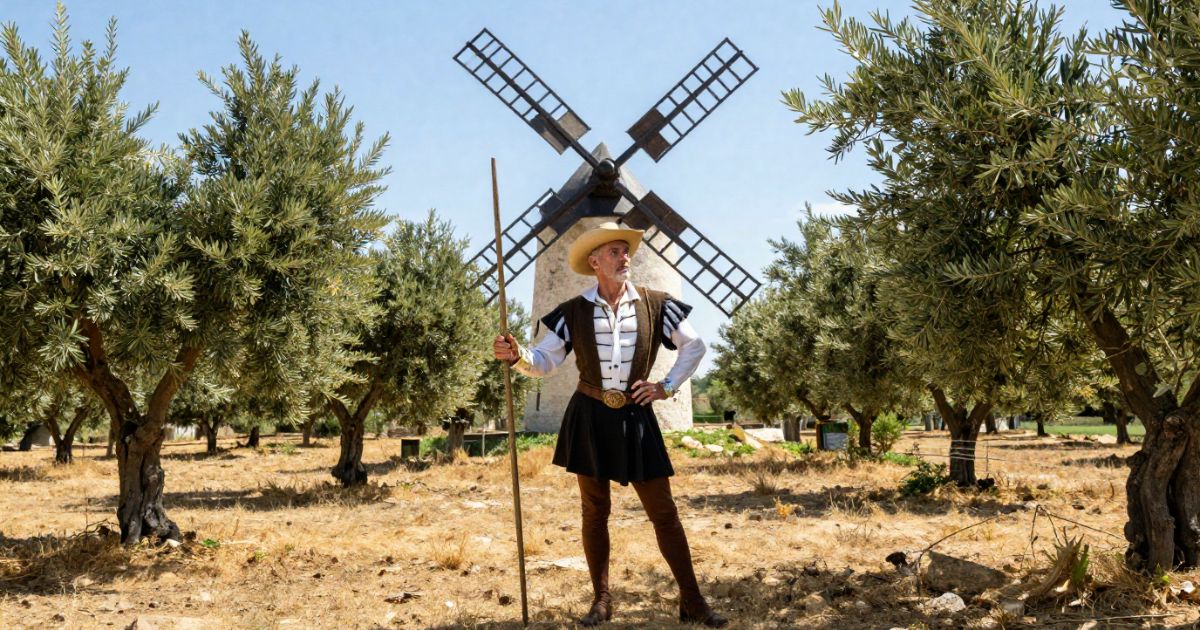
At this point they came in sight of thirty or forty windmills that
there are on that plain, and as soon as Don Quixote saw them he said to
his squire, “Fortune is arranging matters for us better than we could
have shaped our desires ourselves, for look there, friend Sancho Panza,
where thirty or more monstrous giants present themselves, all of whom I
mean to engage in battle and slay, and with whose spoils we shall begin
to make our fortunes; for this is righteous warfare, and it is God’s
good service to sweep so evil a breed from off the face of the earth.”
“What giants?” said Sancho Panza.
“Those thou seest there,” answered his master, “with the long arms, and
some have them nearly two leagues long.”
“Look, your worship,” said Sancho; “what we see there are not giants
but windmills, and what seem to be their arms are the sails that turned
by the wind make the millstone go.”
“It is easy to see,” replied Don Quixote, “that thou art not used to
this business of adventures; those are giants; and if thou art afraid,
away with thee out of this and betake thyself to prayer while I engage
them in fierce and unequal combat.”
So saying, he gave the spur to his steed Rocinante, heedless of the
cries his squire Sancho sent after him, warning him that most certainly
they were windmills and not giants he was going to attack. He, however,
was so positive they were giants that he neither heard the cries of
Sancho, nor perceived, near as he was, what they were, but made at them
shouting, “Fly not, cowards and vile beings, for a single knight
attacks you.”
A slight breeze at this moment sprang up, and the great sails began to
move, seeing which Don Quixote exclaimed, “Though ye flourish more arms
than the giant Briareus, ye have to reckon with me.”
So saying, and commending himself with all his heart to his lady
Dulcinea, imploring her to support him in such a peril, with lance in
rest and covered by his buckler, he charged at Rocinante’s fullest
gallop and fell upon the first mill that stood in front of him; but as
he drove his lance-point into the sail the wind whirled it round with
such force that it shivered the lance to pieces, sweeping with it horse
and rider, who went rolling over on the plain, in a sorry condition.
Sancho hastened to his assistance as fast as his ass could go, and when
he came up found him unable to move, with such a shock had Rocinante
fallen with him.
“God bless me!” said Sancho, “did I not tell your worship to mind what
you were about, for they were only windmills? and no one could have
made any mistake about it but one who had something of the same kind in
his head.”
“Hush, friend Sancho,” replied Don Quixote, “the fortunes of war more
than any other are liable to frequent fluctuations; and moreover I
think, and it is the truth, that that same sage Friston who carried off
my study and books, has turned these giants into mills in order to rob
me of the glory of vanquishing them, such is the enmity he bears me;
but in the end his wicked arts will avail but little against my good
sword.”
“God order it as he may,” said Sancho Panza, and helping him to rise
got him up again on Rocinante, whose shoulder was half out; and then,
discussing the late adventure, they followed the road to Puerto Lapice,
for there, said Don Quixote, they could not fail to find adventures in
abundance and variety, as it was a great thoroughfare. For all that, he
was much grieved at the loss of his lance, and saying so to his squire,
he added, “I remember having read how a Spanish knight, Diego Perez de
Vargas by name, having broken his sword in battle, tore from an oak a
ponderous bough or branch, and with it did such things that day, and
pounded so many Moors, that he got the surname of Machuca, and he and
his descendants from that day forth were called Vargas y Machuca. I
mention this because from the first oak I see I mean to rend such
another branch, large and stout like that, with which I am determined
and resolved to do such deeds that thou mayest deem thyself very
fortunate in being found worthy to come and see them, and be an
eyewitness of things that will with difficulty be believed.”
“Be that as God will,” said Sancho, “I believe it all as your worship
says it; but straighten yourself a little, for you seem all on one
side, may be from the shaking of the fall.”
“That is the truth,” said Don Quixote, “and if I make no complaint of
the pain it is because knights-errant are not permitted to complain of
any wound, even though their bowels be coming out through it.”
“If so,” said Sancho, “I have nothing to say; but God knows I would
rather your worship complained when anything ailed you. For my part, I
confess I must complain however small the ache may be; unless this rule
about not complaining extends to the squires of knights-errant also.”
Don Quixote could not help laughing at his squire’s simplicity, and he
assured him he might complain whenever and however he chose, just as he
liked, for, so far, he had never read of anything to the contrary in
the order of knighthood.
Sancho bade him remember it was dinner-time, to which his master
answered that he wanted nothing himself just then, but that he might
eat when he had a mind. With this permission Sancho settled himself as
comfortably as he could on his beast, and taking out of the alforjas
what he had stowed away in them, he jogged along behind his master
munching deliberately, and from time to time taking a pull at the bota
with a relish that the thirstiest tapster in Malaga might have envied;
and while he went on in this way, gulping down draught after draught,
he never gave a thought to any of the promises his master had made him,
nor did he rate it as hardship but rather as recreation going in quest
of adventures, however dangerous they might be. Finally they passed the
night among some trees, from one of which Don Quixote plucked a dry
branch to serve him after a fashion as a lance, and fixed on it the
head he had removed from the broken one. All that night Don Quixote lay
awake thinking of his lady Dulcinea, in order to conform to what he had
read in his books, how many a night in the forests and deserts knights
used to lie sleepless supported by the memory of their mistresses. Not
so did Sancho Panza spend it, for having his stomach full of something
stronger than chicory water he made but one sleep of it, and, if his
master had not called him, neither the rays of the sun beating on his
face nor all the cheery notes of the birds welcoming the approach of
day would have had power to waken him. On getting up he tried the bota
and found it somewhat less full than the night before, which grieved
his heart because they did not seem to be on the way to remedy the
deficiency readily. Don Quixote did not care to break his fast, for, as
has been already said, he confined himself to savoury recollections for
nourishment.
They returned to the road they had set out with, leading to Puerto
Lapice, and at three in the afternoon they came in sight of it. “Here,
brother Sancho Panza,” said Don Quixote when he saw it, “we may plunge
our hands up to the elbows in what they call adventures; but observe,
even shouldst thou see me in the greatest danger in the world, thou
must not put a hand to thy sword in my defence, unless indeed thou
perceivest that those who assail me are rabble or base folk; for in
that case thou mayest very properly aid me; but if they be knights it
is on no account permitted or allowed thee by the laws of knighthood to
help me until thou hast been dubbed a knight.”
“Most certainly, señor,” replied Sancho, “your worship shall be fully
obeyed in this matter; all the more as of myself I am peaceful and no
friend to mixing in strife and quarrels: it is true that as regards the
defence of my own person I shall not give much heed to those laws, for
laws human and divine allow each one to defend himself against any
assailant whatever.”
“That I grant,” said Don Quixote, “but in this matter of aiding me
against knights thou must put a restraint upon thy natural
impetuosity.”
“I will do so, I promise you,” answered Sancho, “and will keep this
precept as carefully as Sunday.”
While they were thus talking there appeared on the road two friars of
the order of St. Benedict, mounted on two dromedaries, for not less
tall were the two mules they rode on. They wore travelling spectacles
and carried sunshades; and behind them came a coach attended by four or
five persons on horseback and two muleteers on foot. In the coach there
was, as afterwards appeared, a Biscay lady on her way to Seville, where
her husband was about to take passage for the Indies with an
appointment of high honour. The friars, though going the same road,
were not in her company; but the moment Don Quixote perceived them he
said to his squire, “Either I am mistaken, or this is going to be the
most famous adventure that has ever been seen, for those black bodies
we see there must be, and doubtless are, magicians who are carrying off
some stolen princess in that coach, and with all my might I must undo
this wrong.”
“This will be worse than the windmills,” said Sancho. “Look, señor;
those are friars of St. Benedict, and the coach plainly belongs to some
travellers: I tell you to mind well what you are about and don’t let
the devil mislead you.”
“I have told thee already, Sancho,” replied Don Quixote, “that on the
subject of adventures thou knowest little. What I say is the truth, as
thou shalt see presently.”
So saying, he advanced and posted himself in the middle of the road
along which the friars were coming, and as soon as he thought they had
come near enough to hear what he said, he cried aloud, “Devilish and
unnatural beings, release instantly the highborn princesses whom you
are carrying off by force in this coach, else prepare to meet a speedy
death as the just punishment of your evil deeds.”
The friars drew rein and stood wondering at the appearance of Don
Quixote as well as at his words, to which they replied, “Señor
Caballero, we are not devilish or unnatural, but two brothers of St.
Benedict following our road, nor do we know whether or not there are
any captive princesses coming in this coach.”
“No soft words with me, for I know you, lying rabble,” said Don
Quixote, and without waiting for a reply he spurred Rocinante and with
levelled lance charged the first friar with such fury and
determination, that, if the friar had not flung himself off the mule,
he would have brought him to the ground against his will, and sore
wounded, if not killed outright. The second brother, seeing how his
comrade was treated, drove his heels into his castle of a mule and made
off across the country faster than the wind.
Sancho Panza, when he saw the friar on the ground, dismounting briskly
from his ass, rushed towards him and began to strip off his gown. At
that instant the friars’ muleteers came up and asked what he was
stripping him for. Sancho answered them that this fell to him lawfully
as spoil of the battle which his lord Don Quixote had won. The
muleteers, who had no idea of a joke and did not understand all this
about battles and spoils, seeing that Don Quixote was some distance off
talking to the travellers in the coach, fell upon Sancho, knocked him
down, and leaving hardly a hair in his beard, belaboured him with kicks
and left him stretched breathless and senseless on the ground; and
without any more delay helped the friar to mount, who, trembling,
terrified, and pale, as soon as he found himself in the saddle, spurred
after his companion, who was standing at a distance looking on,
watching the result of the onslaught; then, not caring to wait for the
end of the affair just begun, they pursued their journey making more
crosses than if they had the devil after them.
Don Quixote was, as has been said, speaking to the lady in the coach:
“Your beauty, lady mine,” said he, “may now dispose of your person as
may be most in accordance with your pleasure, for the pride of your
ravishers lies prostrate on the ground through this strong arm of mine;
and lest you should be pining to know the name of your deliverer, know
that I am called Don Quixote of La Mancha, knight-errant and
adventurer, and captive to the peerless and beautiful lady Dulcinea del
Toboso: and in return for the service you have received of me I ask no
more than that you should return to El Toboso, and on my behalf present
yourself before that lady and tell her what I have done to set you
free.”
One of the squires in attendance upon the coach, a Biscayan, was
listening to all Don Quixote was saying, and, perceiving that he would
not allow the coach to go on, but was saying it must return at once to
El Toboso, he made at him, and seizing his lance addressed him in bad
Castilian and worse Biscayan after his fashion, “Begone, caballero, and
ill go with thee; by the God that made me, unless thou quittest coach,
slayest thee as art here a Biscayan.”
Don Quixote understood him quite well, and answered him very quietly,
“If thou wert a knight, as thou art none, I should have already
chastised thy folly and rashness, miserable creature.” To which the
Biscayan returned, “I no gentleman!—I swear to God thou liest as I am
Christian: if thou droppest lance and drawest sword, soon shalt thou
see thou art carrying water to the cat: Biscayan on land, hidalgo at
sea, hidalgo at the devil, and look, if thou sayest otherwise thou
liest.”
“‘“You will see presently,” said Agrajes,’” replied Don Quixote; and
throwing his lance on the ground he drew his sword, braced his buckler
on his arm, and attacked the Biscayan, bent upon taking his life.
The Biscayan, when he saw him coming on, though he wished to dismount
from his mule, in which, being one of those sorry ones let out for
hire, he had no confidence, had no choice but to draw his sword; it was
lucky for him, however, that he was near the coach, from which he was
able to snatch a cushion that served him for a shield; and they went at
one another as if they had been two mortal enemies. The others strove
to make peace between them, but could not, for the Biscayan declared in
his disjointed phrase that if they did not let him finish his battle he
would kill his mistress and everyone that strove to prevent him. The
lady in the coach, amazed and terrified at what she saw, ordered the
coachman to draw aside a little, and set herself to watch this severe
struggle, in the course of which the Biscayan smote Don Quixote a
mighty stroke on the shoulder over the top of his buckler, which, given
to one without armour, would have cleft him to the waist. Don Quixote,
feeling the weight of this prodigious blow, cried aloud, saying, “O
lady of my soul, Dulcinea, flower of beauty, come to the aid of this
your knight, who, in fulfilling his obligations to your beauty, finds
himself in this extreme peril.” To say this, to lift his sword, to
shelter himself well behind his buckler, and to assail the Biscayan was
the work of an instant, determined as he was to venture all upon a
single blow. The Biscayan, seeing him come on in this way, was
convinced of his courage by his spirited bearing, and resolved to
follow his example, so he waited for him keeping well under cover of
his cushion, being unable to execute any sort of manoeuvre with his
mule, which, dead tired and never meant for this kind of game, could
not stir a step.
On, then, as aforesaid, came Don Quixote against the wary Biscayan,
with uplifted sword and a firm intention of splitting him in half,
while on his side the Biscayan waited for him sword in hand, and under
the protection of his cushion; and all present stood trembling, waiting
in suspense the result of blows such as threatened to fall, and the
lady in the coach and the rest of her following were making a thousand
vows and offerings to all the images and shrines of Spain, that God
might deliver her squire and all of them from this great peril in which
they found themselves. But it spoils all, that at this point and crisis
the author of the history leaves this battle impending, giving as
excuse that he could find nothing more written about these achievements
of Don Quixote than what has been already set forth. It is true the
second author of this work was unwilling to believe that a history so
curious could have been allowed to fall under the sentence of oblivion,
or that the wits of La Mancha could have been so undiscerning as not to
preserve in their archives or registries some documents referring to
this famous knight; and this being his persuasion, he did not despair
of finding the conclusion of this pleasant history, which, heaven
favouring him, he did find in a way that shall be related in the Second
Part.
c08e.jpg (54K)
Master this chapter. Complete your experience
Purchase the complete book to access all chapters and support classic literature
As an Amazon Associate, we earn a small commission from qualifying purchases at no additional cost to you.
Available in paperback, hardcover, and e-book formats
Let's Analyse the Pattern
A recurring theme explored in this chapter.
Why This Matters
Connect literature to life
This chapter teaches how to recognize when you're protecting a story instead of facing facts.
Practice This Today
This week, notice when you explain away evidence that contradicts something you really want to believe—that's your windmill moment.
Now let's explore the literary elements.
Key Quotes & Analysis
"Fortune is arranging matters for us better than we could have shaped our desires ourselves, for look there, friend Sancho Panza, where thirty or more monstrous giants present themselves."
Context: When he first spots the windmills on the plain
This shows how Don Quixote interprets everything through the lens of his fantasy. He sees ordinary windmills as a gift from fate, proof that he's living the heroic life he's always dreamed of. His excitement reveals how desperately he wants his delusions to be real.
In Today's Words:
This is perfect - look at all those huge enemies I get to fight!
"What we see there are not giants but windmills, and what seem to be their arms are the sails that turned by the wind make the millstone go."
Context: Trying to convince Don Quixote to see reality
Sancho speaks with simple, clear logic, explaining exactly what the objects actually are and how they work. His practical knowledge contrasts sharply with his master's fantasy, showing the tension between common sense and wishful thinking.
In Today's Words:
Those aren't monsters - they're just machines that grind grain when the wind blows.
"It is easy to see that thou art not used to this business of adventures; those are giants; and if thou art afraid, away with thee out of this."
Context: Dismissing Sancho's warning before charging at the windmills
Don Quixote can't admit he might be wrong, so he attacks Sancho's credibility instead. He frames his delusion as experience and Sancho's wisdom as cowardice. This is how people defend their bad decisions by questioning others' courage or commitment.
In Today's Words:
You just don't understand how this works - those are definitely enemies, and if you're too scared, then leave.
Thematic Threads
Identity
In This Chapter
Don Quixote's entire sense of self depends on being a knight, making him unable to see reality that contradicts this identity
Development
Building on earlier chapters where he transforms himself from Alonso to Don Quixote
In Your Life:
You might cling to outdated versions of yourself that no longer serve you because changing feels like losing who you are
Loyalty
In This Chapter
Sancho follows despite seeing the obvious truth, showing love that transcends agreement
Development
Deepening from earlier chapters where Sancho first agrees to join the quest
In Your Life:
You might struggle between being honest with loved ones and supporting their dreams, even when those dreams seem impossible
Class
In This Chapter
Don Quixote's delusions stem partly from reading too many chivalric romances, a luxury of his social position
Development
Continuing the theme of how different classes experience reality differently
In Your Life:
You might find that your problems or perspectives seem invisible to people from different economic backgrounds
Truth
In This Chapter
Multiple versions of reality exist simultaneously—windmills, giants, and magically transformed giants
Development
Expanding from earlier questions about what makes something 'real'
In Your Life:
You might discover that insisting on being 'right' matters less than understanding why others see things differently
You now have the context. Time to form your own thoughts.
Discussion Questions
- 1
Why does Don Quixote insist the windmills are giants even after being thrown to the ground?
analysis • surface - 2
What does Don Quixote's explanation about evil magicians reveal about how people protect their beliefs?
analysis • medium - 3
Where do you see people in your workplace or community 'fighting windmills'—defending stories that don't match reality?
application • medium - 4
How can you tell the difference between persistence worth having and stubbornly defending a fantasy?
application • deep - 5
What does Sancho's loyalty teach us about supporting people we care about who might be chasing impossible dreams?
reflection • deep
Critical Thinking Exercise
Identify Your Own Windmills
Think of a time when you kept pushing toward a goal despite mounting evidence it wasn't working—a relationship, job, project, or dream. Write down what story you were telling yourself about why it would work out, and what evidence you were ignoring or explaining away. Then identify what you would have had to admit about yourself if you'd acknowledged the reality earlier.
Consider:
- •What identity or self-image was tied to this goal succeeding?
- •How did you explain away the warning signs or failures?
- •What would you lose (beyond the goal itself) by admitting it wasn't working?
Journaling Prompt
Write about someone in your life who acts like Sancho—who sees reality clearly but supports you anyway. How do you respond when they try to point out your 'windmills'? What would change if you listened more carefully to their perspective?
Coming Up Next...
Chapter 29: The Battle Ends and the Story Begins
The sword fight between Don Quixote and the Biscayan traveler reaches its dramatic conclusion. Will our knight-errant prove his valor in actual combat, or will reality once again clash with his romantic ideals?