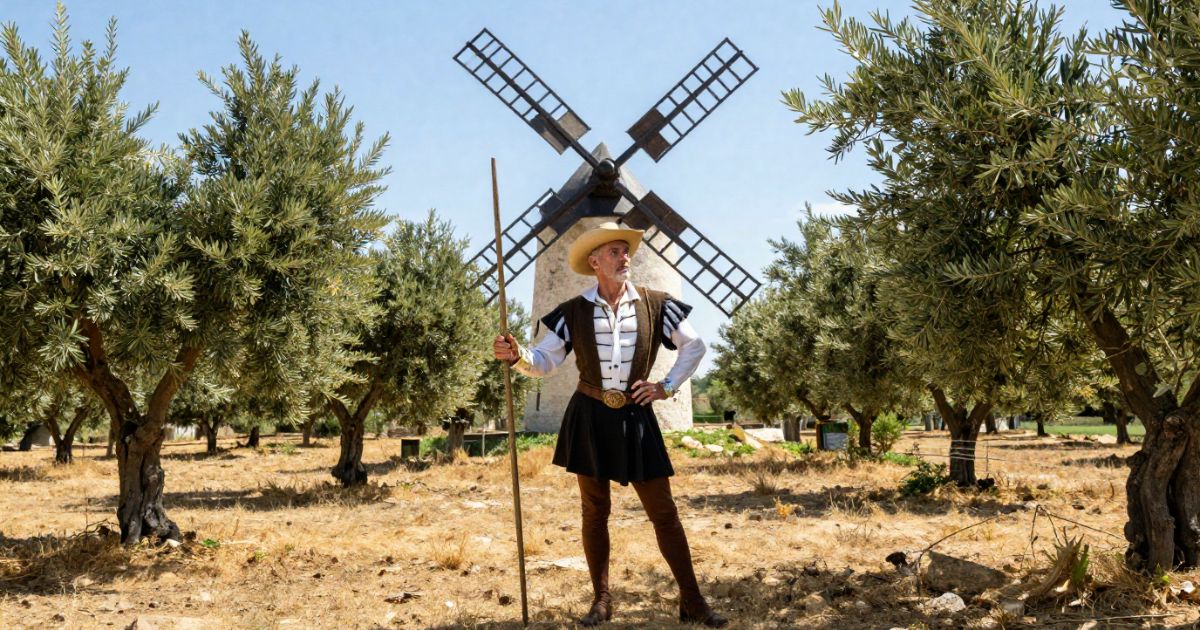
An excerpt from the original text.(complete · 2779 words)
OF THE DIVERTING AND IMPORTANT SCRUTINY WHICH THE CURATE AND THE BARBER
MADE IN THE LIBRARY OF OUR INGENIOUS GENTLEMAN
He was still sleeping; so the curate asked the niece for the keys of
the room where the books, the authors of all the mischief, were, and
right willingly she gave them. They all went in, the housekeeper with
them, and found more than a hundred volumes of big books very well
bound, and some other small ones. The moment the housekeeper saw them
she turned about and ran out of the room, and came back immediately
with a saucer of holy water and a sprinkler, saying, “Here, your
worship, señor licentiate, sprinkle this room; don’t leave any magician
of the many there are in these books to bewitch us in revenge for our
design of banishing them from the world.”
The simplicity of the housekeeper made the licentiate laugh, and he
directed the barber to give him the books one by one to see what they
were about, as there might be some to be found among them that did not
deserve the penalty of fire.
“No,” said the niece, “there is no reason for showing mercy to any of
them; they have every one of them done mischief; better fling them out
of the window into the court and make a pile of them and set fire to
them; or else carry them into the yard, and there a bonfire can be made
without the smoke giving any annoyance.” The housekeeper said the same,
so eager were they both for the slaughter of those innocents, but the
curate would not agree to it without first reading at any rate the
titles.
The first that Master Nicholas put into his hand was “The four books of
Amadis of Gaul.” “This seems a mysterious thing,” said the curate,
“for, as I have heard say, this was the first book of chivalry printed
in Spain, and from this all the others derive their birth and origin;
so it seems to me that we ought inexorably to condemn it to the flames
as the founder of so vile a sect.”
“Nay, sir,” said the barber, “I too, have heard say that this is the
best of all the books of this kind that have been written, and so, as
something singular in its line, it ought to be pardoned.”
“True,” said the curate; “and for that reason let its life be spared
for the present. Let us see that other which is next to it.”
“It is,” said the barber, “the ‘Sergas de Esplandian,’ the lawful son
of Amadis of Gaul.”
“Then verily,” said the curate, “the merit of the father must not be
put down to the account of the son. Take it, mistress housekeeper; open
the window and fling it into the yard and lay the foundation of the
pile for the bonfire we are to make.”
The housekeeper obeyed with great satisfaction, and the worthy
“Esplandian” went flying into the yard to await with all patience the
fire that was in store for him.
“Proceed,” said the curate.
“This that comes next,” said the barber, “is ‘Amadis of Greece,’ and,
indeed, I believe all those on this side are of the same Amadis
lineage.”
“Then to the yard with the whole of them,” said the curate; “for to
have the burning of Queen Pintiquiniestra, and the shepherd Darinel and
his eclogues, and the bedevilled and involved discourses of his author,
I would burn with them the father who begot me if he were going about
in the guise of a knight-errant.”
“I am of the same mind,” said the barber.
“And so am I,” added the niece.
“In that case,” said the housekeeper, “here, into the yard with them!”
They were handed to her, and as there were many of them, she spared
herself the staircase, and flung them down out of the window.
“Who is that tub there?” said the curate.
“This,” said the barber, “is ‘Don Olivante de Laura.’”
“The author of that book,” said the curate, “was the same that wrote
‘The Garden of Flowers,’ and truly there is no deciding which of the
two books is the more truthful, or, to put it better, the less lying;
all I can say is, send this one into the yard for a swaggering fool.”
“This that follows is ‘Florismarte of Hircania,’” said the barber.
“Señor Florismarte here?” said the curate; “then by my faith he must
take up his quarters in the yard, in spite of his marvellous birth and
visionary adventures, for the stiffness and dryness of his style
deserve nothing else; into the yard with him and the other, mistress
housekeeper.”
“With all my heart, señor,” said she, and executed the order with great
delight.
“This,” said the barber, “is ‘The Knight Platir.’”
“An old book that,” said the curate, “but I find no reason for clemency
in it; send it after the others without appeal;” which was done.
Another book was opened, and they saw it was entitled, “The Knight of
the Cross.”
“For the sake of the holy name this book has,” said the curate, “its
ignorance might be excused; but then, they say, ‘behind the cross
there’s the devil;’ to the fire with it.”
Taking down another book, the barber said, “This is ‘The Mirror of
Chivalry.’”
“I know his worship,” said the curate; “that is where Señor Reinaldos
of Montalvan figures with his friends and comrades, greater thieves
than Cacus, and the Twelve Peers of France with the veracious historian
Turpin; however, I am not for condemning them to more than perpetual
banishment, because, at any rate, they have some share in the invention
of the famous Matteo Boiardo, whence too the Christian poet Ludovico
Ariosto wove his web, to whom, if I find him here, and speaking any
language but his own, I shall show no respect whatever; but if he
speaks his own tongue I will put him upon my head.”
“Well, I have him in Italian,” said the barber, “but I do not
understand him.”
“Nor would it be well that you should understand him,” said the curate,
“and on that score we might have excused the Captain if he had not
brought him into Spain and turned him into Castilian. He robbed him of
a great deal of his natural force, and so do all those who try to turn
books written in verse into another language, for, with all the pains
they take and all the cleverness they show, they never can reach the
level of the originals as they were first produced. In short, I say
that this book, and all that may be found treating of those French
affairs, should be thrown into or deposited in some dry well, until
after more consideration it is settled what is to be done with them;
excepting always one ‘Bernardo del Carpio’ that is going about, and
another called ‘Roncesvalles;’ for these, if they come into my hands,
shall pass at once into those of the housekeeper, and from hers into
the fire without any reprieve.”
To all this the barber gave his assent, and looked upon it as right and
proper, being persuaded that the curate was so staunch to the Faith and
loyal to the Truth that he would not for the world say anything opposed
to them. Opening another book he saw it was “Palmerin de Oliva,” and
beside it was another called “Palmerin of England,” seeing which the
licentiate said, “Let the Olive be made firewood of at once and burned
until no ashes even are left; and let that Palm of England be kept and
preserved as a thing that stands alone, and let such another case be
made for it as that which Alexander found among the spoils of Darius
and set aside for the safe keeping of the works of the poet Homer. This
book, gossip, is of authority for two reasons, first because it is very
good, and secondly because it is said to have been written by a wise
and witty king of Portugal. All the adventures at the Castle of
Miraguarda are excellent and of admirable contrivance, and the language
is polished and clear, studying and observing the style befitting the
speaker with propriety and judgment. So then, provided it seems good to
you, Master Nicholas, I say let this and ‘Amadis of Gaul’ be remitted
the penalty of fire, and as for all the rest, let them perish without
further question or query.”
“Nay, gossip,” said the barber, “for this that I have here is the
famous ‘Don Belianis.’”
“Well,” said the curate, “that and the second, third, and fourth parts
all stand in need of a little rhubarb to purge their excess of bile,
and they must be cleared of all that stuff about the Castle of Fame and
other greater affectations, to which end let them be allowed the
over-seas term, and, according as they mend, so shall mercy or justice
be meted out to them; and in the mean time, gossip, do you keep them in
your house and let no one read them.”
“With all my heart,” said the barber; and not caring to tire himself
with reading more books of chivalry, he told the housekeeper to take
all the big ones and throw them into the yard. It was not said to one
dull or deaf, but to one who enjoyed burning them more than weaving the
broadest and finest web that could be; and seizing about eight at a
time, she flung them out of the window.
In carrying so many together she let one fall at the feet of the
barber, who took it up, curious to know whose it was, and found it
said, “History of the Famous Knight, Tirante el Blanco.”
“God bless me!” said the curate with a shout, “‘Tirante el Blanco’
here! Hand it over, gossip, for in it I reckon I have found a treasury
of enjoyment and a mine of recreation. Here is Don Kyrieleison of
Montalvan, a valiant knight, and his brother Thomas of Montalvan, and
the knight Fonseca, with the battle the bold Tirante fought with the
mastiff, and the witticisms of the damsel Placerdemivida, and the loves
and wiles of the widow Reposada, and the empress in love with the
squire Hipolito—in truth, gossip, by right of its style it is the best
book in the world. Here knights eat and sleep, and die in their beds,
and make their wills before dying, and a great deal more of which there
is nothing in all the other books. Nevertheless, I say he who wrote it,
for deliberately composing such fooleries, deserves to be sent to the
galleys for life. Take it home with you and read it, and you will see
that what I have said is true.”
“As you will,” said the barber; “but what are we to do with these
little books that are left?”
“These must be, not chivalry, but poetry,” said the curate; and opening
one he saw it was the “Diana” of Jorge de Montemayor, and, supposing
all the others to be of the same sort, “these,” he said, “do not
deserve to be burned like the others, for they neither do nor can do
the mischief the books of chivalry have done, being books of
entertainment that can hurt no one.”
“Ah, señor!” said the niece, “your worship had better order these to be
burned as well as the others; for it would be no wonder if, after being
cured of his chivalry disorder, my uncle, by reading these, took a
fancy to turn shepherd and range the woods and fields singing and
piping; or, what would be still worse, to turn poet, which they say is
an incurable and infectious malady.”
“The damsel is right,” said the curate, “and it will be well to put
this stumbling-block and temptation out of our friend’s way. To begin,
then, with the ‘Diana’ of Montemayor. I am of opinion it should not be
burned, but that it should be cleared of all that about the sage
Felicia and the magic water, and of almost all the longer pieces of
verse: let it keep, and welcome, its prose and the honour of being the
first of books of the kind.”
“This that comes next,” said the barber, “is the ‘Diana,’ entitled the
‘Second Part, by the Salamancan,’ and this other has the same title,
and its author is Gil Polo.”
“As for that of the Salamancan,” replied the curate, “let it go to
swell the number of the condemned in the yard, and let Gil Polo’s be
preserved as if it came from Apollo himself: but get on, gossip, and
make haste, for it is growing late.”
“This book,” said the barber, opening another, “is the ten books of the
‘Fortune of Love,’ written by Antonio de Lofraso, a Sardinian poet.”
“By the orders I have received,” said the curate, “since Apollo has
been Apollo, and the Muses have been Muses, and poets have been poets,
so droll and absurd a book as this has never been written, and in its
way it is the best and the most singular of all of this species that
have as yet appeared, and he who has not read it may be sure he has
never read what is delightful. Give it here, gossip, for I make more
account of having found it than if they had given me a cassock of
Florence stuff.”
He put it aside with extreme satisfaction, and the barber went on,
“These that come next are ‘The Shepherd of Iberia,’ ‘Nymphs of
Henares,’ and ‘The Enlightenment of Jealousy.’”
“Then all we have to do,” said the curate, “is to hand them over to the
secular arm of the housekeeper, and ask me not why, or we shall never
have done.”
“This next is the ‘Pastor de Fílida.’”
“No Pastor that,” said the curate, “but a highly polished courtier; let
it be preserved as a precious jewel.”
“This large one here,” said the barber, “is called ‘The Treasury of
various Poems.’”
“If there were not so many of them,” said the curate, “they would be
more relished: this book must be weeded and cleansed of certain
vulgarities which it has with its excellences; let it be preserved
because the author is a friend of mine, and out of respect for other
more heroic and loftier works that he has written.”
“This,” continued the barber, “is the ‘Cancionero’ of Lopez de
Maldonado.”
“The author of that book, too,” said the curate, “is a great friend of
mine, and his verses from his own mouth are the admiration of all who
hear them, for such is the sweetness of his voice that he enchants when
he chants them: it gives rather too much of its eclogues, but what is
good was never yet plentiful: let it be kept with those that have been
set apart. But what book is that next it?”
“The ‘Galatea’ of Miguel de Cervantes,” said the barber.
“That Cervantes has been for many years a great friend of mine, and to
my knowledge he has had more experience in reverses than in verses. His
book has some good invention in it, it presents us with something but
brings nothing to a conclusion: we must wait for the Second Part it
promises: perhaps with amendment it may succeed in winning the full
measure of grace that is now denied it; and in the mean time do you,
señor gossip, keep it shut up in your own quarters.”
“Very good,” said the barber; “and here come three together, the
‘Araucana’ of Don Alonso de Ercilla, the ‘Austriada’ of Juan Rufo,
Justice of Cordova, and the ‘Montserrate’ of Christobal de Virués, the
Valencian poet.”
“These three books,” said the curate, “are the best that have been
written in Castilian in heroic verse, and they may compare with the
most famous of Italy; let them be preserved as the richest treasures of
poetry that Spain possesses.”
The curate was tired and would not look into any more books, and so he
decided that, “contents uncertified,” all the rest should be burned;
but just then the barber held open one, called “The Tears of Angelica.”
“I should have shed tears myself,” said the curate when he heard the
title, “had I ordered that book to be burned, for its author was one of
the famous poets of the world, not to say of Spain, and was very happy
in the translation of some of Ovid’s fables.”
c06e.jpg (30K)
Master this chapter. Complete your experience
Purchase the complete book to access all chapters and support classic literature
As an Amazon Associate, we earn a small commission from qualifying purchases at no additional cost to you.
Available in paperback, hardcover, and e-book formats
Let's Analyse the Pattern
When people who care about you destroy what brings you joy, convinced they're saving you from yourself.
Why This Matters
Connect literature to life
This chapter teaches how to recognize when people destroy what matters to you while claiming they're helping.
Practice This Today
This week, notice when someone wants to 'fix' your life by removing something you value—ask yourself if they're expanding your options or eliminating them.
Now let's explore the literary elements.
Key Quotes & Analysis
"Here, your worship, señor licentiate, sprinkle this room; don't leave any magician of the many there are in these books to bewitch us in revenge for our design of banishing them from the world."
Context: She brings holy water to protect them from the 'magic' in Don Quixote's books
This reveals how fear and superstition fuel censorship. The housekeeper literally believes books contain dangerous magic, showing how people can convince themselves that ideas are physically threatening. Her solution is ritual protection rather than understanding.
In Today's Words:
Better safe than sorry - who knows what kind of crazy ideas these things might put in our heads.
"No, there is no reason for showing mercy to any of them; they have every one of them done mischief; better fling them out of the window."
Context: She argues against the curate's plan to examine each book individually
This shows the extremist position in any censorship debate - the voice that says all potentially harmful content must be destroyed without discrimination. Her use of 'mercy' reveals she sees books as criminals deserving punishment.
In Today's Words:
Why waste time sorting through them? They're all bad news - just get rid of everything.
"This book was the first of chivalry printed in Spain, and from it all the others had their beginning and origin, and therefore, as the founder of so vain a sect, it should be condemned to the fire without any excuse."
Context: He condemns 'Amadis of Gaul' despite acknowledging its historical importance
The curate contradicts himself, recognizing the book's significance while condemning it for inspiring others. This shows how censors often acknowledge the value of what they're destroying, but prioritize control over cultural preservation.
In Today's Words:
This started all the trouble, so even though it's historically important, it's got to go.
Thematic Threads
Authority
In This Chapter
The curate assumes he has the right to judge which books deserve to exist, making arbitrary decisions about literature and life
Development
Introduced here - shows how assumed authority operates in intimate spaces
In Your Life:
You see this when family members, doctors, or managers make decisions 'for your own good' without asking what you actually want
Identity
In This Chapter
They're literally burning the sources of Don Quixote's sense of self, trying to force him back into their version of who he should be
Development
Deepens from earlier chapters - shows how others police our chosen identities
In Your Life:
This happens when people dismiss your interests, career choices, or relationships as 'just a phase' you need to outgrow
Class
In This Chapter
The educated curate gets to decide which books have 'literary merit' while dismissing popular entertainment that brings others joy
Development
Continues class theme - shows how cultural gatekeeping works
In Your Life:
You experience this when others judge your entertainment, food choices, or lifestyle as 'low-class' or unsophisticated
Social Expectations
In This Chapter
Everyone assumes Don Quixote should return to being a quiet country gentleman instead of pursuing his dreams
Development
Builds on conformity pressure - shows how communities enforce 'normal' behavior
In Your Life:
This pressure appears when family or friends expect you to abandon goals they consider unrealistic or inappropriate for your age or station
Human Relationships
In This Chapter
Love becomes controlling - they care so much they're willing to destroy his happiness to ensure his 'safety'
Development
Introduced here - explores how care can become destructive
In Your Life:
You see this in relationships where someone loves you but tries to change everything about how you live, work, or dream
You now have the context. Time to form your own thoughts.
Discussion Questions
- 1
What specific reasons did each character give for burning Don Quixote's books, and how did their approaches differ?
analysis • surface - 2
Why do you think the curate saved some books while condemning others, and what does this reveal about how censorship actually works?
analysis • medium - 3
Where have you seen people destroy or remove something important to someone else 'for their own good'—in families, workplaces, or communities?
application • medium - 4
If someone you cared about was making choices you thought were harmful, how would you approach them without becoming like the book-burners?
application • deep - 5
What does this scene teach us about the difference between genuine care and the need to control others?
reflection • deep
Critical Thinking Exercise
Rewrite the Intervention
Imagine you're the curate, but instead of burning books, you want to genuinely help Don Quixote. Write a conversation where you express your concerns without trying to control his choices. Focus on asking questions rather than making demands, and offering support rather than elimination.
Consider:
- •How can you express worry without assuming you know what's best for someone else?
- •What's the difference between offering help and imposing solutions?
- •How might Don Quixote respond differently to genuine curiosity versus judgment?
Journaling Prompt
Write about a time when someone tried to 'help' you by removing something you valued. How did it feel? What would have been more helpful? Or describe a time when you wanted to fix someone else's choices—what were you really afraid of?
Coming Up Next...
Chapter 27: Don Quixote Recruits Sancho Panza
The book burning is interrupted by Don Quixote's sudden awakening—and he's ready for his second adventure. What happens when our knight discovers his beloved library has been ransacked?