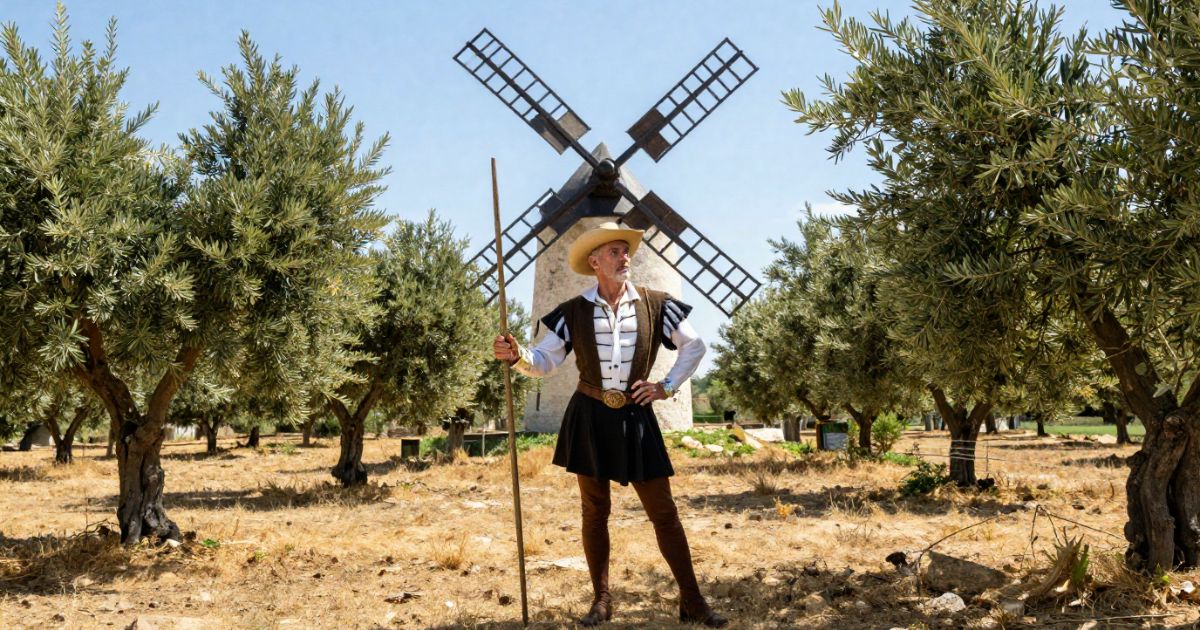
An excerpt from the original text.(complete · 3496 words)
WHEREIN IS SET FORTH WHO THE ENCHANTERS AND EXECUTIONERS WERE WHO
FLOGGED THE DUENNA AND PINCHED DON QUIXOTE, AND ALSO WHAT BEFELL THE
PAGE WHO CARRIED THE LETTER TO TERESA PANZA, SANCHO PANZA’S WIFE
Cide Hamete, the painstaking investigator of the minute points of this
veracious history, says that when Doña Rodriguez left her own room to
go to Don Quixote’s, another duenna who slept with her observed her,
and as all duennas are fond of prying, listening, and sniffing, she
followed her so silently that the good Rodriguez never perceived it;
and as soon as the duenna saw her enter Don Quixote’s room, not to fail
in a duenna’s invariable practice of tattling, she hurried off that
instant to report to the duchess how Doña Rodriguez was closeted with
Don Quixote. The duchess told the duke, and asked him to let her and
Altisidora go and see what the said duenna wanted with Don Quixote. The
duke gave them leave, and the pair cautiously and quietly crept to the
door of the room and posted themselves so close to it that they could
hear all that was said inside. But when the duchess heard how the
Rodriguez had made public the Aranjuez of her issues she could not
restrain herself, nor Altisidora either; and so, filled with rage and
thirsting for vengeance, they burst into the room and tormented Don
Quixote and flogged the duenna in the manner already described; for
indignities offered to their charms and self-esteem mightily provoke
the anger of women and make them eager for revenge. The duchess told
the duke what had happened, and he was much amused by it; and she, in
pursuance of her design of making merry and diverting herself with Don
Quixote, despatched the page who had played the part of Dulcinea in the
negotiations for her disenchantment (which Sancho Panza in the cares of
government had forgotten all about) to Teresa Panza his wife with her
husband’s letter and another from herself, and also a great string of
fine coral beads as a present.
Now the history says this page was very sharp and quick-witted; and
eager to serve his lord and lady he set off very willingly for Sancho’s
village. Before he entered it he observed a number of women washing in
a brook, and asked them if they could tell him whether there lived
there a woman of the name of Teresa Panza, wife of one Sancho Panza,
squire to a knight called Don Quixote of La Mancha. At the question a
young girl who was washing stood up and said, “Teresa Panza is my
mother, and that Sancho is my father, and that knight is our master.”
“Well then, miss,” said the page, “come and show me where your mother
is, for I bring her a letter and a present from your father.”
“That I will with all my heart, señor,” said the girl, who seemed to be
about fourteen, more or less; and leaving the clothes she was washing
to one of her companions, and without putting anything on her head or
feet, for she was bare-legged and had her hair hanging about her, away
she skipped in front of the page’s horse, saying, “Come, your worship,
our house is at the entrance of the town, and my mother is there,
sorrowful enough at not having had any news of my father this ever so
long.”
“Well,” said the page, “I am bringing her such good news that she will
have reason to thank God.”
And then, skipping, running, and capering, the girl reached the town,
but before going into the house she called out at the door, “Come out,
mother Teresa, come out, come out; here’s a gentleman with letters and
other things from my good father.” At these words her mother Teresa
Panza came out spinning a bundle of flax, in a grey petticoat (so short
was it one would have fancied “they to her shame had cut it short”), a
grey bodice of the same stuff, and a smock. She was not very old,
though plainly past forty, strong, healthy, vigorous, and sun-dried;
and seeing her daughter and the page on horseback, she exclaimed,
“What’s this, child? What gentleman is this?”
“A servant of my lady, Doña Teresa Panza,” replied the page; and
suiting the action to the word he flung himself off his horse, and with
great humility advanced to kneel before the lady Teresa, saying, “Let
me kiss your hand, Señora Doña Teresa, as the lawful and only wife of
Señor Don Sancho Panza, rightful governor of the island of Barataria.”
“Ah, señor, get up, do that,” said Teresa; “for I’m not a bit of a
court lady, but only a poor country woman, the daughter of a
clodcrusher, and the wife of a squire-errant and not of any governor at
all.”
“You are,” said the page, “the most worthy wife of a most arch-worthy
governor; and as a proof of what I say accept this letter and this
present;” and at the same time he took out of his pocket a string of
coral beads with gold clasps, and placed it on her neck, and said,
“This letter is from his lordship the governor, and the other as well
as these coral beads from my lady the duchess, who sends me to your
worship.”
Teresa stood lost in astonishment, and her daughter just as much, and
the girl said, “May I die but our master Don Quixote’s at the bottom of
this; he must have given father the government or county he so often
promised him.”
“That is the truth,” said the page; “for it is through Señor Don
Quixote that Señor Sancho is now governor of the island of Barataria,
as will be seen by this letter.”
“Will your worship read it to me, noble sir?” said Teresa; “for though
I can spin I can’t read, not a scrap.”
“Nor I either,” said Sanchica; “but wait a bit, and I’ll go and fetch
someone who can read it, either the curate himself or the bachelor
Samson Carrasco, and they’ll come gladly to hear any news of my
father.”
“There is no need to fetch anybody,” said the page; “for though I can’t
spin I can read, and I’ll read it;” and so he read it through, but as
it has been already given it is not inserted here; and then he took out
the other one from the duchess, which ran as follows:
Friend Teresa,—Your husband Sancho’s good qualities, of heart as well
as of head, induced and compelled me to request my husband the duke to
give him the government of one of his many islands. I am told he
governs like a gerfalcon, of which I am very glad, and my lord the
duke, of course, also; and I am very thankful to heaven that I have not
made a mistake in choosing him for that same government; for I would
have Señora Teresa know that a good governor is hard to find in this
world and may God make me as good as Sancho’s way of governing.
Herewith I send you, my dear, a string of coral beads with gold clasps;
I wish they were Oriental pearls; but “he who gives thee a bone does
not wish to see thee dead;” a time will come when we shall become
acquainted and meet one another, but God knows the future. Commend me
to your daughter Sanchica, and tell her from me to hold herself in
readiness, for I mean to make a high match for her when she least
expects it. They tell me there are big acorns in your village; send me
a couple of dozen or so, and I shall value them greatly as coming from
your hand; and write to me at length to assure me of your health and
well-being; and if there be anything you stand in need of, it is but to
open your mouth, and that shall be the measure; and so God keep you.
From this place.
Your loving friend,
THE DUCHESS.
“Ah, what a good, plain, lowly lady!” said Teresa when she heard the
letter; “that I may be buried with ladies of that sort, and not the
gentlewomen we have in this town, that fancy because they are
gentlewomen the wind must not touch them, and go to church with as much
airs as if they were queens, no less, and seem to think they are
disgraced if they look at a farmer’s wife! And see here how this good
lady, for all she’s a duchess, calls me ‘friend,’ and treats me as if I
was her equal—and equal may I see her with the tallest church-tower in
La Mancha! And as for the acorns, señor, I’ll send her ladyship a peck
and such big ones that one might come to see them as a show and a
wonder. And now, Sanchica, see that the gentleman is comfortable; put
up his horse, and get some eggs out of the stable, and cut plenty of
bacon, and let’s give him his dinner like a prince; for the good news
he has brought, and his own bonny face deserve it all; and meanwhile
I’ll run out and give the neighbours the news of our good luck, and
father curate, and Master Nicholas the barber, who are and always have
been such friends of thy father’s.”
“That I will, mother,” said Sanchica; “but mind, you must give me half
of that string; for I don’t think my lady the duchess could have been
so stupid as to send it all to you.”
“It is all for thee, my child,” said Teresa; “but let me wear it round
my neck for a few days; for verily it seems to make my heart glad.”
“You will be glad too,” said the page, “when you see the bundle there
is in this portmanteau, for it is a suit of the finest cloth, that the
governor only wore one day out hunting and now sends, all for Señora
Sanchica.”
“May he live a thousand years,” said Sanchica, “and the bearer as many,
nay two thousand, if needful.”
With this Teresa hurried out of the house with the letters, and with
the string of beads round her neck, and went along thrumming the
letters as if they were a tambourine, and by chance coming across the
curate and Samson Carrasco she began capering and saying, “None of us
poor now, faith! We’ve got a little government! Ay, let the finest fine
lady tackle me, and I’ll give her a setting down!”
“What’s all this, Teresa Panza,” said they; “what madness is this, and
what papers are those?”
“The madness is only this,” said she, “that these are the letters of
duchesses and governors, and these I have on my neck are fine coral
beads, with ave-marias and paternosters of beaten gold, and I am a
governess.”
“God help us,” said the curate, “we don’t understand you, Teresa, or
know what you are talking about.”
“There, you may see it yourselves,” said Teresa, and she handed them
the letters.
The curate read them out for Samson Carrasco to hear, and Samson and he
regarded one another with looks of astonishment at what they had read,
and the bachelor asked who had brought the letters. Teresa in reply
bade them come with her to her house and they would see the messenger,
a most elegant youth, who had brought another present which was worth
as much more. The curate took the coral beads from her neck and
examined them again and again, and having satisfied himself as to their
fineness he fell to wondering afresh, and said, “By the gown I wear I
don’t know what to say or think of these letters and presents; on the
one hand I can see and feel the fineness of these coral beads, and on
the other I read how a duchess sends to beg for a couple of dozen of
acorns.”
“Square that if you can,” said Carrasco; “well, let’s go and see the
messenger, and from him we’ll learn something about this mystery that
has turned up.”
They did so, and Teresa returned with them. They found the page sifting
a little barley for his horse, and Sanchica cutting a rasher of bacon
to be paved with eggs for his dinner. His looks and his handsome
apparel pleased them both greatly; and after they had saluted him
courteously, and he them, Samson begged him to give them his news, as
well of Don Quixote as of Sancho Panza, for, he said, though they had
read the letters from Sancho and her ladyship the duchess, they were
still puzzled and could not make out what was meant by Sancho’s
government, and above all of an island, when all or most of those in
the Mediterranean belonged to his Majesty.
To this the page replied, “As to Señor Sancho Panza’s being a governor
there is no doubt whatever; but whether it is an island or not that he
governs, with that I have nothing to do; suffice it that it is a town
of more than a thousand inhabitants; with regard to the acorns I may
tell you my lady the duchess is so unpretending and unassuming that,
not to speak of sending to beg for acorns from a peasant woman, she has
been known to send to ask for the loan of a comb from one of her
neighbours; for I would have your worships know that the ladies of
Aragon, though they are just as illustrious, are not so punctilious and
haughty as the Castilian ladies; they treat people with greater
familiarity.”
In the middle of this conversation Sanchica came in with her skirt full
of eggs, and said she to the page, “Tell me, señor, does my father wear
trunk-hose since he has been governor?”
“I have not noticed,” said the page; “but no doubt he wears them.”
“Ah! my God!” said Sanchica, “what a sight it must be to see my father
in tights! Isn’t it odd that ever since I was born I have had a longing
to see my father in trunk-hose?”
“As things go you will see that if you live,” said the page; “by God he
is in the way to take the road with a sunshade if the government only
lasts him two months more.”
The curate and the bachelor could see plainly enough that the page
spoke in a waggish vein; but the fineness of the coral beads, and the
hunting suit that Sancho sent (for Teresa had already shown it to them)
did away with the impression; and they could not help laughing at
Sanchica’s wish, and still more when Teresa said, “Señor curate, look
about if there’s anybody here going to Madrid or Toledo, to buy me a
hooped petticoat, a proper fashionable one of the best quality; for
indeed and indeed I must do honour to my husband’s government as well
as I can; nay, if I am put to it and have to, I’ll go to Court and set
a coach like all the world; for she who has a governor for her husband
may very well have one and keep one.”
“And why not, mother!” said Sanchica; “would to God it were to-day
instead of to-morrow, even though they were to say when they saw me
seated in the coach with my mother, ‘See that rubbish, that
garlic-stuffed fellow’s daughter, how she goes stretched at her ease in
a coach as if she was a she-pope!’ But let them tramp through the mud,
and let me go in my coach with my feet off the ground. Bad luck to
backbiters all over the world; ‘let me go warm and the people may
laugh.’ Do I say right, mother?”
“To be sure you do, my child,” said Teresa; “and all this good luck,
and even more, my good Sancho foretold me; and thou wilt see, my
daughter, he won’t stop till he has made me a countess; for to make a
beginning is everything in luck; and as I have heard thy good father
say many a time (for besides being thy father he’s the father of
proverbs too), ‘When they offer thee a heifer, run with a halter; when
they offer thee a government, take it; when they would give thee a
county, seize it; when they say, “Here, here!” to thee with something
good, swallow it.’ Oh no! go to sleep, and don’t answer the strokes of
good fortune and the lucky chances that are knocking at the door of
your house!”
“And what do I care,” added Sanchica, “whether anybody says when he
sees me holding my head up, ‘The dog saw himself in hempen breeches,’
and the rest of it?”
Hearing this the curate said, “I do believe that all this family of the
Panzas are born with a sackful of proverbs in their insides, every one
of them; I never saw one of them that does not pour them out at all
times and on all occasions.”
“That is true,” said the page, “for Señor Governor Sancho utters them
at every turn; and though a great many of them are not to the purpose,
still they amuse one, and my lady the duchess and the duke praise them
highly.”
“Then you still maintain that all this about Sancho’s government is
true, señor,” said the bachelor, “and that there actually is a duchess
who sends him presents and writes to him? Because we, although we have
handled the present and read the letters, don’t believe it and suspect
it to be something in the line of our fellow-townsman Don Quixote, who
fancies that everything is done by enchantment; and for this reason I
am almost ready to say that I’d like to touch and feel your worship to
see whether you are a mere ambassador of the imagination or a man of
flesh and blood.”
“All I know, sirs,” replied the page, “is that I am a real ambassador,
and that Señor Sancho Panza is governor as a matter of fact, and that
my lord and lady the duke and duchess can give, and have given him this
same government, and that I have heard it said Sancho Panza bears
himself very stoutly therein; whether there be any enchantment in all
this or not, it is for your worships to settle between you; for that’s
all I know by the oath I swear, and that is by the life of my parents
whom I have still alive, and love dearly.”
“It may be so,” said the bachelor; “but dubitat Augustinus.”
“Doubt who will,” said the page; “what I have told you is the truth,
and that will always rise above falsehood as oil above water; if not
operibus credite, et non verbis. Let one of you come with me, and he
will see with his eyes what he does not believe with his ears.”
“It’s for me to make that trip,” said Sanchica; “take me with you,
señor, behind you on your horse; for I’ll go with all my heart to see
my father.”
“Governors’ daughters,” said the page, “must not travel along the roads
alone, but accompanied by coaches and litters and a great number of
attendants.”
“By God,” said Sanchica, “I can go just as well mounted on a she-ass as
in a coach; what a dainty lass you must take me for!”
“Hush, girl,” said Teresa; “you don’t know what you’re talking about;
the gentleman is quite right, for ‘as the time so the behaviour;’ when
it was Sancho it was ‘Sancha;’ when it is governor it’s ‘señora;’ I
don’t know if I’m right.”
“Señora Teresa says more than she is aware of,” said the page; “and now
give me something to eat and let me go at once, for I mean to return
this evening.”
“Come and do penance with me,” said the curate at this; “for Señora
Teresa has more will than means to serve so worthy a guest.”
The page refused, but had to consent at last for his own sake; and the
curate took him home with him very gladly, in order to have an
opportunity of questioning him at leisure about Don Quixote and his
doings. The bachelor offered to write the letters in reply for Teresa;
but she did not care to let him mix himself up in her affairs, for she
thought him somewhat given to joking; and so she gave a cake and a
couple of eggs to a young acolyte who was a penman, and he wrote for
her two letters, one for her husband and the other for the duchess,
dictated out of her own head, which are not the worst inserted in this
great history, as will be seen farther on.
p50e.jpg (19K)
Master this chapter. Complete your experience
Purchase the complete book to access all chapters and support classic literature
As an Amazon Associate, we earn a small commission from qualifying purchases at no additional cost to you.
Available in paperback, hardcover, and e-book formats
Let's Analyse the Pattern
Sudden changes in fortune or power reveal people's true character, often contrasting authentic responses with performative ones.
Why This Matters
Connect literature to life
This chapter teaches how to distinguish between genuine support and calculated positioning when circumstances change.
Practice This Today
This week, notice when someone treats you differently after good or bad news—ask yourself whether their response reveals character or calculation.
Now let's explore the literary elements.
Key Quotes & Analysis
"All duennas are fond of prying, listening, and sniffing"
Context: Explaining why Doña Rodriguez was followed and discovered
Cervantes uses humor to expose a social truth about how household servants gained power through information gathering. This observation reveals the complex dynamics of domestic life where knowledge became currency.
In Today's Words:
Gossips gonna gossip - they can't help themselves from getting into everyone's business
"Indignities offered to their charms and self-esteem mightily provoked them"
Context: Describing why the duchess and Altisidora attacked Don Quixote
Shows how wounded pride, especially about physical appearance, can drive people to cruel revenge. The phrase reveals the vanity underlying aristocratic behavior and how personal insults can escalate to violence.
In Today's Words:
They were furious that someone had talked about their looks and couldn't let it slide
"I kiss your hands, though I don't deserve to untie your shoes"
Context: Writing back to the duchess in gratitude
Teresa's humble response shows genuine gratitude without losing her dignity. Her words demonstrate how common people could acknowledge social differences while maintaining their self-respect and humanity.
In Today's Words:
Thank you so much - I know you didn't have to be this kind to someone like me
Thematic Threads
Class
In This Chapter
The duchess's dual nature—generous benefactor by day, petty attacker by night—versus Teresa's authentic dignity regardless of station
Development
Evolved from earlier class conflicts to show how power corrupts even seemingly kind nobles
In Your Life:
You might see this in how management treats staff differently in public versus private settings
Identity
In This Chapter
Teresa maintains her essential self despite sudden elevation, while the duchess reveals multiple contradictory identities
Development
Continues the theme of authentic versus performed identity throughout the novel
In Your Life:
You face this when promotions or windfalls test whether you'll stay true to your values
Social Expectations
In This Chapter
Village intellectuals doubt the impossible news while Teresa simply accepts and responds practically
Development
Builds on the pattern of educated people overthinking while simple wisdom proves more reliable
In Your Life:
You might experience this when good opportunities seem 'too good to be true' to others
Human Relationships
In This Chapter
The duchess treats Teresa as an equal in letters while attacking Don Quixote in darkness
Development
Deepens exploration of how relationships change with power dynamics and hidden motivations
In Your Life:
You see this in relationships where people show different faces depending on who's watching
Personal Growth
In This Chapter
Teresa's balanced response to fortune—excited but grounded, ambitious but not grasping
Development
Contrasts with other characters' responses to change throughout the story
In Your Life:
You experience this test whenever life hands you unexpected opportunities or challenges
You now have the context. Time to form your own thoughts.
Discussion Questions
- 1
What does Teresa's reaction to the news of Sancho's governorship reveal about her character compared to how others might respond to sudden good fortune?
analysis • surface - 2
Why does the duchess act kindly toward Teresa in her letter while also orchestrating cruel midnight attacks on Don Quixote?
analysis • medium - 3
Where have you seen people change dramatically when they receive promotions, windfalls, or sudden status - and what patterns do you notice?
application • medium - 4
How would you maintain your authentic character if you suddenly received life-changing good news, based on what Teresa does right?
application • deep - 5
What does this chapter suggest about the difference between having power and having character?
reflection • deep
Critical Thinking Exercise
Character Under Pressure Test
Think of three people you know well - family, friends, or coworkers. Imagine each one suddenly receiving great news: a promotion, inheritance, or public recognition. Write down how you honestly think each would respond based on their current character. Then consider what their responses would reveal about who they really are underneath their everyday masks.
Consider:
- •Look for patterns in how people handle both good and bad news
- •Notice the difference between public behavior and private character
- •Consider how power or fortune might change someone's treatment of others
Journaling Prompt
Write about a time when you experienced sudden good fortune or elevation. How did it change your behavior toward others? What did you learn about yourself in that moment?
Coming Up Next...
Chapter 123: Sancho's Wise Judgment and Governance
Back at Sancho's island government, a sleepless night of governing has left everyone amazed at his mixture of wisdom and simplicity. As dawn breaks on his second day in power, new challenges will test whether a simple man can truly rule with both heart and head.