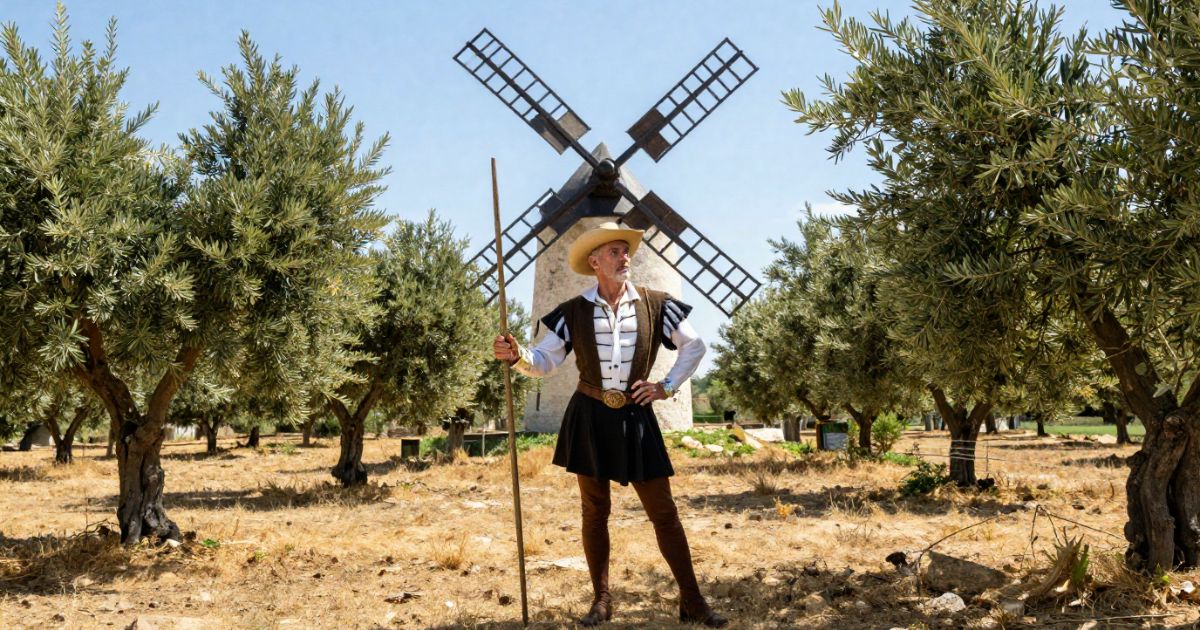
An excerpt from the original text.(complete · 2258 words)
WHEREIN IS RELATED THE STRANGE AND UNDREAMT-OF ADVENTURE OF THE
DISTRESSED DUENNA, ALIAS THE COUNTESS TRIFALDI, TOGETHER WITH A LETTER
WHICH SANCHO PANZA WROTE TO HIS WIFE, TERESA PANZA
The duke had a majordomo of a very facetious and sportive turn, and he
it was that played the part of Merlin, made all the arrangements for
the late adventure, composed the verses, and got a page to represent
Dulcinea; and now, with the assistance of his master and mistress, he
got up another of the drollest and strangest contrivances that can be
imagined.
The duchess asked Sancho the next day if he had made a beginning with
his penance task which he had to perform for the disenchantment of
Dulcinea. He said he had, and had given himself five lashes overnight.
The duchess asked him what he had given them with.
He said with his hand.
“That,” said the duchess, “is more like giving oneself slaps than
lashes; I am sure the sage Merlin will not be satisfied with such
tenderness; worthy Sancho must make a scourge with claws, or a
cat-o’-nine tails, that will make itself felt; for it’s with blood that
letters enter, and the release of so great a lady as Dulcinea will not
be granted so cheaply, or at such a paltry price; and remember, Sancho,
that works of charity done in a lukewarm and half-hearted way are
without merit and of no avail.”
To which Sancho replied, “If your ladyship will give me a proper
scourge or cord, I’ll lay on with it, provided it does not hurt too
much; for you must know, boor as I am, my flesh is more cotton than
hemp, and it won’t do for me to destroy myself for the good of anybody
else.”
“So be it by all means,” said the duchess; “to-morrow I’ll give you a
scourge that will be just the thing for you, and will accommodate
itself to the tenderness of your flesh, as if it was its own sister.”
Then said Sancho, “Your highness must know, dear lady of my soul, that
I have a letter written to my wife, Teresa Panza, giving her an account
of all that has happened me since I left her; I have it here in my
bosom, and there’s nothing wanting but to put the address to it; I’d be
glad if your discretion would read it, for I think it runs in the
governor style; I mean the way governors ought to write.”
“And who dictated it?” asked the duchess.
“Who should have dictated but myself, sinner as I am?” said Sancho.
“And did you write it yourself?” said the duchess.
“That I didn’t,” said Sancho; “for I can neither read nor write, though
I can sign my name.”
“Let us see it,” said the duchess, “for never fear but you display in
it the quality and quantity of your wit.”
Sancho drew out an open letter from his bosom, and the duchess, taking
it, found it ran in this fashion:
SANCHO PANZA’S LETTER TO HIS WIFE, TERESA PANZA
If I was well whipped I went mounted like a gentleman; if I have got a
good government it is at the cost of a good whipping. Thou wilt not
understand this just now, my Teresa; by-and-by thou wilt know what it
means. I may tell thee, Teresa, I mean thee to go in a coach, for that
is a matter of importance, because every other way of going is going on
all-fours. Thou art a governor’s wife; take care that nobody speaks
evil of thee behind thy back. I send thee here a green hunting suit
that my lady the duchess gave me; alter it so as to make a petticoat
and bodice for our daughter. Don Quixote, my master, if I am to believe
what I hear in these parts, is a madman of some sense, and a droll
blockhead, and I am in no way behind him. We have been in the cave of
Montesinos, and the sage Merlin has laid hold of me for the
disenchantment of Dulcinea del Toboso, her that is called Aldonza
Lorenzo over there. With three thousand three hundred lashes, less
five, that I’m to give myself, she will be left as entirely
disenchanted as the mother that bore her. Say nothing of this to
anyone; for, make thy affairs public, and some will say they are white
and others will say they are black. I shall leave this in a few days
for my government, to which I am going with a mighty great desire to
make money, for they tell me all new governors set out with the same
desire; I will feel the pulse of it and will let thee know if thou art
to come and live with me or not. Dapple is well and sends many
remembrances to thee; I am not going to leave him behind though they
took me away to be Grand Turk. My lady the duchess kisses thy hands a
thousand times; do thou make a return with two thousand, for as my
master says, nothing costs less or is cheaper than civility. God has
not been pleased to provide another valise for me with another hundred
crowns, like the one the other day; but never mind, my Teresa, the
bell-ringer is in safe quarters, and all will come out in the scouring
of the government; only it troubles me greatly what they tell me—that
once I have tasted it I will eat my hands off after it; and if that is
so it will not come very cheap to me; though to be sure the maimed have
a benefice of their own in the alms they beg for; so that one way or
another thou wilt be rich and in luck. God give it to thee as he can,
and keep me to serve thee. From this castle, the 20th of July, 1614.
Thy husband, the governor,
SANCHO PANZA
When she had done reading the letter the duchess said to Sancho, “On
two points the worthy governor goes rather astray; one is in saying or
hinting that this government has been bestowed upon him for the lashes
that he is to give himself, when he knows (and he cannot deny it) that
when my lord the duke promised it to him nobody ever dreamt of such a
thing as lashes; the other is that he shows himself here to be very
covetous; and I would not have him a money-seeker, for ‘covetousness
bursts the bag,’ and the covetous governor does ungoverned justice.”
“I don’t mean it that way, señora,” said Sancho; “and if you think the
letter doesn’t run as it ought to do, it’s only to tear it up and make
another; and maybe it will be a worse one if it is left to my
gumption.”
“No, no,” said the duchess, “this one will do, and I wish the duke to
see it.”
With this they betook themselves to a garden where they were to dine,
and the duchess showed Sancho’s letter to the duke, who was highly
delighted with it. They dined, and after the cloth had been removed and
they had amused themselves for a while with Sancho’s rich conversation,
the melancholy sound of a fife and harsh discordant drum made itself
heard. All seemed somewhat put out by this dull, confused, martial
harmony, especially Don Quixote, who could not keep his seat from pure
disquietude; as to Sancho, it is needless to say that fear drove him to
his usual refuge, the side or the skirts of the duchess; and indeed and
in truth the sound they heard was a most doleful and melancholy one.
While they were still in uncertainty they saw advancing towards them
through the garden two men clad in mourning robes so long and flowing
that they trailed upon the ground. As they marched they beat two great
drums which were likewise draped in black, and beside them came the
fife player, black and sombre like the others. Following these came a
personage of gigantic stature enveloped rather than clad in a gown of
the deepest black, the skirt of which was of prodigious dimensions.
Over the gown, girdling or crossing his figure, he had a broad baldric
which was also black, and from which hung a huge scimitar with a black
scabbard and furniture. He had his face covered with a transparent
black veil, through which might be descried a very long beard as white
as snow. He came on keeping step to the sound of the drums with great
gravity and dignity; and, in short, his stature, his gait, the
sombreness of his appearance and his following might well have struck
with astonishment, as they did, all who beheld him without knowing who
he was. With this measured pace and in this guise he advanced to kneel
before the duke, who, with the others, awaited him standing. The duke,
however, would not on any account allow him to speak until he had
risen. The prodigious scarecrow obeyed, and standing up, removed the
veil from his face and disclosed the most enormous, the longest, the
whitest and the thickest beard that human eyes had ever beheld until
that moment, and then fetching up a grave, sonorous voice from the
depths of his broad, capacious chest, and fixing his eyes on the duke,
he said:
“Most high and mighty señor, my name is Trifaldin of the White Beard; I
am squire to the Countess Trifaldi, otherwise called the Distressed
Duenna, on whose behalf I bear a message to your highness, which is
that your magnificence will be pleased to grant her leave and
permission to come and tell you her trouble, which is one of the
strangest and most wonderful that the mind most familiar with trouble
in the world could have imagined; but first she desires to know if the
valiant and never vanquished knight, Don Quixote of La Mancha, is in
this your castle, for she has come in quest of him on foot and without
breaking her fast from the kingdom of Kandy to your realms here; a
thing which may and ought to be regarded as a miracle or set down to
enchantment; she is even now at the gate of this fortress or plaisance,
and only waits for your permission to enter. I have spoken.” And with
that he coughed, and stroked down his beard with both his hands, and
stood very tranquilly waiting for the response of the duke, which was
to this effect: “Many days ago, worthy squire Trifaldin of the White
Beard, we heard of the misfortune of my lady the Countess Trifaldi,
whom the enchanters have caused to be called the Distressed Duenna. Bid
her enter, O stupendous squire, and tell her that the valiant knight
Don Quixote of La Mancha is here, and from his generous disposition she
may safely promise herself every protection and assistance; and you may
tell her, too, that if my aid be necessary it will not be withheld, for
I am bound to give it to her by my quality of knight, which involves
the protection of women of all sorts, especially widowed, wronged, and
distressed dames, such as her ladyship seems to be.”
On hearing this Trifaldin bent the knee to the ground, and making a
sign to the fifer and drummers to strike up, he turned and marched out
of the garden to the same notes and at the same pace as when he
entered, leaving them all amazed at his bearing and solemnity. Turning
to Don Quixote, the duke said, “After all, renowned knight, the mists
of malice and ignorance are unable to hide or obscure the light of
valour and virtue. I say so, because your excellence has been barely
six days in this castle, and already the unhappy and the afflicted come
in quest of you from lands far distant and remote, and not in coaches
or on dromedaries, but on foot and fasting, confident that in that
mighty arm they will find a cure for their sorrows and troubles; thanks
to your great achievements, which are circulated all over the known
earth.”
“I wish, señor duke,” replied Don Quixote, “that blessed ecclesiastic,
who at table the other day showed such ill-will and bitter spite
against knights-errant, were here now to see with his own eyes whether
knights of the sort are needed in the world; he would at any rate learn
by experience that those suffering any extraordinary affliction or
sorrow, in extreme cases and unusual misfortunes do not go to look for
a remedy to the houses of jurists or village sacristans, or to the
knight who has never attempted to pass the bounds of his own town, or
to the indolent courtier who only seeks for news to repeat and talk of,
instead of striving to do deeds and exploits for others to relate and
record. Relief in distress, help in need, protection for damsels,
consolation for widows, are to be found in no sort of persons better
than in knights-errant; and I give unceasing thanks to heaven that I am
one, and regard any misfortune or suffering that may befall me in the
pursuit of so honourable a calling as endured to good purpose. Let this
duenna come and ask what she will, for I will effect her relief by the
might of my arm and the dauntless resolution of my bold heart.”
p36e.jpg (22K)
Master this chapter. Complete your experience
Purchase the complete book to access all chapters and support classic literature
As an Amazon Associate, we earn a small commission from qualifying purchases at no additional cost to you.
Available in paperback, hardcover, and e-book formats
Let's Analyse the Pattern
The Theater of Manipulation - How Drama Hijacks Decision-Making
People use elaborate staging and emotional manipulation to bypass rational judgment and pressure others into compliance.
Why This Matters
Connect literature to life
This chapter teaches how to recognize when elaborate presentations are designed to bypass your rational judgment and trigger emotional compliance.
Practice This Today
This week, notice when someone packages a simple request in unnecessary drama—urgent emails with red exclamation points, meetings that could have been conversations, or flattery that feels excessive.
Now let's explore the literary elements.
Key Quotes & Analysis
"That is more like giving oneself slaps than lashes; I am sure the sage Merlin will not be satisfied with such tenderness."
Context: When she criticizes Sancho's gentle approach to his self-punishment
This reveals how people often demand we go to extremes to prove we're serious, even when our moderate approach is perfectly adequate. The Duchess is pushing Sancho toward real harm for her entertainment.
In Today's Words:
That's barely trying - you need to really make it hurt if you want results.
"It's with blood that letters enter, and the release of so great a lady as Dulcinea will not be granted so cheaply."
Context: Explaining why Sancho must use a real whip instead of hand-slaps
This shows the dangerous logic that suffering equals sincerity, and that easy solutions can't be trusted. It's manipulation disguised as wisdom about the value of sacrifice.
In Today's Words:
No pain, no gain - if it doesn't hurt, it's not working.
"Works of charity done in a lukewarm and half-hearted way are without merit and of no avail."
Context: Continuing her criticism of Sancho's gentle self-flagellation
She's using moral language about charity to justify cruelty. This reveals how people can twist good principles to pressure others into extremes that serve their own interests.
In Today's Words:
If you're not going all-in, you're just wasting everyone's time.
Thematic Threads
Manipulation
In This Chapter
The Duke's household orchestrates elaborate theatrical presentations to control Don Quixote and Sancho's responses
Development
Evolved from simple pranks to sophisticated psychological manipulation using spectacle and social pressure
In Your Life:
You might see this when someone uses drama, urgency, or flattery to pressure you into decisions you haven't fully considered.
Social Pressure
In This Chapter
The Duchess demands Sancho escalate his self-flagellation from gentle hand-slaps to painful whipping
Development
Building on earlier themes of how authority figures push others toward extremes
In Your Life:
You might experience this when others criticize your efforts as insufficient and pressure you to go further than you're comfortable with.
Identity
In This Chapter
Don Quixote responds to the theatrical presentation by embracing his role as noble helper, feeding his heroic self-image
Development
Continues his pattern of letting his desired identity override practical judgment
In Your Life:
You might see this when your desire to be seen as helpful, competent, or generous makes you vulnerable to manipulation.
Class
In This Chapter
Sancho's letter reveals his complex feelings about upcoming power and status, mixing excitement with practical concerns
Development
Deepening exploration of how class mobility affects relationships and self-perception
In Your Life:
You might relate to this when facing promotion or new responsibilities that change your social position and relationships.
Genuine Service
In This Chapter
The tension between Don Quixote's real desire to help others and his enjoyment of the attention and praise
Development
Introduced here as a complication to his heroic motivations
In Your Life:
You might recognize this when questioning whether you're helping others for their benefit or for how it makes you feel about yourself.
You now have the context. Time to form your own thoughts.
Discussion Questions
- 1
Why does the Duchess push Sancho to use a real whip instead of accepting his gentle hand-slaps?
analysis • surface - 2
How does the elaborate theatrical entrance with drums and costumes affect Don Quixote's response compared to a simple request for help?
analysis • medium - 3
Where do you see people using drama or spectacle to get what they want in your workplace, family, or community?
application • medium - 4
When someone approaches you with an urgent, dramatic request, what steps could you take to evaluate the actual need underneath the presentation?
application • deep - 5
What does this chapter reveal about why people often say yes to things they later regret?
reflection • deep
Critical Thinking Exercise
Strip Away the Theater
Think of a recent time someone made a request of you using urgency, flattery, or dramatic presentation. Write down what they actually asked for in the simplest possible terms. Then write what your response might have been if they had asked plainly, without the theatrical elements.
Consider:
- •Notice how the presentation style affected your emotional response
- •Consider whether the urgency was real or manufactured
- •Think about what the person gained by adding drama to their request
Journaling Prompt
Write about a time when you used dramatic presentation to get something you wanted. What were you afraid would happen if you just asked directly? How did the other person respond to your approach?
Coming Up Next...
Chapter 109: The Duenna Defense League
The mysterious Distressed Duenna finally appears to tell her tale of woe, but Sancho grows suspicious about duennas and their tendency to complicate everything. His street-smart skepticism might prove more valuable than his master's noble eagerness to help.