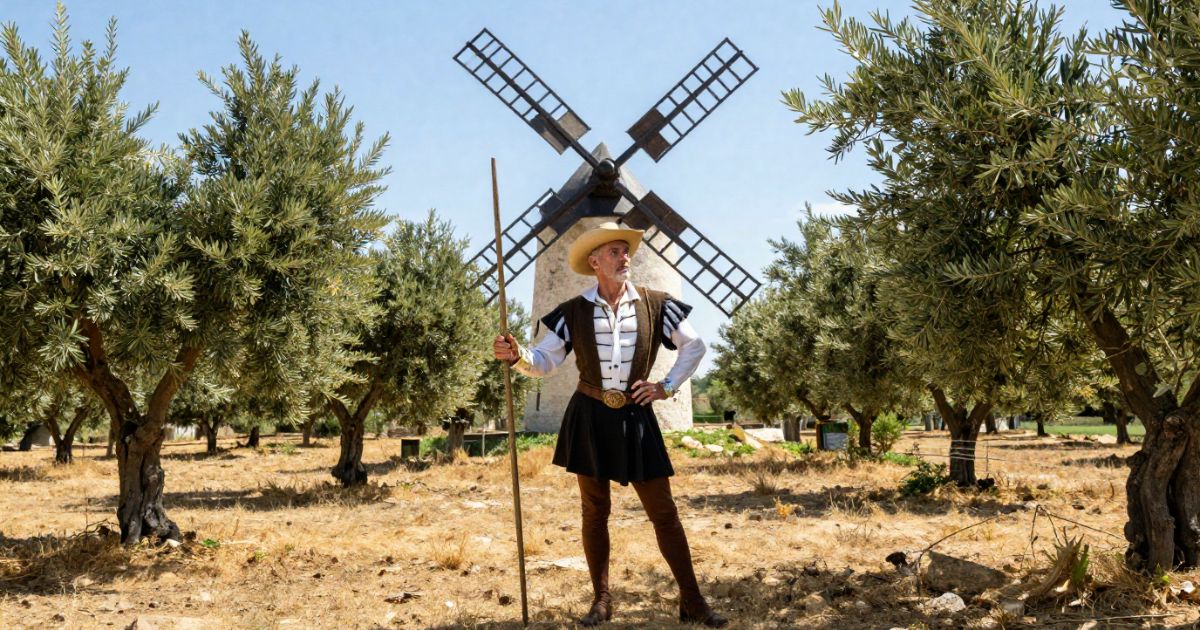
An excerpt from the original text.(complete · 2407 words)
OF THE FAMOUS ADVENTURE OF THE ENCHANTED BARK
By stages as already described or left undescribed, two days after
quitting the grove Don Quixote and Sancho reached the river Ebro, and
the sight of it was a great delight to Don Quixote as he contemplated
and gazed upon the charms of its banks, the clearness of its stream,
the gentleness of its current and the abundance of its crystal waters;
and the pleasant view revived a thousand tender thoughts in his mind.
Above all, he dwelt upon what he had seen in the cave of Montesinos;
for though Master Pedro’s ape had told him that of those things part
was true, part false, he clung more to their truth than to their
falsehood, the very reverse of Sancho, who held them all to be
downright lies.
As they were thus proceeding, then, they discovered a small boat,
without oars or any other gear, that lay at the water’s edge tied to
the stem of a tree growing on the bank. Don Quixote looked all round,
and seeing nobody, at once, without more ado, dismounted from Rocinante
and bade Sancho get down from Dapple and tie both beasts securely to
the trunk of a poplar or willow that stood there. Sancho asked him the
reason of this sudden dismounting and tying. Don Quixote made answer,
“Thou must know, Sancho, that this bark is plainly, and without the
possibility of any alternative, calling and inviting me to enter it,
and in it go to give aid to some knight or other person of distinction
in need of it, who is no doubt in some sore strait; for this is the way
of the books of chivalry and of the enchanters who figure and speak in
them. When a knight is involved in some difficulty from which he cannot
be delivered save by the hand of another knight, though they may be at
a distance of two or three thousand leagues or more one from the other,
they either take him up on a cloud, or they provide a bark for him to
get into, and in less than the twinkling of an eye they carry him where
they will and where his help is required; and so, Sancho, this bark is
placed here for the same purpose; this is as true as that it is now
day, and ere this one passes tie Dapple and Rocinante together, and
then in God’s hand be it to guide us; for I would not hold back from
embarking, though barefooted friars were to beg me.”
“As that’s the case,” said Sancho, “and your worship chooses to give in
to these—I don’t know if I may call them absurdities—at every turn,
there’s nothing for it but to obey and bow the head, bearing in mind
the proverb, ‘Do as thy master bids thee, and sit down to table with
him;’ but for all that, for the sake of easing my conscience, I warn
your worship that it is my opinion this bark is no enchanted one, but
belongs to some of the fishermen of the river, for they catch the best
shad in the world here.”
As Sancho said this, he tied the beasts, leaving them to the care and
protection of the enchanters with sorrow enough in his heart. Don
Quixote bade him not be uneasy about deserting the animals, “for he who
would carry themselves over such longinquous roads and regions would
take care to feed them.”
“I don’t understand that logiquous,” said Sancho, “nor have I ever
heard the word all the days of my life.”
“Longinquous,” replied Don Quixote, “means far off; but it is no wonder
thou dost not understand it, for thou art not bound to know Latin, like
some who pretend to know it and don’t.”
“Now they are tied,” said Sancho; “what are we to do next?”
“What?” said Don Quixote, “cross ourselves and weigh anchor; I mean,
embark and cut the moorings by which the bark is held;” and the bark
began to drift away slowly from the bank. But when Sancho saw himself
somewhere about two yards out in the river, he began to tremble and
give himself up for lost; but nothing distressed him more than hearing
Dapple bray and seeing Rocinante struggling to get loose, and said he
to his master, “Dapple is braying in grief at our leaving him, and
Rocinante is trying to escape and plunge in after us. O dear friends,
peace be with you, and may this madness that is taking us away from
you, turned into sober sense, bring us back to you.” And with this he
fell weeping so bitterly, that Don Quixote said to him, sharply and
angrily, “What art thou afraid of, cowardly creature? What art thou
weeping at, heart of butter-paste? Who pursues or molests thee, thou
soul of a tame mouse? What dost thou want, unsatisfied in the very
heart of abundance? Art thou, perchance, tramping barefoot over the
Riphaean mountains, instead of being seated on a bench like an archduke
on the tranquil stream of this pleasant river, from which in a short
space we shall come out upon the broad sea? But we must have already
emerged and gone seven hundred or eight hundred leagues; and if I had
here an astrolabe to take the altitude of the pole, I could tell thee
how many we have travelled, though either I know little, or we have
already crossed or shall shortly cross the equinoctial line which parts
the two opposite poles midway.”
“And when we come to that line your worship speaks of,” said Sancho,
“how far shall we have gone?”
“Very far,” said Don Quixote, “for of the three hundred and sixty
degrees that this terraqueous globe contains, as computed by Ptolemy,
the greatest cosmographer known, we shall have travelled one-half when
we come to the line I spoke of.”
“By God,” said Sancho, “your worship gives me a nice authority for what
you say, putrid Dolly something transmogrified, or whatever it is.”
Don Quixote laughed at the interpretation Sancho put upon “computed,”
and the name of the cosmographer Ptolemy, and said he, “Thou must know,
Sancho, that with the Spaniards and those who embark at Cadiz for the
East Indies, one of the signs they have to show them when they have
passed the equinoctial line I told thee of, is, that the lice die upon
everybody on board the ship, and not a single one is left, or to be
found in the whole vessel if they gave its weight in gold for it; so,
Sancho, thou mayest as well pass thy hand down thy thigh, and if thou
comest upon anything alive we shall be no longer in doubt; if not, then
we have crossed.”
“I don’t believe a bit of it,” said Sancho; “still, I’ll do as your
worship bids me; though I don’t know what need there is for trying
these experiments, for I can see with my own eyes that we have not
moved five yards away from the bank, or shifted two yards from where
the animals stand, for there are Rocinante and Dapple in the very same
place where we left them; and watching a point, as I do now, I swear by
all that’s good, we are not stirring or moving at the pace of an ant.”
“Try the test I told thee of, Sancho,” said Don Quixote, “and don’t
mind any other, for thou knowest nothing about colures, lines,
parallels, zodiacs, ecliptics, poles, solstices, equinoxes, planets,
signs, bearings, the measures of which the celestial and terrestrial
spheres are composed; if thou wert acquainted with all these things, or
any portion of them, thou wouldst see clearly how many parallels we
have cut, what signs we have seen, and what constellations we have left
behind and are now leaving behind. But again I tell thee, feel and
hunt, for I am certain thou art cleaner than a sheet of smooth white
paper.”
Sancho felt, and passing his hand gently and carefully down to the
hollow of his left knee, he looked up at his master and said, “Either
the test is a false one, or we have not come to where your worship
says, nor within many leagues of it.”
“Why, how so?” asked Don Quixote; “hast thou come upon aught?”
“Ay, and aughts,” replied Sancho; and shaking his fingers he washed his
whole hand in the river along which the boat was quietly gliding in
midstream, not moved by any occult intelligence or invisible enchanter,
but simply by the current, just there smooth and gentle.
They now came in sight of some large water mills that stood in the
middle of the river, and the instant Don Quixote saw them he cried out,
“Seest thou there, my friend? there stands the castle or fortress,
where there is, no doubt, some knight in durance, or ill-used queen, or
infanta, or princess, in whose aid I am brought hither.”
“What the devil city, fortress, or castle is your worship talking
about, señor?” said Sancho; “don’t you see that those are mills that
stand in the river to grind corn?”
“Hold thy peace, Sancho,” said Don Quixote; “though they look like
mills they are not so; I have already told thee that enchantments
transform things and change their proper shapes; I do not mean to say
they really change them from one form into another, but that it seems
as though they did, as experience proved in the transformation of
Dulcinea, sole refuge of my hopes.”
By this time, the boat, having reached the middle of the stream, began
to move less slowly than hitherto. The millers belonging to the mills,
when they saw the boat coming down the river, and on the point of being
sucked in by the draught of the wheels, ran out in haste, several of
them, with long poles to stop it, and being all mealy, with faces and
garments covered with flour, they presented a sinister appearance. They
raised loud shouts, crying, “Devils of men, where are you going to? Are
you mad? Do you want to drown yourselves, or dash yourselves to pieces
among these wheels?”
“Did I not tell thee, Sancho,” said Don Quixote at this, “that we had
reached the place where I am to show what the might of my arm can do?
See what ruffians and villains come out against me; see what monsters
oppose me; see what hideous countenances come to frighten us! You shall
soon see, scoundrels!” And then standing up in the boat he began in a
loud voice to hurl threats at the millers, exclaiming, “Ill-conditioned
and worse-counselled rabble, restore to liberty and freedom the person
ye hold in durance in this your fortress or prison, high or low or of
whatever rank or quality he be, for I am Don Quixote of La Mancha,
otherwise called the Knight of the Lions, for whom, by the disposition
of heaven above, it is reserved to give a happy issue to this
adventure;” and so saying he drew his sword and began making passes in
the air at the millers, who, hearing but not understanding all this
nonsense, strove to stop the boat, which was now getting into the
rushing channel of the wheels. Sancho fell upon his knees devoutly
appealing to heaven to deliver him from such imminent peril; which it
did by the activity and quickness of the millers, who, pushing against
the boat with their poles, stopped it, not, however, without upsetting
and throwing Don Quixote and Sancho into the water; and lucky it was
for Don Quixote that he could swim like a goose, though the weight of
his armour carried him twice to the bottom; and had it not been for the
millers, who plunged in and hoisted them both out, it would have been
Troy town with the pair of them. As soon as, more drenched than
thirsty, they were landed, Sancho went down on his knees and with
clasped hands and eyes raised to heaven, prayed a long and fervent
prayer to God to deliver him evermore from the rash projects and
attempts of his master. The fishermen, the owners of the boat, which
the mill-wheels had knocked to pieces, now came up, and seeing it
smashed they proceeded to strip Sancho and to demand payment for it
from Don Quixote; but he with great calmness, just as if nothing had
happened him, told the millers and fishermen that he would pay for the
bark most cheerfully, on condition that they delivered up to him, free
and unhurt, the person or persons that were in durance in that castle
of theirs.
“What persons or what castle art thou talking of, madman? Art thou for
carrying off the people who come to grind corn in these mills?”
“That’s enough,” said Don Quixote to himself, “it would be preaching in
the desert to attempt by entreaties to induce this rabble to do any
virtuous action. In this adventure two mighty enchanters must have
encountered one another, and one frustrates what the other attempts;
one provided the bark for me, and the other upset me; God help us, this
world is all machinations and schemes at cross purposes one with the
other. I can do no more.” And then turning towards the mills he said
aloud, “Friends, whoe’er ye be that are immured in that prison, forgive
me that, to my misfortune and yours, I cannot deliver you from your
misery; this adventure is doubtless reserved and destined for some
other knight.”
So saying he settled with the fishermen, and paid fifty reals for the
boat, which Sancho handed to them very much against the grain, saying,
“With a couple more bark businesses like this we shall have sunk our
whole capital.”
The fishermen and the millers stood staring in amazement at the two
figures, so very different to all appearance from ordinary men, and
were wholly unable to make out the drift of the observations and
questions Don Quixote addressed to them; and coming to the conclusion
that they were madmen, they left them and betook themselves, the
millers to their mills, and the fishermen to their huts. Don Quixote
and Sancho returned to their beasts, and to their life of beasts, and
so ended the adventure of the enchanted bark.
p29e.jpg (54K)
Master this chapter. Complete your experience
Purchase the complete book to access all chapters and support classic literature
As an Amazon Associate, we earn a small commission from qualifying purchases at no additional cost to you.
Available in paperback, hardcover, and e-book formats
Let's Analyse the Pattern
The Conviction Trap - When Being Right Becomes Wrong
The stronger our conviction becomes, the more we ignore contradicting evidence and drag others into costly consequences rather than admit we might be wrong.
Why This Matters
Connect literature to life
This chapter teaches how to recognize when our confidence has crossed the line from helpful conviction into dangerous delusion.
Practice This Today
This week, notice when you feel most certain about something important—then actively seek out one piece of contradicting evidence before making your next move.
Now let's explore the literary elements.
Key Quotes & Analysis
"This bark is plainly, and without the possibility of any alternative, calling and inviting me to enter it"
Context: When he first sees the abandoned fishing boat by the river
Shows how Don Quixote interprets random coincidences as destiny calling him to adventure. He can't consider any mundane explanation - it must be magical and about him.
In Today's Words:
This is obviously meant for me - it's a sign I should do this crazy thing.
"We have not moved three yards from where we embarked"
Context: Trying to convince Don Quixote they haven't traveled far while he claims they've crossed oceans
Represents the voice of practical reality trying to break through delusion. Sancho can see the obvious truth that Don Quixote refuses to accept.
In Today's Words:
Dude, we're literally still right where we started - what are you talking about?
"Those whom you see there are not giants, but water mills"
Context: When Don Quixote prepares to attack the flour mills as if they were an enchanted castle
Echoes the famous windmill scene, showing this is a pattern. Sancho keeps trying to inject reality into Don Quixote's fantasies, usually unsuccessfully.
In Today's Words:
Those aren't your enemies - that's just regular people doing their jobs.
Thematic Threads
Delusion
In This Chapter
Don Quixote transforms a simple fishing boat into an enchanted vessel and refuses to acknowledge reality even after near-drowning
Development
His delusions are becoming more dangerous, now endangering both himself and Sancho with real financial and physical consequences
In Your Life:
You might catch yourself explaining away obvious problems in your relationships or work situations rather than facing uncomfortable truths
Class
In This Chapter
The fifty reals cost for the destroyed boat represents significant money to Sancho, showing how the wealthy's fantasies burden the working class
Development
Continues the theme of Don Quixote's privilege allowing him to pursue dreams while others pay the practical costs
In Your Life:
You might recognize when someone else's grand plans consistently leave you handling the cleanup and expenses
Responsibility
In This Chapter
Don Quixote refuses accountability for the disaster, blaming competing enchanters instead of his own poor judgment
Development
His pattern of avoiding responsibility is becoming more entrenched and costly to those around him
In Your Life:
You might notice when you or others consistently blame external forces rather than examining personal choices that led to problems
Loyalty
In This Chapter
Sancho follows Don Quixote onto the boat despite knowing it's dangerous, showing misplaced loyalty that enables destructive behavior
Development
Sancho's loyalty is becoming increasingly problematic as he enables rather than challenges his master's delusions
In Your Life:
You might recognize when your loyalty to someone is actually enabling their harmful behavior rather than helping them grow
Reality
In This Chapter
The physical consequences—near-drowning and financial loss—force a confrontation between fantasy and reality that Don Quixote still refuses to accept
Development
Reality's consequences are escalating, but Don Quixote's denial is also strengthening in response
In Your Life:
You might notice when mounting real-world consequences still aren't enough to make someone reconsider their approach to a situation
You now have the context. Time to form your own thoughts.
Discussion Questions
- 1
What convinced Don Quixote that the fishing boat was enchanted, and how did he interpret the evidence that contradicted his belief?
analysis • surface - 2
Why does Don Quixote blame 'competing enchanters' for the disaster instead of reconsidering his original assumption about the boat?
analysis • medium - 3
Think of someone you know who refuses to admit when they're wrong. What do they do when reality contradicts their beliefs?
application • medium - 4
How can you tell the difference between being confident in your judgment and being dangerously attached to being right?
application • deep - 5
What does this chapter reveal about how our need to feel special or important can cloud our judgment and hurt others?
reflection • deep
Critical Thinking Exercise
Create Your Reality Check System
Think of a current situation where you feel strongly that you're right but others keep pushing back. Write down what evidence would actually make you reconsider your position. Then identify three people whose judgment you trust and imagine what they would say about this situation if they were being completely honest.
Consider:
- •Notice if you can't think of any evidence that would change your mind—that's a red flag
- •Pay attention to your emotional reaction to imagining you might be wrong
- •Consider what it's costing you (time, money, relationships) to maintain this position
Journaling Prompt
Write about a time when you were convinced you were right but later realized you were wrong. What did you learn about your own blind spots, and how do you spot that pattern now?
Coming Up Next...
Chapter 102: Meeting the Duke and Duchess
Still dripping wet and fifty reals poorer, our heroes encounter a group of elegant hunters in the forest. Don Quixote's attention is immediately captured by a beautiful huntress who might just be the distraction he needs from his recent humiliation—or another opportunity for disaster.