
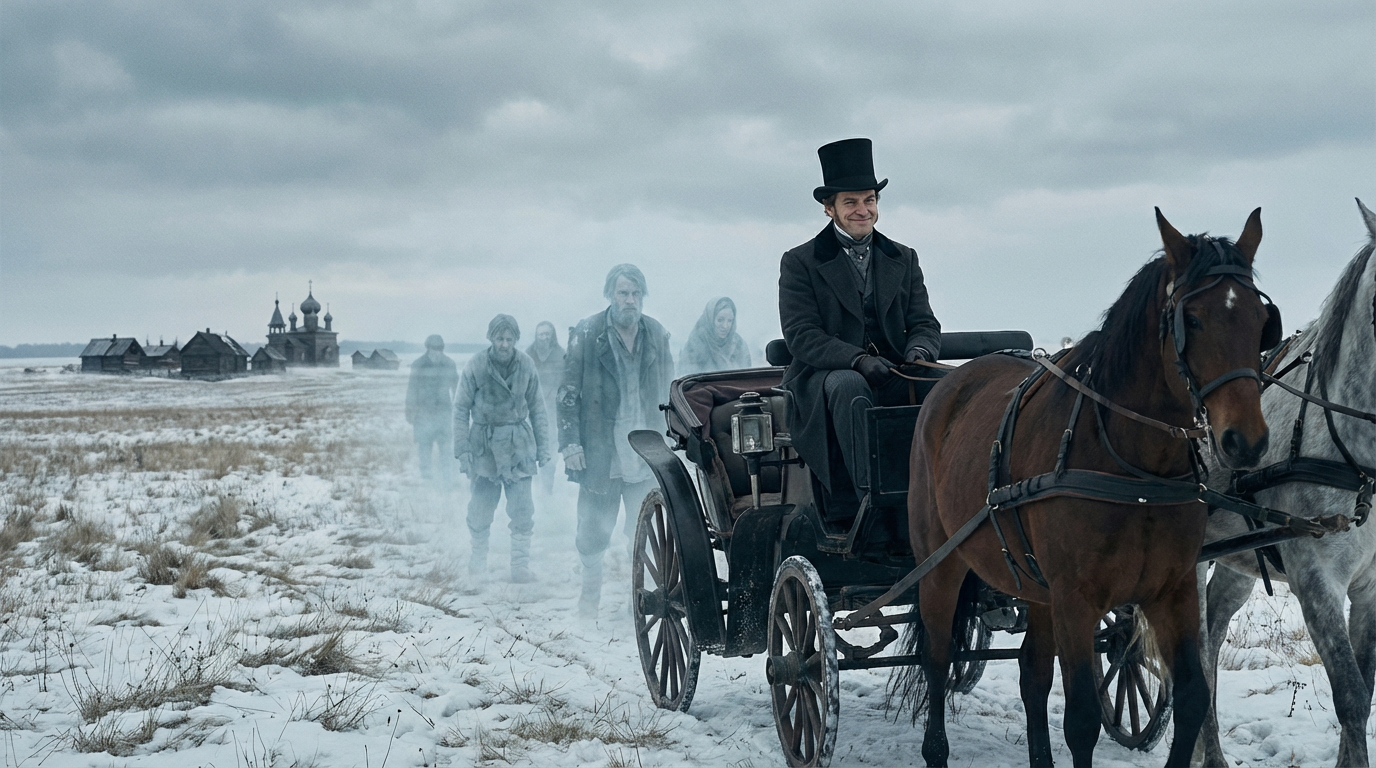
An excerpt from the original text.(complete · 14738 words)
“f Colonel Koshkarev should turn out to be as mad as the last one it
is a bad look-out,” said Chichikov to himself on opening his eyes amid
fields and open country--everything else having disappeared save the
vault of heaven and a couple of low-lying clouds.
“Selifan,” he went on, “did you ask how to get to Colonel Koshkarev’s?”
“Yes, Paul Ivanovitch. At least, there was such a clatter around the
koliaska that I could not; but Petrushka asked the coachman.”
“You fool! How often have I told you not to rely on Petrushka? Petrushka
is a blockhead, an idiot. Besides, at the present moment I believe him
to be drunk.”
“No, you are wrong, barin,” put in the person referred to, turning his
head with a sidelong glance. “After we get down the next hill we shall
need but to keep bending round it. That is all.”
“Yes, and I suppose you’ll tell me that sivnkha is the only thing that
has passed your lips? Well, the view at least is beautiful. In fact,
when one has seen this place one may say that one has seen one of
the beauty spots of Europe.” This said, Chichikov added to himself,
smoothing his chin: “What a difference between the features of a
civilised man of the world and those of a common lacquey!”
Meanwhile the koliaska quickened its pace, and Chichikov once more
caught sight of Tientietnikov’s aspen-studded meadows. Undulating gently
on elastic springs, the vehicle cautiously descended the steep incline,
and then proceeded past water-mills, rumbled over a bridge or two, and
jolted easily along the rough-set road which traversed the flats. Not a
molehill, not a mound jarred the spine. The vehicle was comfort itself.
Swiftly there flew by clumps of osiers, slender elder trees, and
silver-leaved poplars, their branches brushing against Selifan and
Petrushka, and at intervals depriving the valet of his cap. Each time
that this happened, the sullen-faced servitor fell to cursing both the
tree responsible for the occurrence and the landowner responsible for
the tree being in existence; yet nothing would induce him thereafter
either to tie on the cap or to steady it with his hand, so complete was
his assurance that the accident would never be repeated. Soon to the
foregoing trees there became added an occasional birch or spruce fir,
while in the dense undergrowth around their roots could be seen the blue
iris and the yellow wood-tulip. Gradually the forest grew darker, as
though eventually the obscurity would become complete. Then through
the trunks and the boughs there began to gleam points of light like
glittering mirrors, and as the number of trees lessened, these points
grew larger, until the travellers debouched upon the shore of a lake
four versts or so in circumference, and having on its further margin
the grey, scattered log huts of a peasant village. In the water a great
commotion was in progress. In the first place, some twenty men, immersed
to the knee, to the breast, or to the neck, were dragging a large
fishing-net inshore, while, in the second place, there was entangled in
the same, in addition to some fish, a stout man shaped precisely like a
melon or a hogshead. Greatly excited, he was shouting at the top of his
voice: “Let Kosma manage it, you lout of a Denis! Kosma, take the end
of the rope from Denis! Don’t bear so hard on it, Thoma Bolshoy [41]! Go
where Thoma Menshov [42] is! Damn it, bring the net to land, will you!”
From this it became clear that it was not on his own account that the
stout man was worrying. Indeed, he had no need to do so, since his fat
would in any case have prevented him from sinking. Yes, even if he
had turned head over heels in an effort to dive, the water would
persistently have borne him up; and the same if, say, a couple of men
had jumped on his back--the only result would have been that he would
have become a trifle deeper submerged, and forced to draw breath by
spouting bubbles through his nose. No, the cause of his agitation was
lest the net should break, and the fish escape: wherefore he was urging
some additional peasants who were standing on the bank to lay hold of
and to pull at, an extra rope or two.
“That must be the barin--Colonel Koshkarev,” said Selifan.
“Why?” asked Chichikov.
“Because, if you please, his skin is whiter than the rest, and he has
the respectable paunch of a gentleman.”
Meanwhile good progress was being made with the hauling in of the barin;
until, feeling the ground with his feet, he rose to an upright position,
and at the same moment caught sight of the koliaska, with Chichikov
seated therein, descending the declivity.
“Have you dined yet?” shouted the barin as, still entangled in the net,
he approached the shore with a huge fish on his back. With one hand
shading his eyes from the sun, and the other thrown backwards, he
looked, in point of pose, like the Medici Venus emerging from her bath.
“No,” replied Chichikov, raising his cap, and executing a series of
bows.
“Then thank God for that,” rejoined the gentleman.
“Why?” asked Chichikov with no little curiosity, and still holding his
cap over his head.
“Because of THIS. Cast off the net, Thoma Menshov, and pick up that
sturgeon for the gentleman to see. Go and help him, Telepen Kuzma.”
With that the peasants indicated picked up by the head what was a
veritable monster of a fish.
“Isn’t it a beauty--a sturgeon fresh run from the river?” exclaimed the
stout barin. “And now let us be off home. Coachman, you can take the
lower road through the kitchen garden. Run, you lout of a Thoma Bolshoy,
and open the gate for him. He will guide you to the house, and I myself
shall be along presently.”
Thereupon the barelegged Thoma Bolshoy, clad in nothing but a shirt,
ran ahead of the koliaska through the village, every hut of which had
hanging in front of it a variety of nets, for the reason that every
inhabitant of the place was a fisherman. Next, he opened a gate into a
large vegetable enclosure, and thence the koliaska emerged into a square
near a wooden church, with, showing beyond the latter, the roofs of the
manorial homestead.
“A queer fellow, that Koshkarev!” said Chichikov to himself.
“Well, whatever I may be, at least I’m here,” said a voice by his side.
Chichikov looked round, and perceived that, in the meanwhile, the barin
had dressed himself and overtaken the carriage. With a pair of yellow
trousers he was wearing a grass-green jacket, and his neck was as
guiltless of a collar as Cupid’s. Also, as he sat sideways in his
drozhki, his bulk was such that he completely filled the vehicle.
Chichikov was about to make some remark or another when the stout
gentleman disappeared; and presently his drozhki re-emerged into view at
the spot where the fish had been drawn to land, and his voice could be
heard reiterating exhortations to his serfs. Yet when Chichikov reached
the verandah of the house he found, to his intense surprise, the stout
gentleman waiting to welcome the visitor. How he had contrived to
convey himself thither passed Chichikov’s comprehension. Host and guest
embraced three times, according to a bygone custom of Russia. Evidently
the barin was one of the old school.
“I bring you,” said Chichikov, “a greeting from his Excellency.”
“From whom?”
“From your relative General Alexander Dmitrievitch.”
“Who is Alexander Dmitrievitch?”
“What? You do not know General Alexander Dmitrievitch Betrishev?”
exclaimed Chichikov with a touch of surprise.
“No, I do not,” replied the gentleman.
Chichikov’s surprise grew to absolute astonishment.
“How comes that about?” he ejaculated. “I hope that I have the honour of
addressing Colonel Koshkarev?”
“Your hopes are vain. It is to my house, not to his, that you have come;
and I am Peter Petrovitch Pietukh--yes, Peter Petrovitch Pietukh.”
Chichikov, dumbfounded, turned to Selifan and Petrushka.
“What do you mean?” he exclaimed. “I told you to drive to the house
of Colonel Koshkarev, whereas you have brought me to that of Peter
Petrovitch Pietukh.”
“All the same, your fellows have done quite right,” put in the gentleman
referred to. “Do you” (this to Selifan and Petrushka) “go to the
kitchen, where they will give you a glassful of vodka apiece. Then put
up the horses, and be off to the servants’ quarters.”
“I regret the mistake extremely,” said Chichikov.
“But it is not a mistake. When you have tried the dinner which I have in
store for you, just see whether you think IT a mistake. Enter, I beg of
you.” And, taking Chichikov by the arm, the host conducted him within,
where they were met by a couple of youths.
“Let me introduce my two sons, home for their holidays from the
Gymnasium [43],” said Pietukh. “Nikolasha, come and entertain our
good visitor, while you, Aleksasha, follow me.” And with that the host
disappeared.
Chichikov turned to Nikolasha, whom he found to be a budding man about
town, since at first he opened a conversation by stating that, as no
good was to be derived from studying at a provincial institution, he and
his brother desired to remove, rather, to St. Petersburg, the provinces
not being worth living in.
“I quite understand,” Chichikov thought to himself. “The end of the
chapter will be confectioners’ assistants and the boulevards.”
“Tell me,” he added aloud, “how does your father’s property at present
stand?”
“It is all mortgaged,” put in the father himself as he re-entered the
room. “Yes, it is all mortgaged, every bit of it.”
“What a pity!” thought Chichikov. “At this rate it will not be long
before this man has no property at all left. I must hurry my departure.”
Aloud he said with an air of sympathy: “That you have mortgaged the
estate seems to me a matter of regret.”
“No, not at all,” replied Pietukh. “In fact, they tell me that it is a
good thing to do, and that every one else is doing it. Why should I act
differently from my neighbours? Moreover, I have had enough of living
here, and should like to try Moscow--more especially since my sons are
always begging me to give them a metropolitan education.”
“Oh, the fool, the fool!” reflected Chichikov. “He is for throwing
up everything and making spendthrifts of his sons. Yet this is a nice
property, and it is clear that the local peasants are doing well, and
that the family, too, is comfortably off. On the other hand, as soon as
ever these lads begin their education in restaurants and theatres, the
devil will away with every stick of their substance. For my own part, I
could desire nothing better than this quiet life in the country.”
“Let me guess what is in your mind,” said Pietukh.
“What, then?” asked Chichikov, rather taken aback.
“You are thinking to yourself: ‘That fool of a Pietukh has asked me to
dinner, yet not a bite of dinner do I see.’ But wait a little. It will
be ready presently, for it is being cooked as fast as a maiden who has
had her hair cut off plaits herself a new set of tresses.”
“Here comes Platon Mikhalitch, father!” exclaimed Aleksasha, who had
been peeping out of the window.
“Yes, and on a grey horse,” added his brother.
“Who is Platon Mikhalitch?” inquired Chichikov.
“A neighbour of ours, and an excellent fellow.”
The next moment Platon Mikhalitch himself entered the room, accompanied
by a sporting dog named Yarb. He was a tall, handsome man, with
extremely red hair. As for his companion, it was of the keen-muzzled
species used for shooting.
“Have you dined yet?” asked the host.
“Yes,” replied Platon.
“Indeed? What do you mean by coming here to laugh at us all? Do I ever
go to YOUR place after dinner?”
The newcomer smiled. “Well, if it can bring you any comfort,” he said,
“let me tell you that I ate nothing at the meal, for I had no appetite.”
“But you should see what I have caught--what sort of a sturgeon fate has
brought my way! Yes, and what crucians and carp!”
“Really it tires one to hear you. How come you always to be so
cheerful?”
“And how come YOU always to be so gloomy?” retorted the host.
“How, you ask? Simply because I am so.”
“The truth is you don’t eat enough. Try the plan of making a good
dinner. Weariness of everything is a modern invention. Once upon a time
one never heard of it.”
“Well, boast away, but have you yourself never been tired of things?”
“Never in my life. I do not so much as know whether I should find time
to be tired. In the morning, when one awakes, the cook is waiting, and
the dinner has to be ordered. Then one drinks one’s morning tea, and
then the bailiff arrives for HIS orders, and then there is fishing to be
done, and then one’s dinner has to be eaten. Next, before one has even
had a chance to utter a snore, there enters once again the cook, and one
has to order supper; and when she has departed, behold, back she comes
with a request for the following day’s dinner! What time does THAT leave
one to be weary of things?”
Throughout this conversation, Chichikov had been taking stock of
the newcomer, who astonished him with his good looks, his upright,
picturesque figure, his appearance of fresh, unwasted youthfulness,
and the boyish purity, innocence, and clarity of his features. Neither
passion nor care nor aught of the nature of agitation or anxiety of mind
had ventured to touch his unsullied face, or to lay a single wrinkle
thereon. Yet the touch of life which those emotions might have imparted
was wanting. The face was, as it were, dreaming, even though from time
to time an ironical smile disturbed it.
“I, too, cannot understand,” remarked Chichikov, “how a man of your
appearance can find things wearisome. Of course, if a man is hard
pressed for money, or if he has enemies who are lying in wait for his
life (as have certain folk of whom I know), well, then--”
“Believe me when I say,” interrupted the handsome guest, “that, for the
sake of a diversion, I should be glad of ANY sort of an anxiety. Would
that some enemy would conceive a grudge against me! But no one does so.
Everything remains eternally dull.”
“But perhaps you lack a sufficiency of land or souls?”
“Not at all. I and my brother own ten thousand desiatins [44] of land,
and over a thousand souls.”
“Curious! I do not understand it. But perhaps the harvest has failed,
or you have sickness about, and many of your male peasants have died of
it?”
“On the contrary, everything is in splendid order, for my brother is the
best of managers.”
“Then to find things wearisome!” exclaimed Chichikov. “It passes my
comprehension.” And he shrugged his shoulders.
“Well, we will soon put weariness to flight,” interrupted the host.
“Aleksasha, do you run helter-skelter to the kitchen, and there tell
the cook to serve the fish pasties. Yes, and where have that gawk of an
Emelian and that thief of an Antoshka got to? Why have they not handed
round the zakuski?”
At this moment the door opened, and the “gawk” and the “thief” in
question made their appearance with napkins and a tray--the latter
bearing six decanters of variously-coloured beverages. These they placed
upon the table, and then ringed them about with glasses and platefuls
of every conceivable kind of appetiser. That done, the servants applied
themselves to bringing in various comestibles under covers, through
which could be heard the hissing of hot roast viands. In particular
did the “gawk” and the “thief” work hard at their tasks. As a matter
of fact, their appellations had been given them merely to spur them to
greater activity, for, in general, the barin was no lover of abuse, but,
rather, a kind-hearted man who, like most Russians, could not get on
without a sharp word or two. That is to say, he needed them for his
tongue as he need a glass of vodka for his digestion. What else could
you expect? It was his nature to care for nothing mild.
To the zakuski succeeded the meal itself, and the host became a perfect
glutton on his guests’ behalf. Should he notice that a guest had taken
but a single piece of a comestible, he added thereto another one,
saying: “Without a mate, neither man nor bird can live in this world.”
Should any one take two pieces, he added thereto a third, saying: “What
is the good of the number 2? God loves a trinity.” Should any one
take three pieces, he would say: “Where do you see a waggon with three
wheels? Who builds a three-cornered hut?” Lastly, should any one take
four pieces, he would cap them with a fifth, and add thereto the punning
quip, “Na piat opiat [45]”. After devouring at least twelve steaks
of sturgeon, Chichikov ventured to think to himself, “My host cannot
possibly add to THEM,” but found that he was mistaken, for, without a
word, Pietukh heaped upon his plate an enormous portion of spit-roasted
veal, and also some kidneys. And what veal it was!
“That calf was fed two years on milk,” he explained. “I cared for it
like my own son.”
“Nevertheless I can eat no more,” said Chichikov.
“Do you try the veal before you say that you can eat no more.”
“But I could not get it down my throat. There is no room left.”
“If there be no room in a church for a newcomer, the beadle is sent for,
and room is very soon made--yes, even though before there was such a
crush that an apple couldn’t have been dropped between the people. Do
you try the veal, I say. That piece is the titbit of all.”
So Chichikov made the attempt; and in very truth the veal was beyond all
praise, and room was found for it, even though one would have supposed
the feat impossible.
“Fancy this good fellow removing to St. Petersburg or Moscow!” said the
guest to himself. “Why, with a scale of living like this, he would be
ruined in three years.” For that matter, Pietukh might well have been
ruined already, for hospitality can dissipate a fortune in three months
as easily as it can in three years.
The host also dispensed the wine with a lavish hand, and what the guests
did not drink he gave to his sons, who thus swallowed glass after glass.
Indeed, even before coming to table, it was possible to discern to what
department of human accomplishment their bent was turned. When the meal
was over, however, the guests had no mind for further drinking. Indeed,
it was all that they could do to drag themselves on to the balcony,
and there to relapse into easy chairs. Indeed, the moment that the host
subsided into his seat--it was large enough for four--he fell asleep,
and his portly presence, converting itself into a sort of blacksmith’s
bellows, started to vent, through open mouth and distended nostrils,
such sounds as can have greeted the reader’s ear but seldom--sounds as
of a drum being beaten in combination with the whistling of a flute and
the strident howling of a dog.
“Listen to him!” said Platon.
Chichikov smiled.
“Naturally, on such dinners as that,” continued the other, “our host
does NOT find the time dull. And as soon as dinner is ended there can
ensue sleep.”
“Yes, but, pardon me, I still fail to understand why you should find
life wearisome. There are so many resources against ennui!”
“As for instance?”
“For a young man, dancing, the playing of one or another musical
instrument, and--well, yes, marriage.”
“Marriage to whom?”
“To some maiden who is both charming and rich. Are there none in these
parts?”
“No.”
“Then, were I you, I should travel, and seek a maiden elsewhere.” And a
brilliant idea therewith entered Chichikov’s head. “This last resource,”
he added, “is the best of all resources against ennui.”
“What resource are you speaking of?”
“Of travel.”
“But whither?”
“Well, should it so please you, you might join me as my companion.” This
said, the speaker added to himself as he eyed Platon: “Yes, that would
suit me exactly, for then I should have half my expenses paid, and could
charge him also with the cost of mending the koliaska.”
“And whither should we go?”
“In that respect I am not wholly my own master, as I have business to do
for others as well as for myself. For instance, General Betristchev--an
intimate friend and, I might add, a generous benefactor of mine--has
charged me with commissions to certain of his relatives. However, though
relatives are relatives, I am travelling likewise on my own account,
since I wish to see the world and the whirligig of humanity--which, in
spite of what people may say, is as good as a living book or a second
education.” As a matter of fact, Chichikov was reflecting, “Yes, the
plan is an excellent one. I might even contrive that he should have to
bear the whole of our expenses, and that his horses should be used while
my own should be put out to graze on his farm.”
“Well, why should I not adopt the suggestion?” was Platon’s thought.
“There is nothing for me to do at home, since the management of the
estate is in my brother’s hands, and my going would cause him no
inconvenience. Yes, why should I not do as Chichikov has suggested?”
Then he added aloud:
“Would you come and stay with my brother for a couple of days? Otherwise
he might refuse me his consent.”
“With great pleasure,” said Chichikov. “Or even for three days.”
“Then here is my hand on it. Let us be off at once.” Platon seemed
suddenly to have come to life again.
“Where are you off to?” put in their host unexpectedly as he roused
himself and stared in astonishment at the pair. “No, no, my good sirs. I
have had the wheels removed from your koliaska, Monsieur Chichikov, and
have sent your horse, Platon Mikhalitch, to a grazing ground fifteen
versts away. Consequently you must spend the night here, and depart
to-morrow morning after breakfast.”
What could be done with a man like Pietukh? There was no help for it but
to remain. In return, the guests were rewarded with a beautiful spring
evening, for, to spend the time, the host organised a boating expedition
on the river, and a dozen rowers, with a dozen pairs of oars, conveyed
the party (to the accompaniment of song) across the smooth surface of
the lake and up a great river with towering banks. From time to time the
boat would pass under ropes, stretched across for purposes of fishing,
and at each turn of the rippling current new vistas unfolded themselves
as tier upon tier of woodland delighted the eye with a diversity of
timber and foliage. In unison did the rowers ply their sculls, yet it
was though of itself that the skiff shot forward, bird-like, over the
glassy surface of the water; while at intervals the broad-shouldered
young oarsman who was seated third from the bow would raise, as from
a nightingale’s throat, the opening staves of a boat song, and then be
joined by five or six more, until the melody had come to pour forth in a
volume as free and boundless as Russia herself. And Pietukh, too, would
give himself a shake, and help lustily to support the chorus; and even
Chichikov felt acutely conscious of the fact that he was a Russian. Only
Platon reflected: “What is there so splendid in these melancholy songs?
They do but increase one’s depression of spirits.”
The journey homeward was made in the gathering dusk. Rhythmically the
oars smote a surface which no longer reflected the sky, and darkness had
fallen when they reached the shore, along which lights were twinkling
where the fisherfolk were boiling live eels for soup. Everything had now
wended its way homeward for the night; the cattle and poultry had
been housed, and the herdsmen, standing at the gates of the village
cattle-pens, amid the trailing dust lately raised by their charges,
were awaiting the milk-pails and a summons to partake of the eel-broth.
Through the dusk came the hum of humankind, and the barking of dogs in
other and more distant villages; while, over all, the moon was rising,
and the darkened countryside was beginning to glimmer to light again
under her beams. What a glorious picture! Yet no one thought of admiring
it. Instead of galloping over the countryside on frisky cobs,
Nikolasha and Aleksasha were engaged in dreaming of Moscow, with its
confectioners’ shops and the theatres of which a cadet, newly arrived on
a visit from the capital, had just been telling them; while their father
had his mind full of how best to stuff his guests with yet more food,
and Platon was given up to yawning. Only in Chichikov was a spice of
animation visible. “Yes,” he reflected, “some day I, too, will become
lord of such a country place.” And before his mind’s eye there arose
also a helpmeet and some little Chichikovs.
By the time that supper was finished the party had again over-eaten
themselves, and when Chichikov entered the room allotted him for the
night, he lay down upon the bed, and prodded his stomach. “It is as
tight as a drum,” he said to himself. “Not another titbit of veal could
now get into it.” Also, circumstances had so brought it about that
next door to him there was situated his host’s apartment; and since the
intervening wall was thin, Chichikov could hear every word that was
said there. At the present moment the master of the house was engaged in
giving the cook orders for what, under the guise of an early breakfast,
promised to constitute a veritable dinner. You should have heard
Pietukh’s behests! They would have excited the appetite of a corpse.
“Yes,” he said, sucking his lips, and drawing a deep breath, “in the
first place, make a pasty in four divisions. Into one of the divisions
put the sturgeon’s cheeks and some viaziga [46], and into another
division some buckwheat porridge, young mushrooms and onions,
sweet milk, calves’ brains, and anything else that you may find
suitable--anything else that you may have got handy. Also, bake the
pastry to a nice brown on one side, and but lightly on the other. Yes,
and, as to the under side, bake it so that it will be all juicy and
flaky, so that it shall not crumble into bits, but melt in the mouth
like the softest snow that ever you heard of.” And as he said this
Pietukh fairly smacked his lips.
“The devil take him!” muttered Chichikov, thrusting his head beneath the
bedclothes to avoid hearing more. “The fellow won’t give one a chance to
sleep.”
Nevertheless he heard through the blankets:
“And garnish the sturgeon with beetroot, smelts, peppered mushrooms,
young radishes, carrots, beans, and anything else you like, so as to
have plenty of trimmings. Yes, and put a lump of ice into the pig’s
bladder, so as to swell it up.”
Many other dishes did Pietukh order, and nothing was to be heard but
his talk of boiling, roasting, and stewing. Finally, just as mention was
being made of a turkey cock, Chichikov fell asleep.
Next morning the guest’s state of repletion had reached the point
of Platon being unable to mount his horse; wherefore the latter was
dispatched homeward with one of Pietukh’s grooms, and the two guests
entered Chichikov’s koliaska. Even the dog trotted lazily in the rear;
for he, too, had over-eaten himself.
“It has been rather too much of a good thing,” remarked Chichikov as the
vehicle issued from the courtyard.
“Yes, and it vexes me to see the fellow never tire of it,” replied
Platon.
“Ah,” thought Chichikov to himself, “if I had an income of seventy
thousand roubles, as you have, I’d very soon give tiredness one in
the eye! Take Murazov, the tax-farmer--he, again, must be worth ten
millions. What a fortune!”
“Do you mind where we drive?” asked Platon. “I should like first to go
and take leave of my sister and my brother-in-law.”
“With pleasure,” said Chichikov.
“My brother-in-law is the leading landowner hereabouts. At the present
moment he is drawing an income of two hundred thousand roubles from a
property which, eight years ago, was producing a bare twenty thousand.”
“Truly a man worthy of the utmost respect! I shall be most interested to
make his acquaintance. To think of it! And what may his family name be?”
“Kostanzhoglo.”
“And his Christian name and patronymic?”
“Constantine Thedorovitch.”
“Constantine Thedorovitch Kostanzhoglo. Yes, it will be a most
interesting event to make his acquaintance. To know such a man must be a
whole education.”
Here Platon set himself to give Selifan some directions as to the way,
a necessary proceeding in view of the fact that Selifan could hardly
maintain his seat on the box. Twice Petrushka, too, had fallen headlong,
and this necessitated being tied to his perch with a piece of rope.
“What a clown!” had been Chichikov’s only comment.
“This is where my brother-in-law’s land begins,” said Platon.
“They give one a change of view.”
And, indeed, from this point the countryside became planted with timber;
the rows of trees running as straight as pistol-shots, and having beyond
them, and on higher ground, a second expanse of forest, newly planted
like the first; while beyond it, again, loomed a third plantation of
older trees. Next there succeeded a flat piece of the same nature.
“All this timber,” said Platon, “has grown up within eight or ten years
at the most; whereas on another man’s land it would have taken twenty to
attain the same growth.”
“And how has your brother-in-law effected this?”
“You must ask him yourself. He is so excellent a husbandman that nothing
ever fails with him. You see, he knows the soil, and also knows what
ought to be planted beside what, and what kinds of timber are the best
neighbourhood for grain. Again, everything on his estate is made to
perform at least three or four different functions. For instance, he
makes his timber not only serve as timber, but also serve as a provider
of moisture and shade to a given stretch of land, and then as a
fertiliser with its fallen leaves. Consequently, when everywhere else
there is drought, he still has water, and when everywhere else there
has been a failure of the harvest, on his lands it will have proved a
success. But it is a pity that I know so little about it all as to be
unable to explain to you his many expedients. Folk call him a wizard,
for he produces so much. Nevertheless, personally I find what he does
uninteresting.”
“Truly an astonishing fellow!” reflected Chichikov with a glance at his
companion. “It is sad indeed to see a man so superficial as to be unable
to explain matters of this kind.”
At length the manor appeared in sight--an establishment looking almost
like a town, so numerous were the huts where they stood arranged in
three tiers, crowned with three churches, and surrounded with huge ricks
and barns. “Yes,” thought Chichikov to himself, “one can see what a
jewel of a landowner lives here.” The huts in question were stoutly
built and the intervening alleys well laid-out; while, wherever a waggon
was visible, it looked serviceable and more or less new. Also, the local
peasants bore an intelligent look on their faces, the cattle were of the
best possible breed, and even the peasants’ pigs belonged to the porcine
aristocracy. Clearly there dwelt here peasants who, to quote the
song, were accustomed to “pick up silver by the shovelful.” Nor were
Englishified gardens and parterres and other conceits in evidence, but,
on the contrary, there ran an open view from the manor house to the
farm buildings and the workmen’s cots, so that, after the old Russian
fashion, the barin should be able to keep an eye upon all that was going
on around him. For the same purpose, the mansion was topped with a tall
lantern and a superstructure--a device designed, not for ornament,
nor for a vantage-spot for the contemplation of the view, but for
supervision of the labourers engaged in distant fields. Lastly, the
brisk, active servants who received the visitors on the verandah were
very different menials from the drunken Petrushka, even though they did
not wear swallow-tailed coats, but only Cossack tchekmenu [47] of blue
homespun cloth.
The lady of the house also issued on to the verandah. With her face of
the freshness of “blood and milk” and the brightness of God’s daylight,
she as nearly resembled Platon as one pea resembles another, save that,
whereas he was languid, she was cheerful and full of talk.
“Good day, brother!” she cried. “How glad I am to see you! Constantine
is not at home, but will be back presently.”
“Where is he?”
“Doing business in the village with a party of factors,” replied the
lady as she conducted her guests to the drawing-room.
With no little curiosity did Chichikov gaze at the interior of the
mansion inhabited by the man who received an annual income of two
hundred thousand roubles; for he thought to discern therefrom the nature
of its proprietor, even as from a shell one may deduce the species of
oyster or snail which has been its tenant, and has left therein its
impression. But no such conclusions were to be drawn. The rooms were
simple, and even bare. Not a fresco nor a picture nor a bronze nor a
flower nor a china what-not nor a book was there to be seen. In short,
everything appeared to show that the proprietor of this abode spent the
greater part of his time, not between four walls, but in the field, and
that he thought out his plans, not in sybaritic fashion by the fireside,
nor in an easy chair beside the stove, but on the spot where work was
actually in progress--that, in a word, where those plans were conceived,
there they were put into execution. Nor in these rooms could Chichikov
detect the least trace of a feminine hand, beyond the fact that
certain tables and chairs bore drying-boards whereon were arranged some
sprinklings of flower petals.
“What is all this rubbish for?” asked Platon.
“It is not rubbish,” replied the lady of the house. “On the contrary, it
is the best possible remedy for fever. Last year we cured every one of
our sick peasants with it. Some of the petals I am going to make into an
ointment, and some into an infusion. You may laugh as much as you like
at my potting and preserving, yet you yourself will be glad of things of
the kind when you set out on your travels.”
Platon moved to the piano, and began to pick out a note or two.
“Good Lord, what an ancient instrument!” he exclaimed. “Are you not
ashamed of it, sister?”
“Well, the truth is that I get no time to practice my music. You see,”
she added to Chichikov, “I have an eight-year-old daughter to educate;
and to hand her over to a foreign governess in order that I may have
leisure for my own piano-playing--well, that is a thing which I could
never bring myself to do.”
“You have become a wearisome sort of person,” commented Platon, and
walked away to the window. “Ah, here comes Constantine,” presently he
added.
Chichikov also glanced out of the window, and saw approaching the
verandah a brisk, swarthy-complexioned man of about forty, a man clad in
a rough cloth jacket and a velveteen cap. Evidently he was one of those
who care little for the niceties of dress. With him, bareheaded, there
came a couple of men of a somewhat lower station in life, and all
three were engaged in an animated discussion. One of the barin’s two
companions was a plain peasant, and the other (clad in a blue Siberian
smock) a travelling factor. The fact that the party halted awhile by
the entrance steps made it possible to overhear a portion of their
conversation from within.
“This is what you peasants had better do,” the barin was saying.
“Purchase your release from your present master. I will lend you the
necessary money, and afterwards you can work for me.”
“No, Constantine Thedorovitch,” replied the peasant. “Why should we do
that? Remove us just as we are. You will know how to arrange it, for a
cleverer gentleman than you is nowhere to be found. The misfortune of us
muzhiks is that we cannot protect ourselves properly. The tavern-keepers
sell us such liquor that, before a man knows where he is, a glassful of
it has eaten a hole through his stomach, and made him feel as though
he could drink a pail of water. Yes, it knocks a man over before he can
look around. Everywhere temptation lies in wait for the peasant, and he
needs to be cunning if he is to get through the world at all. In fact,
things seem to be contrived for nothing but to make us peasants lose
our wits, even to the tobacco which they sell us. What are folk like
ourselves to do, Constantine Thedorovitch? I tell you it is terribly
difficult for a muzhik to look after himself.”
“Listen to me. This is how things are done here. When I take on a serf,
I fit him out with a cow and a horse. On the other hand, I demand of him
thereafter more than is demanded of a peasant anywhere else. That is to
say, first and foremost I make him work. Whether a peasant be working
for himself or for me, never do I let him waste time. I myself toil like
a bullock, and I force my peasants to do the same, for experience
has taught me that that is the only way to get through life. All the
mischief in the world comes through lack of employment. Now, do you go
and consider the matter, and talk it over with your mir [48].”
“We have done that already, Constantine Thedorovitch, and our elders’
opinion is: ‘There is no need for further talk. Every peasant belonging
to Constantine Thedorovitch is well off, and hasn’t to work for nothing.
The priests of his village, too, are men of good heart, whereas ours
have been taken away, and there is no one to bury us.’”
“Nevertheless, do you go and talk the matter over again.”
“We will, barin.”
Here the factor who had been walking on the barin’s other side put in a
word.
“Constantine Thedorovitch,” he said, “I beg of you to do as I have
requested.”
“I have told you before,” replied the barin, “that I do not care to play
the huckster. I am not one of those landowners whom fellows of your sort
visit on the very day that the interest on a mortgage is due. Ah, I know
your fraternity thoroughly, and know that you keep lists of all who have
mortgages to repay. But what is there so clever about that? Any man,
if you pinch him sufficiently, will surrender you a mortgage at
half-price,--any man, that is to say, except myself, who care nothing
for your money. Were a loan of mine to remain out three years, I should
never demand a kopeck of interest on it.”
“Quite so, Constantine Thedorovitch,” replied the factor. “But I am
asking this of you more for the purpose of establishing us on a business
footing than because I desire to win your favour. Prey, therefore,
accept this earnest money of three thousand roubles.” And the man drew
from his breast pocket a dirty roll of bank-notes, which, carelessly
receiving, Kostanzhoglo thrust, uncounted, into the back pocket of his
overcoat.
“Hm!” thought Chichikov. “For all he cares, the notes might have been a
handkerchief.”
When Kostanzhoglo appeared at closer quarters--that is to say, in the
doorway of the drawing-room--he struck Chichikov more than ever with the
swarthiness of his complexion, the dishevelment of his black, slightly
grizzled locks, the alertness of his eye, and the impression of fiery
southern origin which his whole personality diffused. For he was not
wholly a Russian, nor could he himself say precisely who his forefathers
had been. Yet, inasmuch as he accounted genealogical research no part of
the science of estate-management, but a mere superfluity, he looked upon
himself as, to all intents and purposes, a native of Russia, and the
more so since the Russian language was the only tongue he knew.
Platon presented Chichikov, and the pair exchanged greetings.
“To get rid of my depression, Constantine,” continued Platon, “I am
thinking of accompanying our guest on a tour through a few of the
provinces.”
“An excellent idea,” said Kostanzhoglo. “But precisely whither?” he
added, turning hospitably to Chichikov.
“To tell you the truth,” replied that personage with an affable
inclination of the head as he smoothed the arm of his chair with his
hand, “I am travelling less on my own affairs than on the affairs of
others. That is to say, General Betristchev, an intimate friend, and,
I might add, a generous benefactor, of mine, has charged me with
commissions to some of his relatives. Nevertheless, though relatives are
relatives, I may say that I am travelling on my own account as well, in
that, in addition to possible benefit to my health, I desire to see the
world and the whirligig of humanity, which constitute, so to speak, a
living book, a second course of education.”
“Yes, there is no harm in looking at other corners of the world besides
one’s own.”
“You speak truly. There IS no harm in such a proceeding. Thereby one may
see things which one has not before encountered, one may meet men with
whom one has not before come in contact. And with some men of that kind
a conversation is as precious a benefit as has been conferred upon me
by the present occasion. I come to you, most worthy Constantine
Thedorovitch, for instruction, and again for instruction, and beg of you
to assuage my thirst with an exposition of the truth as it is. I hunger
for the favour of your words as for manna.”
“But how so? What can I teach you?” exclaimed Kostanzhoglo in
confusion. “I myself was given but the plainest of educations.”
“Nay, most worthy sir, you possess wisdom, and again wisdom. Wisdom only
can direct the management of a great estate, that can derive a
sound income from the same, that can acquire wealth of a real, not a
fictitious, order while also fulfilling the duties of a citizen and
thereby earning the respect of the Russian public. All this I pray you
to teach me.”
“I tell you what,” said Kostanzhoglo, looking meditatively at his guest.
“You had better stay with me for a few days, and during that time I can
show you how things are managed here, and explain to you everything.
Then you will see for yourself that no great wisdom is required for the
purpose.”
“Yes, certainly you must stay here,” put in the lady of the house. Then,
turning to her brother, she added: “And you too must stay. Why should
you be in such a hurry?”
“Very well,” he replied. “But what say YOU, Paul Ivanovitch?”
“I say the same as you, and with much pleasure,” replied Chichikov.
“But also I ought to tell you this: that there is a relative of General
Betristchev’s, a certain Colonel Koshkarev--”
“Yes, we know him; but he is quite mad.”
“As you say, he is mad, and I should not have been intending to visit
him, were it not that General Betristchev is an intimate friend of mine,
as well as, I might add, my most generous benefactor.”
“Then,” said Kostanzhoglo, “do you go and see Colonel Koshkarev NOW.
He lives less than ten versts from here, and I have a gig already
harnessed. Go to him at once, and return here for tea.”
“An excellent idea!” cried Chichikov, and with that he seized his cap.
Half an hour’s drive sufficed to bring him to the Colonel’s
establishment. The village attached to the manor was in a state of utter
confusion, since in every direction building and repairing operations
were in progress, and the alleys were choked with heaps of lime, bricks,
and beams of wood. Also, some of the huts were arranged to resemble
offices, and superscribed in gilt letters “Depot for Agricultural
Implements,” “Chief Office of Accounts,” “Estate Works Committee,”
“Normal School for the Education of Colonists,” and so forth.
Chichikov found the Colonel posted behind a desk and holding a pen
between his teeth. Without an instant’s delay the master of the
establishment--who seemed a kindly, approachable man, and accorded to
his visitor a very civil welcome--plunged into a recital of the labour
which it had cost him to bring the property to its present condition of
affluence. Then he went on to lament the fact that he could not make
his peasantry understand the incentives to labour which the riches
of science and art provide; for instance, he had failed to induce his
female serfs to wear corsets, whereas in Germany, where he had resided
for fourteen years, every humble miller’s daughter could play the piano.
None the less, he said, he meant to peg away until every peasant on
the estate should, as he walked behind the plough, indulge in a regular
course of reading Franklin’s Notes on Electricity, Virgil’s Georgics, or
some work on the chemical properties of soil.
“Good gracious!” mentally exclaimed Chichikov. “Why, I myself have not
had time to finish that book by the Duchesse de la Valliere!”
Much else the Colonel said. In particular did he aver that, provided
the Russian peasant could be induced to array himself in German costume,
science would progress, trade increase, and the Golden Age dawn in
Russia.
For a while Chichikov listened with distended eyes. Then he felt
constrained to intimate that with all that he had nothing to do, seeing
that his business was merely to acquire a few souls, and thereafter to
have their purchase confirmed.
“If I understand you aright,” said the Colonel, “you wish to present a
Statement of Plea?”
“Yes, that is so.”
“Then kindly put it into writing, and it shall be forwarded to the
Office for the Reception of Reports and Returns. Thereafter that Office
will consider it, and return it to me, who will, in turn, dispatch it to
the Estate Works Committee, who will, in turn, revise it, and present it
to the Administrator, who, jointly with the Secretary, will--”
“Pardon me,” expostulated Chichikov, “but that procedure will take up a
great deal of time. Why need I put the matter into writing at all? It is
simply this. I want a few souls which are--well, which are, so to speak,
dead.”
“Very good,” commented the Colonel. “Do you write down in your Statement
of Plea that the souls which you desire are, ‘so to speak, dead.’”
“But what would be the use of my doing so? Though the souls are dead, my
purpose requires that they should be represented as alive.”
“Very good,” again commented the Colonel. “Do you write down in your
Statement that ‘it is necessary’ (or, should you prefer an alternative
phrase, ‘it is requested,’ or ‘it is desiderated,’ or ‘it is prayed,’)
‘that the souls be represented as alive.’ At all events, WITHOUT
documentary process of that kind, the matter cannot possibly be carried
through. Also, I will appoint a Commissioner to guide you round the
various Offices.”
And he sounded a bell; whereupon there presented himself a man whom,
addressing as “Secretary,” the Colonel instructed to summon the
“Commissioner.” The latter, on appearing, was seen to have the air, half
of a peasant, half of an official.
“This man,” the Colonel said to Chichikov, “will act as your escort.”
What could be done with a lunatic like Koshkarev? In the end, curiosity
moved Chichikov to accompany the Commissioner. The Committee for the
Reception of Reports and Returns was discovered to have put up its
shutters, and to have locked its doors, for the reason that the Director
of the Committee had been transferred to the newly-formed Committee
of Estate Management, and his successor had been annexed by the same
Committee. Next, Chichikov and his escort rapped at the doors of the
Department of Estate Affairs; but that Department’s quarters happened to
be in a state of repair, and no one could be made to answer the
summons save a drunken peasant from whom not a word of sense was to be
extracted. At length the escort felt himself moved to remark:
“There is a deal of foolishness going on here. Fellows like that
drunkard lead the barin by the nose, and everything is ruled by the
Committee of Management, which takes men from their proper work, and
sets them to do any other it likes. Indeed, only through the Committee
does ANYTHING get done.”
By this time Chichikov felt that he had seen enough; wherefore he
returned to the Colonel, and informed him that the Office for the
Reception of Reports and Returns had ceased to exist. At once the
Colonel flamed to noble rage. Pressing Chichikov’s hand in token of
gratitude for the information which the guest had furnished, he took
paper and pen, and noted eight searching questions under three separate
headings: (1) “Why has the Committee of Management presumed to issue
orders to officials not under its jurisdiction?” (2) “Why has the Chief
Manager permitted his predecessor, though still in retention of his
post, to follow him to another Department?” and (3) “Why has the
Committee of Estate Affairs suffered the Office for the Reception of
Reports and Returns to lapse?”
“Now for a row!” thought Chichikov to himself, and turned to depart; but
his host stopped him, saying:
“I cannot let you go, for, in addition to my honour having become
involved, it behoves me to show my people how the regular, the
organised, administration of an estate may be conducted. Herewith I will
hand over the conduct of your affair to a man who is worth all the rest
of the staff put together, and has had a university education. Also, the
better to lose no time, may I humbly beg you to step into my library,
where you will find notebooks, paper, pens, and everything else that
you may require. Of these articles pray make full use, for you are
a gentleman of letters, and it is your and my joint duty to bring
enlightenment to all.”
So saying, he ushered his guest into a large room lined from floor to
ceiling with books and stuffed specimens. The books in question
were divided into sections--a section on forestry, a section on
cattle-breeding, a section on the raising of swine, and a section on
horticulture, together with special journals of the type circulated
merely for the purposes of reference, and not for general reading.
Perceiving that these works were scarcely of a kind calculated to while
away an idle hour, Chichikov turned to a second bookcase. But to do so
was to fall out of the frying-pan into the fire, for the contents of the
second bookcase proved to be works on philosophy, while, in particular,
six huge volumes confronted him under a label inscribed “A Preparatory
Course to the Province of Thought, with the Theory of Community of
Effort, Co-operation, and Subsistence, in its Application to a Right
Understanding of the Organic Principles of a Mutual Division of
Social Productivity.” Indeed, wheresoever Chichikov looked, every page
presented to his vision some such words as “phenomenon,” “development,”
“abstract,” “contents,” and “synopsis.” “This is not the sort of thing
for me,” he murmured, and turned his attention to a third bookcase,
which contained books on the Arts. Extracting a huge tome in which some
by no means reticent mythological illustrations were contained, he set
himself to examine these pictures. They were of the kind which pleases
mostly middle-aged bachelors and old men who are accustomed to seek
in the ballet and similar frivolities a further spur to their waning
passions. Having concluded his examination, Chichikov had just extracted
another volume of the same species when Colonel Koshkarev returned with
a document of some sort and a radiant countenance.
“Everything has been carried through in due form!” he cried. “The man
whom I mentioned is a genius indeed, and I intend not only to promote
him over the rest, but also to create for him a special Department.
Herewith shall you hear what a splendid intellect is his, and how in a
few minutes he has put the whole affair in order.”
“May the Lord be thanked for that!” thought Chichikov. Then he settled
himself while the Colonel read aloud:
“‘After giving full consideration to the Reference which your Excellency
has entrusted to me, I have the honour to report as follows:
“‘(1) In the Statement of Plea presented by one Paul Ivanovitch
Chichikov, Gentleman, Chevalier, and Collegiate Councillor, there
lurks an error, in that an oversight has led the Petitioner to apply to
Revisional Souls the term “Dead.” Now, from the context it would appear
that by this term the Petitioner desires to signify Souls Approaching
Death rather than Souls Actually Deceased: wherefore the term employed
betrays such an empirical instruction in letters as must, beyond doubt,
have been confined to the Village School, seeing that in truth the Soul
is Deathless.’
“The rascal!” Koshkarev broke off to exclaim delightedly. “He has
got you there, Monsieur Chichikov. And you will admit that he has a
sufficiently incisive pen?
“‘(2) On this Estate there exist no Unmortgaged Souls whatsoever,
whether Approaching Death or Otherwise; for the reason that all Souls
thereon have been pledged not only under a First Deed of Mortgage, but
also (for the sum of One Hundred and Fifty Roubles per Soul) under
a Second,--the village of Gurmailovka alone excepted, in that,
in consequence of a Suit having been brought against Landowner
Priadistchev, and of a caveat having been pronounced by the Land Court,
and of such caveat having been published in No. 42 of the Gazette of
Moscow, the said Village has come within the Jurisdiction of the Court
Above-Mentioned.”
“Why did you not tell me all this before?” cried Chichikov furiously.
“Why you have kept me dancing about for nothing?”
“Because it was absolutely necessary that you should view the matter
through forms of documentary process. This is no jest on my part. The
inexperienced may see things subconsciously, yet it is imperative that
he should also see them CONSCIOUSLY.”
But to Chichikov’s patience an end had come. Seizing his cap, and
casting all ceremony to the winds, he fled from the house, and rushed
through the courtyard. As it happened, the man who had driven him
thither had, warned by experience, not troubled even to take out the
horses, since he knew that such a proceeding would have entailed not
only the presentation of a Statement of Plea for fodder, but also a
delay of twenty-four hours until the Resolution granting the same should
have been passed. Nevertheless the Colonel pursued his guest to the
gates, and pressed his hand warmly as he thanked him for having enabled
him (the Colonel) thus to exhibit in operation the proper management of
an estate. Also, he begged to state that, under the circumstances, it
was absolutely necessary to keep things moving and circulating, since,
otherwise, slackness was apt to supervene, and the working of the
machine to grow rusty and feeble; but that, in spite of all, the
present occasion had inspired him with a happy idea--namely, the idea
of instituting a Committee which should be entitled “The Committee of
Supervision of the Committee of Management,” and which should have
for its function the detection of backsliders among the body first
mentioned.
It was late when, tired and dissatisfied, Chichikov regained
Kostanzhoglo’s mansion. Indeed, the candles had long been lit.
“What has delayed you?” asked the master of the house as Chichikov
entered the drawing-room.
“Yes, what has kept you and the Colonel so long in conversation
together?” added Platon.
“This--the fact that never in my life have I come across such an
imbecile,” was Chichikov’s reply.
“Never mind,” said Kostanzhoglo. “Koshkarev is a most reassuring
phenomenon. He is necessary in that in him we see expressed in
caricature all the more crying follies of our intellectuals--of the
intellectuals who, without first troubling to make themselves acquainted
with their own country, borrow silliness from abroad. Yet that is
how certain of our landowners are now carrying on. They have set up
‘offices’ and factories and schools and ‘commissions,’ and the devil
knows what else besides. A fine lot of wiseacres! After the French War
in 1812 they had to reconstruct their affairs: and see how they have
done it! Yet so much worse have they done it than a Frenchman would have
done that any fool of a Peter Petrovitch Pietukh now ranks as a good
landowner!”
“But he has mortgaged the whole of his estate?” remarked Chichikov.
“Yes, nowadays everything is being mortgaged, or is going to be.” This
said, Kostanzhoglo’s temper rose still further. “Out upon your factories
of hats and candles!” he cried. “Out upon procuring candle-makers
from London, and then turning landowners into hucksters! To think of
a Russian pomiestchik [49], a member of the noblest of callings,
conducting workshops and cotton mills! Why, it is for the wenches of
towns to handle looms for muslin and lace.”
“But you yourself maintain workshops?” remarked Platon.
“I do; but who established them? They established themselves. For
instance, wool had accumulated, and since I had nowhere to store it, I
began to weave it into cloth--but, mark you, only into good, plain cloth
of which I can dispose at a cheap rate in the local markets, and which
is needed by peasants, including my own. Again, for six years on end
did the fish factories keep dumping their offal on my bank of the river;
wherefore, at last, as there was nothing to be done with it, I took
to boiling it into glue, and cleared forty thousand roubles by the
process.”
“The devil!” thought Chichikov to himself as he stared at his host.
“What a fist this man has for making money!”
“Another reason why I started those factories,” continued Kostanzhoglo,
“is that they might give employment to many peasants who would otherwise
have starved. You see, the year happened to have been a lean one--thanks
to those same industry-mongering landowners, in that they had neglected
to sow their crops; and now my factories keep growing at the rate of
a factory a year, owing to the circumstance that such quantities
of remnants and cuttings become so accumulated that, if a man looks
carefully to his management, he will find every sort of rubbish to be
capable of bringing in a return--yes, to the point of his having to
reject money on the plea that he has no need of it. Yet I do not find
that to do all this I require to build a mansion with facades and
pillars!”
“Marvellous!” exclaimed Chichikov. “Beyond all things does it surprise
me that refuse can be so utilised.”
“Yes, and that is what can be done by SIMPLE methods. But nowadays every
one is a mechanic, and wants to open that money chest with an instrument
instead of simply. For that purpose he hies him to England. Yes, THAT is
the thing to do. What folly!” Kostanzhoglo spat and added: “Yet when
he returns from abroad he is a hundred times more ignorant than when he
went.”
“Ah, Constantine,” put in his wife anxiously, “you know how bad for you
it is to talk like this.”
“Yes, but how am I to help losing my temper? The thing touches me too
closely, it vexes me too deeply to think that the Russian character
should be degenerating. For in that character there has dawned a sort of
Quixotism which never used to be there. Yes, no sooner does a man get
a little education into his head than he becomes a Don Quixote, and
establishes schools on his estate such as even a madman would never have
dreamed of. And from that school there issues a workman who is good for
nothing, whether in the country or in the town--a fellow who drinks
and is for ever standing on his dignity. Yet still our landowners keep
taking to philanthropy, to converting themselves into philanthropic
knights-errant, and spending millions upon senseless hospitals and
institutions, and so ruining themselves and turning their families
adrift. Yes, that is all that comes of philanthropy.”
Chichikov’s business had nothing to do with the spread of enlightenment,
he was but seeking an opportunity to inquire further concerning the
putting of refuse to lucrative uses; but Kostanzhoglo would not let
him get a word in edgeways, so irresistibly did the flow of sarcastic
comment pour from the speaker’s lips.
“Yes,” went on Kostanzhoglo, “folk are always scheming to educate the
peasant. But first make him well-off and a good farmer. THEN he will
educate himself fast enough. As things are now, the world has grown
stupid to a degree that passes belief. Look at the stuff our present-day
scribblers write! Let any sort of a book be published, and at once you
will see every one making a rush for it. Similarly will you find
folk saying: ‘The peasant leads an over-simple life. He ought to be
familiarised with luxuries, and so led to yearn for things above his
station.’ And the result of such luxuries will be that the peasant will
become a rag rather than a man, and suffer from the devil only knows
what diseases, until there will remain in the land not a boy of eighteen
who will not have experienced the whole gamut of them, and found himself
left with not a tooth in his jaws or a hair on his pate. Yes, that is
what will come of infecting the peasant with such rubbish. But, thank
God, there is still one healthy class left to us--a class which has
never taken up with the ‘advantages’ of which I speak. For that we ought
to be grateful. And since, even yet, the Russian agriculturist remains
the most respect-worthy man in the land, why should he be touched? Would
to God every one were an agriculturist!”
“Then you believe agriculture to be the most profitable of occupations?”
said Chichikov.
“The best, at all events--if not the most profitable. ‘In the sweat
of thy brow shalt thou till the land.’ To quote that requires no
great wisdom, for the experience of ages has shown us that, in the
agricultural calling, man has ever remained more moral, more pure, more
noble than in any other. Of course I do not mean to imply that no other
calling ought to be practised: simply that the calling in question lies
at the root of all the rest. However much factories may be established
privately or by the law, there will still lie ready to man’s hand all
that he needs--he will still require none of those amenities which
are sapping the vitality of our present-day folk, nor any of those
industrial establishments which make their profit, and keep themselves
going, by causing foolish measures to be adopted which, in the end,
are bound to deprave and corrupt our unfortunate masses. I myself am
determined never to establish any manufacture, however profitable,
which will give rise to a demand for ‘higher things,’ such as sugar
and tobacco--no not if I lose a million by my refusing to do so. If
corruption MUST overtake the MIR, it shall not be through my hands.
And I think that God will justify me in my resolve. Twenty years have
I lived among the common folk, and I know what will inevitably come of
such things.”
“But what surprises me most,” persisted Chichikov, “is that from refuse
it should be possible, with good management, to make such an immensity
of profit.”
“And as for political economy,” continued Kostanzhoglo, without noticing
him, and with his face charged with bilious sarcasm, “--as for political
economy, it is a fine thing indeed. Just one fool sitting on another
fool’s back, and flogging him along, even though the rider can see
no further than his own nose! Yet into the saddle will that fool
climb--spectacles and all! Oh, the folly, the folly of such things!” And
the speaker spat derisively.
“That may be true,” said his wife. “Yet you must not get angry about it.
Surely one can speak on such subjects without losing one’s temper?”
“As I listen to you, most worthy Constantine Thedorovitch,” Chichikov
hastened to remark, “it becomes plain to me that you have penetrated
into the meaning of life, and laid your finger upon the essential root
of the matter. Yet supposing, for a moment, we leave the affairs of
humanity in general, and turn our attention to a purely individual
affair, might I ask you how, in the case of a man becoming a landowner,
and having a mind to grow wealthy as quickly as possible (in order that
he may fulfil his bounden obligations as a citizen), he can best set
about it?”
“How he can best set about growing wealthy?” repeated Kostanzhoglo.
“Why,--”
“Let us go to supper,” interrupted the lady of the house, rising from
her chair, and moving towards the centre of the room, where she wrapped
her shivering young form in a shawl. Chichikov sprang up with the
alacrity of a military man, offered her his arm, and escorted her, as
on parade, to the dining-room, where awaiting them there was the
soup-toureen. From it the lid had just been removed, and the room was
redolent of the fragrant odour of early spring roots and herbs. The
company took their seats, and at once the servants placed the
remainder of the dishes (under covers) upon the table and withdrew,
for Kostanzhoglo hated to have servants listening to their employers’
conversation, and objected still more to their staring at him all the
while that he was eating.
When the soup had been consumed, and glasses of an excellent vintage
resembling Hungarian wine had been poured out, Chichikov said to his
host:
“Most worthy sir, allow me once more to direct your attention to the
subject of which we were speaking at the point when the conversation
became interrupted. You will remember that I was asking you how best a
man can set about, proceed in, the matter of growing...”
[Here from the original two pages are missing.]
... “A property for which, had he asked forty thousand, I should still
have demanded a reduction.”
“Hm!” thought Chichikov; then added aloud: “But why do you not purchase
it yourself?”
“Because to everything there must be assigned a limit. Already my
property keeps me sufficiently employed. Moreover, I should cause our
local dvoriane to begin crying out in chorus that I am exploiting their
extremities, their ruined position, for the purpose of acquiring land
for under its value. Of that I am weary.”
“How readily folk speak evil!” exclaimed Chichikov.
“Yes, and the amount of evil-speaking in our province surpasses belief.
Never will you hear my name mentioned without my being called also
a miser and a usurer of the worst possible sort; whereas my accusers
justify themselves in everything, and say that, ‘though we have wasted
our money, we have started a demand for the higher amenities of life,
and therefore encouraged industry with our wastefulness, a far better
way of doing things than that practised by Kostanzhoglo, who lives like
a pig.’”
“Would I could live in your ‘piggish’ fashion!” ejaculated Chichikov.
“And so forth, and so forth. Yet what are the ‘higher amenities of
life’? What good can they do to any one? Even if a landowner of the
day sets up a library, he never looks at a single book in it, but soon
relapses into card-playing--the usual pursuit. Yet folk call me names
simply because I do not waste my means upon the giving of dinners! One
reason why I do not give such dinners is that they weary me; and another
reason is that I am not used to them. But come you to my house for the
purpose of taking pot luck, and I shall be delighted to see you. Also,
folk foolishly say that I lend money on interest; whereas the truth is
that if you should come to me when you are really in need, and should
explain to me openly how you propose to employ my money, and I should
perceive that you are purposing to use that money wisely, and that you
are really likely to profit thereby--well, in that case you would find
me ready to lend you all that you might ask without interest at all.”
“That is a thing which it is well to know,” reflected Chichikov.
“Yes,” repeated Kostanzhoglo, “under those circumstances I should never
refuse you my assistance. But I do object to throwing my money to the
winds. Pardon me for expressing myself so plainly. To think of lending
money to a man who is merely devising a dinner for his mistress, or
planning to furnish his house like a lunatic, or thinking of taking his
paramour to a masked ball or a jubilee in honour of some one who had
better never have been born!”
And, spitting, he came near to venting some expression which would
scarcely have been becoming in the presence of his wife. Over his face
the dark shadow of hypochondria had cast a cloud, and furrows had formed
on his brow and temples, and his every gesture bespoke the influence of
a hot, nervous rancour.
“But allow me once more to direct your attention to the subject of our
recently interrupted conversation,” persisted Chichikov as he sipped a
glass of excellent raspberry wine. “That is to say, supposing I were
to acquire the property which you have been good enough to bring to my
notice, how long would it take me to grow rich?”
“That would depend on yourself,” replied Kostanzhoglo with grim
abruptness and evident ill-humour. “You might either grow rich quickly
or you might never grow rich at all. If you made up your mind to grow
rich, sooner or later you would find yourself a wealthy man.”
“Indeed?” ejaculated Chichikov.
“Yes,” replied Kostanzhoglo, as sharply as though he were angry with
Chichikov. “You would merely need to be fond of work: otherwise you
would effect nothing. The main thing is to like looking after your
property. Believe me, you would never grow weary of doing so. People
would have it that life in the country is dull; whereas, if I were to
spend a single day as it is spent by some folk, with their stupid clubs
and their restaurants and their theatres, I should die of ennui. The
fools, the idiots, the generations of blind dullards! But a landowner
never finds the days wearisome--he has not the time. In his life not a
moment remains unoccupied; it is full to the brim. And with it all goes
an endless variety of occupations. And what occupations! Occupations
which genuinely uplift the soul, seeing that the landowner walks with
nature and the seasons of the year, and takes part in, and is intimate
with, everything which is evolved by creation. For let us look at the
round of the year’s labours. Even before spring has arrived there will
have begun a general watching and a waiting for it, and a preparing for
sowing, and an apportioning of crops, and a measuring of seed grain by
byres, and drying of seed, and a dividing of the workers into teams.
For everything needs to be examined beforehand, and calculations must be
made at the very start. And as soon as ever the ice shall have melted,
and the rivers be flowing, and the land have dried sufficiently to be
workable, the spade will begin its task in kitchen and flower garden,
and the plough and the harrow their tasks in the field; until everywhere
there will be tilling and sowing and planting. And do you understand
what the sum of that labour will mean? It will mean that the harvest is
being sown, that the welfare of the world is being sown, that the
food of millions is being put into the earth. And thereafter will come
summer, the season of reaping, endless reaping; for suddenly the crops
will have ripened, and rye-sheaf will be lying heaped upon rye-sheaf,
with, elsewhere, stocks of barley, and of oats, and of wheat. And
everything will be teeming with life, and not a moment will there need
to be lost, seeing that, had you even twenty eyes, you would have need
for them all. And after the harvest festivities there will be grain to
be carted to byre or stacked in ricks, and stores to be prepared for the
winter, and storehouses and kilns and cattle-sheds to be cleaned for the
same purpose, and the women to be assigned their tasks, and the totals
of everything to be calculated, so that one may see the value of
what has been done. And lastly will come winter, when in every
threshing-floor the flail will be working, and the grain, when threshed,
will need to be carried from barn to binn, and the mills require to be
seen to, and the estate factories to be inspected, and the workmen’s
huts to be visited for the purpose of ascertaining how the muzhik is
faring (for, given a carpenter who is clever with his tools, I, for one,
am only too glad to spend an hour or two in his company, so cheering
to me is labour). And if, in addition, one discerns the end to which
everything is moving, and the manner in which the things of earth are
everywhere multiplying and multiplying, and bringing forth more and more
fruit to one’s profiting, I cannot adequately express what takes
place in a man’s soul. And that, not because of the growth in his
wealth--money is money and no more--but because he will feel that
everything is the work of his own hands, and that he has been the cause
of everything, and its creator, and that from him, as from a magician,
there has flowed bounty and goodness for all. In what other calling will
you find such delights in prospect?” As he spoke, Kostanzhoglo raised
his face, and it became clear that the wrinkles had fled from it, and
that, like the Tsar on the solemn day of his crowning, Kostanzhoglo’s
whole form was diffusing light, and his features had in them a gentle
radiance. “In all the world,” he repeated, “you will find no joys like
these, for herein man imitates the God who projected creation as the
supreme happiness, and now demands of man that he, too, should act as
the creator of prosperity. Yet there are folk who call such functions
tedious!”
Kostanzhoglo’s mellifluous periods fell upon Chichikov’s ear like
the notes of a bird of paradise. From time to time he gulped, and his
softened eyes expressed the pleasure which it gave him to listen.
“Constantine, it is time to leave the table,” said the lady of the
house, rising from her seat. Every one followed her example, and
Chichikov once again acted as his hostess’s escort--although with less
dexterity of deportment than before, owing to the fact that this time
his thoughts were occupied with more essential matters of procedure.
“In spite of what you say,” remarked Platon as he walked behind the
pair, “I, for my part, find these things wearisome.”
But the master of the house paid no attention to his remark, for he was
reflecting that his guest was no fool, but a man of serious thought
and speech who did not take things lightly. And, with the thought,
Kostanzhoglo grew lighter in soul, as though he had warmed himself with
his own words, and were exulting in the fact that he had found some one
capable of listening to good advice.
When they had settled themselves in the cosy, candle-lighted
drawing-room, with its balcony and the glass door opening out into the
garden--a door through which the stars could be seen glittering amid the
slumbering tops of the trees--Chichikov felt more comfortable than he
had done for many a day past. It was as though, after long journeying,
his own roof-tree had received him once more--had received him when
his quest had been accomplished, when all that he wished for had been
gained, when his travelling-staff had been laid aside with the words “It
is finished.” And of this seductive frame of mind the true source had
been the eloquent discourse of his hospitable host. Yes, for every man
there exist certain things which, instantly that they are said, seem to
touch him more closely, more intimately, than anything has done before.
Nor is it an uncommon occurrence that in the most unexpected fashion,
and in the most retired of retreats, one will suddenly come face to face
with a man whose burning periods will lead one to forget oneself and
the tracklessness of the route and the discomfort of one’s nightly
halting-places, and the futility of crazes and the falseness of tricks
by which one human being deceives another. And at once there will become
engraven upon one’s memory--vividly, and for all time--the evening thus
spent. And of that evening one’s remembrance will hold true, both as to
who was present, and where each such person sat, and what he or she was
wearing, and what the walls and the stove and other trifling features of
the room looked like.
In the same way did Chichikov note each detail that evening--both the
appointments of the agreeable, but not luxuriously furnished, room, and
the good-humoured expression which reigned on the face of the thoughtful
host, and the design of the curtains, and the amber-mounted pipe smoked
by Platon, and the way in which he kept puffing smoke into the fat
jowl of the dog Yarb, and the sneeze which, on each such occasion, Yarb
vented, and the laughter of the pleasant-faced hostess (though always
followed by the words “Pray do not tease him any more”) and the cheerful
candle-light, and the cricket chirping in a corner, and the glass door,
and the spring night which, laying its elbows upon the tree-tops, and
spangled with stars, and vocal with the nightingales which were pouring
forth warbled ditties from the recesses of the foliage, kept glancing
through the door, and regarding the company within.
“How it delights me to hear your words, good Constantine Thedorovitch!”
said Chichikov. “Indeed, nowhere in Russia have I met with a man of
equal intellect.”
Kostanzhoglo smiled, while realising that the compliment was scarcely
deserved.
“If you want a man of GENUINE intellect,” he said, “I can tell you of
one. He is a man whose boot soles are worth more than my whole body.”
“Who may he be?” asked Chichikov in astonishment.
“Murazov, our local Commissioner of Taxes.”
“Ah! I have heard of him before,” remarked Chichikov.
“He is a man who, were he not the director of an estate, might well be a
director of the Empire. And were the Empire under my direction, I should
at once appoint him my Minister of Finance.”
“I have heard tales beyond belief concerning him--for instance, that he
has acquired ten million roubles.”
“Ten? More than forty. Soon half Russia will be in his hands.”
“You don’t say so?” cried Chichikov in amazement.
“Yes, certainly. The man who has only a hundred thousand roubles to work
with grows rich but slowly, whereas he who has millions at his disposal
can operate over a greater radius, and so back whatsoever he undertakes
with twice or thrice the money which can be brought against him.
Consequently his field becomes so spacious that he ends by having no
rivals. Yes, no one can compete with him, and, whatsoever price he may
fix for a given commodity, at that price it will have to remain, nor
will any man be able to outbid it.”
“My God!” muttered Chichikov, crossing himself, and staring at
Kostanzhoglo with his breath catching in his throat. “The mind cannot
grasp it--it petrifies one’s thoughts with awe. You see folk marvelling
at what Science has achieved in the matter of investigating the habits
of cowbugs, but to me it is a far more marvellous thing that in the
hands of a single mortal there can become accumulated such gigantic sums
of money. But may I ask whether the great fortune of which you speak has
been acquired through honest means?”
“Yes; through means of the most irreproachable kind--through the most
honourable of methods.”
“Yet so improbable does it seem that I can scarcely believe it.
Thousands I could understand, but millions--!”
“On the contrary, to make thousands honestly is a far more difficult
matter than to make millions. Millions are easily come by, for a
millionaire has no need to resort to crooked ways; the way lies straight
before him, and he needs but to annex whatsoever he comes across. No
rival will spring up to oppose him, for no rival will be sufficiently
strong, and since the millionaire can operate over an extensive radius,
he can bring (as I have said) two or three roubles to bear upon any one
else’s one. Consequently, what interest will he derive from a thousand
roubles? Why, ten or twenty per cent. at the least.”
“And it is beyond measure marvellous that the whole should have started
from a single kopeck.”
“Had it started otherwise, the thing could never have been done at all.
Such is the normal course. He who is born with thousands, and is brought
up to thousands, will never acquire a single kopeck more, for he will
have been set up with the amenities of life in advance, and so never
come to stand in need of anything. It is necessary to begin from the
beginning rather than from the middle; from a kopeck rather than from a
rouble; from the bottom rather than from the top. For only thus will a
man get to know the men and conditions among which his career will have
to be carved. That is to say, through encountering the rough and the
tumble of life, and through learning that every kopeck has to be beaten
out with a three-kopeck nail, and through worsting knave after knave, he
will acquire such a degree of perspicuity and wariness that he will err
in nothing which he may tackle, and never come to ruin. Believe me, it
is so. The beginning, and not the middle, is the right starting point.
No one who comes to me and says, ‘Give me a hundred thousand roubles,
and I will grow rich in no time,’ do I believe, for he is likely to meet
with failure rather than with the success of which he is so assured.
’Tis with a kopeck, and with a kopeck only, that a man must begin.”
“If that is so, I shall grow rich,” said Chichikov, involuntarily
remembering the dead souls. “For of a surety I began with nothing.”
“Constantine, pray allow Paul Ivanovitch to retire to rest,” put in
the lady of the house. “It is high time, and I am sure you have talked
enough.”
“Yes, beyond a doubt you will grow rich,” continued Kostanzhoglo,
without heeding his wife. “For towards you there will run rivers and
rivers of gold, until you will not know what to do with all your gains.”
As though spellbound, Chichikov sat in an aureate world of ever-growing
dreams and fantasies. All his thoughts were in a whirl, and on a carpet
of future wealth his tumultuous imagination was weaving golden patterns,
while ever in his ears were ringing the words, “towards you there will
run rivers and rivers of gold.”
“Really, Constantine, DO allow Paul Ivanovitch to go to bed.”
“What on earth is the matter?” retorted the master of the household
testily. “Pray go yourself if you wish to.” Then he stopped short, for
the snoring of Platon was filling the whole room, and also--outrivalling
it--that of the dog Yarb. This caused Kostanzhoglo to realise that
bedtime really had arrived; wherefore, after he had shaken Platon out
of his slumbers, and bidden Chichikov good night, all dispersed to their
several chambers, and became plunged in sleep.
All, that is to say, except Chichikov, whose thoughts remained wakeful,
and who kept wondering and wondering how best he could become the owner,
not of a fictitious, but of a real, estate. The conversation with
his host had made everything clear, had made the possibility of
his acquiring riches manifest, had made the difficult art of estate
management at once easy and understandable; until it would seem as
though particularly was his nature adapted for mastering the art in
question. All that he would need to do would be to mortgage the dead
souls, and then to set up a genuine establishment. Already he
saw himself acting and administering as Kostanzhoglo had advised
him--energetically, and through personal oversight, and undertaking
nothing new until the old had been thoroughly learned, and viewing
everything with his own eyes, and making himself familiar with each
member of his peasantry, and abjuring all superfluities, and giving
himself up to hard work and husbandry. Yes, already could he taste the
pleasure which would be his when he had built up a complete industrial
organisation, and the springs of the industrial machine were in vigorous
working order, and each had become able to reinforce the other. Labour
should be kept in active operation, and, even as, in a mill, flour comes
flowing from grain, so should cash, and yet more cash, come flowing from
every atom of refuse and remnant. And all the while he could see before
him the landowner who was one of the leading men in Russia, and for whom
he had conceived such an unbounded respect. Hitherto only for rank or
for opulence had Chichikov respected a man--never for mere intellectual
power; but now he made a first exception in favour of Kostanzhoglo,
seeing that he felt that nothing undertaken by his host could possibly
come to naught. And another project which was occupying Chichikov’s mind
was the project of purchasing the estate of a certain landowner named
Khlobuev. Already Chichikov had at his disposal ten thousand roubles,
and a further fifteen thousand he would try and borrow of Kostanzhoglo
(seeing that the latter had himself said that he was prepared to help
any one who really desired to grow rich); while, as for the remainder,
he would either raise the sum by mortgaging the estate or force Khlobuev
to wait for it--just to tell him to resort to the courts if such might
be his pleasure.
Long did our hero ponder the scheme; until at length the slumber which
had, these four hours past, been holding the rest of the household in
its embraces enfolded also Chichikov, and he sank into oblivion.
Master this chapter. Complete your experience
Purchase the complete book to access all chapters and support classic literature
As an Amazon Associate, we earn a small commission from qualifying purchases at no additional cost to you.
Available in paperback, hardcover, and e-book formats
Let's Analyse the Pattern
The tendency to build elaborate processes that become more important than the results they were meant to achieve.
Why This Matters
Connect literature to life
This chapter teaches how to distinguish between impressive-looking processes and actual productive work.
Practice This Today
This week, notice when meetings about meetings replace actual problem-solving, or when tracking systems become more complex than the work they're supposed to measure.
Now let's explore the literary elements.
Key Quotes & Analysis
"What a difference between the features of a civilised man of the world and those of a common lacquey!"
Context: Chichikov admires himself while criticizing his servant's appearance
This reveals Chichikov's vanity and class consciousness. Even as he travels between failed schemes, he maintains his sense of superiority over working people, showing how disconnected he is from the honest labor that Kostanzhoglo will soon praise.
In Today's Words:
Look how much better I look than these regular working people
"You fool! How often have I told you not to rely on Petrushka? Petrushka is a blockhead, an idiot."
Context: Chichikov berates his servant for getting directions from another servant
Shows Chichikov's need to control and blame others when things go wrong. His harsh treatment of his servants contrasts sharply with Kostanzhoglo's respectful management of his workers.
In Today's Words:
I told you not to trust that guy - he's completely useless!
"When one has seen this place one may say that one has seen one of the beauty spots of Europe."
Context: Chichikov admires the Russian countryside
Despite his scheming nature, Chichikov can appreciate natural beauty and Russian landscapes. This moment of genuine appreciation foreshadows his later attraction to Kostanzhoglo's philosophy of working the land honestly.
In Today's Words:
This has got to be one of the most beautiful places you'll ever see
Thematic Threads
Class
In This Chapter
Kostanzhoglo represents authentic wealth built through understanding and work, while Koshkarev displays hollow aristocratic pretensions
Development
Evolved from Chichikov's encounters with various landowners to show the spectrum from genuine to performative class status
In Your Life:
You might recognize the difference between people who have real skills versus those who just talk impressively about their methods.
Identity
In This Chapter
Chichikov begins questioning his scheme-based identity when confronted with Kostanzhoglo's model of honest self-made success
Development
First time Chichikov seriously considers abandoning his dead souls plan for legitimate pursuits
In Your Life:
You might find yourself reconsidering your approach to goals when you meet someone who achieved similar results through completely different methods.
Social Expectations
In This Chapter
Koshkarev slavishly copies European bureaucratic models while Kostanzhoglo succeeds by ignoring fashion and focusing on fundamentals
Development
Continues the critique of mindless imitation of foreign trends over practical Russian wisdom
In Your Life:
You might catch yourself adopting popular methods that don't actually work for your specific situation.
Personal Growth
In This Chapter
Kostanzhoglo's philosophy of starting from nothing and learning through hands-on experience offers a blueprint for authentic development
Development
First clear positive model for growth presented in the novel
In Your Life:
You might realize that real expertise comes from doing the work yourself rather than managing systems or following trends.
Human Relationships
In This Chapter
Kostanzhoglo's genuine care for his peasants contrasts sharply with Koshkarev's bureaucratic distance from his suffering workers
Development
Shows how authentic leadership requires direct human connection rather than administrative systems
In Your Life:
You might notice whether your relationships are based on genuine care or just going through the proper motions.
You now have the context. Time to form your own thoughts.
Discussion Questions
- 1
What's the difference between how Colonel Koshkarev and Kostanzhoglo run their estates?
analysis • surface - 2
Why does Koshkarev's elaborate system of committees and forms actually prevent work from getting done?
analysis • medium - 3
Where do you see this pattern of impressive processes that don't produce results in your workplace, school, or community?
application • medium - 4
If you had to choose between Koshkarev's complex system or Kostanzhoglo's simple approach for a project you're working on, which would you pick and why?
application • deep - 5
What does this chapter suggest about the human tendency to mistake activity for accomplishment?
reflection • deep
Critical Thinking Exercise
Process Audit: Systems vs. Substance
Think of something in your life that isn't working well—maybe your morning routine, a work project, or how your family handles chores. Write down all the steps, rules, or procedures currently involved. Now imagine you're Kostanzhoglo: what's the actual goal, and what's the simplest way to achieve it? Cross out everything that doesn't directly contribute to that outcome.
Consider:
- •Are you spending more time managing the system than doing the actual work?
- •What would happen if you eliminated the most complicated step entirely?
- •Which parts of your process impress others versus which parts get results?
Journaling Prompt
Write about a time when you got so caught up in planning or organizing that you forgot what you were trying to accomplish. What did you learn from that experience?
Coming Up Next...
Chapter 15: The Final Reckoning
Armed with Kostanzhoglo's wisdom and a promised loan, Chichikov sets out to visit the bankrupt landowner Khlobuev, whose estate might be the key to transforming from a schemer of dead souls into a genuine proprietor of living wealth.



