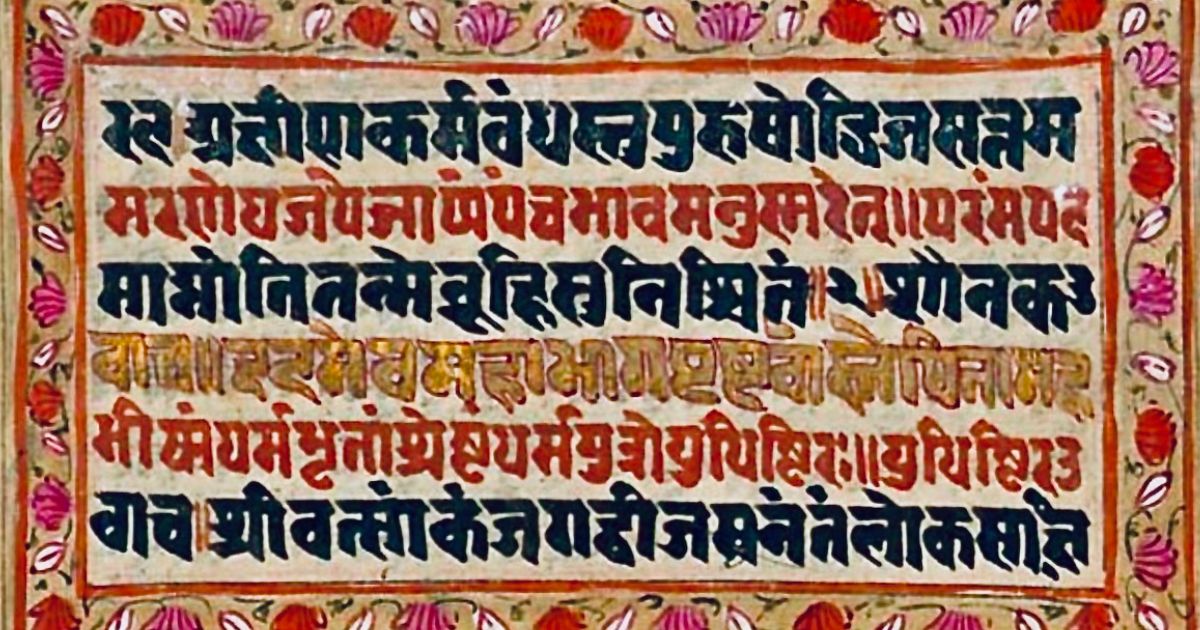
An excerpt from the original text.(complete · 812 words)
rishna.
Learn now, dear Prince! how, if thy soul be set
Ever on Me--still exercising Yog,
Still making Me thy Refuge--thou shalt come
Most surely unto perfect hold of Me.
I will declare to thee that utmost lore,
Whole and particular, which, when thou knowest,
Leaveth no more to know here in this world.
Of many thousand mortals, one, perchance,
Striveth for Truth; and of those few that strive--
Nay, and rise high--one only--here and there--
Knoweth Me, as I am, the very Truth.
Earth, water, flame, air, ether, life, and mind,
And individuality--those eight
Make up the showing of Me, Manifest.
These be my lower Nature; learn the higher,
Whereby, thou Valiant One! this Universe
Is, by its principle of life, produced;
Whereby the worlds of visible things are born
As from a Yoni. Know! I am that womb:
I make and I unmake this Universe:
Than me there is no other Master, Prince!
No other Maker! All these hang on me
As hangs a row of pearls upon its string.
I am the fresh taste of the water; I
The silver of the moon, the gold o' the sun,
The word of worship in the Veds, the thrill
That passeth in the ether, and the strength
Of man's shed seed. I am the good sweet smell
Of the moistened earth, I am the fire's red light,
The vital air moving in all which moves,
The holiness of hallowed souls, the root
Undying, whence hath sprung whatever is;
The wisdom of the wise, the intellect
Of the informed, the greatness of the great.
The splendour of the splendid. Kunti's Son!
These am I, free from passion and desire;
Yet am I right desire in all who yearn,
Chief of the Bharatas! for all those moods,
Soothfast, or passionate, or ignorant,
Which Nature frames, deduce from me; but all
Are merged in me--not I in them! The world--
Deceived by those three qualities of being--
Wotteth not Me Who am outside them all,
Above them all, Eternal! Hard it is
To pierce that veil divine of various shows
Which hideth Me; yet they who worship Me
Pierce it and pass beyond.
I am not known
To evil-doers, nor to foolish ones,
Nor to the base and churlish; nor to those
Whose mind is cheated by the show of things,
Nor those that take the way of Asuras.[FN#12]
Four sorts of mortals know me: he who weeps,
Arjuna! and the man who yearns to know;
And he who toils to help; and he who sits
Certain of me, enlightened.
Of these four,
O Prince of India! highest, nearest, best
That last is, the devout soul, wise, intent
Upon "The One." Dear, above all, am I
To him; and he is dearest unto me!
All four are good, and seek me; but mine own,
The true of heart, the faithful--stayed on me,
Taking me as their utmost blessedness,
They are not "mine,"but I--even I myself!
At end of many births to Me they come!
Yet hard the wise Mahatma is to find,
That man who sayeth, "All is Vasudev!"[FN#13]
There be those, too, whose knowledge, turned aside
By this desire or that, gives them to serve
Some lower gods, with various rites, constrained
By that which mouldeth them. Unto all such--
Worship what shrine they will, what shapes, in faith--
'Tis I who give them faith! I am content!
The heart thus asking favour from its God,
Darkened but ardent, hath the end it craves,
The lesser blessing--but 'tis I who give!
Yet soon is withered what small fruit they reap:
Those men of little minds, who worship so,
Go where they worship, passing with their gods.
But Mine come unto me! Blind are the eyes
Which deem th' Unmanifested manifest,
Not comprehending Me in my true Self!
Imperishable, viewless, undeclared,
Hidden behind my magic veil of shows,
I am not seen by all; I am not known--
Unborn and changeless--to the idle world.
But I, Arjuna! know all things which were,
And all which are, and all which are to be,
Albeit not one among them knoweth Me!
By passion for the "pairs of opposites,"
By those twain snares of Like and Dislike, Prince!
All creatures live bewildered, save some few
Who, quit of sins, holy in act, informed,
Freed from the "opposites,"and fixed in faith,
Cleave unto Me.
Who cleave, who seek in Me
Refuge from birth[FN#14] and death, those have the Truth!
Those know Me BRAHMA; know Me Soul of Souls,
The ADHYATMAN; know KARMA, my work;
Know I am ADHIBHUTA, Lord of Life,
And ADHIDAIVA, Lord of all the Gods,
And ADHIYAJNA, Lord of Sacrifice;
Worship Me well, with hearts of love and faith,
And find and hold me in the hour of death.
HERE ENDETH CHAPTER VII. OF THE BHAGAVAD-GITA,
Entitled "Vijnanayog,"
Or "The Book of Religion by Discernment."
Master this chapter. Complete your experience
Purchase the complete book to access all chapters and support classic literature
As an Amazon Associate, we earn a small commission from qualifying purchases at no additional cost to you.
Available in paperback, hardcover, and e-book formats
Let's Analyse the Pattern
Finding stability and meaning by recognizing the extraordinary elements woven into ordinary daily experiences.
Why This Matters
Connect literature to life
This chapter teaches how to find meaning and stability in daily experiences rather than constantly seeking external validation.
Practice This Today
This week, notice when you feel most connected to your purpose—usually it's in small moments of genuine connection or competence, not in recognition or rewards.
Now let's explore the literary elements.
Key Quotes & Analysis
"I am the fresh taste of the water; I the silver of the moon, the gold o' the sun"
Context: Krishna is explaining how the divine presence shows up in everyday experiences
This radically reframes how we see ordinary life. Instead of the sacred being somewhere else, it's in the simple things we encounter every day. It's about learning to pay attention differently.
In Today's Words:
I'm in every sip of cold water that hits just right, every beautiful sunset, every moment that makes you stop and notice
"Of many thousand mortals, one, perchance, striveth for Truth; and of those few that strive - one only knoweth Me"
Context: Krishna is explaining why so few people find lasting peace and meaning
This isn't about being special or chosen - it's about how rare it is for people to look beyond surface-level living. Most people get caught up in the drama and never ask deeper questions.
In Today's Words:
Out of thousands of people, maybe one actually tries to figure out what life is really about, and even fewer actually get it
"All these hang on me as hangs a row of pearls upon its string"
Context: Krishna is describing how everything in existence is connected through divine presence
This image shows that life isn't random events happening to us - there's an underlying thread that connects everything. When you see this connection, life makes more sense.
In Today's Words:
Everything in your life is connected by something deeper - like pearls on a string, they look separate but they're held together
Thematic Threads
Identity
In This Chapter
Krishna reveals identity as multilayered—surface personality versus deeper, unchanging essence
Development
Builds on earlier chapters about duty and role, now showing identity beyond social position
In Your Life:
You might notice how your core values remain constant even when your circumstances change dramatically
Recognition
In This Chapter
Four types of seekers are identified, each representing different motivations for deeper understanding
Development
Introduced here as framework for understanding different paths to wisdom
In Your Life:
You might recognize which type of seeker you are when facing major life decisions
Social Expectations
In This Chapter
Krishna distinguishes between following social religious practices versus genuine spiritual understanding
Development
Evolves from duty-based action to understanding the motivation behind actions
In Your Life:
You might question whether you're following traditions because they're meaningful or just expected
Personal Growth
In This Chapter
Growth happens through shifting perspective from surface reactions to deeper recognition
Development
Advances from action-based growth to perception-based transformation
In Your Life:
You might find that changing how you see situations is more powerful than trying to change the situations themselves
You now have the context. Time to form your own thoughts.
Discussion Questions
- 1
Krishna says he is 'the taste of water' and 'the light of the moon.' What is he really trying to tell Arjuna about where to look for meaning?
analysis • surface - 2
Why do some people find stability in chaos while others get thrown around by every problem? What's the difference in how they're looking at their lives?
analysis • medium - 3
Think about someone you know who stays calm during workplace drama or family stress. What do they seem to see that others miss?
application • medium - 4
Krishna describes four types of seekers - those in pain, the curious, the dedicated helpers, and those with inner certainty. Which type describes you right now, and how might that affect how you handle your current challenges?
application • deep - 5
If you could train yourself to see the 'sacred in the ordinary' like Krishna suggests, how might that change the way you experience your daily routine?
reflection • deep
Critical Thinking Exercise
Map Your Sacred Ordinary
Make two lists: first, write down five ordinary moments from your typical day (making coffee, commuting, helping someone, handling a problem). Second, for each ordinary moment, identify what deeper value or strength it actually represents (care, persistence, service, problem-solving). Notice how the same qualities show up in different situations.
Consider:
- •Look for patterns - the same strengths appearing in different contexts
- •Consider what remains constant about you even when circumstances change
- •Notice which ordinary moments actually connect you to something larger than yourself
Journaling Prompt
Write about a time when you found unexpected meaning or strength in what seemed like just another ordinary day. What helped you see beyond the surface of that experience?
Coming Up Next...
Chapter 8: The Ultimate Questions About Life and Death
Arjuna isn't satisfied with mystical language—he wants concrete answers. He fires off a series of direct questions, demanding Krishna explain exactly what he means by all these spiritual terms and how any of this helps when you're actually dying.