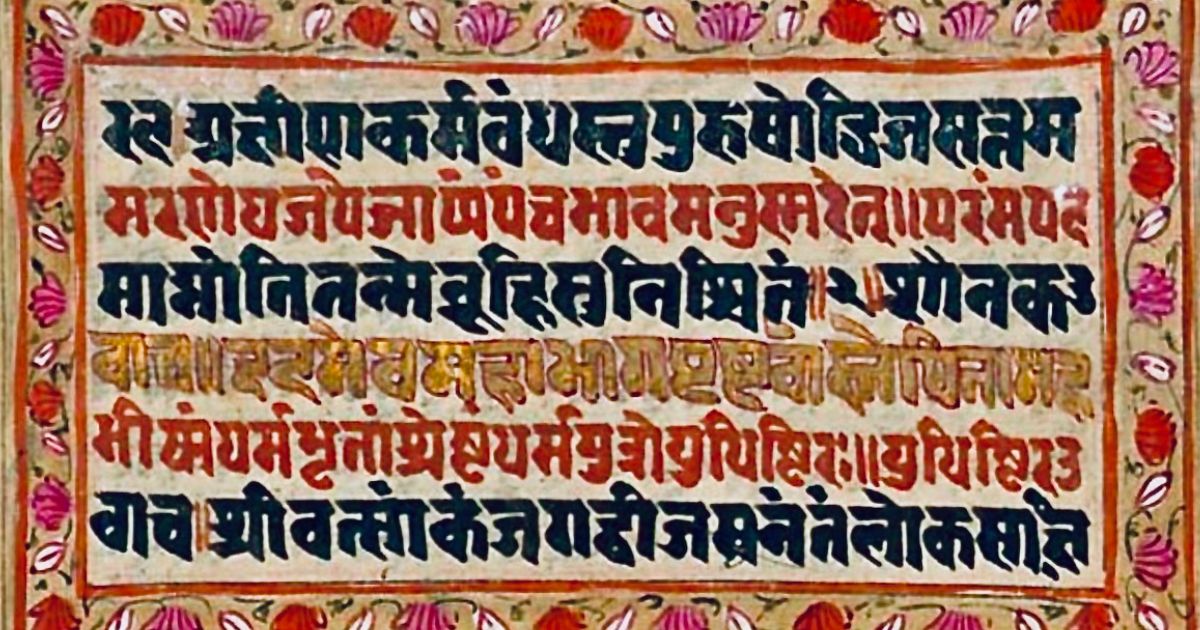
An excerpt from the original text.(complete · 2139 words)
rjuna.
This, for my soul's peace, have I heard from Thee,
The unfolding of the Mystery Supreme
Named Adhyatman; comprehending which,
My darkness is dispelled; for now I know--
O Lotus-eyed![FN#21]--whence is the birth of men,
And whence their death, and what the majesties
Of Thine immortal rule. Fain would I see,
As thou Thyself declar'st it, Sovereign Lord!
The likeness of that glory of Thy Form
Wholly revealed. O Thou Divinest One!
If this can be, if I may bear the sight,
Make Thyself visible, Lord of all prayers!
Show me Thy very self, the Eternal God!
Krishna.
Gaze, then, thou Son of Pritha! I manifest for thee
Those hundred thousand thousand shapes that clothe my Mystery:
I show thee all my semblances, infinite, rich, divine,
My changeful hues, my countless forms. See! in this face of mine,
Adityas, Vasus, Rudras, Aswins, and Maruts; see
Wonders unnumbered, Indian Prince! revealed to none save thee.
Behold! this is the Universe!--Look! what is live and dead
I gather all in one--in Me! Gaze, as thy lips have said,
On GOD ETERNAL, VERY GOD! See Me! see what thou prayest!
Thou canst not!--nor, with human eyes, Arjuna! ever mayest!
Therefore I give thee sense divine. Have other eyes, new light!
And, look! This is My glory, unveiled to mortal sight!
Sanjaya.
Then, O King! the God, so saying,
Stood, to Pritha's Son displaying
All the splendour, wonder, dread
Of His vast Almighty-head.
Out of countless eyes beholding,
Out of countless mouths commanding,
Countless mystic forms enfolding
In one Form: supremely standing
Countless radiant glories wearing,
Countless heavenly weapons bearing,
Crowned with garlands of star-clusters,
Robed in garb of woven lustres,
Breathing from His perfect Presence
Breaths of every subtle essence
Of all heavenly odours; shedding
Blinding brilliance; overspreading--
Boundless, beautiful--all spaces
With His all-regarding faces;
So He showed! If there should rise
Suddenly within the skies
Sunburst of a thousand suns
Flooding earth with beams undeemed-of,
Then might be that Holy One's
Majesty and radiance dreamed of!
So did Pandu's Son behold
All this universe enfold
All its huge diversity
Into one vast shape, and be
Visible, and viewed, and blended
In one Body--subtle, splendid,
Nameless--th' All-comprehending
God of Gods, the Never-Ending
Deity!
But, sore amazed,
Thrilled, o'erfilled, dazzled, and dazed,
Arjuna knelt; and bowed his head,
And clasped his palms; and cried, and said:
Arjuna.
Yea! I have seen! I see!
Lord! all is wrapped in Thee!
The gods are in Thy glorious frame! the creatures
Of earth, and heaven, and hell
In Thy Divine form dwell,
And in Thy countenance shine all the features
Of Brahma, sitting lone
Upon His lotus-throne;
Of saints and sages, and the serpent races
Ananta, Vasuki;
Yea! mightiest Lord! I see
Thy thousand thousand arms, and breasts, and faces,
And eyes,--on every side
Perfect, diversified;
And nowhere end of Thee, nowhere beginning,
Nowhere a centre! Shifts--
Wherever soul's gaze lifts--
Thy central Self, all-wielding, and all-winning!
Infinite King! I see
The anadem on Thee,
The club, the shell, the discus; see Thee burning
In beams insufferable,
Lighting earth, heaven, and hell
With brilliance blazing, glowing, flashing; turning
Darkness to dazzling day,
Look I whichever way;
Ah, Lord! I worship Thee, the Undivided,
The Uttermost of thought,
The Treasure-Palace wrought
To hold the wealth of the worlds; the Shield provided
To shelter Virtue's laws;
The Fount whence Life's stream draws
All waters of all rivers of all being:
The One Unborn, Unending:
Unchanging and Unblending!
With might and majesty, past thought, past seeing!
Silver of moon and gold
Of sun are glories rolled
From Thy great eyes; Thy visage, beaming tender
Throughout the stars and skies,
Doth to warm life surprise
Thy Universe. The worlds are filled with wonder
Of Thy perfections! Space
Star-sprinkled, and void place
From pole to pole of the Blue, from bound to bound,
Hath Thee in every spot,
Thee, Thee!--Where Thou art not,
O Holy, Marvellous Form! is nowhere found!
O Mystic, Awful One!
At sight of Thee, made known,
The Three Worlds quake; the lower gods draw nigh Thee;
They fold their palms, and bow
Body, and breast, and brow,
And, whispering worship, laud and magnify Thee!
Rishis and Siddhas cry
"Hail! Highest Majesty!"
From sage and singer breaks the hymn of glory
In dulcet harmony,
Sounding the praise of Thee;
While countless companies take up the story,
Rudras, who ride the storms,
Th' Adityas' shining forms,
Vasus and Sadhyas, Viswas, Ushmapas;
Maruts, and those great Twins
The heavenly, fair, Aswins,
Gandharvas, Rakshasas, Siddhas, and Asuras,[FN#22]--
These see Thee, and revere
In sudden-stricken fear;
Yea! the Worlds,--seeing Thee with form stupendous,
With faces manifold,
With eyes which all behold,
Unnumbered eyes, vast arms, members tremendous,
Flanks, lit with sun and star,
Feet planted near and far,
Tushes of terror, mouths wrathful and tender;--
The Three wide Worlds before Thee
Adore, as I adore Thee,
Quake, as I quake, to witness so much splendour!
I mark Thee strike the skies
With front, in wondrous wise
Huge, rainbow-painted, glittering; and thy mouth
Opened, and orbs which see
All things, whatever be
In all Thy worlds, east, west, and north and south.
O Eyes of God! O Head!
My strength of soul is fled,
Gone is heart's force, rebuked is mind's desire!
When I behold Thee so,
With awful brows a-glow,
With burning glance, and lips lighted by fire
Fierce as those flames which shall
Consume, at close of all,
Earth, Heaven! Ah me! I see no Earth and Heaven!
Thee, Lord of Lords! I see,
Thee only-only Thee!
Now let Thy mercy unto me be given,
Thou Refuge of the World!
Lo! to the cavern hurled
Of Thy wide-opened throat, and lips white-tushed,
I see our noblest ones,
Great Dhritarashtra's sons,
Bhishma, Drona, and Karna, caught and crushed!
The Kings and Chiefs drawn in,
That gaping gorge within;
The best of both these armies torn and riven!
Between Thy jaws they lie
Mangled full bloodily,
Ground into dust and death! Like streams down-driven
With helpless haste, which go
In headlong furious flow
Straight to the gulfing deeps of th' unfilled ocean,
So to that flaming cave
Those heroes great and brave
Pour, in unending streams, with helpless motion!
Like moths which in the night
Flutter towards a light,
Drawn to their fiery doom, flying and dying,
So to their death still throng,
Blind, dazzled, borne along
Ceaselessly, all those multitudes, wild flying!
Thou, that hast fashioned men,
Devourest them again,
One with another, great and small, alike!
The creatures whom Thou mak'st,
With flaming jaws Thou tak'st,
Lapping them up! Lord God! Thy terrors strike
From end to end of earth,
Filling life full, from birth
To death, with deadly, burning, lurid dread!
Ah, Vishnu! make me know
Why is Thy visage so?
Who art Thou, feasting thus upon Thy dead?
Who? awful Deity!
I bow myself to Thee,
Namostu Te, Devavara! Prasid![FN#23]
O Mightiest Lord! rehearse
Why hast Thou face so fierce?
Whence doth this aspect horrible proceed?
Krishna.
Thou seest Me as Time who kills,
Time who brings all to doom,
The Slayer Time, Ancient of Days, come hither to consume;
Excepting thee, of all these hosts of hostile chiefs arrayed,
There stands not one shall leave alive the battlefield! Dismayed
No longer be! Arise! obtain renown! destroy thy foes!
Fight for the kingdom waiting thee when thou hast vanquished those.
By Me they fall--not thee! the stroke of death is dealt them now,
Even as they show thus gallantly; My instrument art thou!
Strike, strong-armed Prince, at Drona! at Bhishma strike! deal death
On Karna, Jyadratha; stay all their warlike breath!
'Tis I who bid them perish! Thou wilt but slay the slain;
Fight! they must fall, and thou must live, victor upon this plain!
Sanjaya.
Hearing mighty Keshav's word,
Tremblingly that helmed Lord
Clasped his lifted palms, and--praying
Grace of Krishna--stood there, saying,
With bowed brow and accents broken,
These words, timorously spoken:
Arjuna.
Worthily, Lord of Might!
The whole world hath delight
In Thy surpassing power, obeying Thee;
The Rakshasas, in dread
At sight of Thee, are sped
To all four quarters; and the company
Of Siddhas sound Thy name.
How should they not proclaim
Thy Majesties, Divinest, Mightiest?
Thou Brahm, than Brahma greater!
Thou Infinite Creator!
Thou God of gods, Life's Dwelling-place and Rest!
Thou, of all souls the Soul!
The Comprehending Whole!
Of being formed, and formless being the Framer;
O Utmost One! O Lord!
Older than eld, Who stored
The worlds with wealth of life! O Treasure-Claimer,
Who wottest all, and art
Wisdom Thyself! O Part
In all, and All; for all from Thee have risen
Numberless now I see
The aspects are of Thee!
Vayu[FN#24] Thou art, and He who keeps the prison
Of Narak, Yama dark;
And Agni's shining spark;
Varuna's waves are Thy waves. Moon and starlight
Are Thine! Prajapati
Art Thou, and 'tis to Thee
They knelt in worshipping the old world's far light,
The first of mortal men.
Again, Thou God! again
A thousand thousand times be magnified!
Honour and worship be--
Glory and praise,--to Thee
Namo, Namaste, cried on every side;
Cried here, above, below,
Uttered when Thou dost go,
Uttered where Thou dost come! Namo! we call;
Namostu! God adored!
Namostu! Nameless Lord!
Hail to Thee! Praise to Thee! Thou One in all;
For Thou art All! Yea, Thou!
Ah! if in anger now
Thou shouldst remember I did think Thee Friend,
Speaking with easy speech,
As men use each to each;
Did call Thee "Krishna," "Prince," nor comprehend
Thy hidden majesty,
The might, the awe of Thee;
Did, in my heedlessness, or in my love,
On journey, or in jest,
Or when we lay at rest,
Sitting at council, straying in the grove,
Alone, or in the throng,
Do Thee, most Holy! wrong,
Be Thy grace granted for that witless sin!
For Thou art, now I know,
Father of all below,
Of all above, of all the worlds within
Guru of Gurus; more
To reverence and adore
Than all which is adorable and high!
How, in the wide worlds three
Should any equal be?
Should any other share Thy Majesty?
Therefore, with body bent
And reverent intent,
I praise, and serve, and seek Thee, asking grace.
As father to a son,
As friend to friend, as one
Who loveth to his lover, turn Thy face
In gentleness on me!
Good is it I did see
This unknown marvel of Thy Form! But fear
Mingles with joy! Retake,
Dear Lord! for pity's sake
Thine earthly shape, which earthly eyes may bear!
Be merciful, and show
The visage that I know;
Let me regard Thee, as of yore, arrayed
With disc and forehead-gem,
With mace and anadem,
Thou that sustainest all things! Undismayed
Let me once more behold
The form I loved of old,
Thou of the thousand arms and countless eyes!
This frightened heart is fain
To see restored again
My Charioteer, in Krishna's kind disguise.
Krishna.
Yea! thou hast seen, Arjuna! because I loved thee well,
The secret countenance of Me, revealed by mystic spell,
Shining, and wonderful, and vast, majestic, manifold,
Which none save thou in all the years had favour to behold;
For not by Vedas cometh this, nor sacrifice, nor alms,
Nor works well-done, nor penance long, nor prayers, nor chaunted
psalms,
That mortal eyes should bear to view the Immortal Soul unclad,
Prince of the Kurus! This was kept for thee alone! Be glad!
Let no more trouble shake thy heart, because thine eyes have seen
My terror with My glory. As I before have been
So will I be again for thee; with lightened heart behold!
Once more I am thy Krishna, the form thou knew'st of old!
Sanjaya.
These words to Arjuna spake
Vasudev, and straight did take
Back again the semblance dear
Of the well-loved charioteer;
Peace and joy it did restore
When the Prince beheld once more
Mighty BRAHMA's form and face
Clothed in Krishna's gentle grace.
Arjuna.
Now that I see come back, Janardana!
This friendly human frame, my mind can think
Calm thoughts once more; my heart beats still again!
Krishna.
Yea! it was wonderful and terrible
To view me as thou didst, dear Prince! The gods
Dread and desire continually to view!
Yet not by Vedas, nor from sacrifice,
Nor penance, nor gift-giving, nor with prayer
Shall any so behold, as thou hast seen!
Only by fullest service, perfect faith,
And uttermost surrender am I known
And seen, and entered into, Indian Prince!
Who doeth all for Me; who findeth Me
In all; adoreth always; loveth all
Which I have made, and Me, for Love's sole end
That man, Arjuna! unto Me doth wend.
HERE ENDETH CHAPTER XI. OF THE BHAGAVAD-GITA,
Entitled "Viswarupadarsanam,"
Or "The Book of the Manifesting of the One and Manifold."
Master this chapter. Complete your experience
Purchase the complete book to access all chapters and support classic literature
As an Amazon Associate, we earn a small commission from qualifying purchases at no additional cost to you.
Available in paperback, hardcover, and e-book formats
Let's Analyse the Pattern
Demanding more truth than you can constructively handle leads to paralysis rather than empowerment.
Why This Matters
Connect literature to life
This chapter teaches how to distinguish between information that empowers action and information that paralyzes it.
Practice This Today
This week, notice when you're asking for 'the whole truth' and pause to consider: do I want this information because I can use it constructively, or because I think I should know it?
Now let's explore the literary elements.
Key Quotes & Analysis
"Thou canst not--nor, with human eyes, Arjuna! ever mayest! Therefore I give thee sense divine."
Context: Krishna explains why Arjuna needs special vision to see divine truth
Shows that some realities are beyond normal human perception and require a different kind of sight. This isn't about intelligence or worthiness, but about the limitations of ordinary awareness.
In Today's Words:
You can't see this with regular eyes, so I'm giving you a different way to look at it.
"Behold! this is the Universe!--Look! what is live and dead I gather all in one--in Me!"
Context: Krishna reveals himself as containing all of existence within his cosmic form
Demonstrates the overwhelming nature of ultimate reality - everything that exists, has existed, or will exist is part of one cosmic whole. This vision shows unity behind apparent separation.
In Today's Words:
Everything that ever was or will be - it's all right here, all part of me.
"Show me Thy very self, the Eternal God!"
Context: Arjuna requests to see Krishna's true divine nature
Represents the human desire for ultimate truth and direct experience of the divine. Shows courage in asking for revelation, though Arjuna will soon discover he's not prepared for what he's requesting.
In Today's Words:
I want to see who you really are - show me the real you.
Thematic Threads
Identity
In This Chapter
Arjuna discovers his friend Krishna contains infinite cosmic identity beyond human comprehension
Development
Builds on earlier identity questions—now showing identity can be too vast to grasp
In Your Life:
You might struggle when someone close to you reveals depths you never suspected
Power
In This Chapter
Krishna demonstrates ultimate divine power but chooses to return to gentle human form
Development
Develops the power theme by showing restraint and appropriate application
In Your Life:
You might need to dial back your full capabilities to remain effective with others
Fear
In This Chapter
Arjuna becomes terrified when confronted with cosmic reality beyond his understanding
Development
Introduced here as response to overwhelming truth
In Your Life:
You might feel afraid when facing truths that challenge your basic assumptions about reality
Relationships
In This Chapter
The teacher-student bond requires returning to manageable human scale after cosmic revelation
Development
Develops relationship theme by showing how intimacy requires appropriate boundaries
In Your Life:
You might need to moderate how much you reveal to maintain functional relationships
Growth
In This Chapter
True spiritual growth means integrating overwhelming experiences into daily life
Development
Advances growth theme by showing integration rather than escape
In Your Life:
You might need to process major insights gradually rather than trying to change everything at once
You now have the context. Time to form your own thoughts.
Discussion Questions
- 1
Why does Arjuna immediately regret seeing Krishna's true cosmic form, even though he specifically asked for it?
analysis • surface - 2
What does Krishna's willingness to return to human form tell us about effective teaching and leadership?
analysis • medium - 3
Think about a time when you got more information than you could handle. How did it affect your ability to make good decisions?
application • medium - 4
When someone in your life is demanding 'the whole truth' about a difficult situation, how do you decide what to share and when?
application • deep - 5
What does this chapter suggest about the relationship between knowledge and wisdom?
reflection • deep
Critical Thinking Exercise
Truth Dosage Assessment
Think of a situation where you want more information - about your health, your relationship, your job, or your family. Write down what you want to know, then honestly assess: Are you asking because you're ready to act on this information constructively, or because you feel you 'should' know? What would be the right 'dose' of truth that would help rather than overwhelm you?
Consider:
- •Consider your emotional bandwidth right now
- •Think about what you would actually do with the information
- •Ask whether partial information might be more useful than complete information
Journaling Prompt
Write about a time when you received more truth than you could handle. What did you learn about timing and your own capacity for difficult information?
Coming Up Next...
Chapter 12: The Path of Loving Devotion
Having seen the cosmic vision, Arjuna now faces a fundamental question about spiritual practice: Is it better to worship God in a personal form you can relate to, or to seek the formless absolute beyond all description? Krishna's answer will reshape how we think about the different paths to spiritual fulfillment.