
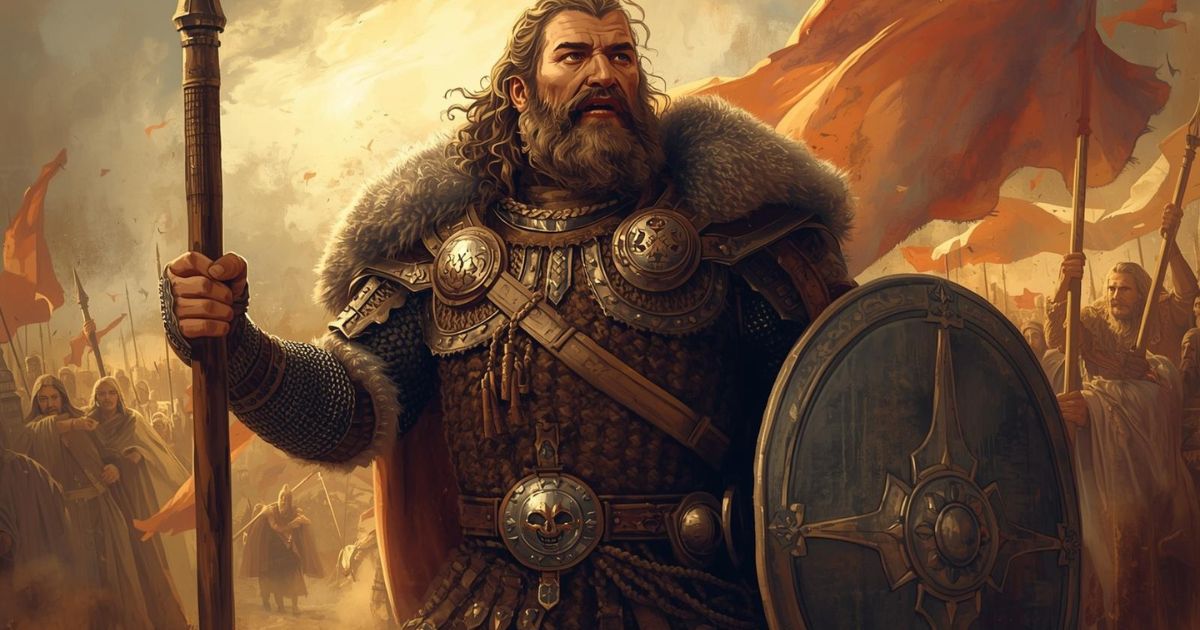
An excerpt from the original text.(complete · 875 words)
LIII.

THE BURNING OF BEOWULF.


{Beowulf's pyre.}

          The folk of the Geatmen got him then ready
          A pile on the earth strong for the burning,
          Behung with helmets, hero-knights' targets,
          And bright-shining burnies, as he begged they should have them;
        5 Then wailing war-heroes their world-famous chieftain,
          Their liegelord beloved, laid in the middle.

{The funeral-flame.}

          Soldiers began then to make on the barrow
          The largest of dead-fires: dark o'er the vapor
          The smoke-cloud ascended, the sad-roaring fire,
       10 Mingled with weeping (the wind-roar subsided)
          Till the building of bone it had broken to pieces,
          Hot in the heart. Heavy in spirit
          They mood-sad lamented the men-leader's ruin;
          And mournful measures the much-grieving widow
       15 *       *       *       *       *       *       *
          *       *       *       *       *       *       *
          *       *       *       *       *       *       *
          *       *       *       *       *       *       *
          *       *       *       *       *       *       *
       20 *       *       *       *       *       *       *

{The Weders carry out their lord's last request.}

          The men of the Weders made accordingly
          A hill on the height, high and extensive,
          Of sea-going sailors to be seen from a distance,
          And the brave one's beacon built where the fire was,
       25 In ten-days' space, with a wall surrounded it,
          As wisest of world-folk could most worthily plan it.
          They placed in the barrow rings and jewels,

[107]

{Rings and gems are laid in the barrow.}

          All such ornaments as erst in the treasure
          War-mooded men had won in possession:
       30 The earnings of earlmen to earth they entrusted,
          The gold to the dust, where yet it remaineth
          As useless to mortals as in foregoing eras.
          'Round the dead-mound rode then the doughty-in-battle,
          Bairns of all twelve of the chiefs of the people,

{They mourn for their lord, and sing his praises.}

       35 More would they mourn, lament for their ruler,
          Speak in measure, mention him with pleasure,
          Weighed his worth, and his warlike achievements
          Mightily commended, as 'tis meet one praise his
          Liegelord in words and love him in spirit,
       40 When forth from his body he fares to destruction.
          So lamented mourning the men of the Geats,
          Fond-loving vassals, the fall of their lord,

{An ideal king.}

          Said he was kindest of kings under heaven,
          Gentlest of men, most winning of manner,
       45 Friendliest to folk-troops and fondest of honor.

[109]


ADDENDA.


Several discrepancies and other oversights have been noticed in the H.-So.
glossary. Of these a good part were avoided by Harrison and Sharp, the
American editors of Beowulf, in their last edition, 1888. The rest will, I
hope, be noticed in their fourth edition. As, however, this book may fall
into the hands of some who have no copy of the American edition, it seems
best to notice all the principal oversights of the German editors.

~From hám~ (194).--Notes and glossary conflict; the latter not having been
altered to suit the conclusions accepted in the former.

~Þær gelýfan sceal dryhtnes dóme~ (440).--Under 'dóm' H. says 'the might
of the Lord'; while under 'gelýfan' he says 'the judgment of the Lord.'

~Eal bencþelu~ (486).--Under 'benc-þelu' H. says _nom. plu._; while under
'eal' he says _nom. sing._

~Heatho-ræmas~ (519).--Under 'ætberan' H. translates 'to the Heathoremes';
while under 'Heatho-ræmas' he says 'Heathoræmas reaches Breca in the
swimming-match with Beowulf.' Harrison and Sharp (3d edition, 1888) avoid
the discrepancy.

~Fáh féond-scaða~ (554).--Under 'féond-scaða' H. says 'a gleaming
sea-monster'; under 'fáh' he says 'hostile.'

~Onfeng hraðe inwit-þancum~ (749).--Under 'onfón' H. says 'he _received_
the maliciously-disposed one'; under 'inwit-þanc' he says 'he _grasped_,'
etc.

~Níð-wundor séon~ (1366).--Under 'níð-wundor' H. calls this word itself
_nom. sing._; under 'séon' he translates it as accus. sing., understanding
'man' as subject of 'séon.' H. and S. (3d edition) make the correction.

~Forgeaf hilde-bille~ (1521).--H., under the second word, calls it instr.
dat.; while under 'forgifan' he makes it the dat. of indir. obj. H. and S.
(3d edition) make the change.

~Brád~ and ~brún-ecg~ (1547).--Under 'brád' H. says 'das breite Hüftmesser
mit bronzener Klinge'; under 'brún-ecg' he says 'ihr breites Hüftmesser
mit blitzender Klinge.'

[110]

~Yðelíce~ (1557).--Under this word H. makes it modify 'ástód.' If this be
right, the punctuation of the fifth edition is wrong. See H. and S.,
appendix.

~Sélran gesóhte~ (1840).--Under 'sél' and 'gesécan' H. calls these two
words accus. plu.; but this is clearly an error, as both are nom. plu.,
pred. nom. H. and S. correct under 'sél.'

~Wið sylfne~ (1978).--Under 'wið' and 'gesittan' H. says 'wið = near, by';
under 'self' he says 'opposite.'

~þéow~ (2225) is omitted from the glossary.

~For duguðum~ (2502).--Under 'duguð' H. translates this phrase, 'in
Tüchtigkeit'; under 'for,' by 'vor der edlen Kriegerschaar.'

~þær~ (2574).--Under 'wealdan' H. translates _þær_ by 'wo'; under 'mótan,'
by 'da.' H. and S. suggest 'if' in both passages.

~Wunde~ (2726).--Under 'wund' H. says 'dative,' and under 'wæl-bléate' he
says 'accus.' It is without doubt accus., parallel with 'benne.'

~Strengum gebæded~ (3118).--Under 'strengo' H. says 'Strengum' = mit
Macht; under 'gebæded' he translates 'von den Sehnen.' H. and S. correct
this discrepancy by rejecting the second reading.

~Bronda be láfe~ (3162).--A recent emendation. The fourth edition had
'bronda betost.' In the fifth edition the editor neglects to change the
glossary to suit the new emendation. See 'bewyrcan.'
Master this chapter. Complete your experience
Purchase the complete book to access all chapters and support classic literature
As an Amazon Associate, we earn a small commission from qualifying purchases at no additional cost to you.
Available in paperback, hardcover, and e-book formats
Let's Analyse the Pattern
True legacy comes from choosing to serve others over serving yourself, creating lasting impact through character rather than accumulation.
Why This Matters
Connect literature to life
This chapter teaches how to recognize the difference between being remembered for achievements versus being remembered for character.
Practice This Today
This week, notice when you have a choice between looking good and doing good—choose the one that serves others, even when nobody's watching.
Now let's explore the literary elements.
Key Quotes & Analysis
"They placed in the barrow rings and jewels, all such ornaments as erst in the treasure war-mooded men had won in possession"
Context: As the Geats bury treasure with Beowulf's remains
This shows how the treasure Beowulf died protecting is now returned to the earth, 'as useless to mortals as in foregoing eras.' It suggests that material wealth means nothing compared to the love and respect of one's people.
In Today's Words:
They buried all the gold and jewelry with him - the same stuff he died trying to protect, now going back into the ground where it can't help anyone.
"The men of the Weders made accordingly a hill on the height, high and extensive, of sea-going sailors to be seen from a distance"
Context: Describing the construction of Beowulf's burial mound
The mound's visibility from the sea ensures Beowulf's memory will endure. Every sailor who passes will remember the great king who once protected this land, making his legacy literally larger than life.
In Today's Words:
His people built a huge monument on the cliff so everyone sailing by would see it and remember the great king who used to protect this place.
"They mourned their hero-king, praised his earlship, judged well of his prowess"
Context: The twelve warriors circling the barrow and speaking of Beowulf
This shows how a good leader is remembered not for wealth or power, but for character and service. The warriors focus on Beowulf's courage, kindness, and how he treated his people.
In Today's Words:
They talked about what a good leader he was, how brave he'd been, and how well he'd taken care of everyone.
Thematic Threads
Class
In This Chapter
The Geats honor Beowulf not for his royal birth but for how he protected common people
Development
Evolved from early focus on bloodlines to final emphasis on earned respect through service
In Your Life:
You might see this when coworkers respect someone based on how they treat everyone, not their job title
Identity
In This Chapter
Beowulf's identity becomes permanently defined by his willingness to sacrifice for others
Development
Progressed from warrior seeking glory to leader choosing ultimate sacrifice
In Your Life:
You might see this when you realize you're known more for what you give than what you achieve
Social Expectations
In This Chapter
The community creates elaborate funeral rites that honor character over conquest
Development
Shifted from expectations of individual heroism to collective recognition of service
In Your Life:
You might see this when your workplace or family celebrates someone who always helped others succeed
Human Relationships
In This Chapter
The bond between Beowulf and his people transcends death through shared memory and honor
Development
Culminated from early loyalty exchanges to deep mutual love and respect
In Your Life:
You might see this in how some people's deaths leave lasting holes because of how they treated others
Personal Growth
In This Chapter
Beowulf's final act represents the completion of his journey from glory-seeker to selfless protector
Development
Reached full maturity from young warrior seeking fame to wise king choosing sacrifice
In Your Life:
You might see this when you find yourself choosing what's right for others over what's easy for you
You now have the context. Time to form your own thoughts.
Discussion Questions
- 1
What did the Geats do to honor Beowulf after his death, and what does their choice to bury the treasure with him reveal about their values?
analysis • surface - 2
Why do the Geats call the buried treasure 'as useless to mortals as in foregoing eras' when Beowulf died protecting it?
analysis • medium - 3
Think about funerals or memorial services you've attended. What qualities do people actually praise when someone dies—achievements or character traits?
application • medium - 4
If you knew people would speak about you after you're gone, what would you want them to remember—and what daily choices would build that legacy?
application • deep - 5
What does this ending suggest about the difference between building a reputation and building a legacy?
reflection • deep
Critical Thinking Exercise
Write Your Own Eulogy
Imagine you're writing what people would say at your funeral if you died today. Then write what you'd want them to say if you lived according to your values. Compare the two versions and identify the gap between your current path and your desired legacy.
Consider:
- •Focus on character traits and how you treated people, not just accomplishments
- •Think about the daily actions that would build the legacy you want
- •Consider which relationships and communities would be affected by your loss
Journaling Prompt
Write about someone whose death would leave a hole in your community. What daily choices did they make that built such a strong legacy? How can you apply their pattern to your own life?



