
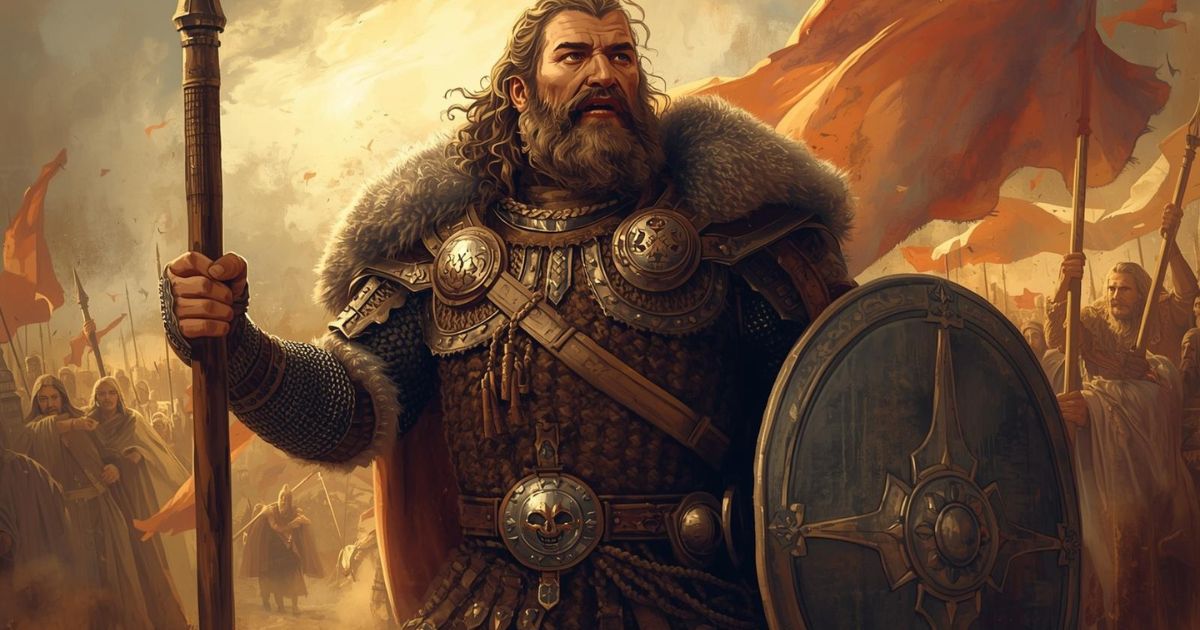
An excerpt from the original text.(complete · 1334 words)
LI.

THE MESSENGER'S RETROSPECT.


{The messenger continues, and refers to the feuds of Swedes and Geats.}

          "The blood-stainèd trace of Swedes and Geatmen,
          The death-rush of warmen, widely was noticed,
          How the folks with each other feud did awaken.
          The worthy one went then[1] with well-beloved comrades,
        5 Old and dejected to go to the fastness,
          Ongentheo earl upward then turned him;
          Of Higelac's battle he'd heard on inquiry,
          The exultant one's prowess, despaired of resistance,
          With earls of the ocean to be able to struggle,
       10 'Gainst sea-going sailors to save the hoard-treasure,
          His wife and his children; he fled after thenceward
          Old 'neath the earth-wall. Then was offered pursuance
          To the braves of the Swedemen, the banner[2] to Higelac.
[100]     They fared then forth o'er the field-of-protection,
       15 When the Hrethling heroes hedgeward had thronged them.
          Then with edges of irons was Ongentheow driven,
          The gray-haired to tarry, that the troop-ruler had to
          Suffer the power solely of Eofor:

{Wulf wounds Ongentheow.}

          Wulf then wildly with weapon assaulted him,
       20 Wonred his son, that for swinge of the edges
          The blood from his body burst out in currents,
          Forth 'neath his hair. He feared not however,
          Gray-headed Scylfing, but speedily quited

{Ongentheow gives a stout blow in return.}

          The wasting wound-stroke with worse exchange,
       25 When the king of the thane-troop thither did turn him:
          The wise-mooded son of Wonred was powerless
          To give a return-blow to the age-hoary man,
          But his head-shielding helmet first hewed he to pieces,
          That flecked with gore perforce he did totter,
       30 Fell to the earth; not fey was he yet then,
          But up did he spring though an edge-wound had reached him.

{Eofor smites Ongentheow fiercely.}

          Then Higelac's vassal, valiant and dauntless,
          When his brother lay dead, made his broad-bladed weapon,
          Giant-sword ancient, defence of the giants,
       35 Bound o'er the shield-wall; the folk-prince succumbed then,

{Ongentheow is slain.}

          Shepherd of people, was pierced to the vitals.
          There were many attendants who bound up his kinsman,
          Carried him quickly when occasion was granted
          That the place of the slain they were suffered to manage.
       40 This pending, one hero plundered the other,
          His armor of iron from Ongentheow ravished,
          His hard-sword hilted and helmet together;

{Eofor takes the old king's war-gear to Higelac.}

          The old one's equipments he carried to Higelac.
          He the jewels received, and rewards 'mid the troopers
       45 Graciously promised, and so did accomplish:
          The king of the Weders requited the war-rush,
          Hrethel's descendant, when home he repaired him,

{Higelac rewards the brothers.}

          To Eofor and Wulf with wide-lavished treasures,
          To each of them granted a hundred of thousands
[101]  50 In land and rings wrought out of wire:

{His gifts were beyond cavil.}

          None upon mid-earth needed to twit him[3]
          With the gifts he gave them, when glory they conquered;

{To Eofor he also gives his only daughter in marriage.}

          And to Eofor then gave he his one only daughter,
          The honor of home, as an earnest of favor.
       55 That's the feud and hatred--as ween I 'twill happen--
          The anger of earthmen, that earls of the Swedemen
          Will visit on us, when they hear that our leader
          Lifeless is lying, he who longtime protected
          His hoard and kingdom 'gainst hating assailers,
       60 Who on the fall of the heroes defended of yore
          The deed-mighty Scyldings,[4] did for the troopers
          What best did avail them, and further moreover

{It is time for us to pay the last marks of respect to our lord.}

          Hero-deeds 'complished. Now is haste most fitting,
          That the lord of liegemen we look upon yonder,
       65 And _that_ one carry on journey to death-pyre
          Who ring-presents gave us. Not aught of it all
          Shall melt with the brave one--there's a mass of bright jewels,
          Gold beyond measure, grewsomely purchased
          And ending it all ornament-rings too
       70 Bought with his life; these fire shall devour,
          Flame shall cover, no earlman shall wear
          A jewel-memento, nor beautiful virgin
          Have on her neck rings to adorn her,
          But wretched in spirit bereavèd of gold-gems
       75 She shall oft with others be exiled and banished,
          Since the leader of liegemen hath laughter forsaken,
[102]     Mirth and merriment. Hence many a war-spear
          Cold from the morning shall be clutched in the fingers,
          Heaved in the hand, no harp-music's sound shall
       80 Waken the warriors, but the wan-coated raven
          Fain over fey ones freely shall gabble,
          Shall say to the eagle how he sped in the eating,
          When, the wolf his companion, he plundered the slain."
          So the high-minded hero was rehearsing these stories
       85 Loathsome to hear; he lied as to few of

{The warriors go sadly to look at Beowulf's lifeless body.}

          Weirds and of words. All the war-troop arose then,
          'Neath the Eagle's Cape sadly betook them,
          Weeping and woful, the wonder to look at.
          They saw on the sand then soulless a-lying,
       90 His slaughter-bed holding, him who rings had given them
          In days that were done; then the death-bringing moment
          Was come to the good one, that the king very warlike,
          Wielder of Weders, with wonder-death perished.
          First they beheld there a creature more wondrous,

{They also see the dragon.}

       95 The worm on the field, in front of them lying,
          The foeman before them: the fire-spewing dragon,
          Ghostly and grisly guest in his terrors,
          Was scorched in the fire; as he lay there he measured
          Fifty of feet; came forth in the night-time[5]
      100 To rejoice in the air, thereafter departing
          To visit his den; he in death was then fastened,
          He would joy in no other earth-hollowed caverns.
          There stood round about him beakers and vessels,
          Dishes were lying and dear-valued weapons,
      105 With iron-rust eaten, as in earth's mighty bosom
          A thousand of winters there they had rested:

{The hoard was under a magic spell.}

          That mighty bequest then with magic was guarded,
          Gold of the ancients, that earlman not any
          The ring-hall could touch, save Ruling-God only,
[103] 110 Sooth-king of Vict'ries gave whom He wished to

{God alone could give access to it.}

          [6](He is earth-folk's protector) to open the treasure,
          E'en to such among mortals as seemed to Him proper.

    [1] For 'góda,' which seems a surprising epithet for a Geat to apply
    to the "terrible" Ongentheow, B. suggests 'gomela.' The passage would
    then stand: '_The old one went then,' etc._

    [2] For 'segn Higeláce,' K., Th., and B. propose 'segn Higeláces,'
    meaning: _Higelac's banner followed the Swedes (in pursuit)._--S.
    suggests 'sæcc Higeláces,' and renders: _Higelac's pursuit._--The
    H.-So. reading, as translated in our text, means that the banner of
    the enemy was captured and brought to Higelac as a trophy.

    [3] The rendering given in this translation represents the king as
    being generous beyond the possibility of reproach; but some
    authorities construe 'him' (2996) as plu., and understand the passage
    to mean that no one reproached the two brothers with having received
    more reward than they were entitled to.

    [4] The name 'Scyldingas' here (3006) has caused much discussion, and
    given rise to several theories, the most important of which are as
    follows: (1) After the downfall of Hrothgar's family, Beowulf was king
    of the Danes, or Scyldings. (2) For 'Scyldingas' read
    'Scylfingas'--that is, after killing Eadgils, the Scylfing prince,
    Beowulf conquered his land, and held it in subjection. (3) M.
    considers 3006 a thoughtless repetition of 2053. (Cf. H.-So.)

    [5] B. takes 'nihtes' and 'hwílum' (3045) as separate adverbial cases,
    and renders: _Joy in the air had he of yore by night, etc_. He thinks
    that the idea of vanished time ought to be expressed.

    [6] The parenthesis is by some emended so as to read: (1) (_He_ (i.e.
    _God_) _is the hope of men_); (2) (_he is the hope of heroes_). Gr.'s
    reading has no parenthesis, but says: ... _could touch, unless God
    himself, true king of victories, gave to whom he would to open the
    treasure, the secret place of enchanters, etc_. The last is rejected
    on many grounds.
Master this chapter. Complete your experience
Purchase the complete book to access all chapters and support classic literature
As an Amazon Associate, we earn a small commission from qualifying purchases at no additional cost to you.
Available in paperback, hardcover, and e-book formats
Let's Analyse the Pattern
Past successes create future targets as defeated enemies wait for weakness to seek revenge.
Why This Matters
Connect literature to life
This chapter teaches how to recognize when protective authority disappears and old enemies see opportunity.
Practice This Today
This week, notice when your usual advocate is absent from meetings—watch how dynamics shift and who speaks differently.
Now let's explore the literary elements.
Key Quotes & Analysis
"The blood-stained trace of Swedes and Geatmen, the death-rush of warmen, widely was noticed"
Context: He begins explaining the old feud that will now resume with Beowulf's death
This sets up the entire problem: past violence creates future violence. The messenger uses vivid imagery to show how battles leave lasting marks that everyone remembers. The phrase 'widely was noticed' emphasizes that these conflicts become public knowledge that shapes future relationships.
In Today's Words:
Everyone knew about the bloody war between our people and theirs
"He feared not however, gray-headed Scylfing, but speedily quited the wasting wound-stroke with worse exchange"
Context: Describing how Ongentheow fought back even when wounded
This shows the warrior code in action - even facing death, a true warrior fights back harder. The 'worse exchange' means Ongentheow dealt more damage than he received, proving his worth even in defeat.
In Today's Words:
The old king didn't back down; he hit back twice as hard
"No more joy shall they know, no more mead-drinking"
Context: Predicting the Geats' grim future without Beowulf's protection
This captures how the loss of a protector destroys not just safety but all the good things in life. The messenger connects military vulnerability to the end of celebration and community joy.
In Today's Words:
The good times are over - no more parties, no more fun
Thematic Threads
Class
In This Chapter
The messenger understands social hierarchies - how Higelac's rewards created status but also obligations and enemies
Development
Evolved from individual warrior status to understanding how class position affects entire communities
In Your Life:
Your promotions and raises might create resentment among colleagues who remember when you were equals
Identity
In This Chapter
The Geats' identity as victorious warriors becomes their curse - they're known by their past wins
Development
Developed from personal heroic identity to collective tribal identity and its burdens
In Your Life:
The reputation you build in good times becomes the standard others hold you to in bad times
Social Expectations
In This Chapter
The messenger expects the warriors to understand the political implications of Beowulf's death
Development
Expanded from individual heroic expectations to complex political and social obligations
In Your Life:
Others expect you to maintain the same level of performance or support even when your circumstances change
Human Relationships
In This Chapter
Old alliances and enmities shape current reality - relationships echo across generations
Development
Deepened from personal bonds to understanding how past relationships affect present security
In Your Life:
Family feuds or workplace conflicts from years ago can resurface when you're vulnerable
You now have the context. Time to form your own thoughts.
Discussion Questions
- 1
Why does the messenger believe the Swedes will attack the Geats now that Beowulf is dead?
analysis • surface - 2
How did the Geats' past victory over the Swedes create their current vulnerability?
analysis • medium - 3
Where do you see this pattern of 'past victories creating future enemies' in workplaces, families, or communities today?
application • medium - 4
If you were advising the Geats, how would you prepare for the consequences of their earlier success against the Swedes?
application • deep - 5
What does this chapter reveal about the hidden costs of winning and the cyclical nature of conflict?
reflection • deep
Critical Thinking Exercise
Map Your Victory Vulnerabilities
Think of a time when you 'won' something—got promoted over colleagues, proved someone wrong publicly, or came out ahead in a family dispute. Map out who might have been hurt or embarrassed by your victory. Consider what vulnerabilities this success might have created for you, and identify any signs that past 'losers' are waiting for their chance at payback.
Consider:
- •Focus on wins where others clearly lost face or status
- •Look for patterns of subtle resistance or undermining since your victory
- •Consider whether crushing defeats create more enemies than narrow wins
Journaling Prompt
Write about a time when someone's past victory over you influenced how you responded to them later when they were vulnerable. What did this teach you about managing your own wins?
Coming Up Next...
Chapter 42: Wiglaf Takes Command After Loss
With Beowulf's body discovered and the dragon's hoard revealed, the Geats must now face the practical reality of honoring their fallen king while preparing for the wars his death will surely bring.



