
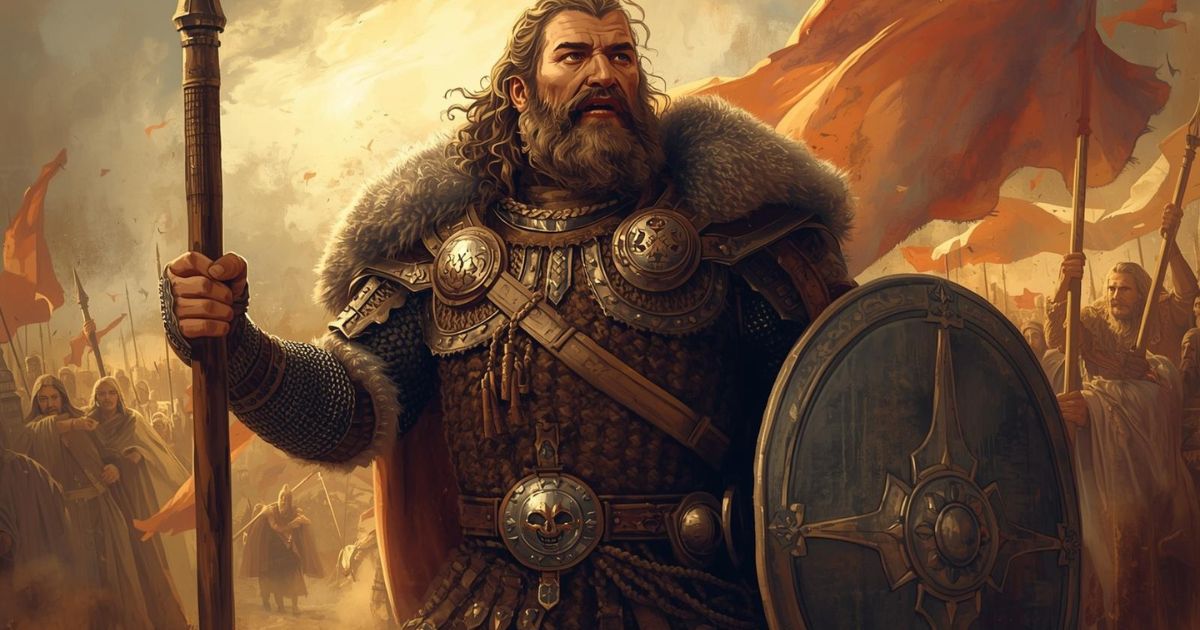
An excerpt from the original text.(complete · 873 words)
BEOWULF GOES TO HROTHGAR'S ASSISTANCE.


{Hrothgar sees no way of escape from the persecutions of Grendel.}

          So Healfdene's kinsman constantly mused on
          His long-lasting sorrow; the battle-thane clever
          Was not anywise able evils to 'scape from:
          Too crushing the sorrow that came to the people,
        5 Loathsome and lasting the life-grinding torture,

{Beowulf, the Geat, hero of the poem, hears of Hrothgar's sorrow, and
resolves to go to his assistance.}

          Greatest of night-woes. So Higelac's liegeman,
          Good amid Geatmen, of Grendel's achievements
          Heard in his home:[1] of heroes then living
          He was stoutest and strongest, sturdy and noble.
       10 He bade them prepare him a bark that was trusty;
          He said he the war-king would seek o'er the ocean,
          The folk-leader noble, since he needed retainers.
          For the perilous project prudent companions
          Chided him little, though loving him dearly;
       15 They egged the brave atheling, augured him glory.

{With fourteen carefully chosen companions, he sets out for Dane-land.}

          The excellent knight from the folk of the Geatmen
          Had liegemen selected, likest to prove them
          Trustworthy warriors; with fourteen companions
          The vessel he looked for; a liegeman then showed them,
       20 A sea-crafty man, the bounds of the country.
          Fast the days fleeted; the float was a-water,
          The craft by the cliff. Clomb to the prow then
          Well-equipped warriors: the wave-currents twisted
          The sea on the sand; soldiers then carried
       25 On the breast of the vessel bright-shining jewels,
          Handsome war-armor; heroes outshoved then,
          Warmen the wood-ship, on its wished-for adventure.

[9]

{The vessel sails like a bird}

          The foamy-necked floater fanned by the breeze,
          Likest a bird, glided the waters,

{In twenty four hours they reach the shores of Hrothgar's dominions}

       30 Till twenty and four hours thereafter
          The twist-stemmed vessel had traveled such distance
          That the sailing-men saw the sloping embankments,
          The sea cliffs gleaming, precipitous mountains,
          Nesses enormous: they were nearing the limits
       35 At the end of the ocean.[2] Up thence quickly
          The men of the Weders clomb to the mainland,
          Fastened their vessel (battle weeds rattled,
          War burnies clattered), the Wielder they thanked
          That the ways o'er the waters had waxen so gentle.

{They are hailed by the Danish coast guard}

       40 Then well from the cliff edge the guard of the Scyldings
          Who the sea-cliffs should see to, saw o'er the gangway
          Brave ones bearing beauteous targets,
          Armor all ready, anxiously thought he,
          Musing and wondering what men were approaching.
       45 High on his horse then Hrothgar's retainer
          Turned him to coastward, mightily brandished
          His lance in his hands, questioned with boldness.

{His challenge}

          "Who are ye men here, mail-covered warriors
          Clad in your corslets, come thus a-driving
       50 A high riding ship o'er the shoals of the waters,
          [3]And hither 'neath helmets have hied o'er the ocean?
[10]      I have been strand-guard, standing as warden,
          Lest enemies ever anywise ravage
          Danish dominions with army of war-ships.
       55 More boldly never have warriors ventured
          Hither to come; of kinsmen's approval,
          Word-leave of warriors, I ween that ye surely

{He is struck by Beowulf's appearance.}

          Nothing have known. Never a greater one
          Of earls o'er the earth have _I_ had a sight of
       60 Than is one of your number, a hero in armor;
          No low-ranking fellow[4] adorned with his weapons,
          But launching them little, unless looks are deceiving,
          And striking appearance. Ere ye pass on your journey
          As treacherous spies to the land of the Scyldings
       65 And farther fare, I fully must know now
          What race ye belong to. Ye far-away dwellers,
          Sea-faring sailors, my simple opinion
          Hear ye and hearken: haste is most fitting
          Plainly to tell me what place ye are come from."

    [1] 'From hám' (194) is much disputed. One rendering is: _Beowulf,
    being away from home, heard of Hrothgar's troubles, etc_. Another,
    that adopted by S. and endorsed in the H.-So. notes, is: _B. heard
    from his neighborhood (neighbors),_ i.e. _in his home, etc_. A third
    is: _B., being at home, heard this as occurring away from home_. The
    H.-So. glossary and notes conflict.

    [2] 'Eoletes' (224) is marked with a (?) by H.-So.; our rendering
    simply follows his conjecture.--Other conjectures as to 'eolet' are:
    (1) _voyage_, (2) _toil_, _labor_, (3) _hasty journey_.

    [3] The lacuna of the MS at this point has been supplied by various
    conjectures. The reading adopted by H.-So. has been rendered in the
    above translation. W., like H.-So., makes 'ic' the beginning of a new
    sentence, but, for 'helmas bæron,' he reads 'hringed stefnan.' This
    has the advantage of giving a parallel to 'brontne ceol' instead of a
    kenning for 'go.'--B puts the (?) after 'holmas', and begins a new
    sentence at the middle of the line. Translate: _What warriors are ye,
    clad in armor, who have thus come bringing the foaming vessel over the
    water way, hither over the seas? For some time on the wall I have been
    coast guard, etc_. S. endorses most of what B. says, but leaves out
    'on the wall' in the last sentence. If W.'s 'hringed stefnan' be
    accepted, change line 51 above to, _A ring-stemmed vessel hither
    o'ersea_.

    [4] 'Seld-guma' (249) is variously rendered: (1) _housecarle_; (2)
    _home-stayer_; (3) _common man_. Dr. H. Wood suggests _a man-at-arms
    in another's house_.
Master this chapter. Complete your experience
Purchase the complete book to access all chapters and support classic literature
As an Amazon Associate, we earn a small commission from qualifying purchases at no additional cost to you.
Available in paperback, hardcover, and e-book formats
Let's Analyse the Pattern
The fundamental choice between moving toward problems with imperfect knowledge versus being paralyzed by the desire for complete understanding.
Why This Matters
Connect literature to life
This chapter teaches how to recognize when thinking has become a substitute for doing.
Practice This Today
This week, notice when you catch yourself saying 'I need to research more' or 'I'm not ready yet'—then identify one small action you could take today instead.
Now let's explore the literary elements.
Key Quotes & Analysis
"He was stoutest and strongest, sturdy and noble"
Context: Describing Beowulf when he first hears about Grendel's attacks
This establishes that Beowulf has both physical power and moral character. The combination of strength and nobility is crucial - he's not just a brute, but someone who uses his gifts responsibly.
In Today's Words:
He was the toughest guy around, but also had real class and integrity
"They egged the brave atheling, augured him glory"
Context: Describing how Beowulf's companions react to his decision to help Hrothgar
Instead of trying to talk him out of a dangerous mission, his friends encourage him and predict success. This shows the power of having people who believe in your potential.
In Today's Words:
His crew backed him up and told him he was going to crush it
"The vessel he looked for; a liegeman then showed them, a sea-crafty man, the bounds of the country"
Context: As Beowulf prepares for the sea journey to Denmark
This shows Beowulf's wisdom in surrounding himself with experts. He's strong and brave, but smart enough to rely on others' specialized knowledge.
In Today's Words:
He found the right boat and got an experienced sailor to show them the way
Thematic Threads
Class
In This Chapter
Beowulf's royal status gives him the confidence and resources to act decisively, while others might hesitate
Development
Building from earlier themes of inherited status—now showing how privilege can enable bold action
In Your Life:
Your background affects your confidence to take big risks, but action itself builds the confidence you might not have inherited
Identity
In This Chapter
Beowulf's identity as a warrior drives his immediate response to seek out challenges rather than avoid them
Development
Expanding from personal identity to show how it shapes decision-making patterns
In Your Life:
How you see yourself determines whether you approach problems as threats to avoid or opportunities to grow
Social Expectations
In This Chapter
The coast guard's aggressive challenge tests whether Beowulf will meet expectations of leadership and strength
Development
Continuing exploration of how others' expectations shape our behavior and opportunities
In Your Life:
People constantly test whether you'll live up to the confidence you project—your response determines their respect
Personal Growth
In This Chapter
Beowulf chooses the difficult path of facing an unknown monster rather than staying safely in familiar territory
Development
Growth requires leaving comfort zones and engaging with challenges that stretch your capabilities
In Your Life:
Real growth happens when you stop avoiding difficult situations and start moving toward them intentionally
Human Relationships
In This Chapter
Beowulf's warriors support his dangerous mission instead of trying to talk him out of it
Development
Introduced here—showing how healthy relationships encourage growth rather than safety
In Your Life:
The people around you either support your growth or try to keep you small—choose your circle carefully
You now have the context. Time to form your own thoughts.
Discussion Questions
- 1
What's the key difference between how Hrothgar and Beowulf respond to the Grendel problem?
analysis • surface - 2
Why do you think Beowulf's friends support his dangerous mission instead of trying to talk him out of it?
analysis • medium - 3
Where do you see people getting stuck in analysis paralysis in your own workplace or community?
application • medium - 4
Think of a problem you've been putting off addressing. What would taking 'Beowulf action' look like for you?
application • deep - 5
What does this chapter suggest about the relationship between confidence and action?
reflection • deep
Critical Thinking Exercise
The Analysis Trap Audit
Think of three situations in your life where you've been stuck in planning mode for weeks or months. For each one, write down what you've been analyzing and what the smallest possible first action would be. Don't worry about whether it's the perfect action—just identify one real step you could take this week.
Consider:
- •Focus on actions you can control, not outcomes you can't guarantee
- •Look for patterns in what kinds of decisions you tend to overthink
- •Consider whether you're avoiding action because you're afraid of judgment or failure
Journaling Prompt
Write about a time when you took action without having all the answers. What happened? How did it feel different from times when you got stuck in analysis?
Coming Up Next...
Chapter 5: Making First Impressions That Matter
The Danish coast guard's challenge sets up a crucial test—how Beowulf responds will determine whether he's seen as a threat or a savior. His next words could make or break his mission before it even begins.



