
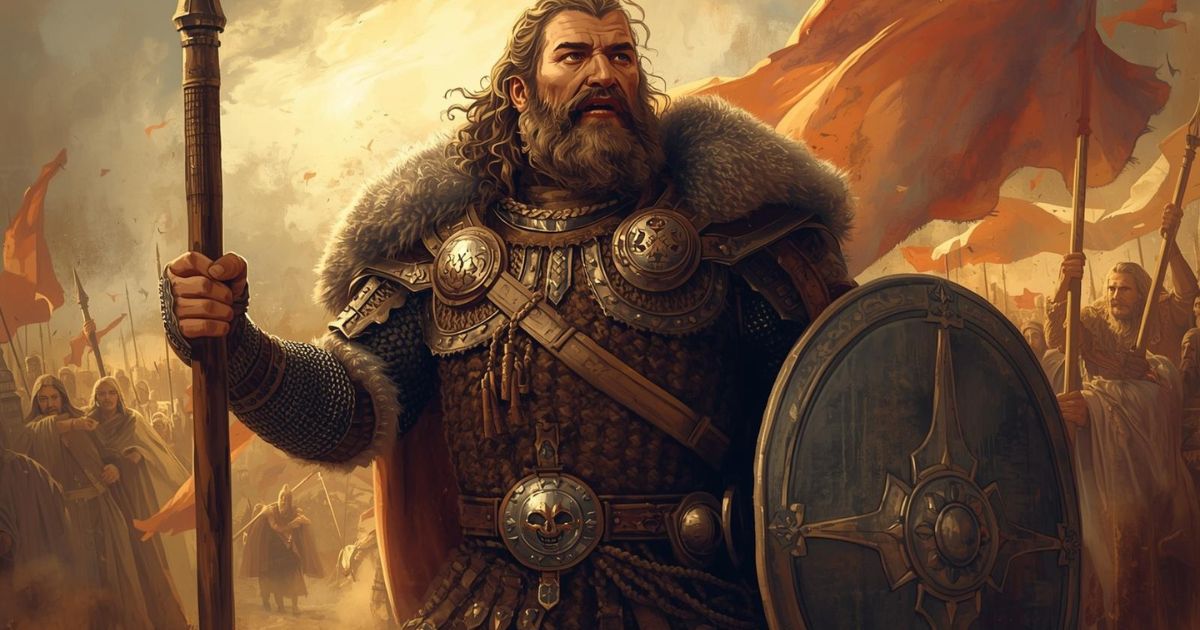
An excerpt from the original text.(complete · 1342 words)
REMINISCENCES (_continued_).--BEOWULF'S LAST BATTLE.


          "He seeks then his chamber, singeth a woe-song
          One for the other; all too extensive
          Seemed homesteads and plains. So the helm of the Weders

{Hrethel grieves for Herebald.}

          Mindful of Herebald heart-sorrow carried,
        5 Stirred with emotion, nowise was able
          To wreak his ruin on the ruthless destroyer:
          He was unable to follow the warrior with hatred,
          With deeds that were direful, though dear he not held him.
[84]      Then pressed by the pang this pain occasioned him,
       10 He gave up glee, God-light elected;
          He left to his sons, as the man that is rich does,
          His land and fortress, when from life he departed.

{Strife between Swedes and Geats.}

          Then was crime and hostility 'twixt Swedes and Geatmen,
          O'er wide-stretching water warring was mutual,
       15 Burdensome hatred, when Hrethel had perished,
          And Ongentheow's offspring were active and valiant,
          Wished not to hold to peace oversea, but
          Round Hreosna-beorh often accomplished
          Cruelest massacre. This my kinsman avengèd,
       20 The feud and fury, as 'tis found on inquiry,
          Though one of them paid it with forfeit of life-joys,

{Hæthcyn's fall at Ravenswood.}

          With price that was hard: the struggle became then
          Fatal to Hæthcyn, lord of the Geatmen.
          Then I heard that at morning one brother the other
       25 With edges of irons egged on to murder,
          Where Ongentheow maketh onset on Eofor:
          The helmet crashed, the hoary-haired Scylfing
          Sword-smitten fell, his hand then remembered
          Feud-hate sufficient, refused not the death-blow.

{I requited him for the jewels he gave me.}

       30 The gems that he gave me, with jewel-bright sword I
          'Quited in contest, as occasion was offered:
          Land he allowed me, life-joy at homestead,
          Manor to live on. Little he needed
          From Gepids or Danes or in Sweden to look for
       35 Trooper less true, with treasure to buy him;
          'Mong foot-soldiers ever in front I would hie me,
          Alone in the vanguard, and evermore gladly
          Warfare shall wage, while this weapon endureth
          That late and early often did serve me

{Beowulf refers to his having slain Dæghrefn.}

       40 When I proved before heroes the slayer of Dæghrefn,
          Knight of the Hugmen: he by no means was suffered
          To the king of the Frisians to carry the jewels,
          The breast-decoration; but the banner-possessor
          Bowed in the battle, brave-mooded atheling.
[85]   45 No weapon was slayer, but war-grapple broke then
          The surge of his spirit, his body destroying.
          Now shall weapon's edge make war for the treasure,
          And hand and firm-sword." Beowulf spake then,
          Boast-words uttered--the latest occasion:

{He boasts of his youthful prowess, and declares himself still fearless.}

       50 "I braved in my youth-days battles unnumbered;
          Still am I willing the struggle to look for,
          Fame-deeds perform, folk-warden prudent,
          If the hateful despoiler forth from his cavern
          Seeketh me out!" Each of the heroes,
       55 Helm-bearers sturdy, he thereupon greeted

{His last salutations.}

          Belovèd co-liegemen--his last salutation:
          "No brand would I bear, no blade for the dragon,
          Wist I a way my word-boast to 'complish[1]
          Else with the monster, as with Grendel I did it;
       60 But fire in the battle hot I expect there,
          Furious flame-burning: so I fixed on my body
          Target and war-mail. The ward of the barrow[2]
          I'll not flee from a foot-length, the foeman uncanny.
          At the wall 'twill befall us as Fate decreeth,

{Let Fate decide between us.}

       65 Each one's Creator. I am eager in spirit,
          With the wingèd war-hero to away with all boasting.
          Bide on the barrow with burnies protected,

{Wait ye here till the battle is over.}

          Earls in armor, which of _us_ two may better
          Bear his disaster, when the battle is over.
       70 'Tis no matter of yours, and man cannot do it,
          But me and me only, to measure his strength with
          The monster of malice, might-deeds to 'complish.
          I with prowess shall gain the gold, or the battle,
[86]      Direful death-woe will drag off your ruler!"
       75 The mighty champion rose by his shield then,
          Brave under helmet, in battle-mail went he
          'Neath steep-rising stone-cliffs, the strength he relied on
          Of one man alone: no work for a coward.
          Then he saw by the wall who a great many battles
       80 Had lived through, most worthy, when foot-troops collided,

{The place of strife is described.}

          Stone-arches standing, stout-hearted champion,
          Saw a brook from the barrow bubbling out thenceward:
          The flood of the fountain was fuming with war-flame:
          Not nigh to the hoard, for season the briefest
       85 Could he brave, without burning, the abyss that was yawning,
          The drake was so fiery. The prince of the Weders
          Caused then that words came from his bosom,
          So fierce was his fury; the firm-hearted shouted:
          His battle-clear voice came in resounding
       90 'Neath the gray-colored stone. Stirred was his hatred,

{Beowulf calls out under the stone arches.}

          The hoard-ward distinguished the speech of a man;
          Time was no longer to look out for friendship.
          The breath of the monster issued forth first,
          Vapory war-sweat, out of the stone-cave:

{The terrible encounter.}

       95 The earth re-echoed. The earl 'neath the barrow
          Lifted his shield, lord of the Geatmen,
          Tow'rd the terrible stranger: the ring-twisted creature's
          Heart was then ready to seek for a struggle.

{Beowulf brandishes his sword,}

          The excellent battle-king first brandished his weapon,
      100 The ancient heirloom, of edges unblunted,[3]
          To the death-planners twain was terror from other.

{and stands against his shield.}

          The lord of the troopers intrepidly stood then
          'Gainst his high-rising shield, when the dragon coiled him

{The dragon coils himself.}

          Quickly together: in corslet he bided.
[87]  105 He went then in blazes, bended and striding,
          Hasting him forward. His life and body
          The targe well protected, for time-period shorter
          Than wish demanded for the well-renowned leader,
          Where he then for the first day was forced to be victor,
      110 Famous in battle, as Fate had not willed it.
          The lord of the Geatmen uplifted his hand then,
          Smiting the fire-drake with sword that was precious,
          That bright on the bone the blade-edge did weaken,
          Bit more feebly than his folk-leader needed,
      115 Burdened with bale-griefs. Then the barrow-protector,

{The dragon rages}

          When the sword-blow had fallen, was fierce in his spirit,
          Flinging his fires, flamings of battle
          Gleamed then afar: the gold-friend of Weders

{Beowulf's sword fails him.}

          Boasted no conquests, his battle-sword failed him
      120 Naked in conflict, as by no means it ought to,
          Long-trusty weapon. 'Twas no slight undertaking
          That Ecgtheow's famous offspring would leave
          The drake-cavern's bottom; he must live in some region
          Other than this, by the will of the dragon,
      125 As each one of earthmen existence must forfeit.
          'Twas early thereafter the excellent warriors

{The combat is renewed.}

          Met with each other. Anew and afresh
          The hoard-ward took heart (gasps heaved then his bosom):

{The great hero is reduced to extremities.}

          Sorrow he suffered encircled with fire
      130 Who the people erst governed. His companions by no means
          Were banded about him, bairns of the princes,

{His comrades flee!}

          With valorous spirit, but they sped to the forest,
          Seeking for safety. The soul-deeps of one were

{Blood is thicker than water.}

          Ruffled by care: kin-love can never
      135 Aught in him waver who well doth consider.

[88]

    [1] The clause 2520(2)-2522(1), rendered by 'Wist I ... monster,' Gr.,
    followed by S., translates substantially as follows: _If I knew how
    else I might combat the boastful defiance of the monster_.--The
    translation turns upon 'wiðgrípan,' a word not understood.

    [2] B. emends and translates: _I will not flee the space of a foot
    from the guard of the barrow, but there shall be to us a fight at the
    wall, as fate decrees, each one's Creator._

    [3] The translation of this passage is based on 'unsláw' (2565),
    accepted by H.-So., in lieu of the long-standing 'ungléaw.' The former
    is taken as an adj. limiting 'sweord'; the latter as an adj. c.
    'gúð-cyning': _The good war-king, rash with edges, brandished his
    sword, his old relic._ The latter gives a more rhetorical Anglo-Saxon
    (poetical) sentence.
Master this chapter. Complete your experience
Purchase the complete book to access all chapters and support classic literature
As an Amazon Associate, we earn a small commission from qualifying purchases at no additional cost to you.
Available in paperback, hardcover, and e-book formats
Let's Analyse the Pattern
When past success creates an identity so dependent on independence that asking for needed help becomes impossible.
Why This Matters
Connect literature to life
This chapter teaches how success can create rigid identities that prevent adaptation when circumstances change.
Practice This Today
This week, notice when you refuse help because it threatens your image as the capable one, then practice asking for small assistance to build the muscle before you need it for big problems.
Now let's explore the literary elements.
Key Quotes & Analysis
"He was unable to follow the warrior with hatred, With deeds that were direful, though dear he not held him"
Context: Describing how Hrethel couldn't seek revenge against the son who accidentally killed his brother
This captures the impossible position of loving someone who has caused you unbearable pain. Hrethel is trapped between justice and love, unable to act on either.
In Today's Words:
He couldn't bring himself to hate his own son, even though that son had destroyed his world.
"Then I heard that at morning one brother the other With edges of irons egged on to murder"
Context: Describing the battle where Hæthcyn died fighting the Swedes
Shows how family tragedy leads to larger conflicts. The personal becomes political, and private grief becomes public warfare.
In Today's Words:
At dawn, they went at each other with weapons, brother against brother in everything but blood.
"The helmet crashed, the hoary-haired Scylfing Sword-smitten fell"
Context: Beowulf recalling how he killed the Swedish king Ongentheow in battle
This moment of triumph from Beowulf's past contrasts sharply with his current situation facing the dragon. It reminds us of what he once was.
In Today's Words:
The old king's helmet shattered and he went down hard, finished by my sword.
Thematic Threads
Identity
In This Chapter
Beowulf's identity as the invincible hero prevents him from accepting help when facing the dragon
Development
Evolved from young warrior proving himself to established king trapped by his own legend
In Your Life:
You might resist asking for help at work or home because it threatens how you see yourself
Class
In This Chapter
Royal responsibility demands Beowulf maintain the image of unbreakable leadership his people expect
Development
Deepened from earlier themes of proving worthiness to maintaining established status
In Your Life:
You might feel pressure to appear stronger or more capable than you are to maintain your position
Social Expectations
In This Chapter
The warriors expect Beowulf to handle threats alone, then abandon him when he shows vulnerability
Development
Intensified from loyalty bonds to the breaking point where expectations become impossible
In Your Life:
You might find people disappear when you can no longer meet the unrealistic standards they've set for you
Human Relationships
In This Chapter
Decades of being the problem-solver has isolated Beowulf from genuine partnership in crisis
Development
Culmination of earlier relationship patterns showing the cost of always being the strong one
In Your Life:
You might struggle to build relationships where you can be vulnerable because you're always the helper
Personal Growth
In This Chapter
Beowulf's inability to adapt his approach despite aging shows how past success can prevent evolution
Development
Contrast to earlier adaptability, showing how success can create rigidity
In Your Life:
You might find yourself using outdated strategies because they worked before, even when circumstances have changed
You now have the context. Time to form your own thoughts.
Discussion Questions
- 1
Why does Beowulf insist on fighting the dragon alone, even though he has warriors with him?
analysis • surface - 2
How does Beowulf's past success as a solo warrior trap him into making a dangerous decision as an older king?
analysis • medium - 3
Where do you see people today refusing help because they've always been 'the strong one' or 'the one who handles everything'?
application • medium - 4
What's the difference between healthy independence and dangerous isolation, and how can someone tell which one they're practicing?
application • deep - 5
What does this chapter reveal about how our greatest strengths can become our biggest weaknesses?
reflection • deep
Critical Thinking Exercise
Map Your Support Network Before You Need It
Think of three major challenges you might face in the next year - at work, at home, or with health. For each challenge, identify two specific people you could realistically ask for help and write down exactly what kind of help they could provide. Don't just list names - be specific about what you'd actually ask them to do.
Consider:
- •Consider people with different types of resources - time, skills, connections, or emotional support
- •Think about what you could offer in return, even if it's just genuine gratitude
- •Notice any resistance you feel to asking certain people for help and examine why
Journaling Prompt
Write about a time when you struggled alone with something that would have been easier with help. What stopped you from asking? How might you handle a similar situation differently now?
Coming Up Next...
Chapter 36: When Everyone Else Runs Away
As Beowulf faces the dragon alone with a useless sword and flames closing in, one young warrior must choose between safety and loyalty. The fate of the Geats hangs on a single act of courage.



