
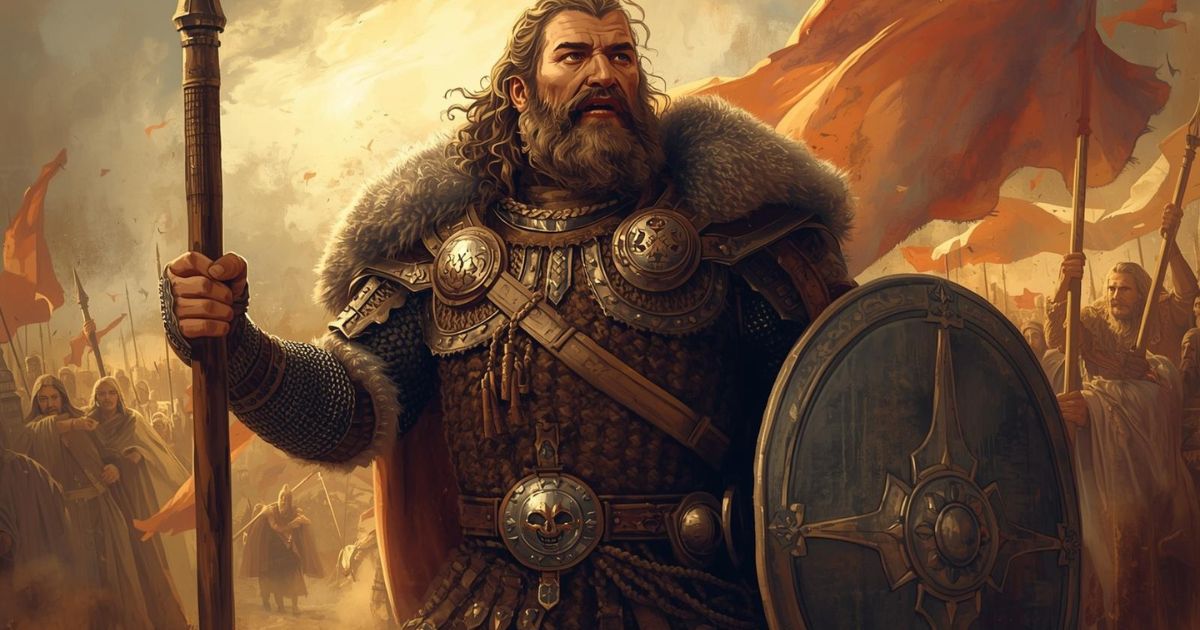
An excerpt from the original text.(complete · 978 words)
REJOICING OF THE DANES.


{At early dawn, warriors from far and near come together to hear of the
night's adventures.}

          In the mist of the morning many a warrior
          Stood round the gift-hall, as the story is told me:
          Folk-princes fared then from far and from near
          Through long-stretching journeys to look at the wonder,
        5 The footprints of the foeman. Few of the warriors

{Few warriors lamented Grendel's destruction.}

          Who gazed on the foot-tracks of the inglorious creature
          His parting from life pained very deeply,
          How, weary in spirit, off from those regions
          In combats conquered he carried his traces,
       10 Fated and flying, to the flood of the nickers.

{Grendel's blood dyes the waters.}

          There in bloody billows bubbled the currents,
          The angry eddy was everywhere mingled
          And seething with gore, welling with sword-blood;[1]
          He death-doomed had hid him, when reaved of his joyance
       15 He laid down his life in the lair he had fled to,
          His heathenish spirit, where hell did receive him.
          Thence the friends from of old backward turned them,
          And many a younker from merry adventure,
          Striding their stallions, stout from the seaward,
       20 Heroes on horses. There were heard very often

{Beowulf is the hero of the hour.}

          Beowulf's praises; many often asserted
          That neither south nor north, in the circuit of waters,

{He is regarded as a probable successor to Hrothgar.}

          O'er outstretching earth-plain, none other was better
          'Mid bearers of war-shields, more worthy to govern,
       25 'Neath the arch of the ether. Not any, however,
          'Gainst the friend-lord muttered, mocking-words uttered

{But no word is uttered to derogate from the old king}

          Of Hrothgar the gracious (a good king he).
          Oft the famed ones permitted their fallow-skinned horses
[31]      To run in rivalry, racing and chasing,
       30 Where the fieldways appeared to them fair and inviting,
          Known for their excellence; oft a thane of the folk-lord,[2]

{The gleeman sings the deeds of heroes.}

          [3]A man of celebrity, mindful of rhythms,
          Who ancient traditions treasured in memory,
          New word-groups found properly bound:
       35 The bard after 'gan then Beowulf's venture

{He sings in alliterative measures of Beowulf's prowess.}

          Wisely to tell of, and words that were clever
          To utter skilfully, earnestly speaking,
          Everything told he that he heard as to Sigmund's

{Also of Sigemund, who has slain a great fire-dragon.}

          Mighty achievements, many things hidden,
       40 The strife of the Wælsing, the wide-going ventures
          The children of men knew of but little,
          The feud and the fury, but Fitela with him,
          When suchlike matters he minded to speak of,
          Uncle to nephew, as in every contention
       45 Each to other was ever devoted:
          A numerous host of the race of the scathers
          They had slain with the sword-edge. To Sigmund accrued then
          No little of glory, when his life-days were over,
          Since he sturdy in struggle had destroyed the great dragon,
       50 The hoard-treasure's keeper; 'neath the hoar-grayish stone he,
          The son of the atheling, unaided adventured
          The perilous project; not present was Fitela,
          Yet the fortune befell him of forcing his weapon
          Through the marvellous dragon, that it stood in the wall,
       55 Well-honored weapon; the worm was slaughtered.
          The great one had gained then by his glorious achievement
          To reap from the ring-hoard richest enjoyment,
[32]      As best it did please him: his vessel he loaded,
          Shining ornaments on the ship's bosom carried,
       60 Kinsman of Wæls: the drake in heat melted.

{Sigemund was widely famed.}

          He was farthest famed of fugitive pilgrims,
          Mid wide-scattered world-folk, for works of great prowess,
          War-troopers' shelter: hence waxed he in honor.[4]

{Heremod, an unfortunate Danish king, is introduced by way of contrast.}

          Afterward Heremod's hero-strength failed him,
       65 His vigor and valor. 'Mid venomous haters
          To the hands of foemen he was foully delivered,
          Offdriven early. Agony-billows

{Unlike Sigemund and Beowulf, Heremod was a burden to his people.}

          Oppressed him too long, to his people he became then,
          To all the athelings, an ever-great burden;
       70 And the daring one's journey in days of yore
          Many wise men were wont to deplore,
          Such as hoped he would bring them help in their sorrow,
          That the son of their ruler should rise into power,
          Holding the headship held by his fathers,
       75 Should govern the people, the gold-hoard and borough,
          The kingdom of heroes, the realm of the Scyldings.

{Beowulf is an honor to his race.}

          He to all men became then far more beloved,
          Higelac's kinsman, to kindreds and races,
          To his friends much dearer; him malice assaulted.--

{The story is resumed.}

       80 Oft running and racing on roadsters they measured
          The dun-colored highways. Then the light of the morning
          Was hurried and hastened. Went henchmen in numbers
          To the beautiful building, bold ones in spirit,
          To look at the wonder; the liegelord himself then
       85 From his wife-bower wending, warden of treasures,
          Glorious trod with troopers unnumbered,
          Famed for his virtues, and with him the queen-wife
          Measured the mead-ways, with maidens attending.

    [1] S. emends, suggesting 'déop' for 'déog,' and removing semicolon
    after 'wéol.' The two half-lines 'welling ... hid him' would then
    read: _The bloody deep welled with sword-gore_. B. accepts 'déop' for
    'déog,' but reads 'déað-fæges': _The deep boiled with the sword-gore
    of the death-doomed one_.

    [2] Another and quite different rendering of this passage is as
    follows: _Oft a liegeman of the king, a fame-covered man mindful of
    songs, who very many ancient traditions remembered (he found other
    word-groups accurately bound together) began afterward to tell of
    Beowulf's adventure, skilfully to narrate it, etc_.

    [3] Might 'guma gilp-hladen' mean 'a man laden with boasts of the
    deeds of others'?

    [4] t.B. accepts B.'s 'hé þæs áron þáh' as given by H.-So., but puts a
    comma after 'þáh,' and takes 'siððan' as introducing a dependent
    clause: _He throve in honor since Heremod's strength ... had
    decreased_.

[33]
Master this chapter. Complete your experience
Purchase the complete book to access all chapters and support classic literature
As an Amazon Associate, we earn a small commission from qualifying purchases at no additional cost to you.
Available in paperback, hardcover, and e-book formats
Let's Analyse the Pattern
Your standing in any community depends less on your actions than on how others tell the story of your actions.
Why This Matters
Connect literature to life
This chapter teaches how to recognize when your reputation is being actively constructed through other people's storytelling and political positioning.
Practice This Today
This week, notice when colleagues talk about someone who isn't present—pay attention to how they frame that person's actions and what it reveals about workplace politics and alliance-building.
Now let's explore the literary elements.
Key Quotes & Analysis
"Many often asserted that neither south nor north, in the circuit of waters, none other was better 'mid bearers of war-shields, more worthy to govern"
Context: Warriors discussing Beowulf's worthiness while being careful not to insult Hrothgar
This shows how reputation is built through collective agreement and how skilled politicians can praise someone without threatening existing power structures. The warriors are essentially saying Beowulf could rule anywhere, but they're not saying he should rule here.
In Today's Words:
Everyone agreed he was the best leader material they'd ever seen, but they were smart about how they said it.
"There in bloody billows bubbled the currents, the angry eddy was everywhere mingled and seething with gore"
Context: Describing the mere where Grendel died, showing the physical evidence of his defeat
The vivid description serves as proof of the monster's death and adds drama to the story. Physical evidence matters in a world where reputation is everything—people need to see proof of heroic deeds.
In Today's Words:
The water was churning red with blood—you could see exactly where the monster had died.
"Few of the warriors who gazed on the foot-tracks of the inglorious creature his parting from life pained very deeply"
Context: Describing the crowd's reaction to seeing Grendel's trail of blood
This understated way of saying 'nobody was sorry the monster was dead' shows Anglo-Saxon irony and emphasizes how completely Grendel had terrorized the community. Their relief is so great it's almost humorous.
In Today's Words:
Nobody was exactly crying over the monster's death—good riddance was more like it.
Thematic Threads
Identity
In This Chapter
Beowulf's identity transforms from visiting warrior to legendary hero through communal storytelling and comparison to mythic figures
Development
Evolved from personal identity quest to public identity construction
In Your Life:
Your professional identity depends on how colleagues describe your work to others
Class
In This Chapter
The bard's stories establish hierarchies of worthiness, elevating Beowulf while maintaining respect for existing power structures
Development
Developed from rigid class boundaries to merit-based social mobility through heroic action
In Your Life:
Your social standing can shift based on how others frame your achievements and character
Social Expectations
In This Chapter
The community uses stories of Heremod to define what makes a leader worthy versus burdensome, setting behavioral standards
Development
Expanded from individual heroic expectations to leadership accountability standards
In Your Life:
People judge your leadership potential by comparing you to examples of good and bad leaders they know
Human Relationships
In This Chapter
The careful balance of praising Beowulf without diminishing Hrothgar shows sophisticated relationship management within power dynamics
Development
Developed from simple loyalty bonds to complex multi-party relationship navigation
In Your Life:
You can build relationships by elevating others strategically without threatening existing relationships
You now have the context. Time to form your own thoughts.
Discussion Questions
- 1
How does the community transform from fear to celebration, and what role does storytelling play in this shift?
analysis • surface - 2
Why do the warriors praise Beowulf while being careful not to diminish Hrothgar? What does this reveal about navigating workplace or social hierarchies?
analysis • medium - 3
The bard compares Beowulf to both successful heroes and failed kings. Where do you see this pattern of using comparisons to shape someone's reputation today?
application • medium - 4
Think about a time when someone's reputation was built or damaged by how others told their story. How could understanding this pattern change how you manage your own reputation?
application • deep - 5
What does this chapter suggest about the relationship between individual achievement and community recognition? How does this apply to modern success?
reflection • deep
Critical Thinking Exercise
Map Your Story Network
Identify three people who regularly tell stories about your work, character, or achievements to others. For each person, write down: what story they typically tell about you, how accurate it is, and whether it helps or hurts your reputation. Then consider: who are you missing from your story network, and what stories do you tell about others?
Consider:
- •Think beyond obvious choices like supervisors - include peers, family members, and informal influencers
- •Consider both professional and personal contexts where your reputation matters
- •Notice whether you're actively cultivating positive storytellers or leaving your reputation to chance
Journaling Prompt
Write about a time when someone's story about you opened or closed an opportunity. How did their version differ from your own understanding of events, and what did this teach you about reputation management?
Coming Up Next...
Chapter 15: Recognition and Gratitude
The celebration continues as Hrothgar himself emerges to witness the proof of Beowulf's triumph. The old king's response to seeing Grendel's arm will reveal much about leadership, gratitude, and the complex dynamics between generations of warriors.



