
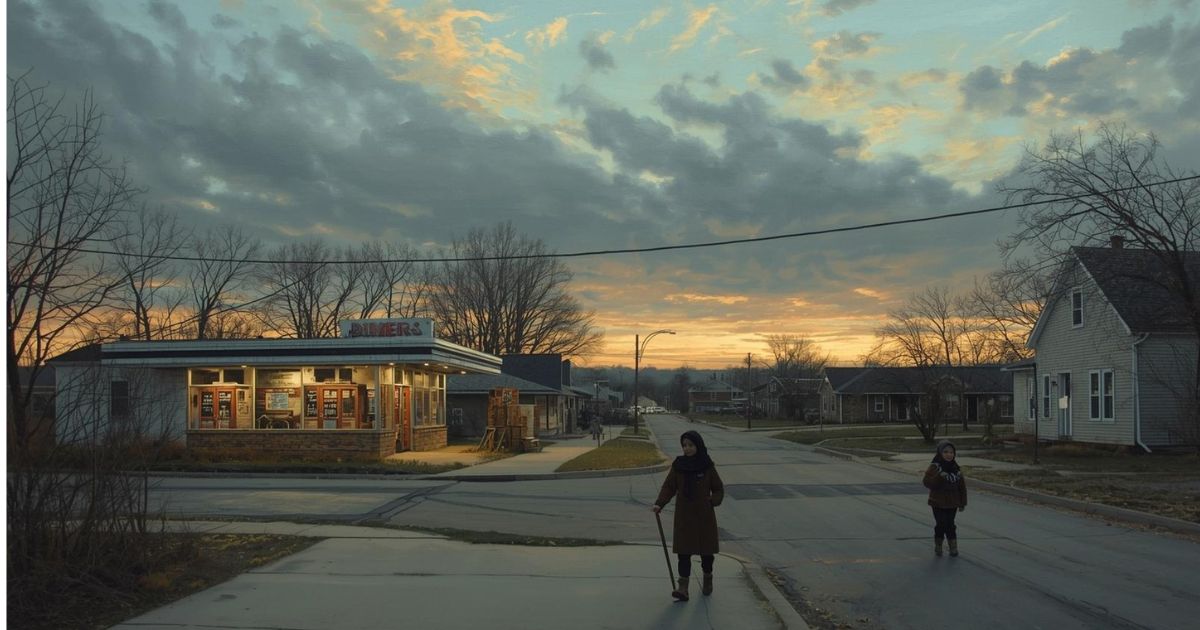
An excerpt from the original text.(complete · 4570 words)
lice was busy with herself for two hours after dinner; but a little
before nine o'clock she stood in front of her long mirror, completed,
bright-eyed and solemn. Her hair, exquisitely arranged, gave all she
asked of it; what artificialities in colour she had used upon her face
were only bits of emphasis that made her prettiness the more distinct;
and the dress, not rumpled by her mother's careful hours of work, was a
white cloud of loveliness. Finally there were two triumphant bouquets
of violets, each with the stems wrapped in tin-foil shrouded by a bow of
purple chiffon; and one bouquet she wore at her waist and the other she
carried in her hand.
Miss Perry, called in by a rapturous mother for the free treat of a look
at this radiance, insisted that Alice was a vision. “Purely and simply
a vision!” she said, meaning that no other definition whatever would
satisfy her. “I never saw anybody look a vision if she don't look one
to-night,” the admiring nurse declared. “Her papa'll think the same I do
about it. You see if he doesn't say she's purely and simply a vision.”
Adams did not fulfil the prediction quite literally when Alice paid a
brief visit to his room to “show” him and bid him good-night; but he
chuckled feebly. “Well, well, well!” he said.
“You look mighty fine--MIGHTY fine!” And he waggled a bony finger at her
two bouquets. “Why, Alice, who's your beau?”
“Never you mind!” she laughed, archly brushing his nose with the violets
in her hand. “He treats me pretty well, doesn't he?”
“Must like to throw his money around! These violets smell mighty sweet,
and they ought to, if they're going to a party with YOU. Have a good
time, dearie.”
“I mean to!” she cried; and she repeated this gaily, but with an
emphasis expressing sharp determination as she left him. “I MEAN to!”
“What was he talking about?” her mother inquired, smoothing the rather
worn and old evening wrap she had placed on Alice's bed. “What were you
telling him you 'mean to?'”
Alice went back to her triple mirror for the last time, then stood
before the long one. “That I mean to have a good time to-night,” she
said; and as she turned from her reflection to the wrap Mrs. Adams held
up for her, “It looks as though I COULD, don't you think so?”
“You'll just be a queen to-night,” her mother whispered in fond emotion.
“You mustn't doubt yourself.”
“Well, there's one thing,” said Alice. “I think I do look nice enough to
get along without having to dance with that Frank Dowling! All I ask is
for it to happen just once; and if he comes near me to-night I'm going
to treat him the way the other girls do. Do you suppose Walter's got the
taxi out in front?”
“He--he's waiting down in the hall,” Mrs. Adams answered, nervously; and
she held up another garment to go over the wrap.
Alice frowned at it. “What's that, mama?”
“It's--it's your father's raincoat. I thought you'd put it on over----”
“But I won't need it in a taxicab.”
“You will to get in and out, and you needn't take it into the Palmers'.
You can leave it in the--in the--It's drizzling, and you'll need it.”
“Oh, well,” Alice consented; and a few minutes later, as with Walter's
assistance she climbed into the vehicle he had provided, she better
understood her mother's solicitude.
“What on earth IS this, Walter?” she asked.
“Never mind; it'll keep you dry enough with the top up,” he returned,
taking his seat beside her. Then for a time, as they went rather jerkily
up the street, she was silent; but finally she repeated her question:
“What IS it, Walter?”
“What's what?”
“This--this CAR?”
“It's a ottomobile.”
“I mean--what kind is it?”
“Haven't you got eyes?”
“It's too dark.”
“It's a second-hand tin Lizzie,” said Walter. “D'you know what that
means? It means a flivver.”
“Yes, Walter.”
“Got 'ny 'bjections?”
“Why, no, dear,” she said, placatively. “Is it yours, Walter? Have you
bought it?”
“Me?” he laughed. “I couldn't buy a used wheelbarrow. I rent this
sometimes when I'm goin' out among 'em. Costs me seventy-five cents and
the price o' the gas.”
“That seems very moderate.”
“I guess it is! The feller owes me some money, and this is the only way
I'd ever get it off him.”
“Is he a garage-keeper?”
“Not exactly!” Walter uttered husky sounds of amusement. “You'll be just
as happy, I guess, if you don't know who he is,” he said.
His tone misgave her; and she said truthfully that she was content not
to know who owned the car. “I joke sometimes about how you keep things
to yourself,” she added, “but I really never do pry in your affairs,
Walter.”
“Oh, no, you don't!”
“Indeed, I don't.”
“Yes, you're mighty nice and cooing when you got me where you want me,”
he jeered. “Well, I just as soon tell you where I get this car.”
“I'd just as soon you wouldn't, Walter,” she said, hurriedly. “Please
don't.”
But Walter meant to tell her. “Why, there's nothin' exactly CRIMINAL
about it,” he said. “It belongs to old J. A. Lamb himself. He keeps it
for their coon chauffeur. I rent it from him.”
“From Mr. LAMB?”
“No; from the coon chauffeur.”
“Walter!” she gasped.
“Sure I do! I can get it any night when the coon isn't goin' to use it
himself. He's drivin' their limousine to-night--that little Henrietta
Lamb's goin' to the party, no matter if her father HAS only been dead
less'n a year!” He paused, then inquired: “Well, how d'you like it?”
She did not speak, and he began to be remorseful for having imparted
so much information, though his way of expressing regret was his own.
“Well, you WILL make the folks make me take you to parties!” he said. “I
got to do it the best way I CAN, don't I?”
Then as she made no response, “Oh, the car's CLEAN enough,” he said.
“This coon, he's as particular as any white man; you needn't worry about
that.” And as she still said nothing, he added gruffly, “I'd of had a
better car if I could afforded it. You needn't get so upset about it.”
“I don't understand--” she said in a low voice--“I don't understand how
you know such people.”
“Such people as who?”
“As--coloured chauffeurs.”
“Oh, look here, now!” he protested, loudly. “Don't you know this is a
democratic country?”
“Not quite that democratic, is it, Walter?”
“The trouble with you,” he retorted, “you don't know there's anybody in
town except just this silk-shirt crowd.” He paused, seeming to await
a refutation; but as none came, he expressed himself definitely: “They
make me sick.”
They were coming near their destination, and the glow of the big,
brightly lighted house was seen before them in the wet night. Other
cars, not like theirs, were approaching this center of brilliance; long
triangles of light near the ground swept through the fine drizzle; small
red tail-lights gleamed again from the moist pavement of the street;
and, through the myriads of little glistening leaves along the curving
driveway, glimpses were caught of lively colours moving in a white glare
as the limousines released their occupants under the shelter of the
porte-cochere.
Alice clutched Walter's arm in a panic; they were just at the driveway
entrance. “Walter, we mustn't go in there.”
“What's the matter?”
“Leave this awful car outside.”
“Why, I----”
“Stop!” she insisted, vehemently. “You've got to! Go back!”
“Oh, Glory!”
The little car was between the entrance posts; but Walter backed it out,
avoiding a collision with an impressive machine which swerved away
from them and passed on toward the porte-cochere, showing a man's face
grinning at the window as it went by. “Flivver runabout got the wrong
number!” he said.
“Did he SEE us?” Alice cried.
“Did who see us?”
“Harvey Malone--in that foreign coupe.”
“No; he couldn't tell who we were under this top,” Walter assured her as
he brought the little car to a standstill beside the curbstone, out in
the street. “What's it matter if he did, the big fish?”
Alice responded with a loud sigh, and sat still.
“Well, want to go on back?” Walter inquired. “You bet I'm willing!”
“No.”
“Well, then, what's the matter our drivin' on up to the porte-cochere?
There's room for me to park just the other side of it.”
“No, NO!”
“What you expect to do? Sit HERE all night?”
“No, leave the car here.”
“I don't care where we leave it,” he said. “Sit still till I lock her,
so none o' these millionaires around here'll run off with her.” He got
out with a padlock and chain; and, having put these in place, offered
Alice his hand. “Come on, if you're ready.”
“Wait,” she said, and, divesting herself of the raincoat, handed it to
Walter. “Please leave this with your things in the men's dressing-room,
as if it were an extra one of your own, Walter.”
He nodded; she jumped out; and they scurried through the drizzle.
As they reached the porte-cochere she began to laugh airily, and spoke
to the impassive man in livery who stood there. “Joke on us!” she
said, hurrying by him toward the door of the house. “Our car broke down
outside the gate.”
The man remained impassive, though he responded with a faint gleam
as Walter, looking back at him, produced for his benefit a cynical
distortion of countenance which offered little confirmation of Alice's
account of things. Then the door was swiftly opened to the brother and
sister; and they came into a marble-floored hall, where a dozen sleeked
young men lounged, smoked cigarettes and fastened their gloves, as they
waited for their ladies. Alice nodded to one or another of these, and
went quickly on, her face uplifted and smiling; but Walter detained her
at the door to which she hastened.
“Listen here,” he said. “I suppose you want me to dance the first dance
with you----”
“If you please, Walter,” she said, meekly.
“How long you goin' to hang around fixin' up in that dressin'-room?”
“I'll be out before you're ready yourself,” she promised him; and kept
her word, she was so eager for her good time to begin. When he came
for her, they went down the hall to a corridor opening upon three great
rooms which had been thrown open together, with the furniture removed
and the broad floors waxed. At one end of the corridor musicians sat in
a green grove, and Walter, with some interest, turned toward these; but
his sister, pressing his arm, impelled him in the opposite direction.
“What's the matter now?” he asked. “That's Jazz Louie and his half-breed
bunch--three white and four mulatto. Let's----?”
“No, no,” she whispered. “We must speak to Mildred and Mr. and Mrs.
Palmer.”
“'Speak' to 'em? I haven't got a thing to say to THOSE berries!”
“Walter, won't you PLEASE behave?”
He seemed to consent, for the moment, at least, and suffered her to take
him down the corridor toward a floral bower where the hostess stood with
her father and mother. Other couples and groups were moving in the
same direction, carrying with them a hubbub of laughter and fragmentary
chatterings; and Alice, smiling all the time, greeted people on
every side of her eagerly--a little more eagerly than most of them
responded--while Walter nodded in a noncommittal manner to one or two,
said nothing, and yawned audibly, the last resource of a person who
finds himself nervous in a false situation. He repeated his yawn and
was beginning another when a convulsive pressure upon his arm made him
understand that he must abandon this method of reassuring himself. They
were close upon the floral bower.
Mildred was giving her hand to one and another of her guests as rapidly
as she could, passing them on to her father and mother, and at the
same time resisting the efforts of three or four detached bachelors who
besought her to give over her duty in favour of the dance-music just
beginning to blare.
She was a large, fair girl, with a kindness of eye somewhat withheld by
an expression of fastidiousness; at first sight of her it was clear that
she would never in her life do anything “incorrect,” or wear anything
“incorrect.” But her correctness was of the finer sort, and had no air
of being studied or achieved; conduct would never offer her a problem to
be settled from a book of rules, for the rules were so deep within her
that she was unconscious of them. And behind this perfection there was
an even ampler perfection of what Mrs. Adams called “background.” The
big, rich, simple house was part of it, and Mildred's father and mother
were part of it. They stood beside her, large, serene people, murmuring
graciously and gently inclining their handsome heads as they gave their
hands to the guests; and even the youngest and most ebullient of these
took on a hushed mannerliness with a closer approach to the bower.
When the opportunity came for Alice and Walter to pass within this
precinct, Alice, going first, leaned forward and whispered in Mildred's
ear. “You DIDN'T wear the maize georgette! That's what I thought you
were going to. But you look simply DARLING! And those pearls----”
Others were crowding decorously forward, anxious to be done with
ceremony and get to the dancing; and Mildred did not prolong the
intimacy of Alice's enthusiastic whispering. With a faint accession of
colour and a smile tending somewhat in the direction of rigidity, she
carried Alice's hand immediately onward to Mrs. Palmer's. Alice's own
colour showed a little heightening as she accepted the suggestion thus
implied; nor was that emotional tint in any wise decreased, a moment
later, by an impression that Walter, in concluding the brief exchange
of courtesies between himself and the stately Mr. Palmer, had again
reassured himself with a yawn.
But she did not speak of it to Walter; she preferred not to confirm the
impression and to leave in her mind a possible doubt that he had done
it. He followed her out upon the waxed floor, said resignedly: “Well,
come on,” put his arm about her, and they began to dance.
Alice danced gracefully and well, but not so well as Walter. Of all the
steps and runs, of all the whimsical turns and twirlings, of all the
rhythmic swayings and dips commanded that season by such blarings as
were the barbaric product, loud and wild, of the Jazz Louies and their
half-breed bunches, the thin and sallow youth was a master. Upon his
face could be seen contempt of the easy marvels he performed as he
moved in swift precision from one smooth agility to another; and if some
too-dainty or jealous cavalier complained that to be so much a stylist
in dancing was “not quite like a gentleman,” at least Walter's style was
what the music called for. No other dancer in the room could be thought
comparable to him. Alice told him so.
“It's wonderful!” she said. “And the mystery is, where you ever learned
to DO it! You never went to dancing-school, but there isn't a man in the
room who can dance half so well. I don't see why, when you dance like
this, you always make such a fuss about coming to parties.”
He sounded his brief laugh, a jeering bark out of one side of the mouth,
and swung her miraculously through a closing space between two other
couples. “You know a lot about what goes on, don't you? You prob'ly
think there's no other place to dance in this town except these
frozen-face joints.”
“'Frozen face?'” she echoed, laughing. “Why, everybody's having a
splendid time. Look at them.”
“Oh, they holler loud enough,” he said. “They do it to make each other
think they're havin' a good time. You don't call that Palmer family
frozen-face berries, I s'pose. No?”
“Certainly not. They're just dignified and----”
“Yeuh!” said Walter. “They're dignified, 'specially when you tried to
whisper to Mildred to show how IN with her you were, and she moved you
on that way. SHE'S a hot friend, isn't she!”
“She didn't mean anything by it. She----”
“Ole Palmer's a hearty, slap you-on-the-back ole berry,” Walter
interrupted; adding in a casual tone, “All I'd like, I'd like to hit
him.”
“Walter! By the way, you mustn't forget to ask Mildred for a dance
before the evening is over.”
“Me?” He produced the lop-sided appearance of his laugh, but without
making it vocal. “You watch me do it!”
“She probably won't have one left, but you must ask her, anyway.”
“Why must I?”
“Because, in the first place, you're supposed to, and, in the second
place, she's my most intimate friend.”
“Yeuh? Is she? I've heard you pull that 'most-intimate-friend' stuff
often enough about her. What's SHE ever do to show she is?”
“Never mind. You really must ask her, Walter. I want you to; and I want
you to ask several other girls afterwhile; I'll tell you who.”
“Keep on wanting; it'll do you good.”
“Oh, but you really----”
“Listen!” he said. “I'm just as liable to dance with any of these
fairies as I am to buy a bucket o' rusty tacks and eat 'em. Forget it!
Soon as I get rid of you I'm goin' back to that room where I left my hat
and overcoat and smoke myself to death.”
“Well,” she said, a little ruefully, as the frenzy of Jazz Louie and his
half-breeds was suddenly abated to silence, “you mustn't--you mustn't
get rid of me TOO soon, Walter.”
They stood near one of the wide doorways, remaining where they had
stopped. Other couples, everywhere, joined one another, forming
vivacious clusters, but none of these groups adopted the brother and
sister, nor did any one appear to be hurrying in Alice's direction to
ask her for the next dance. She looked about her, still maintaining that
jubilance of look and manner she felt so necessary--for it is to the
girls who are “having a good time” that partners are attracted--and, in
order to lend greater colour to her impersonation of a lively belle,
she began to chatter loudly, bringing into play an accompaniment of
frolicsome gesture. She brushed Walter's nose saucily with the bunch
of violets in her hand, tapped him on the shoulder, shook her pretty
forefinger in his face, flourished her arms, kept her shoulders moving,
and laughed continuously as she spoke.
“You NAUGHTY old Walter!” she cried. “AREN'T you ashamed to be such a
wonderful dancer and then only dance with your own little sister! You
could dance on the stage if you wanted to. Why, you could made your
FORTUNE that way! Why don't you? Wouldn't it be just lovely to have all
the rows and rows of people clapping their hands and shouting, 'Hurrah!
Hurrah, for Walter Adams! Hurrah! Hurrah! Hurrah!”
He stood looking at her in stolid pity.
“Cut it out,” he said. “You better be givin' some of these berries the
eye so they'll ask you to dance.”
She was not to be so easily checked, and laughed loudly, flourishing her
violets in his face again. “You WOULD like it; you know you would; you
needn't pretend! Just think! A whole big audience shouting, 'Hurrah!
HURRAH! HUR----'”
“The place'll be pulled if you get any noisier,” he interrupted, not
ungently. “Besides, I'm no muley cow.”
“A 'COW?'” she laughed. “What on earth----”
“I can't eat dead violets,” he explained. “So don't keep tryin' to make
me do it.”
This had the effect he desired, and subdued her; she abandoned her
unsisterly coquetries, and looked beamingly about her, but her smile was
more mechanical than it had been at first.
At home she had seemed beautiful; but here, where the other girls
competed, things were not as they had been there, with only her mother
and Miss Perry to give contrast. These crowds of other girls had all
done their best, also, to look beautiful, though not one of them had
worked so hard for such a consummation as Alice had. They did not need
to; they did not need to get their mothers to make old dresses over;
they did not need to hunt violets in the rain.
At home her dress had seemed beautiful; but that was different,
too, where there were dozens of brilliant fabrics, fashioned in new
ways--some of these new ways startling, which only made the wearers
centers of interest and shocked no one. And Alice remembered that she
had heard a girl say, not long before, “Oh, ORGANDIE! Nobody wears
organdie for evening gowns except in midsummer.” Alice had thought
little of this; but as she looked about her and saw no organdie except
her own, she found greater difficulty in keeping her smile as arch and
spontaneous as she wished it. In fact, it was beginning to make her face
ache a little.
Mildred came in from the corridor, heavily attended. She carried a great
bouquet of violets laced with lilies of-the-valley; and the violets were
lusty, big purple things, their stems wrapped in cloth of gold, with
silken cords dependent, ending in long tassels. She and her convoy
passed near the two young Adamses; and it appeared that one of the
convoy besought his hostess to permit “cutting in”; they were “doing it
other places” of late, he urged; but he was denied and told to console
himself by holding the bouquet, at intervals, until his third of the
sixteenth dance should come. Alice looked dubiously at her own bouquet.
Suddenly she felt that the violets betrayed her; that any one who looked
at them could see how rustic, how innocent of any florist's craft they
were “I can't eat dead violets,” Walter said. The little wild flowers,
dying indeed in the warm air, were drooping in a forlorn mass; and it
seemed to her that whoever noticed them would guess that she had picked
them herself. She decided to get rid of them.
Walter was becoming restive. “Look here!” he said. “Can't you flag one
o' these long-tailed birds to take you on for the next dance? You came
to have a good time; why don't you get busy and have it? I want to get
out and smoke.”
“You MUSTN'T leave me, Walter,” she whispered, hastily. “Somebody'll
come for me before long, but until they do----”
“Well, couldn't you sit somewhere?”
“No, no! There isn't any one I could sit with.”
“Well, why not? Look at those ole dames in the corners. What's the
matter your tyin' up with some o' them for a while?”
“PLEASE, Walter; no!”
In fact, that indomitable smile of hers was the more difficult to
maintain because of these very elders to whom Walter referred. They
were mothers of girls among the dancers, and they were there to fend and
contrive for their offspring; to keep them in countenance through any
trial; to lend them diplomacy in the carrying out of all enterprises;
to be “background” for them; and in these essentially biological
functionings to imitate their own matings and renew the excitement of
their nuptial periods. Older men, husbands of these ladies and fathers
of eligible girls, were also to be seen, most of them with Mr. Palmer
in a billiard-room across the corridor. Mr. and Mrs. Adams had not been
invited. “Of course papa and mama just barely know Mildred Palmer,”
Alice thought, “and most of the other girls' fathers and mothers are old
friends of Mr. and Mrs. Palmer, but I do think she might have ASKED papa
and mama, anyway--she needn't have been afraid just to ask them;
she knew they couldn't come.” And her smiling lip twitched a little
threateningly, as she concluded the silent monologue. “I suppose she
thinks I ought to be glad enough she asked Walter!”
Walter was, in fact, rather noticeable. He was not Mildred's only guest
to wear a short coat and to appear without gloves; but he was singular
(at least in his present surroundings) on account of a kind of
coiffuring he favoured, his hair having been shaped after what seemed
a Mongol inspiration. Only upon the top of the head was actual hair
perceived, the rest appearing to be nudity. And even more than by any
difference in mode he was set apart by his look and manner, in which
there seemed to be a brooding, secretive and jeering superiority and
this was most vividly expressed when he felt called upon for his loud,
short, lop-sided laugh. Whenever he uttered it Alice laughed, too, as
loudly as she could, to cover it.
“Well,” he said. “How long we goin' to stand here? My feet are sproutin'
roots.”
Alice took his arm, and they began to walk aimlessly through the rooms,
though she tried to look as if they had a definite destination, keeping
her eyes eager and her lips parted;--people had called jovially to them
from the distance, she meant to imply, and they were going to join these
merry friends. She was still upon this ghostly errand when a furious
outbreak of drums and saxophones sounded a prelude for the second dance.
Walter danced with her again, but he gave her a warning. “I don't want
to leave you high and dry,” he told her, “but I can't stand it. I got to
get somewhere I don't haf' to hurt my eyes with these berries; I'll go
blind if I got to look at any more of 'em. I'm goin' out to smoke as
soon as the music begins the next time, and you better get fixed for
it.”
Alice tried to get fixed for it. As they danced she nodded sunnily to
every man whose eye she caught, smiled her smile with the under
lip caught between her teeth; but it was not until the end of the
intermission after the dance that she saw help coming.
Across the room sat the globular lady she had encountered that morning,
and beside the globular lady sat a round-headed, round-bodied girl;
her daughter, at first glance. The family contour was also as evident
a characteristic of the short young man who stood in front of Mrs.
Dowling, engaged with her in a discussion which was not without
evidences of an earnestness almost impassioned. Like Walter, he was
declining to dance a third time with sister; he wished to go elsewhere.
Alice from a sidelong eye watched the controversy: she saw the globular
young man glance toward her, over his shoulder; whereupon Mrs. Dowling,
following this glance, gave Alice a look of open fury, became much more
vehement in the argument, and even struck her knee with a round, fat
fist for emphasis.
“I'm on my way,” said Walter. “There's the music startin' up again, and
I told you----”
She nodded gratefully. “It's all right--but come back before long,
Walter.”
The globular young man, red with annoyance, had torn himself from
his family and was hastening across the room to her. “C'n I have this
dance?”
“Why, you nice Frank Dowling!” Alice cried. “How lovely!”
Master this chapter. Complete your experience
Purchase the complete book to access all chapters and support classic literature
As an Amazon Associate, we earn a small commission from qualifying purchases at no additional cost to you.
Available in paperback, hardcover, and e-book formats
Let's Analyse the Pattern
The Performance Trap - When Trying Too Hard Guarantees Failure
The more desperately you perform belonging, the more you signal that you don't belong.
Why This Matters
Connect literature to life
This chapter teaches how to recognize when your anxiety is creating the very rejection you fear.
Practice This Today
This week, notice when you're working too hard to impress someone—then try asking a genuine question about their interests instead of showcasing your own.
Now let's explore the literary elements.
Key Quotes & Analysis
"You look mighty fine--MIGHTY fine!"
Context: Alice shows off her party outfit to her sick father before leaving
His weak enthusiasm shows how the family is trying to support Alice's dreams while knowing they can't really afford this lifestyle. The repetition suggests he's trying to convince himself as much as her.
In Today's Words:
You look great, honey - really great! (But I'm worried about what this is costing us)
"Never you mind!"
Context: Responding to her father asking about her 'beau' when he sees her two bouquets
Alice's coy response hides the fact that she bought her own flowers - a desperate attempt to appear popular and desired. The exclamation shows her brittleness under pressure.
In Today's Words:
Mind your own business! (Because the truth is too embarrassing to admit)
"Purely and simply a vision!"
Context: Admiring Alice's party preparation
The over-the-top praise from someone outside their social circle shows how Alice's family creates an echo chamber of false confidence. They're all invested in the fantasy.
In Today's Words:
Girl, you are absolutely stunning! (But we're all trying too hard to believe it)
Thematic Threads
Class
In This Chapter
The rented Ford and homemade dress become symbols of Alice's true economic position, impossible to disguise despite her efforts
Development
Escalating from earlier hints to stark reality—class differences can't be performed away
In Your Life:
You might recognize this when you feel you have to hide where you shop, live, or work to fit in with certain groups.
Performance
In This Chapter
Alice's elaborate preparation and forced cheerfulness at the party become exhausting theater that fools no one
Development
Introduced here as Alice's primary coping mechanism for social anxiety
In Your Life:
You might catch yourself doing this when you rehearse conversations obsessively or create a fake persona for different social situations.
Shame
In This Chapter
Alice's mortification about the car runs so deep she forces Walter to lie and park blocks away
Development
Building from earlier embarrassments to active deception driven by shame
In Your Life:
You might experience this when you go to great lengths to hide aspects of your background or circumstances from others.
Recognition
In This Chapter
Mildred Palmer's polite dismissal signals Alice's true social status—friendship has limits when class differences are too great
Development
Developing from Alice's social hopes to harsh reality of how others actually see her
In Your Life:
You might notice this when people who seem friendly in private become distant in certain social or professional settings.
Energy
In This Chapter
Alice realizes how exhausting it is to maintain her bright, desperate smile while being ignored
Development
Introduced here—the hidden cost of constant performance
In Your Life:
You might feel this drain when you're constantly 'on' in situations where you don't feel you naturally belong.
You now have the context. Time to form your own thoughts.
Discussion Questions
- 1
What specific choices does Alice make to try to fit in at the Palmer party, and how do these backfire?
analysis • surface - 2
Why does Alice's desperate energy make others uncomfortable, even though she's trying so hard to be likable?
analysis • medium - 3
Where do you see people today performing belonging instead of just being themselves - at work, school, or social media?
application • medium - 4
When you've felt like an outsider, what worked better - trying to prove you belonged or finding a different approach?
application • deep - 5
What does Alice's experience reveal about the difference between genuine confidence and performed confidence?
reflection • deep
Critical Thinking Exercise
Spot the Performance Trap
Think of a recent situation where you felt pressure to fit in or prove yourself. Write down three specific things you did to try to belong. Then honestly assess: did these actions make you feel more confident or more anxious? Did they draw people closer or create distance? Finally, imagine how you might approach the same situation focusing on genuine interest in others rather than proving your worth.
Consider:
- •Performance often requires us to hide our real strengths while showcasing fake ones
- •Desperation has a smell that people pick up on unconsciously
- •The people worth knowing are usually attracted to authenticity, not perfection
Journaling Prompt
Write about a time when you stopped trying to impress someone and just focused on understanding them. What happened? How did the dynamic change when you shifted from performing to connecting?
Coming Up Next...
Chapter 7: The Art of Appearing Wanted
Alice finally gets her dance partner, but Frank Dowling proves to be exactly the kind of awkward rescue she was hoping to avoid. Sometimes the help we get isn't the help we want—and Alice will have to decide how much of her pride she's willing to swallow.



