
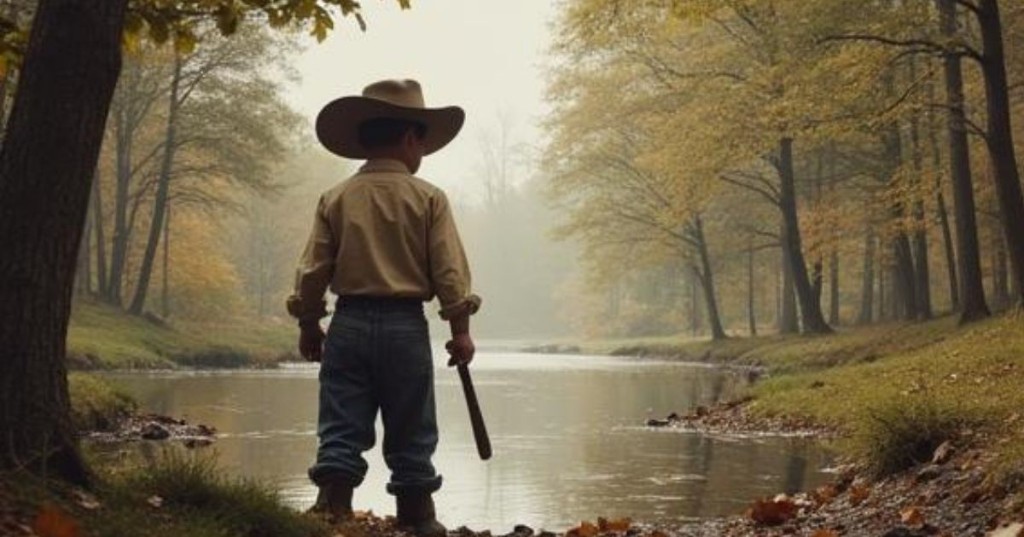
An excerpt from the original text.(complete · 3314 words)
ithin a few minutes the news had spread, and a dozen skiff-loads of
men were on their way to McDougal’s cave, and the ferryboat, well filled
with passengers, soon followed. Tom Sawyer was in the skiff that bore
Judge Thatcher.
When the cave door was unlocked, a sorrowful sight presented itself in
the dim twilight of the place. Injun Joe lay stretched upon the ground,
dead, with his face close to the crack of the door, as if his longing
eyes had been fixed, to the latest moment, upon the light and the cheer
of the free world outside. Tom was touched, for he knew by his own
experience how this wretch had suffered. His pity was moved, but
nevertheless he felt an abounding sense of relief and security, now,
which revealed to him in a degree which he had not fully appreciated
before how vast a weight of dread had been lying upon him since the day
he lifted his voice against this bloody-minded outcast.
Injun Joe’s bowie-knife lay close by, its blade broken in two. The great
foundation-beam of the door had been chipped and hacked through, with
tedious labor; useless labor, too, it was, for the native rock formed a
sill outside it, and upon that stubborn material the knife had wrought
no effect; the only damage done was to the knife itself. But if there
had been no stony obstruction there the labor would have been useless
still, for if the beam had been wholly cut away Injun Joe could not have
squeezed his body under the door, and he knew it. So he had only hacked
that place in order to be doing something—in order to pass the weary
time—in order to employ his tortured faculties. Ordinarily one could
find half a dozen bits of candle stuck around in the crevices of this
vestibule, left there by tourists; but there were none now. The prisoner
had searched them out and eaten them. He had also contrived to catch a
few bats, and these, also, he had eaten, leaving only their claws. The
poor unfortunate had starved to death. In one place, near at hand, a
stalagmite had been slowly growing up from the ground for ages, builded
by the water-drip from a stalactite overhead. The captive had broken off
the stalagmite, and upon the stump had placed a stone, wherein he had
scooped a shallow hollow to catch the precious drop that fell once
in every three minutes with the dreary regularity of a clock-tick—a
dessertspoonful once in four and twenty hours. That drop was falling
when the Pyramids were new; when Troy fell; when the foundations of Rome
were laid; when Christ was crucified; when the Conqueror created the
British empire; when Columbus sailed; when the massacre at Lexington was
“news.”
It is falling now; it will still be falling when all these things shall
have sunk down the afternoon of history, and the twilight of tradition,
and been swallowed up in the thick night of oblivion. Has everything a
purpose and a mission? Did this drop fall patiently during five thousand
years to be ready for this flitting human insect’s need? and has it
another important object to accomplish ten thousand years to come? No
matter. It is many and many a year since the hapless half-breed scooped
out the stone to catch the priceless drops, but to this day the tourist
stares longest at that pathetic stone and that slow-dropping water when
he comes to see the wonders of McDougal’s cave. Injun Joe’s cup stands
first in the list of the cavern’s marvels; even “Aladdin’s Palace”
cannot rival it.
Injun Joe was buried near the mouth of the cave; and people flocked
there in boats and wagons from the towns and from all the farms and
hamlets for seven miles around; they brought their children, and
all sorts of provisions, and confessed that they had had almost as
satisfactory a time at the funeral as they could have had at the
hanging.
This funeral stopped the further growth of one thing—the petition to the
governor for Injun Joe’s pardon. The petition had been largely signed;
many tearful and eloquent meetings had been held, and a committee of
sappy women been appointed to go in deep mourning and wail around the
governor, and implore him to be a merciful ass and trample his duty
under foot. Injun Joe was believed to have killed five citizens of the
village, but what of that? If he had been Satan himself there would
have been plenty of weaklings ready to scribble their names to a
pardon-petition, and drip a tear on it from their permanently impaired
and leaky water-works.
The morning after the funeral Tom took Huck to a private place to have
an important talk. Huck had learned all about Tom’s adventure from the
Welshman and the Widow Douglas, by this time, but Tom said he reckoned
there was one thing they had not told him; that thing was what he wanted
to talk about now. Huck’s face saddened. He said:
“I know what it is. You got into No. 2 and never found anything but
whiskey. Nobody told me it was you; but I just knowed it must ’a’ ben
you, soon as I heard ’bout that whiskey business; and I knowed you
hadn’t got the money becuz you’d ’a’ got at me some way or other and
told me even if you was mum to everybody else. Tom, something’s always
told me we’d never get holt of that swag.”
“Why, Huck, I never told on that tavern-keeper. You know his tavern
was all right the Saturday I went to the picnic. Don’t you remember you
was to watch there that night?”
“Oh yes! Why, it seems ’bout a year ago. It was that very night that I
follered Injun Joe to the widder’s.”
“You followed him?”
“Yes—but you keep mum. I reckon Injun Joe’s left friends behind him, and
I don’t want ’em souring on me and doing me mean tricks. If it hadn’t
ben for me he’d be down in Texas now, all right.”
Then Huck told his entire adventure in confidence to Tom, who had only
heard of the Welshman’s part of it before.
“Well,” said Huck, presently, coming back to the main question, “whoever
nipped the whiskey in No. 2, nipped the money, too, I reckon—anyways
it’s a goner for us, Tom.”
“Huck, that money wasn’t ever in No. 2!”
“What!” Huck searched his comrade’s face keenly. “Tom, have you got on
the track of that money again?”
“Huck, it’s in the cave!”
Huck’s eyes blazed.
“Say it again, Tom.”
“The money’s in the cave!”
“Tom—honest injun, now—is it fun, or earnest?”
“Earnest, Huck—just as earnest as ever I was in my life. Will you go in
there with me and help get it out?”
“I bet I will! I will if it’s where we can blaze our way to it and not
get lost.”
“Huck, we can do that without the least little bit of trouble in the
world.”
“Good as wheat! What makes you think the money’s—”
“Huck, you just wait till we get in there. If we don’t find it I’ll
agree to give you my drum and every thing I’ve got in the world. I will,
by jings.”
“All right—it’s a whiz. When do you say?”
“Right now, if you say it. Are you strong enough?”
“Is it far in the cave? I ben on my pins a little, three or four days,
now, but I can’t walk more’n a mile, Tom—least I don’t think I could.”
“It’s about five mile into there the way anybody but me would go, Huck,
but there’s a mighty short cut that they don’t anybody but me know
about. Huck, I’ll take you right to it in a skiff. I’ll float the skiff
down there, and I’ll pull it back again all by myself. You needn’t ever
turn your hand over.”
“Less start right off, Tom.”
“All right. We want some bread and meat, and our pipes, and a little
bag or two, and two or three kite-strings, and some of these new-fangled
things they call lucifer matches. I tell you, many’s the time I wished I
had some when I was in there before.”
A trifle after noon the boys borrowed a small skiff from a citizen who
was absent, and got under way at once. When they were several miles
below “Cave Hollow,” Tom said:
“Now you see this bluff here looks all alike all the way down from the
cave hollow—no houses, no wood-yards, bushes all alike. But do you see
that white place up yonder where there’s been a landslide? Well, that’s
one of my marks. We’ll get ashore, now.”
They landed.
“Now, Huck, where we’re a-standing you could touch that hole I got out
of with a fishing-pole. See if you can find it.”
Huck searched all the place about, and found nothing. Tom proudly
marched into a thick clump of sumach bushes and said:
“Here you are! Look at it, Huck; it’s the snuggest hole in this country.
You just keep mum about it. All along I’ve been wanting to be a robber,
but I knew I’d got to have a thing like this, and where to run across
it was the bother. We’ve got it now, and we’ll keep it quiet, only we’ll
let Joe Harper and Ben Rogers in—because of course there’s got to be a
Gang, or else there wouldn’t be any style about it. Tom Sawyer’s Gang—it
sounds splendid, don’t it, Huck?”
“Well, it just does, Tom. And who’ll we rob?”
“Oh, most anybody. Waylay people—that’s mostly the way.”
“And kill them?”
“No, not always. Hive them in the cave till they raise a ransom.”
“What’s a ransom?”
“Money. You make them raise all they can, off’n their friends; and after
you’ve kept them a year, if it ain’t raised then you kill them. That’s
the general way. Only you don’t kill the women. You shut up the women,
but you don’t kill them. They’re always beautiful and rich, and awfully
scared. You take their watches and things, but you always take your hat
off and talk polite. They ain’t anybody as polite as robbers—you’ll see
that in any book. Well, the women get to loving you, and after they’ve
been in the cave a week or two weeks they stop crying and after that
you couldn’t get them to leave. If you drove them out they’d turn right
around and come back. It’s so in all the books.”
“Why, it’s real bully, Tom. I believe it’s better’n to be a pirate.”
“Yes, it’s better in some ways, because it’s close to home and circuses
and all that.”
By this time everything was ready and the boys entered the hole, Tom in
the lead. They toiled their way to the farther end of the tunnel, then
made their spliced kite-strings fast and moved on. A few steps brought
them to the spring, and Tom felt a shudder quiver all through him.
He showed Huck the fragment of candle-wick perched on a lump of clay
against the wall, and described how he and Becky had watched the flame
struggle and expire.
The boys began to quiet down to whispers, now, for the stillness and
gloom of the place oppressed their spirits. They went on, and presently
entered and followed Tom’s other corridor until they reached the
“jumping-off place.” The candles revealed the fact that it was not
really a precipice, but only a steep clay hill twenty or thirty feet
high. Tom whispered:
“Now I’ll show you something, Huck.”
He held his candle aloft and said:
“Look as far around the corner as you can. Do you see that? There—on the
big rock over yonder—done with candle-smoke.”
“Tom, it’s a cross!”
“Now where’s your Number Two? ‘under the cross,’ hey? Right yonder’s
where I saw Injun Joe poke up his candle, Huck!”
Huck stared at the mystic sign awhile, and then said with a shaky voice:
“Tom, less git out of here!”
“What! and leave the treasure?”
“Yes—leave it. Injun Joe’s ghost is round about there, certain.”
“No it ain’t, Huck, no it ain’t. It would ha’nt the place where he
died—away out at the mouth of the cave—five mile from here.”
“No, Tom, it wouldn’t. It would hang round the money. I know the ways of
ghosts, and so do you.”
Tom began to fear that Huck was right. Misgivings gathered in his mind.
But presently an idea occurred to him—
“Lookyhere, Huck, what fools we’re making of ourselves! Injun Joe’s
ghost ain’t a going to come around where there’s a cross!”
The point was well taken. It had its effect.
“Tom, I didn’t think of that. But that’s so. It’s luck for us, that
cross is. I reckon we’ll climb down there and have a hunt for that box.”
Tom went first, cutting rude steps in the clay hill as he descended.
Huck followed. Four avenues opened out of the small cavern which the
great rock stood in. The boys examined three of them with no result.
They found a small recess in the one nearest the base of the rock, with
a pallet of blankets spread down in it; also an old suspender, some
bacon rind, and the well-gnawed bones of two or three fowls. But there
was no moneybox. The lads searched and researched this place, but in
vain. Tom said:
“He said under the cross. Well, this comes nearest to being under the
cross. It can’t be under the rock itself, because that sets solid on the
ground.”
They searched everywhere once more, and then sat down discouraged. Huck
could suggest nothing. By-and-by Tom said:
“Lookyhere, Huck, there’s footprints and some candle-grease on the clay
about one side of this rock, but not on the other sides. Now, what’s
that for? I bet you the money is under the rock. I’m going to dig in
the clay.”
“That ain’t no bad notion, Tom!” said Huck with animation.
Tom’s “real Barlow” was out at once, and he had not dug four inches
before he struck wood.
“Hey, Huck!—you hear that?”
Huck began to dig and scratch now. Some boards were soon uncovered and
removed. They had concealed a natural chasm which led under the rock.
Tom got into this and held his candle as far under the rock as he
could, but said he could not see to the end of the rift. He proposed
to explore. He stooped and passed under; the narrow way descended
gradually. He followed its winding course, first to the right, then to
the left, Huck at his heels. Tom turned a short curve, by-and-by, and
exclaimed:
“My goodness, Huck, lookyhere!”
It was the treasure-box, sure enough, occupying a snug little cavern,
along with an empty powder-keg, a couple of guns in leather cases, two
or three pairs of old moccasins, a leather belt, and some other rubbish
well soaked with the water-drip.
“Got it at last!” said Huck, ploughing among the tarnished coins with
his hand. “My, but we’re rich, Tom!”
“Huck, I always reckoned we’d get it. It’s just too good to believe, but
we have got it, sure! Say—let’s not fool around here. Let’s snake it
out. Lemme see if I can lift the box.”
It weighed about fifty pounds. Tom could lift it, after an awkward
fashion, but could not carry it conveniently.
“I thought so,” he said; “They carried it like it was heavy, that day
at the ha’nted house. I noticed that. I reckon I was right to think of
fetching the little bags along.”
The money was soon in the bags and the boys took it up to the cross
rock.
“Now less fetch the guns and things,” said Huck.
“No, Huck—leave them there. They’re just the tricks to have when we
go to robbing. We’ll keep them there all the time, and we’ll hold our
orgies there, too. It’s an awful snug place for orgies.”
“What orgies?”
“I dono. But robbers always have orgies, and of course we’ve got to
have them, too. Come along, Huck, we’ve been in here a long time. It’s
getting late, I reckon. I’m hungry, too. We’ll eat and smoke when we get
to the skiff.”
They presently emerged into the clump of sumach bushes, looked warily
out, found the coast clear, and were soon lunching and smoking in the
skiff. As the sun dipped toward the horizon they pushed out and got
under way. Tom skimmed up the shore through the long twilight, chatting
cheerily with Huck, and landed shortly after dark.
“Now, Huck,” said Tom, “we’ll hide the money in the loft of the widow’s
woodshed, and I’ll come up in the morning and we’ll count it and divide,
and then we’ll hunt up a place out in the woods for it where it will be
safe. Just you lay quiet here and watch the stuff till I run and hook
Benny Taylor’s little wagon; I won’t be gone a minute.”
He disappeared, and presently returned with the wagon, put the two small
sacks into it, threw some old rags on top of them, and started off,
dragging his cargo behind him. When the boys reached the Welshman’s
house, they stopped to rest. Just as they were about to move on, the
Welshman stepped out and said:
“Hallo, who’s that?”
“Huck and Tom Sawyer.”
“Good! Come along with me, boys, you are keeping everybody waiting.
Here—hurry up, trot ahead—I’ll haul the wagon for you. Why, it’s not as
light as it might be. Got bricks in it?—or old metal?”
“Old metal,” said Tom.
“I judged so; the boys in this town will take more trouble and fool away
more time hunting up six bits’ worth of old iron to sell to the foundry
than they would to make twice the money at regular work. But that’s
human nature—hurry along, hurry along!”
The boys wanted to know what the hurry was about.
“Never mind; you’ll see, when we get to the Widow Douglas’.”
Huck said with some apprehension—for he was long used to being falsely
accused:
“Mr. Jones, we haven’t been doing nothing.”
The Welshman laughed.
“Well, I don’t know, Huck, my boy. I don’t know about that. Ain’t you
and the widow good friends?”
“Yes. Well, she’s ben good friends to me, anyway.”
“All right, then. What do you want to be afraid for?”
This question was not entirely answered in Huck’s slow mind before he
found himself pushed, along with Tom, into Mrs. Douglas’ drawing-room.
Mr. Jones left the wagon near the door and followed.
The place was grandly lighted, and everybody that was of any consequence
in the village was there. The Thatchers were there, the Harpers, the
Rogerses, Aunt Polly, Sid, Mary, the minister, the editor, and a great
many more, and all dressed in their best. The widow received the boys
as heartily as any one could well receive two such looking beings. They
were covered with clay and candle-grease. Aunt Polly blushed crimson
with humiliation, and frowned and shook her head at Tom. Nobody suffered
half as much as the two boys did, however. Mr. Jones said:
“Tom wasn’t at home, yet, so I gave him up; but I stumbled on him and
Huck right at my door, and so I just brought them along in a hurry.”
“And you did just right,” said the widow. “Come with me, boys.”
She took them to a bedchamber and said:
“Now wash and dress yourselves. Here are two new suits of
clothes—shirts, socks, everything complete. They’re Huck’s—no, no
thanks, Huck—Mr. Jones bought one and I the other. But they’ll fit both
of you. Get into them. We’ll wait—come down when you are slicked up
enough.”
Then she left.
Master this chapter. Complete your experience
Purchase the complete book to access all chapters and support classic literature
As an Amazon Associate, we earn a small commission from qualifying purchases at no additional cost to you.
Available in paperback, hardcover, and e-book formats
Let's Analyse the Pattern
The Knowledge Advantage - When Information Becomes Power
Information becomes power only when you connect dots others miss and take strategic action on your unique understanding.
Why This Matters
Connect literature to life
This chapter teaches how to spot when you know something valuable that others don't, and how to turn that knowledge into positive action.
Practice This Today
This week, notice when you understand something about your workplace, family, or community that others are missing—then ask yourself how you can use that knowledge to help both yourself and others.
Now let's explore the literary elements.
Key Quotes & Analysis
"Tom was touched, for he knew by his own experience how this wretch had suffered."
Context: When Tom sees Injun Joe's dead body by the cave entrance
This shows Tom's remarkable emotional growth - he can feel genuine compassion for someone who threatened his life. His 'own experience' of being trapped in the cave helps him understand Injun Joe's desperation and fear.
In Today's Words:
Tom felt bad for him because he knew exactly how scary and hopeless it felt to be trapped in there.
"His pity was moved, but nevertheless he felt an abounding sense of relief and security."
Context: Tom's complex emotions upon seeing his enemy dead
Tom experiences two conflicting emotions simultaneously - human compassion and personal relief. This shows his maturity in recognizing that someone can be both pitiable and dangerous, and that it's normal to feel relief when a threat is removed.
In Today's Words:
He felt sorry for the guy, but he also felt like a huge weight had been lifted off his shoulders.
"The great foundation-beam of the door had been chipped and hacked through, with tedious labor; useless labor, too."
Context: Describing Injun Joe's desperate attempt to escape the cave
The phrase 'tedious labor' and 'useless labor' emphasizes both Injun Joe's determination and the futility of his efforts. This creates sympathy for someone who died trying everything possible to survive, even when hope was gone.
In Today's Words:
He had worked for hours and hours trying to cut through that massive wooden beam, but it was all for nothing.
Thematic Threads
Knowledge
In This Chapter
Tom uses his cave knowledge and memory of Injun Joe's hiding spot to find treasure others can't locate
Development
Evolved from Tom's earlier curiosity and observation skills into practical strategic advantage
In Your Life:
The skills or information you've picked up through experience might be more valuable than you realize.
Class
In This Chapter
The boys arrive dirty at an elegant gathering of the town's elite, highlighting the contrast between their adventure and social expectations
Development
Continues the theme of Tom navigating between working-class reality and middle-class aspirations
In Your Life:
You might feel out of place in formal settings, but your real-world experience often has more value than polished appearances.
Justice
In This Chapter
Public opinion swings toward pardoning Injun Joe, showing how mercy can emerge even for dangerous people once they're no longer threatening
Development
Builds on earlier themes about how fear and safety affect moral judgments
In Your Life:
People's attitudes toward 'bad' coworkers or neighbors often soften once the person is gone or powerless.
Partnership
In This Chapter
Tom convinces Huck to join the treasure hunt and shares the reward, strengthening their friendship through mutual benefit
Development
Deepens from their earlier adventures into a more mature understanding of cooperation
In Your Life:
The best opportunities often come when you can bring someone else along instead of going it alone.
Recognition
In This Chapter
The boys are brought to a formal gathering that appears designed to honor their heroic deeds
Development
Culminates the theme of how society rewards those who help others, even if they break rules doing it
In Your Life:
Sometimes doing the right thing, even unconventionally, eventually gets acknowledged by people who matter.
You now have the context. Time to form your own thoughts.
Discussion Questions
- 1
Tom figured out the treasure was still in the cave when everyone else thought it was gone forever. What information did he connect that others missed?
analysis • surface - 2
Why does Tom bring Huck along to get the treasure instead of going alone and keeping it all for himself?
analysis • medium - 3
Think about your workplace or school. When have you seen someone succeed because they knew something others didn't—like Tom knowing the cave shortcuts?
application • medium - 4
If you discovered valuable information that could benefit you, how would you decide whether to act alone or bring others in? What factors would influence your choice?
application • deep - 5
The townspeople were ready to petition for Injun Joe's pardon before finding his body. What does this reveal about how quickly public opinion can shift, and why is this important to understand?
reflection • deep
Critical Thinking Exercise
Map Your Information Advantage
Think about your daily life—work, family, community. List three pieces of information or knowledge you have that others around you might not. These could be practical skills, inside knowledge about how something really works, or understanding about people's motivations. For each piece of knowledge, write down how you could use it to help yourself or others, following Tom's example of turning understanding into positive action.
Consider:
- •Knowledge that helps others usually comes back to benefit you too
- •The most valuable information often seems ordinary until you connect it to something else
- •Acting on information requires courage—most people see opportunities but don't take them
Journaling Prompt
Write about a time when you had information that could have helped a situation, but you didn't act on it. What held you back, and how might you handle it differently now?
Coming Up Next...
Chapter 34: The Big Reveal
At the fancy gathering, Tom and Huck face the town's elite while hiding their incredible secret. But Huck's considering an escape through the window—will the boys' newfound wealth and status be worth the social expectations that come with it?



