
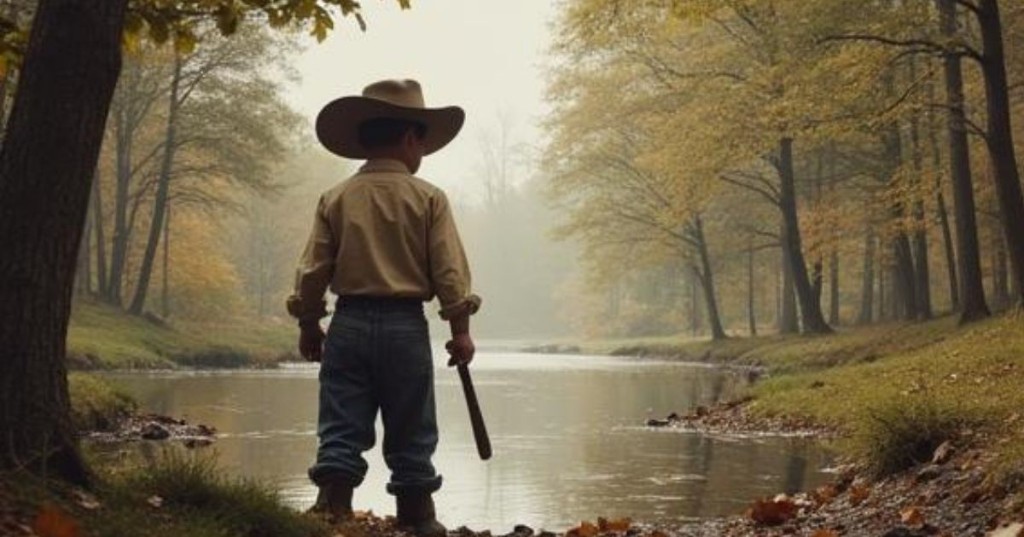
An excerpt from the original text.(complete · 1844 words)
aturday morning was come, and all the summer world was bright and
fresh, and brimming with life. There was a song in every heart; and if
the heart was young the music issued at the lips. There was cheer in
every face and a spring in every step. The locust-trees were in bloom
and the fragrance of the blossoms filled the air. Cardiff Hill, beyond
the village and above it, was green with vegetation and it lay just far
enough away to seem a Delectable Land, dreamy, reposeful, and inviting.
Tom appeared on the sidewalk with a bucket of whitewash and a
long-handled brush. He surveyed the fence, and all gladness left him and
a deep melancholy settled down upon his spirit. Thirty yards of board
fence nine feet high. Life to him seemed hollow, and existence but a
burden. Sighing, he dipped his brush and passed it along the topmost
plank; repeated the operation; did it again; compared the insignificant
whitewashed streak with the far-reaching continent of unwhitewashed
fence, and sat down on a tree-box discouraged. Jim came skipping out at
the gate with a tin pail, and singing Buffalo Gals. Bringing water from
the town pump had always been hateful work in Tom’s eyes, before, but
now it did not strike him so. He remembered that there was company at
the pump. White, mulatto, and negro boys and girls were always there
waiting their turns, resting, trading playthings, quarrelling, fighting,
skylarking. And he remembered that although the pump was only a hundred
and fifty yards off, Jim never got back with a bucket of water under an
hour—and even then somebody generally had to go after him. Tom said:
“Say, Jim, I’ll fetch the water if you’ll whitewash some.”
Jim shook his head and said:
“Can’t, Mars Tom. Ole missis, she tole me I got to go an’ git dis water
an’ not stop foolin’ roun’ wid anybody. She say she spec’ Mars Tom gwine
to ax me to whitewash, an’ so she tole me go ’long an’ ’tend to my own
business—she ’lowed she’d ’tend to de whitewashin’.”
“Oh, never you mind what she said, Jim. That’s the way she always talks.
Gimme the bucket—I won’t be gone only a a minute. She won’t ever
know.”
“Oh, I dasn’t, Mars Tom. Ole missis she’d take an’ tar de head off’n me.
’Deed she would.”
“She! She never licks anybody—whacks ’em over the head with her
thimble—and who cares for that, I’d like to know. She talks awful, but
talk don’t hurt—anyways it don’t if she don’t cry. Jim, I’ll give you a
marvel. I’ll give you a white alley!”
Jim began to waver.
“White alley, Jim! And it’s a bully taw.”
“My! Dat’s a mighty gay marvel, I tell you! But Mars Tom I’s powerful
’fraid ole missis—”
“And besides, if you will I’ll show you my sore toe.”
Jim was only human—this attraction was too much for him. He put down
his pail, took the white alley, and bent over the toe with absorbing
interest while the bandage was being unwound. In another moment he
was flying down the street with his pail and a tingling rear, Tom was
whitewashing with vigor, and Aunt Polly was retiring from the field with
a slipper in her hand and triumph in her eye.
But Tom’s energy did not last. He began to think of the fun he had
planned for this day, and his sorrows multiplied. Soon the free boys
would come tripping along on all sorts of delicious expeditions, and
they would make a world of fun of him for having to work—the very
thought of it burnt him like fire. He got out his worldly wealth and
examined it—bits of toys, marbles, and trash; enough to buy an exchange
of work, maybe, but not half enough to buy so much as half an hour
of pure freedom. So he returned his straitened means to his pocket, and
gave up the idea of trying to buy the boys. At this dark and hopeless
moment an inspiration burst upon him! Nothing less than a great,
magnificent inspiration.
He took up his brush and went tranquilly to work. Ben Rogers hove in
sight presently—the very boy, of all boys, whose ridicule he had been
dreading. Ben’s gait was the hop-skip-and-jump—proof enough that his
heart was light and his anticipations high. He was eating an apple, and
giving a long, melodious whoop, at intervals, followed by a deep-toned
ding-dong-dong, ding-dong-dong, for he was personating a steamboat. As
he drew near, he slackened speed, took the middle of the street, leaned
far over to starboard and rounded to ponderously and with laborious pomp
and circumstance—for he was personating the Big Missouri, and considered
himself to be drawing nine feet of water. He was boat and captain and
engine-bells combined, so he had to imagine himself standing on his own
hurricane-deck giving the orders and executing them:
“Stop her, sir! Ting-a-ling-ling!” The headway ran almost out, and he
drew up slowly toward the sidewalk.
“Ship up to back! Ting-a-ling-ling!” His arms straightened and stiffened
down his sides.
“Set her back on the stabboard! Ting-a-ling-ling! Chow! ch-chow-wow!
Chow!” His right hand, mean-time, describing stately circles—for it was
representing a forty-foot wheel.
“Let her go back on the labboard! Ting-a-ling-ling! Chow-ch-chow-chow!”
The left hand began to describe circles.
“Stop the stabboard! Ting-a-ling-ling! Stop the labboard! Come ahead on
the stabboard! Stop her! Let your outside turn over slow!
Ting-a-ling-ling! Chow-ow-ow! Get out that head-line! lively now!
Come—out with your spring-line—what’re you about there! Take a turn
round that stump with the bight of it! Stand by that stage, now—let her
go! Done with the engines, sir! Ting-a-ling-ling! SH’T! S’H’T! SH’T!”
(trying the gauge-cocks).
Tom went on whitewashing—paid no attention to the steamboat. Ben stared
a moment and then said: “Hi-Yi! You’re up a stump, ain’t you!”
No answer. Tom surveyed his last touch with the eye of an artist, then
he gave his brush another gentle sweep and surveyed the result, as
before. Ben ranged up alongside of him. Tom’s mouth watered for the
apple, but he stuck to his work. Ben said:
“Hello, old chap, you got to work, hey?”
Tom wheeled suddenly and said:
“Why, it’s you, Ben! I warn’t noticing.”
“Say—I’m going in a-swimming, I am. Don’t you wish you could? But of
course you’d druther work—wouldn’t you? Course you would!”
Tom contemplated the boy a bit, and said:
“What do you call work?”
“Why, ain’t that work?”
Tom resumed his whitewashing, and answered carelessly:
“Well, maybe it is, and maybe it ain’t. All I know, is, it suits Tom
Sawyer.”
“Oh come, now, you don’t mean to let on that you like it?”
The brush continued to move.
“Like it? Well, I don’t see why I oughtn’t to like it. Does a boy get a
chance to whitewash a fence every day?”
That put the thing in a new light. Ben stopped nibbling his apple.
Tom swept his brush daintily back and forth—stepped back to note the
effect—added a touch here and there—criticised the effect again—Ben
watching every move and getting more and more interested, more and more
absorbed. Presently he said:
“Say, Tom, let me whitewash a little.”
Tom considered, was about to consent; but he altered his mind:
“No—no—I reckon it wouldn’t hardly do, Ben. You see, Aunt Polly’s awful
particular about this fence—right here on the street, you know—but if it
was the back fence I wouldn’t mind and she wouldn’t. Yes, she’s awful
particular about this fence; it’s got to be done very careful; I reckon
there ain’t one boy in a thousand, maybe two thousand, that can do it
the way it’s got to be done.”
“No—is that so? Oh come, now—lemme just try. Only just a little—I’d let
you, if you was me, Tom.”
“Ben, I’d like to, honest injun; but Aunt Polly—well, Jim wanted to do
it, but she wouldn’t let him; Sid wanted to do it, and she wouldn’t let
Sid. Now don’t you see how I’m fixed? If you was to tackle this fence
and anything was to happen to it—”
“Oh, shucks, I’ll be just as careful. Now lemme try. Say—I’ll give you
the core of my apple.”
“Well, here—No, Ben, now don’t. I’m afeard—”
“I’ll give you all of it!”
Tom gave up the brush with reluctance in his face, but alacrity in his
heart. And while the late steamer Big Missouri worked and sweated in the
sun, the retired artist sat on a barrel in the shade close by,
dangled his legs, munched his apple, and planned the slaughter of more
innocents. There was no lack of material; boys happened along every
little while; they came to jeer, but remained to whitewash. By the time
Ben was fagged out, Tom had traded the next chance to Billy Fisher for
a kite, in good repair; and when he played out, Johnny Miller bought in
for a dead rat and a string to swing it with—and so on, and so on, hour
after hour. And when the middle of the afternoon came, from being a
poor poverty-stricken boy in the morning, Tom was literally rolling in
wealth. He had besides the things before mentioned, twelve marbles, part
of a jews-harp, a piece of blue bottle-glass to look through, a spool
cannon, a key that wouldn’t unlock anything, a fragment of chalk, a
glass stopper of a decanter, a tin soldier, a couple of tadpoles,
six fire-crackers, a kitten with only one eye, a brass door-knob, a
dog-collar—but no dog—the handle of a knife, four pieces of orange-peel,
and a dilapidated old window sash.
He had had a nice, good, idle time all the while—plenty of company—and
the fence had three coats of whitewash on it! If he hadn’t run out of
whitewash he would have bankrupted every boy in the village.
Tom said to himself that it was not such a hollow world, after all. He
had discovered a great law of human action, without knowing it—namely,
that in order to make a man or a boy covet a thing, it is only necessary
to make the thing difficult to attain. If he had been a great and
wise philosopher, like the writer of this book, he would now have
comprehended that Work consists of whatever a body is obliged to do,
and that Play consists of whatever a body is not obliged to do. And
this would help him to understand why constructing artificial flowers or
performing on a tread-mill is work, while rolling ten-pins or climbing
Mont Blanc is only amusement. There are wealthy gentlemen in England
who drive four-horse passenger-coaches twenty or thirty miles on a
daily line, in the summer, because the privilege costs them considerable
money; but if they were offered wages for the service, that would turn
it into work and then they would resign.
The boy mused awhile over the substantial change which had taken place
in his worldly circumstances, and then wended toward headquarters to
report.
Master this chapter. Complete your experience
Purchase the complete book to access all chapters and support classic literature
As an Amazon Associate, we earn a small commission from qualifying purchases at no additional cost to you.
Available in paperback, hardcover, and e-book formats
Let's Analyse the Pattern
Changing how a situation is perceived can completely alter its value and desirability to others.
Why This Matters
Connect literature to life
This chapter teaches how people use artificial scarcity and exclusivity to make ordinary things seem valuable or desirable.
Practice This Today
This week, notice when someone makes their mundane task sound special or exclusive - watch for phrases like 'not everyone can handle this' or 'this is actually a privilege.'
Now let's explore the literary elements.
Key Quotes & Analysis
"Work consists of whatever a body is obliged to do, and Play consists of whatever a body is not obliged to do."
Context: Twain's observation about Tom's psychological discovery
This reveals the core insight of the chapter - that our attitude toward tasks depends entirely on whether we feel forced or choose to do them. Tom figured out how to make work feel like choice.
In Today's Words:
Anything you have to do feels like work, anything you want to do feels like fun - even if it's the exact same activity.
"Does a boy get a chance to whitewash a fence every day?"
Context: Tom's response when Ben asks to try painting
Tom reframes the mundane chore as a rare opportunity, making Ben feel like he's missing out on something special. This is the moment Tom's con really takes off.
In Today's Words:
This is a once-in-a-lifetime opportunity - you'd be crazy to pass it up!
"Tom gave up the brush with reluctance in his face, but alacrity in his heart."
Context: When Tom finally 'allows' Ben to paint
Shows Tom's acting skills - he looks reluctant on the outside while celebrating inside. The perfect con artist move of seeming to give up something valuable.
In Today's Words:
Tom acted like he didn't want to hand it over, but inside he was doing a victory dance.
"If he hadn't run out of whitewash he would have bankrupted every boy in the village."
Context: Describing Tom's complete success
Twain shows that Tom's scheme was so effective it could have continued indefinitely. Tom discovered a psychological principle that works on everyone.
In Today's Words:
Tom's hustle was so good he could have gotten every kid in town to pay him to do his chores.
Thematic Threads
Class
In This Chapter
Tom uses psychological manipulation to escape manual labor while others pay to do his work
Development
Builds on previous chapter's class tensions, showing how cleverness can temporarily flip social positions
In Your Life:
You might notice how certain jobs are seen as desirable or undesirable based on perception, not actual difficulty
Deception
In This Chapter
Tom creates an elaborate con by pretending fence-painting requires special skill and is enjoyable
Development
Introduced here as Tom's signature survival strategy
In Your Life:
You might recognize when someone is making their ordinary tasks seem more important or exclusive than they really are
Social Psychology
In This Chapter
Tom exploits human tendency to want what appears scarce or exclusive
Development
Introduced here through Tom's intuitive understanding of desire and scarcity
In Your Life:
You might notice how your own desires shift based on availability and how others present opportunities
Work
In This Chapter
Physical labor transforms from punishment to privilege through clever presentation
Development
Introduced here as commentary on how framing affects our relationship to tasks
In Your Life:
You might find ways to reframe your own unwanted responsibilities by identifying their hidden benefits or skills
Power
In This Chapter
Tom gains control over the situation by controlling how others perceive it
Development
Introduced here showing how psychological influence can overcome physical disadvantage
In Your Life:
You might recognize moments when you can influence outcomes by changing the conversation or perspective
You now have the context. Time to form your own thoughts.
Discussion Questions
- 1
How does Tom transform fence-painting from punishment into something his friends want to do?
analysis • surface - 2
What psychological trick does Tom use to make the other boys value the work he's supposed to do?
analysis • medium - 3
Where do you see this 'scarcity creates demand' pattern in your daily life - at work, in advertising, or in relationships?
application • medium - 4
Think of a task you hate doing. How could you reframe it to find genuine value or make it more appealing to yourself?
application • deep - 5
What does Tom's success reveal about how much our attitude toward work depends on choice versus obligation?
reflection • deep
Critical Thinking Exercise
Reframe Your Most Dreaded Task
Think of something you have to do regularly that you absolutely hate - whether it's paperwork at work, cleaning the house, or dealing with difficult people. Write down why you hate it, then spend 5 minutes brainstorming how Tom would reframe this task. What hidden benefits could you highlight? What skills does it actually develop? How could you make it seem more exclusive or valuable?
Consider:
- •Focus on finding real benefits, not just pretending the task is fun
- •Consider how the task might prepare you for bigger challenges
- •Think about what skills you're building that others might want to learn
Journaling Prompt
Write about a time when changing your perspective on a situation completely changed your experience of it. What shifted in your thinking, and how did that change affect your actions and results?
Coming Up Next...
Chapter 3: Tom's Triumph and First Heartbreak
Tom returns home expecting praise for his completed fence, but Aunt Polly has more surprises in store. His success may have been too good to be true.



