
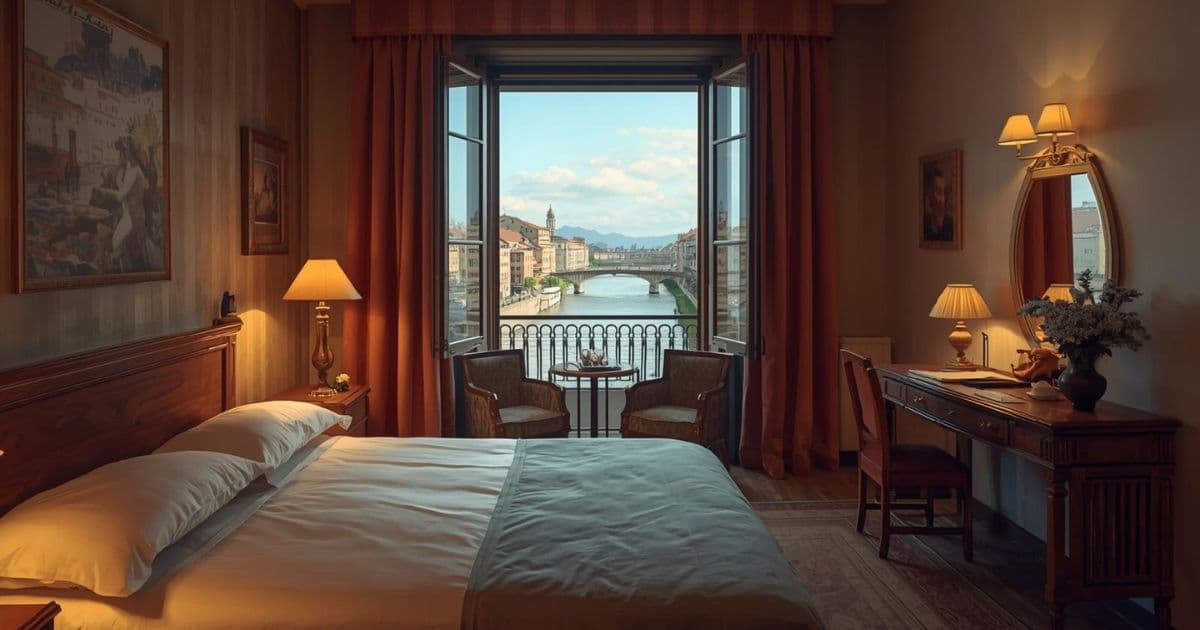
The View Was Always There
Forster announces his theme in the title and delivers it on the first page. The “room” is not a bad place — it is safety, propriety, the world that Lucy Honeychurch's upbringing has prepared for her. The “view” is not merely a landscape — it is direct contact with genuine feeling, the willingness to want what you actually want and to act on it honestly.
The novel's argument is both simple and uncomfortable: most people who live in the room know there is a view. They are not unaware of it. They have chosen, under social pressure they experienced so young they no longer recognize it as pressure, to manage their response to it rather than pursue it. Lucy's problem is not that she doesn't feel. It is that she has become expert at not acting on what she feels.
Italy does not give Lucy the view. Italy removes the usual architecture of the room long enough for her to see the view that was always there. The challenge — and the lesson — is that the same view is accessible from inside England, from inside Surrey, from inside a perfectly conventional life. But it requires choosing it deliberately, without the structural assistance of a hillside above Florence.
Chapter-by-Chapter Analysis
The Complaint That Reveals Everything
A small grievance about a hotel room — Charlotte Bartlett's room lacks a view of the Arno, Lucy's does too — opens the novel. When Mr. Emerson offers to swap, Charlotte refuses in a cascade of social performance. The room itself is almost irrelevant. What matters is what the room represents: the difference between people who want the view and the people whose upbringing has made them afraid to take it when it's freely offered.
The Complaint That Reveals Everything
A Room with a View · Chapter 1
“It was not that she repented of what she had done. It was that she had never done anything.”
Key Insight
Forster's title announces his theme on the first page and the first scene delivers it immediately. The 'room' is not a bad thing — it is safety, propriety, the arrangement of the world that Charlotte and Lucy's class has constructed for them. The 'view' is not merely scenery — it is direct experience, authentic feeling, life lived in contact with the actual. The novel's entire arc is built into this opening: the question is not whether Lucy will eventually choose the view but how long it will take her to admit she wants it.
Music as the Language of the Real Self
Lucy plays Beethoven at the pension, and for the first time we see who she actually is underneath the social performance. At the piano she is different — direct, passionate, uncalculating. Mr. Beebe watches and recognizes something: if she ever lived as she plays, it would be remarkable. The music is the view. Everything else she does in the novel is the room.
Music as the Language of the Real Self
A Room with a View · Chapter 3
“She was no longer either deferential or patronizing; no longer either a rebel or a slave.”
Key Insight
The Beethoven scene is Forster showing us the gap between Lucy's inner life and her social presentation with unusual clarity. She cannot suppress her authentic self when she plays — the music bypasses the social machinery entirely. What Forster is establishing here is not merely that Lucy has hidden depths, but that she already knows how to live authentically in one domain (music) and has somehow failed to extend that knowledge to the rest of her life. The novel is about closing that gap.
The Kiss in the Barley Field
On the hillside above Fiesole, among violets and the sound of Italy, George Emerson kisses Lucy without permission or preamble — and she doesn't stop him. The landscape itself seems to cooperate: the view, the openness, the freedom from English social geometry. It is the novel's first unmanaged moment, the first time the view defeats the room entirely. And then Charlotte appears and the room reasserts itself immediately.
The Kiss in the Barley Field
A Room with a View · Chapter 6
“For a moment she understood — she who had never understood.”
Key Insight
The kiss works not because George is irresistible but because the setting removes the social apparatus that normally governs Lucy's responses. Italy, the hillside, the absence of English rules — these are not romantic backdrop but structural conditions. Forster is precise about this: the same kiss attempted in a Surrey drawing room would have produced a different response. Lucy's authentic self can emerge when the room's walls are down. The tragedy of the rest of the novel is that she rebuilds those walls herself, back in England, and almost succeeds in mortaring herself inside.
Back in the Room
Part Two opens at Windy Corner, the Honeychurch family home in Surrey. Months have passed since Italy. The décor is English, the rhythms are English, the social rules are back in full force. Lucy is engaged — not to George, not to anyone real, just provisionally to the idea of being engaged to the right kind of person. The view of the Arno is as far away as another life. She has successfully returned herself to the room.
Back in the Room
A Room with a View · Chapter 8
Key Insight
The contrast between Parts One and Two is Forster's structural argument. Italy is not idealized — it has tourists, pretension, social awkwardness — but it is a place where the walls can come down. England is not condemned — it has genuine warmth, community, family — but it is a place where the walls go up automatically and no one questions them. Part Two shows what happens to Lucy when she has successfully suppressed what she felt in Italy. The answer is not peace. The answer is a grey, manageable life that she describes to herself as sensible.
Mr. Emerson Speaks Without Code
Mr. Emerson — old, direct, not at all socially fluent — sits with Lucy and simply tells her the truth. He has no code to speak in, no indirectness to deploy. He tells her that she loves George, that she knows it, and that the machinery she has built around not-knowing it is costing her her life. No one has spoken to her like this in the entire novel. No one in her world knows how.
Mr. Emerson Speaks Without Code
A Room with a View · Chapter 18
“Throw it all aside and love him. Love him and save him.”
Key Insight
Mr. Emerson's plainness is Forster's answer to what the room costs you: you lose access to the people who speak directly. Everyone in Lucy's social world communicates in euphemism, implication, and managed impression. Mr. Emerson, standing outside the room entirely, can say what everyone else only circles. His conversation with Lucy is the novel's version of a window being forced open — the view floods in not as beauty but as blunt, uncomfortable truth. She cannot deflect it because he doesn't deploy it tactically. He simply states it.
The View, Finally Chosen
The final chapter places Lucy and George in Florence, honeymooning in the room where it started — the room with a view. The ending is not triumphant so much as earned. She chose, at cost. Charlotte did not stop her; Italy did not save her. She chose it herself, finally, without the hillside and the violets and the structural conditions that made it easy in Chapter 6. This time she chose it from inside England, from inside the room, by walking out the door.
The View, Finally Chosen
A Room with a View · Chapter 20
“Youth enwrapped them; the song of Phaethon announced passion requited, love attained.”
Key Insight
Forster ends the novel where it began — the same room, the same view of the Arno — to make the point that nothing external has changed. The view was always available. Italy was always there. What changed is that Lucy stopped managing what she felt and acted on it instead. The novel's lesson is not that you need Italy or youth or violets or a dramatic hillside. It is that the view is always accessible to people willing to stop pretending they don't want it.
Applying This to Your Life
Name Which Parts of Your Life Are the Room
Forster is not arguing that convention is wrong or that authenticity is always right. He is arguing for conscious choice. Lucy's problem is not that she lives conventionally — it is that she has never examined which parts of her conventional life she actually endorses and which parts she is simply sustaining out of momentum. The practice the novel invites is simple and uncomfortable: identify the rooms in your own life. The choices you made by not making them. The views you have been managing your reaction to rather than pursuing.
Notice Where Your Authentic Self Already Appears
Lucy plays Beethoven the way she cannot live. Most people have a Beethoven — a domain where the social machinery fails to operate, where the authentic self surfaces without effort. Art, sport, certain friendships, moments alone in nature. Forster's question is: what would it look like to extend that quality of presence into the rest of your life? Not to abolish all performance or social management, but to close the gap between who you are in your Beethoven moments and who you are everywhere else.
The View Requires No Special Conditions
The most practical lesson in the novel's final chapter: Lucy doesn't choose the view in Italy, with violets and a hillside and the structural removal of all social constraint. She chooses it in England, from inside the room, by walking out the door. This is harder and more important than the Italy version. You do not need the special conditions. You need the decision.
The Central Lesson
Forster's central metaphor is deceptively simple and almost universally applicable. The room is wherever you are managed, approved, and safe. The view is whatever you can see from there that you have been pretending not to want. The novel does not condemn the room — it condemns the pretending. Lucy's long journey is not from convention to freedom. It is from unconscious convention to conscious choice. That is available without moving to Florence.
Related Themes in A Room with a View
Lying to Yourself
How Lucy's self-deception machinery works — and the six chapters where it finally breaks down
Choosing the Wrong Person
Why Lucy gets engaged to Cecil and what it reveals about how we make bad choices consciously
The Language of Class
How social class creates a private code that prevents genuine connection between people